

A Virginia LLC is formed at the State Corporation Commission, not a Secretary of State. That distinction shapes which office and forms you use when setting up a Virginia limited liability company, and as of 2026 it still catches first-time owners off guard. You file Articles of Organization online for $100, name a registered agent with a real Virginia address, then pay a small fee each year. Here’s how the process runs.
Form a Virginia LLC: where, what, and how much
- Where you file: Virginia State Corporation Commission (SCC), online through the Clerk’s Information System (CIS)
- Formation document: Articles of Organization, Form LLC1011
- Filing fee: $100, as of 2026
- Speed: standard timing isn’t officially published; Next-Day expedite runs $50 to $100, Same-Day is $200
- Every year: a $50 annual registration fee, with no separate annual report
- Who needs one: anyone doing business in Virginia who wants personal liability protection
- Contacts: SCC Office of the Clerk, cis.scc.virginia.gov
How to Start an LLC in Virginia: From SCC Filing to Virginia Tax
Here’s how to start an LLC in Virginia without paying a service to do it for you. Seven steps, most of them handled online.
Step 1: Name your LLC and search the SCC records
Your name has to carry a Virginia designator: LLC, L.L.C., L.C., or “limited liability company.” It also has to be distinguishable from every other entity on file, so run the name through Virginia’s business search before you settle on one.
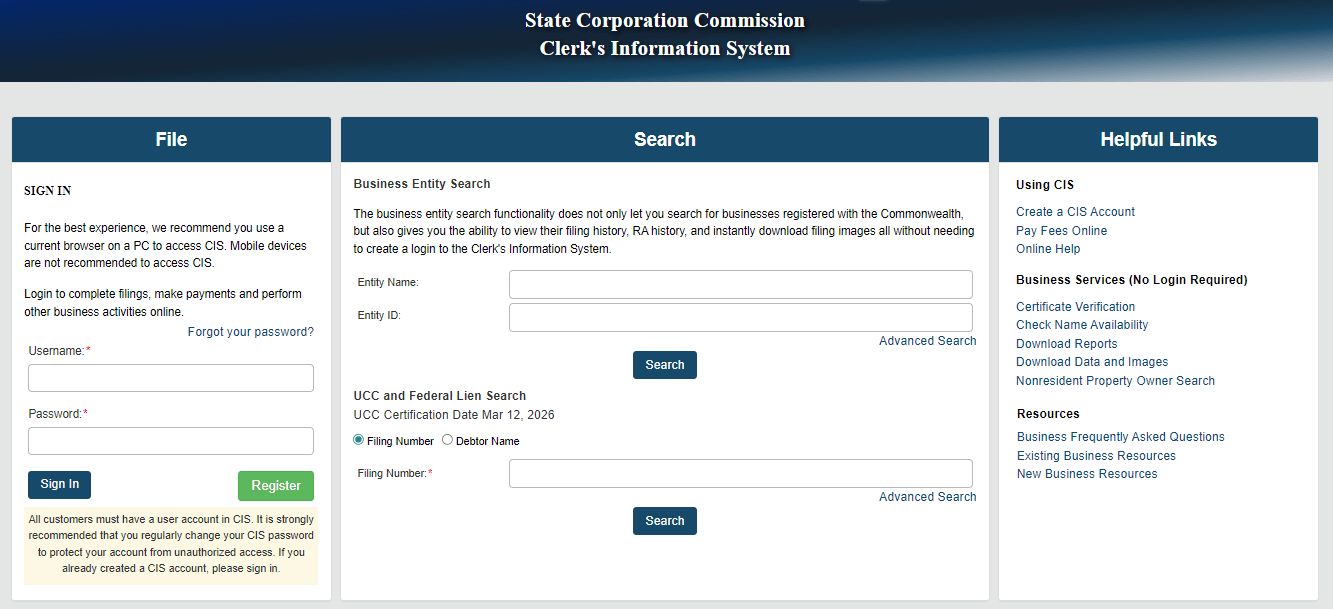
Not set on a name yet? A name reservation holds yours for 120 days for $10, filed through the SCC’s CIS entity search system. It’s worth doing if you need to lock the name before you file.
Step 2: Appoint a Virginia registered agent
Every Virginia LLC needs a registered agent with a physical registered office in the Commonwealth. You can act as your own agent if you’re a Virginia resident, or name a member, manager, or qualifying business.
Out-of-state owners usually need a commercial registered agent in Virginia to keep a qualifying registered office in the Commonwealth.
Step 3: File the Articles of Organization (Form LLC1011)
This filing creates the company. Submit your Articles of Organization on Form LLC1011 through CIS, list your registered office and principal office, and pay the $100 fee. You can confirm that fee on the SCC’s LLC forms and fees page.
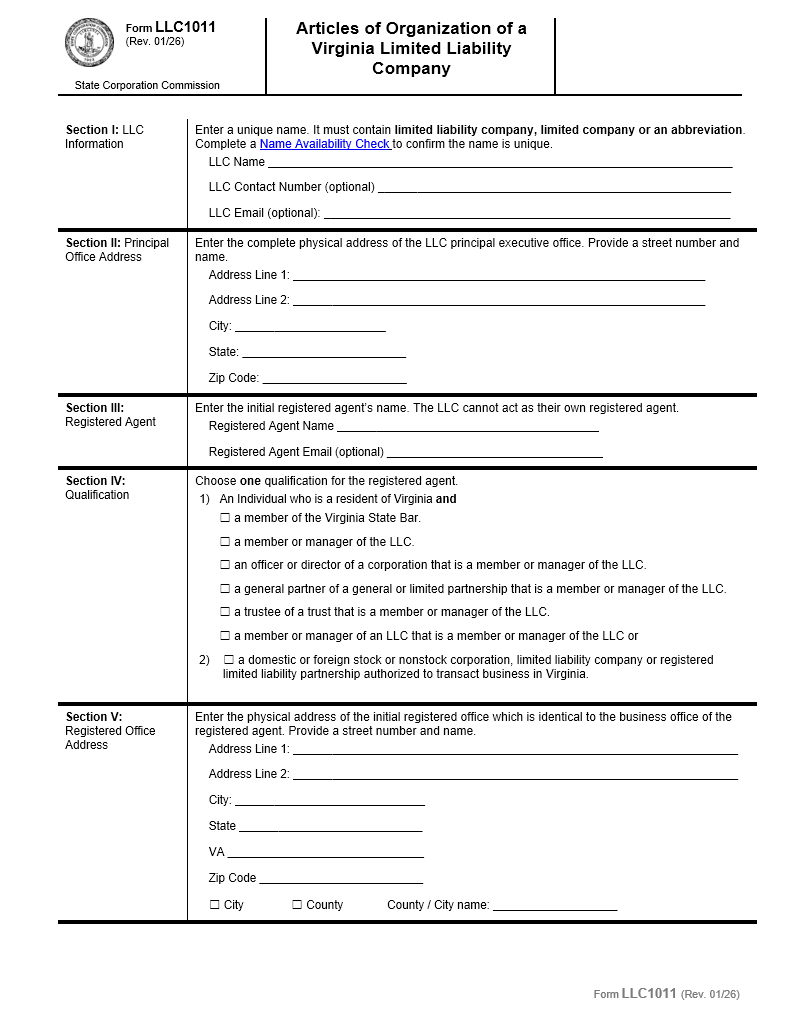
One thing to watch: attaching your own custom articles instead of the standard form can add about five business days for manual review.
Step 4: Put an operating agreement in place
Virginia doesn’t make you file an operating agreement with the SCC, and the statute says it doesn’t even need to be written. Skip it and you hand control of your company to Virginia’s default rules.
Single-member owners need one as much as partners do; it’s the paper trail that keeps your business separate from you. Start from a template you can adapt into a Virginia operating agreement.
Step 5: Get your federal EIN from the IRS
Once the LLC exists, grab an EIN from the IRS employer identification number application. It’s free, it’s quick online, and your bank will ask for it.
Order matters here: form the LLC first, then the EIN, so the name matches on both. Our guide to getting your EIN walks through it.
Step 6: Open a business bank account
Take your stamped Articles and EIN to the bank and open a dedicated business bank account. Mixing personal and business money is the quickest way to weaken the liability shield you just built.
Step 7: Register with Virginia Tax and check local licenses
Formation isn’t the finish line. If you’ll have employees or sell taxable goods, register with Virginia Tax for withholding or sales tax. From there, check whether your city or county wants a local business license.
Northwest is useful if you want the Virginia LLC1011 filing handled without poking around CIS yourself.
Virginia’s $100 SCC fee still applies, but Northwest can form your LLC with registered agent service included and keep the filing focused on the standard Articles route instead of turning a simple CIS submission into a manual-review project.
What a Virginia LLC Filing Fee Actually Buys You
Cost leads the search for this state, so the short version: the Virginia LLC filing fee is $100 for your Articles of Organization. That’s the entire state charge to form. After that, one recurring cost matters, the $50 annual registration fee.
Optional add-ons like the $10 name reservation or expedited service are extras; they aren’t bills you have to pay.
The Virginia LLC Annual Fee, Not an Annual Report
Virginia handles its yearly obligation differently than most states expect. The Virginia LLC annual fee is a flat $50 registration fee paid to the SCC, and there’s no corporation-style annual report behind it.
It’s due by the last day of the month you first formed in, then every year after. Miss it and a $25 penalty lands; keep missing it and the SCC can cancel your LLC. Here’s how the yearly registration fee works in detail.
Virginia LLC Taxes, Licenses, and DBA Names
Here’s where Virginia gets specific. Virginia LLC taxes follow the federal pass-through default unless you elect otherwise, and there’s no statewide franchise or privilege tax stacked on top.
| Tax or charge | Who it applies to | Amount, as of 2026 | Filed with |
|---|---|---|---|
| Federal income tax | All LLCs (pass-through default) | Paid at members’ personal rates | IRS |
| Virginia pass-through return | Multi-member LLCs, electing PTEs | Form 502 (single-member LLCs excluded) | Virginia Tax |
| Elective PTET | LLCs that opt in | 5.75%, optional | Virginia Tax |
| Retail sales and use tax | LLCs selling taxable goods | Register before first sale | Virginia Tax |
| Annual registration fee | Every Virginia LLC | $50 flat | SCC |
The Pass-Through Entity Tax sits at 5.75% only if you opt in; it isn’t automatic. You can read it straight from Virginia Tax’s pass-through entity rules before deciding.
On licensing, there’s no single statewide business license in Virginia. Plenty of cities and counties charge a local one, and regulated trades need a state board license, so it depends on your locality and field.
Trading under a different name? File a fictitious name certificate, Virginia’s version of a DBA, with the SCC and tie it to your LLC.
Why a Virginia LLC Is Cheap to Keep, and Where It Isn’t
Virginia’s real edge is upkeep cost. There’s no statewide franchise tax like California’s $800 minimum, so your only fixed yearly cost is the $50 registration fee.
That puts Virginia in the cheap-to-maintain tier rather than the privacy tier. Online filing moves fast, same-day expedite is there when you’re in a bind, and the LLC Act hands owners a real liability shield.
The honest limit: Virginia isn’t an anonymous-LLC state. Member names stay off the public Articles, yet you still keep internal ownership records and a Virginia registered office.
Where Virginia LLC Filings Go Sideways
The first trap is the name-availability screen: owners skip the SCC search and pick a name that’s already taken.
The rest are quick to dodge once you’ve seen them:
- assuming you file with a Secretary of State
- attaching custom articles and eating the five-day delay
- treating the $50 fee like a report, then missing the date
- mixing up that fee with the elective PTET
Letting your good standing slip on the registration fee is the one that quietly dissolves companies.
Virginia LLC FAQ
A handful of questions come up on almost every Virginia formation, so here are direct answers with the real numbers.
How much does it cost to start an LLC in Virginia?
The total cost to form is $100, paid once to the SCC for your Articles of Organization. Budget $50 a year after that for the registration fee, plus a registered agent service if you don’t act as your own, usually $100 to $300 a year. A $10 name reservation or expedited filing are optional extras.
Does Virginia require an annual report for LLCs?
No, and it’s the biggest Virginia mix-up. Corporations file annual reports; LLCs don’t. A Virginia LLC owes only the $50 annual registration fee to the SCC, due the last day of its formation-anniversary month. Miss it and you’ll pay a $25 penalty, then risk cancellation if it stays unpaid. There’s no annual report to complete.
How long does it take to form an LLC in Virginia?
The SCC doesn’t publish a guaranteed standard timeline, and online filings clear faster than mailed ones. Need certainty? Pay for expedited service: Next-Day at $50 to $100, or Same-Day at $200 if you file by 10 a.m. Eastern. We track current Virginia LLC processing times on their own page.
Can I start a Virginia LLC for free?
Not fully. The $100 SCC fee is unavoidable, and no legitimate route registers an LLC without it. What you can do for free is skip the formation companies that charge hundreds to submit a form you can file yourself in CIS. With a Virginia address, you can also be your own registered agent.
Can I form a Virginia LLC if I live in another state?
Yes. Virginia doesn’t require members or managers to live in-state, and your principal office can sit anywhere. The firm rule for a non-resident: keep a Virginia registered office and a qualifying agent in the Commonwealth. That’s why most out-of-state owners hire a commercial agent instead of qualifying themselves.
Do I need a registered agent, and can it be me?
Every Virginia LLC has to keep a registered agent at a physical Virginia registered office. You can serve yourself if you’re a resident who qualifies under the statute, or name a member, manager, or law firm. Owners living out of state lean on a paid service for the in-state address.
What’s the difference between an LLC and a PLLC in Virginia?
Need a state professional license to work, say as a doctor, attorney, or accountant? Virginia steers you to a professional limited liability company. You file it on Form LLC1103 instead of LLC1011, and the shield is similar, though it won’t cover your own malpractice. Check with your licensing board first.
- Virginia SCC: Online Expedited Services
- Virginia SCC: Limited Liability Companies forms and fees
- Virginia SCC: Clerk’s Information System (CIS) FAQ
- Virginia SCC: Annual Registration Fees
- Code of Virginia, Section 13.1-1005 (fees)
- Virginia Tax: Pass-Through Entities
- IRS: Apply for an Employer Identification Number (EIN)
File your Virginia LLC with Bizee for less guesswork
Bizee helps you prepare your Virginia Articles of Organization, handle the SCC filing process, and get your LLC started with a clearer path from name choice to approval.