

A Pennsylvania LLC is formed by filing the Certificate of Organization with the Department of State, and as of 2026 that filing costs $125. Pennsylvania also works differently on one point: it asks for a registered office, not a registered agent like most states.
It also added an annual report in 2025. Below is how to file, and what it costs to keep one.
Pennsylvania LLC: the office, the fee, the deadline
- How you create it: file the Certificate of Organization (DSCB:15-8821) with the Pennsylvania Department of State.
- Where: file with the Bureau of Corporations and Charitable Organizations, online through Business Filing Services at file.dos.pa.gov.
- Cost: $125 to file, then $7 a year for the annual report.
- Speed: most filings clear in 3 to 5 business days.
- Yearly deadline: the annual report is due September 30.
- Who it’s for: anyone forming an LLC that will do business in Pennsylvania.
- Contacts: Pennsylvania Department of State, Bureau of Corporations and Charitable Organizations; portal at file.dos.pa.gov.
Why a Pennsylvania LLC is cheap to keep: no franchise tax, a $7 report
An LLC separates your business debts from your personal assets. What sets Pennsylvania apart is how little it costs to stay registered.
Pennsylvania charges no general franchise tax on standard LLCs. The Capital Stock and Foreign Franchise Tax was phased out for tax years from 2016 on, so a default LLC doesn’t owe anything at the entity level just for existing.
Put that next to California, where an LLC pays an $800 franchise tax every year, earnings or not. Pennsylvania’s recurring state cost is the $7 report, which puts it among the cheaper states to keep running.
There’s no required registered-agent fee either. Most states make you name and pay a registered agent. Pennsylvania lets you list your own address as the registered office, so that line is zero.
How to start a Pennsylvania LLC: 6 steps and the Certificate of Organization
Here’s the full path for how to start an LLC in Pennsylvania, from the name check to your first bank account.
Step 1: Pick a name and clear it in the state database
Your name has to include “company,” “limited,” “limited liability company,” or an accepted abbreviation, under Pennsylvania’s naming statute at 15 Pa.C.S. section 204. Search the Pennsylvania business name database at file.dos.pa.gov before you commit, because name availability is what trips up most first filings.
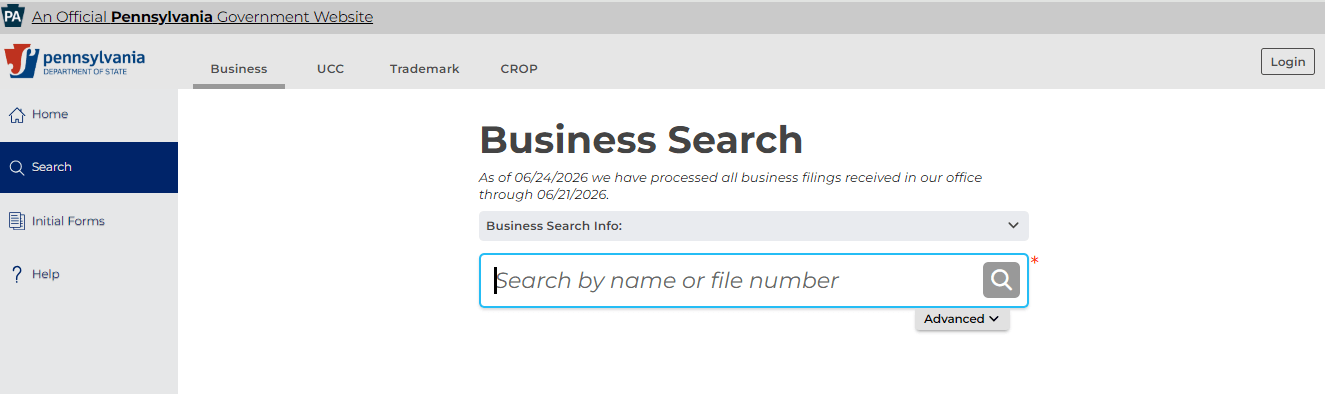
Want to lock a name before filing? You can reserve one for 120 days for $70 under 15 Pa.C.S. section 208.
Step 2: List a Pennsylvania registered office (no registered agent required)
Pennsylvania handles this step differently from most states. It doesn’t require a registered agent; it requires a registered office: a real Pennsylvania street or rural-route address that can accept legal mail. A P.O. box on its own doesn’t qualify.
No Pennsylvania address? You can list a Commercial Registered Office Provider, or CROP, instead. Contract with the provider first, then list them.
Step 3: File the Certificate of Organization with the Department of State
Pennsylvania doesn’t use Articles of Organization. You file the Certificate of Organization, form DSCB:15-8821, plus a Docketing Statement, form DSCB:15-134A, with the Bureau of Corporations and Charitable Organizations through Business Filing Services. The fee on the Department of State fee schedule is $125.
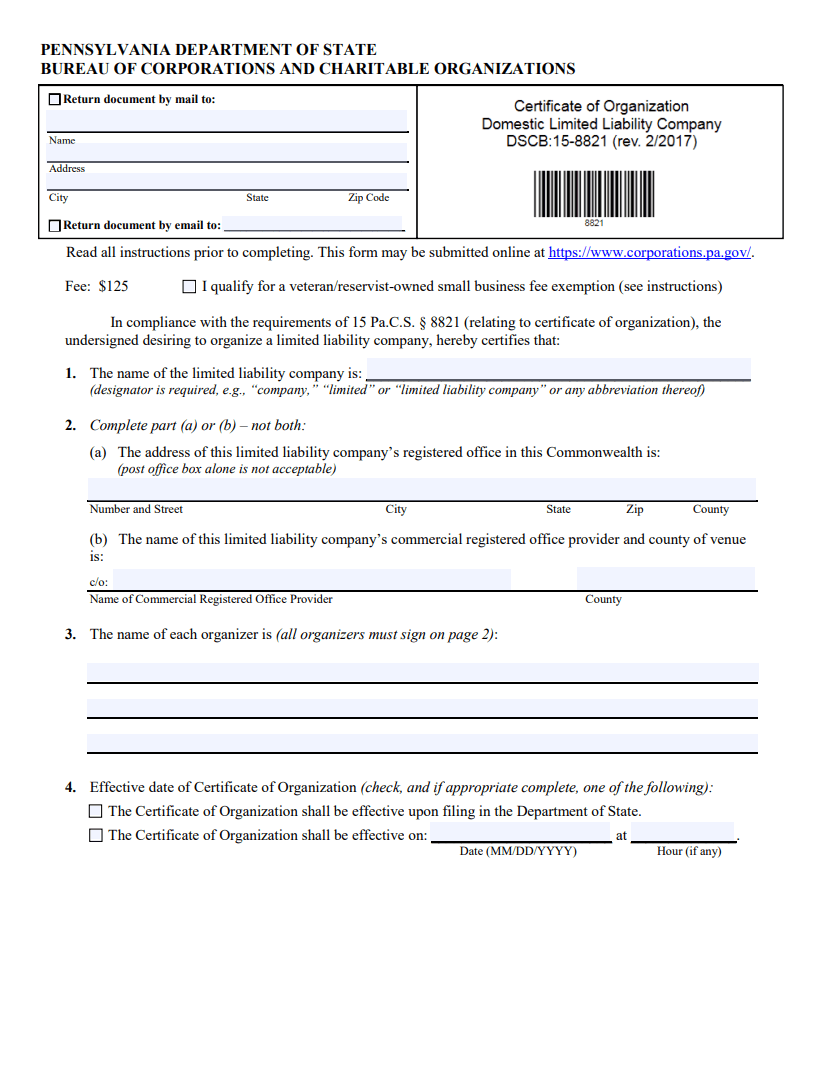
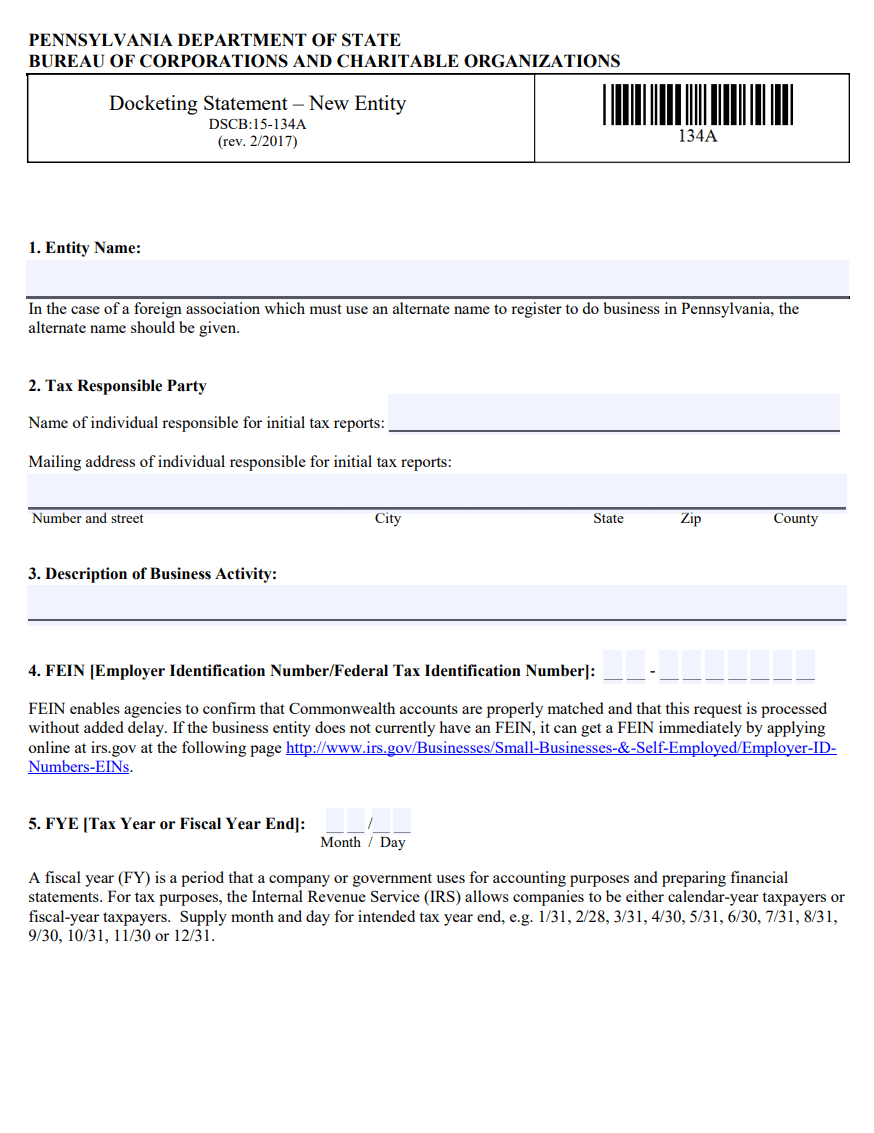
Most Pennsylvania LLC registration filings clear in 3 to 5 business days online. Need it faster? Expedited service is $100 same-day, $300 for 3-hour, or $1,000 for 1-hour on top of the $125, online only. Check how long Pennsylvania approval takes before paying to rush.
Step 4: Write an operating agreement
Pennsylvania doesn’t make you file an operating agreement, and many single-member owners skip it. That’s a mistake.
The agreement governs who owns what, who decides, and how profits move. A Pennsylvania operating agreement matters most when a dispute or buyout hits and nothing is in writing.
Step 5: Get your EIN from the IRS
Once the LLC exists on the state record, get your federal EIN. It’s free; you apply for an EIN with the IRS directly and have the number in minutes. File the LLC first, so the names match.
Hiring, banking, or electing S-corp status all need it; our guide to getting your EIN covers the single-member edge cases.
Step 6: Open a business bank account and handle local setup
Take your Certificate of Organization and EIN to a bank and open a dedicated business bank account. Mixing personal and company money is the fastest way to weaken the liability protection you just built.
Check local rules too, since some Pennsylvania municipalities require a local license or business privilege tax on top of the state filing.
Use Bizee if you want the Pennsylvania filing handled without juggling both forms.
Pennsylvania makes you file the Certificate of Organization and Docketing Statement together. Bizee is useful when you want help preparing the LLC filing while you keep the $125 state fee and any registered office choice clear.
How much does a Pennsylvania LLC cost in 2026?
The real Pennsylvania LLC cost to form is $125, paid once to the Department of State for the Certificate of Organization. After that, the only state charge that’s required is the $7 annual report.
Optional extras: $70 to reserve a name, or expedited fees if you’re rushing.
Can you start a Pennsylvania LLC for free?
Not entirely, and any guide that says otherwise is selling something. The $125 state fee is mandatory, so there’s no truly free LLC in Pennsylvania; the markup is all you avoid.
You file directly at file.dos.pa.gov yourself; a paid service just charges that same $125 plus its own fee to click the buttons you’d click anyway.
The Pennsylvania annual report: $7, due September 30, new since 2025
Pennsylvania replaced its old once-a-decade report with a yearly one in 2025. Domestic LLCs now file an annual report, form DSCB:15-146, every year.
The fee is $7 for a for-profit LLC, and the window runs January 1 through September 30, with September 30 as the hard deadline. You file online at file.dos.pa.gov, where it’s approved within minutes; there’s no expedited option because it’s already instant. You can read the Pennsylvania annual report rules for the exact data required.
Your first report is due the calendar year after you form. On taxes, a default LLC pays nothing at the Pennsylvania entity level; its members report their share on personal returns at the state’s 3.07 percent rate. An LLC that elects corporate treatment instead owes the Corporate Net Income Tax, 7.49 percent for tax year 2026. For the full compliance calendar, see the Pennsylvania annual report in detail.
Where Pennsylvania LLC filings go wrong (registered office, the September 30 report)
Most Pennsylvania mistakes come from applying generic advice to a state that does things its own way.
- Articles of Organization: Pennsylvania has no such form; you want the Certificate of Organization, DSCB:15-8821.
- Paying for a registered agent Pennsylvania never required, when it only needs a registered office or a CROP.
- Listing a P.O. box as the registered office, which the state won’t accept without a real street or rural-route address.
- Believing Pennsylvania has no annual report and blowing past the September 30 deadline.
- Confusing the $125 filing fee with a franchise tax; Pennsylvania doesn’t levy one on standard LLCs.
Pennsylvania LLC questions owners actually ask
These come straight from what people search before and after filing. Several are specific to Pennsylvania, so the answers differ from neighboring states.
Does Pennsylvania require a registered agent?
No, and that trips up newcomers from other states’ guides. Pennsylvania uses a registered office, not a registered agent: a real in-state street or rural-route address that can accept service of process. Have a Pennsylvania address? List your own and pay nothing. Hire a Commercial Registered Office Provider only if you genuinely lack one.
Does a Pennsylvania LLC have to file an annual report, and when is it due?
Yes, recent enough that older guides still say otherwise. Since 2025, every domestic LLC files an annual report, form DSCB:15-146, replacing the old once-a-decade filing. It costs $7, the window runs January 1 to September 30, and approval at file.dos.pa.gov is near-instant. Your first is due the year after you form; miss September 30 and your good standing is at risk.
How much does it cost to start an LLC in Pennsylvania?
$125 to file the Certificate of Organization, then $7 a year to stay in good standing. A name reservation, if you want one, adds $70. The state fee is identical whether you file it or pay a service to type it for you.
How long does it take to get a Pennsylvania LLC approved?
Standard online filings usually clear in 3 to 5 business days. On a deadline, expedited service is same-day for $100, 3-hour for $300, or 1-hour for $1,000 on top of the $125. Most filers don’t need to pay to rush.
Do I need an operating agreement in Pennsylvania?
The state won’t ask for one, but skipping it is a risk, not a shortcut. Pennsylvania law leans on the operating agreement to settle ownership splits, voting, and member exits. For a single-member LLC it also shows the business is separate from you, the whole point of forming one. Write it even when no one makes you.
LLC, corporation, or DBA in Pennsylvania, which do I file?
For most small businesses, the LLC is the answer: a Certificate of Organization gives you liability protection and pass-through tax by default. A corporation is a separate filing taxed under the Corporate Net Income Tax, better suited to companies raising investment or holding earnings. A DBA, called a fictitious name in Pennsylvania, is only a trade name; it adds no liability protection and isn’t a separate entity.
Can I form a Pennsylvania LLC if I live in another state?
Yes; Pennsylvania sets no residency rule for members. You still need a Pennsylvania registered office or a CROP, since the state has to reach you in-state. The catch: forming here while you operate elsewhere usually means foreign-registering in your home state too, so you pay both. Form in Pennsylvania because you do business in Pennsylvania, not to dodge another state’s rules.
- Apply for an Employer Identification Number (EIN) – IRS
- Pennsylvania Limited Liability Company – Pennsylvania Department of State
- Fees and Payments – Pennsylvania Department of State
- Register a PA Domestic LLC – PA Business One-Stop Hub
- Annual Reports in Pennsylvania – Pennsylvania Department of State
- Commercial Registered Office Providers – Pennsylvania Department of State
- Corporate Net Income Tax – Pennsylvania Department of Revenue
Form Your Pennsylvania LLC with ZenBusiness
ZenBusiness helps you move through the Pennsylvania LLC process with guided filing support, business name tools, and a simpler way to handle the required formation forms.