

A Massachusetts LLC carries some of the steeper fees in the country, and that cost shapes your early planning as of 2026. The Secretary of the Commonwealth charges $500 to file, then $500 again each year for the annual report. The filing steps are straightforward; the recurring bill is the part to plan around.
Filing your Massachusetts LLC: the office, the cost, and the yearly report
- Where you file: the Secretary of the Commonwealth, Corporations Division, online via File Online or by mail to Boston.
- What you file: the Certificate of Organization, not the Articles of Organization other states use.
- Filing fee: $500, or $520 online or by fax with the $20 expedited charge, as of 2026.
- Yearly obligation: a $500 annual report, due on your formation anniversary.
- Processing: fax is handled the same or next business day; no standard online time is published.
- Who needs this: anyone forming a single-member or multi-member LLC in MA.
- Contact: Corporations Division, LLC Section, One Ashburton Place, Room 1717, Boston, MA 02108-1512.
Why form an LLC in Massachusetts (and when the $500 is worth it)
Most people behind a new Massachusetts LLC formation form here because they live or work in the state. Filing somewhere cheaper to dodge the fee tends to backfire, since you’ll register as a foreign LLC at home and pay twice.
The core benefit is liability protection. Under the Massachusetts Limited Liability Company Act, the structure is built to keep your personal assets separate from business debts in most situations, with profits passing through by default.
On tax, Massachusetts is gentler than its fees suggest. There is no flat LLC franchise tax for simply existing; what you owe depends on how the business is classified with the Department of Revenue.
You also control how the company runs. You pick member-managed or manager-managed, your operating agreement overrides the defaults, and licensed fields can use the state’s professional LLC option.
From name search to Certificate of Organization: forming your Massachusetts LLC
How to start an LLC in Massachusetts comes down to six steps, from the name check to your first bank deposit. None are hard, though a couple carry a local catch worth knowing before you pay.
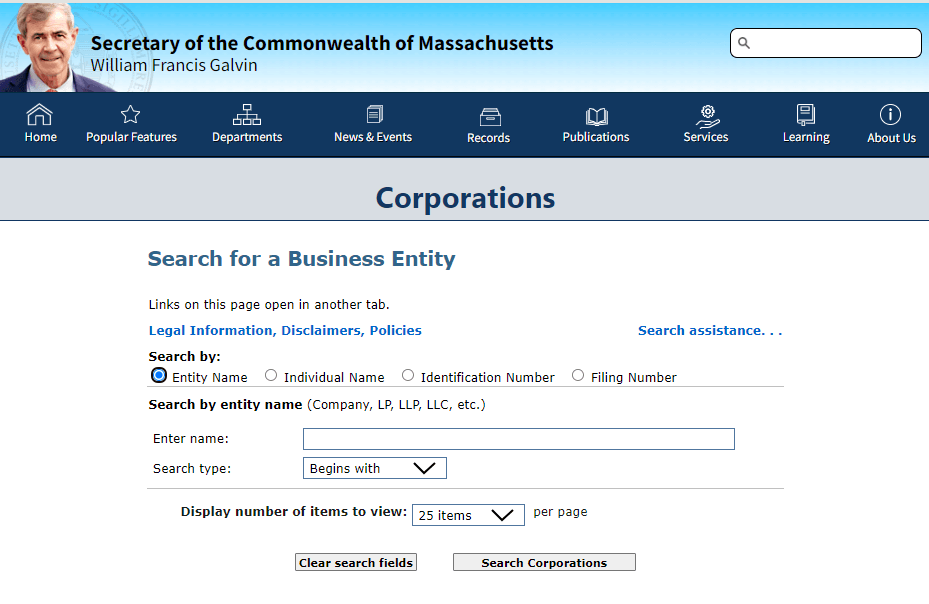
Step 1: Clear your name in the Massachusetts business database
Your name must end in an LLC designator like LLC, L.L.C., or limited liability company, and clear the state business database before you file. A name reservation holds it 60 days for $30, though most owners skip that.
Step 2: Appoint a Massachusetts resident agent
Massachusetts says resident agent, not registered agent, and the agent accepts legal mail at a Massachusetts business address, with written consent on or with your certificate. Without a local address, a Massachusetts resident agent service covers it for a yearly fee.
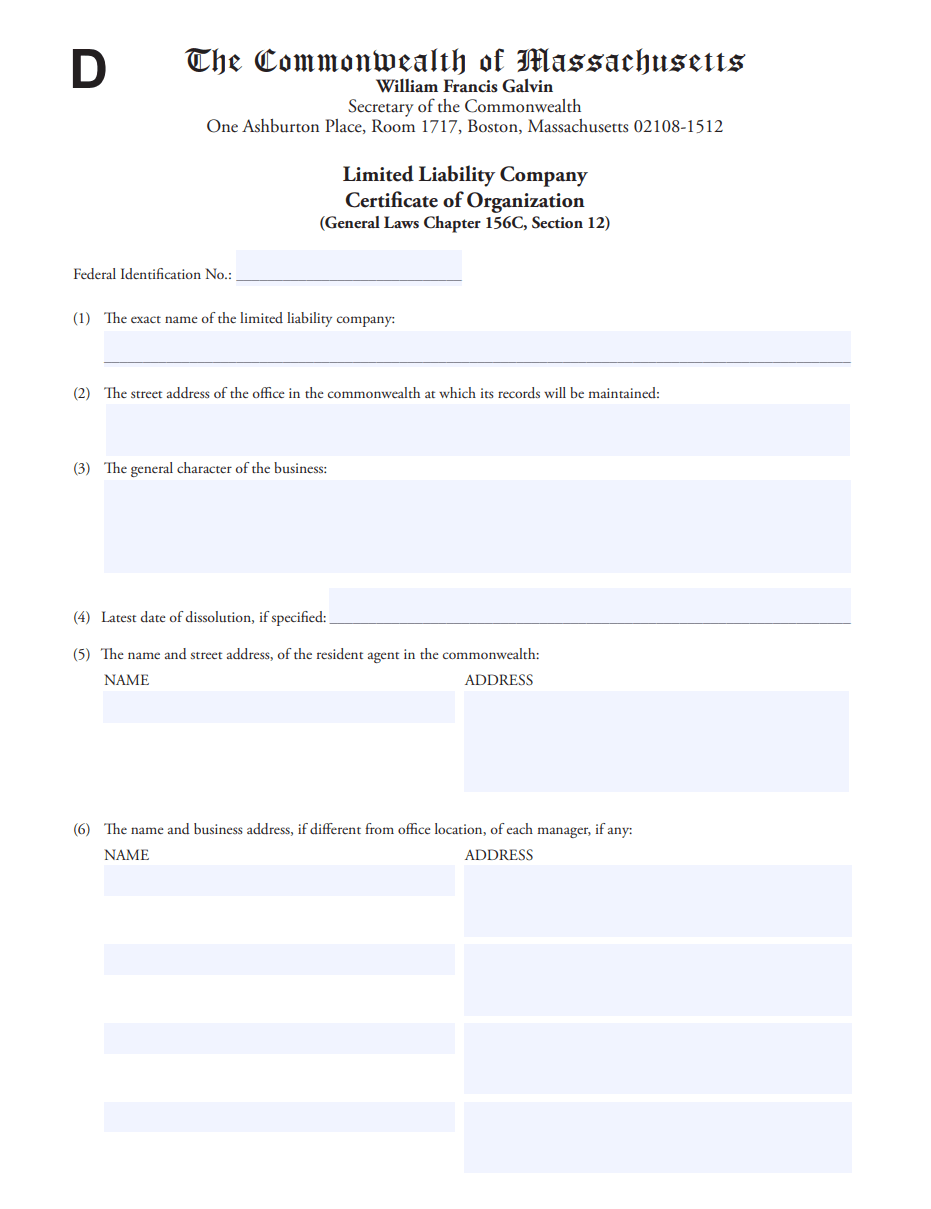
Step 3: File the Certificate of Organization ($500)
Massachusetts calls its formation document the Certificate of Organization, not the Articles of Organization used elsewhere. You file it with the Secretary of the Commonwealth, Corporations Division for $500.
File Online and the total reaches $520, since online and fax filings add a $20 expedited charge to the Massachusetts LLC filing fee. Fax filings clear the same or next business day; for mail and online, how long Massachusetts approval takes is something the Secretary doesn’t publish.
Step 4: Write an operating agreement (not filed, still essential)
Massachusetts won’t make you file an operating agreement, and the Corporations Division never sees it. Skipping it is still a mistake, because state law leans on it to settle ownership, management, and member exits.
A solid Massachusetts operating agreement sets out who owns what and who can sign. Single-member owners need one too, since it shows the LLC stands apart from you if challenged.
Step 5: Get your EIN from the IRS
Once the LLC exists, request an Employer Identification Number from the IRS, free and quick online. Form the LLC first so the names match, then get your EIN and keep the confirmation letter safe.
Step 6: Open a bank account and register with the DOR
With the certificate and EIN in hand, open a dedicated business bank account so personal and company money never mix. If you’ll have employees or owe state tax, register through MassTaxConnect with the Department of Revenue in your first month.
Use ZenBusiness if you want the Massachusetts filing and next steps in one workflow.
The $500 state fee is still the biggest cost, but ZenBusiness can help package the Certificate of Organization filing with formation tools, resident agent options, and follow-up services so the LLC setup does not stop at the state form.
What a Massachusetts LLC costs to start: the $500 filing fee
The formation fee is easy to pin down. How much is an LLC in Massachusetts? It’s $500 for the Certificate of Organization, or $520 online or by fax with the expedited charge, as of 2026.
The recurring side matters more than the one-time fee. You’ll owe the $500 annual report yearly, plus a resident agent’s fee if you hire one.
The $500 annual report and how Massachusetts taxes your LLC
The Massachusetts LLC annual fee is the cost that catches owners off guard. Every LLC files a $500 annual report with the Corporations Division, due on or before its Certificate of Organization anniversary.
There’s no statewide due date to memorize, so your filing date sets your deadline. Let two years lapse without filing and the Division can move to administrative dissolution, so filing the Massachusetts annual report on schedule means tracking your own anniversary.
Massachusetts taxes are friendlier than the fees imply. The state levies no flat LLC tax, so your Massachusetts LLC taxes follow how the business is classified for federal purposes.
A single-member LLC is taxed like a sole proprietor and a multi-member LLC like a partnership, unless you elect otherwise. Elect corporate treatment and the LLC may owe Massachusetts Corporate Excise, with a $456 minimum as of 2026, so weigh that election with a tax adviser first.
What trips up Massachusetts LLC owners: name consents, the $500 mix-up, and missed anniversaries
Most Massachusetts LLC requirements are simple, but a few mistakes recur. These are the ones worth heading off.
- Using the wrong document name: asking for Articles of Organization. Massachusetts issues a Certificate of Organization, and the wrong term slows your filing.
- Skipping the agent’s consent: the resident agent’s written consent must travel with the certificate, or the filing bounces.
- Confusing the two fees: the charge to form and the annual report are both $500, but they’re separate.
- Missing your anniversary: with no shared deadline, owners who wait for a reminder miss the report.
- Forming here while operating elsewhere: run the business from another state and you’ll likely foreign-qualify there too.
Massachusetts LLC FAQ: cost, annual fees, and taxes
Below are the questions Massachusetts owners ask most, pulled from real searches on cost, annual fees, and taxes.
How much does it cost to start an LLC in Massachusetts?
Budget $500 to file the Certificate of Organization, or $520 online or by fax with the $20 expedited charge, as of 2026. That formation cost ranks among the highest in the country.
The annual side adds up faster: a $500 report every year, so a Massachusetts LLC runs near $1,000 in year one and $500 after.
What is the Massachusetts LLC annual fee?
It’s a flat $500, due each year on the anniversary of your Certificate of Organization filing. No sliding scale, and no franchise tax on top.
Massachusetts sets no statewide due date, so the deadline is yours alone to track. Let it lapse two years running and the Corporations Division can dissolve the LLC, then charge to reinstate it.
Does a Massachusetts LLC pay state taxes?
Not as a flat entity tax. Massachusetts won’t charge a franchise tax on an LLC just for existing, so a standard LLC pays nothing to the state simply to hold the structure.
What you owe depends on federal classification. A single-member LLC is treated as a sole proprietorship and a multi-member LLC as a partnership, with income flowing to the owners’ returns.
Electing corporate treatment is the exception, bringing Massachusetts Corporate Excise and its $456 minimum as of 2026. Because the cheaper route depends on your numbers, run the election past a tax adviser first.
What do I actually need to form an LLC in MA?
Five things, none optional: a name that ends in an LLC designator and clears the state database, a Massachusetts resident agent who consents in writing, the Certificate of Organization, and the $500 fee. The fifth is an operating agreement, which the state never sees but you shouldn’t skip.
Do I need an operating agreement in Massachusetts?
Legally, no, and your LLC is valid without one. In practice, write it before you open a bank account.
State law fills the gaps on management, voting, and member exits with its own defaults unless your agreement says otherwise. A single-member owner needs it too, since it shows the LLC stands apart from you if a creditor tests your liability shield.
How long does it take to get an LLC in Massachusetts?
Fax is the fastest route, processed the same or next business day. Online filings post once payment clears, while mail and walk-in carry no official turnaround, so treat them as the slow lane. The Secretary won’t promise a window, so check the database after about 48 hours.
Can someone outside Massachusetts form a Massachusetts LLC?
Yes, residency isn’t required to be a member. What you can’t skip is a Massachusetts resident agent with an in-state address, and you’ll pay the same $500 to form and $500 a year as a local owner.
Be honest about the reason, though. If you run the business from another state, you’ll likely register there as well, turning one LLC into two filings. Form here when Massachusetts is where you operate.
- U.S. Small Business Administration: Register Your Business
- Secretary of the Commonwealth: Limited Liability Company Information
- 950 CMR 112.00: Limited Liability Companies
- Corporations Division Filing Fees
- Massachusetts Department of Revenue: Tax Requirements for LLCs
- Massachusetts Department of Revenue: Tax Rates
- IRS: LLC Filing as a Corporation or Partnership
Build your Massachusetts LLC with Bizee
Bizee helps you file your Massachusetts Certificate of Organization, appoint a resident agent, and handle the key setup steps so your LLC starts clean and stays ready for state requirements.