

Most people researching how to start an LLC in California focus on the $70 filing fee. The bigger number, as of 2026, is the $800 annual franchise tax the state charges every LLC, whether or not it earns a dollar. Both belong in your plan before you file. This guide covers the filing process and the real ongoing cost.
Where you file a California LLC, and what it really costs
You form a California limited liability company (LLC) by filing the Articles of Organization with the California Secretary of State through bizfile Online for $70, with turnaround set by the state’s live Current Processing Dates; after that you owe an $800 annual franchise tax and a $20 Statement of Information every two years.
- Who needs it: anyone running or organizing a business in California, and there’s no residency requirement to be an owner.
- Contacts: the California Secretary of State’s Business Entities office in Sacramento; file at bizfileOnline.sos.ca.gov; main line (916) 653-6814.
How to start an LLC in California, step by step
Forming a California LLC comes down to six steps, each with the real office, fee, and form.
Step 1: Search the name and clear California’s naming rules
Run your idea through California’s official business name search before anything else; the state only approves a name that’s distinguishable in Secretary of State records. Add the required designator (LLC or L.L.C.), and steer clear of restricted words like bank, trust, or insurance.
The search checks other LLC names, not trademarks or fictitious business names, so a clean result isn’t a trademark clearance. You can reserve a name for 60 days for $10 if you’re not ready to file.

Step 2: Name your agent for service of process
California calls the registered agent your agent for service of process. It can be you or any individual who resides in California and has a physical California street address, or a registered corporate agent qualified with the Secretary of State.
Worth knowing: the agent’s name and address appear in the state’s public Business Search records, so this isn’t a privacy workaround. If you’d rather not list your own address, compare the better-rated California agent services.
Step 3: File the Articles of Organization on bizfile
This filing is your California LLC registration. Submit Form LLC-1, the Articles of Organization, to the Secretary of State through bizfile Online for $70, per the Secretary of State’s LLC filing page. Online is the fast path; mailing to the Sacramento P.O. box is slower.
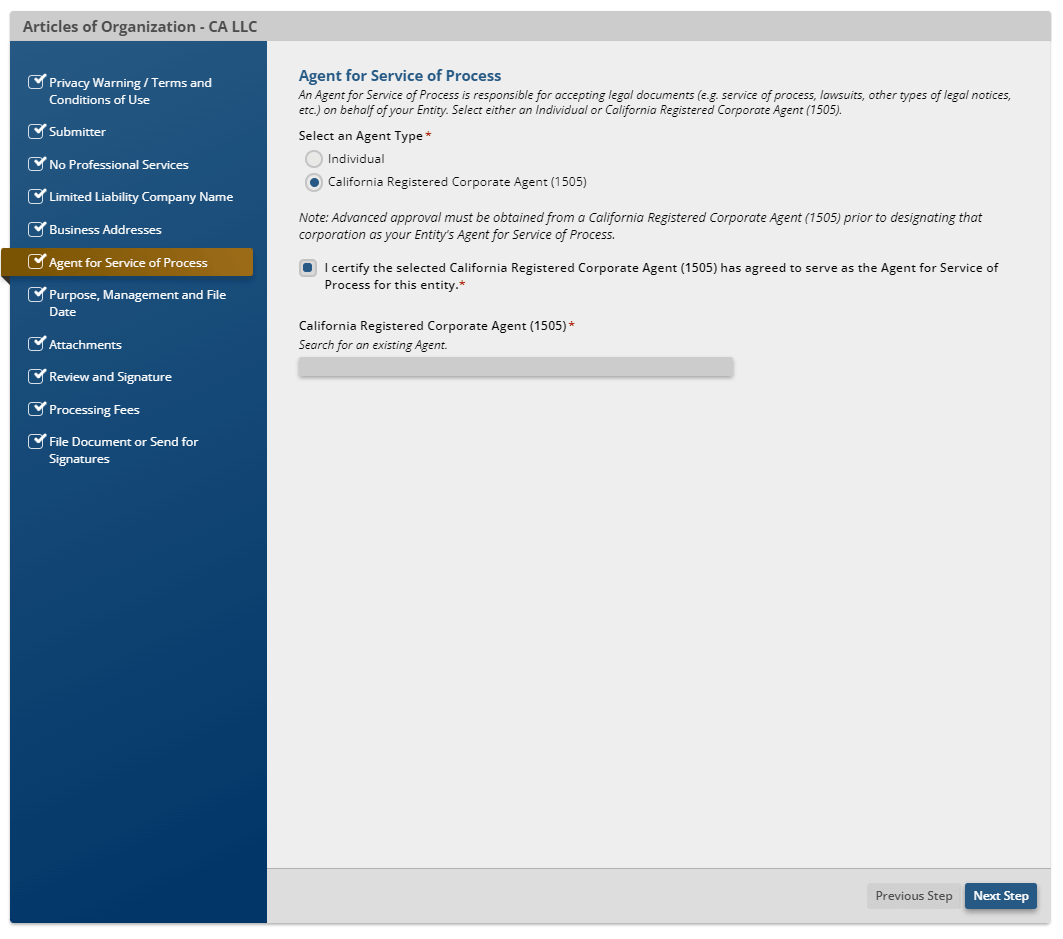
California doesn’t promise a fixed turnaround; it posts live Current Processing Dates that shift week to week. For how long it takes to form an LLC in California, see how long a California LLC really takes. Or pay $350 for 24-hour or $750 for same-day service.
Step 4: Write your operating agreement
Here’s the thing about California: it actually requires an operating agreement, even for a single-member LLC. You keep it with your records rather than filing it, and it sets ownership, voting, member exits, and whether you’re member-managed or manager-managed. If you want a starting point, a California operating agreement template and walkthrough covers the clauses that matter.
Step 5: Get your EIN from the IRS
Once the Articles are approved, get your EIN, the federal Employer Identification Number, free from the IRS EIN application; form the LLC first so the name on both matches. A single-member LLC still needs one to open a bank account and to hire.
For a step-by-step walkthrough, including notes for California businesses, see how to get an EIN. Skip any site that charges for an EIN, because the IRS issues it at no cost.
Step 6: Open your bank account and file what’s due
With the approved Articles and your EIN, open a business bank account to keep personal and company money separate. Then handle the near-term items: the Statement of Information within 90 days and the first $800 tax payment on time. Check, too, whether your city or county requires business licenses or permits.
Use Northwest if you want help filing and an agent address on record.
California’s bizfile process is simple enough to handle yourself, but Northwest can make sense if you want the Articles filed for you and an agent for service of process instead of listing your own California address.
California LLC requirements: what’s mandatory, what’s a myth
The California LLC requirements are short and specific. Four things are mandatory: a distinguishable name, an agent for service of process with a physical California address, the $70 filing, and a written operating agreement.
What’s optional is where owners overspend. You don’t have to live in California to own the LLC, and you don’t need a paid formation service. You can set the LLC up yourself for free beyond the state’s own fees.
California’s ongoing costs: the $800 tax, the report, and the full calendar
California’s recurring layer is what catches people, and it’s the most state-specific part of running the LLC. Here’s every charge, on a timeline.
Every LLC organized or doing business here owes the $800 annual franchise tax, paid to the California Franchise Tax Board on FTB 3522. You owe it even with zero revenue, per the Franchise Tax Board’s LLC tax page. The first-year payment is due the 15th day of the 4th month after you file.
The recurring report is lighter: the Statement of Information is due within 90 days of formation, then every two years, not annually, for $20 on Form LLC-12. You can handle filing the California Statement of Information on bizfile.
The table below shows how much a California LLC costs across its first two years.
| When | What you file | Cost |
|---|---|---|
| At formation | Articles of Organization (Form LLC-1) on bizfile | $70 |
| Within 90 days of approval | Initial Statement of Information (Form LLC-12) | $20 |
| 15th day of the 4th month after filing | First annual franchise tax (FTB 3522) | $800 |
| 15th day of the 4th month, each later year | Annual franchise tax (FTB 3522) | $800 |
| Above $250,000 California income | LLC fee (FTB 3536) | $900 to $11,790 |
| Every two years, in the statutory six-month window | Statement of Information renewal | $20 |
Your real first-year outlay is about $890: the $70 filing, the $20 statement, and the first $800 tax. The income-based LLC fee and the annual Form 568 return only bite once you grow.
The catch is timing. Form in October or November and you can owe two $800 payments within a few months, because the first-year tax and the next year’s tax fall close together. If the business won’t operate until next year, filing in January keeps those two payments a full year apart.
Where California LLCs get tripped up
The most common California LLC problems involve the Statement of Information deadline, stale agent details, and the tax calendar.
Two more trip-ups: a name that isn’t distinguishable in state records bounces at submission, and a stale agent address means you miss official notices. Either one is the quiet way a California LLC loses its good standing.
California LLC questions, answered
These are the questions California owners actually search, answered straight.
How much does it cost to start an LLC in California?
Seventy dollars to file, and that’s the entire state charge to create the LLC. The number people miss is the $800 annual franchise tax, owed every year on top. Add the $20 Statement of Information due within 90 days, and your true first-year cost is about $890.
Can you start a California LLC for free?
California has no truly free path. Two charges are unavoidable: the $70 filing fee and the $800 annual tax. What you can skip is a paid service, since you file the same Articles of Organization yourself on bizfile for the state’s fee. When an ad says “free,” the markup usually hides in the registered-agent renewal.
How long does it take to form an LLC in California?
There’s no fixed promise; the state posts live Current Processing Dates that move each week. Online filings clear well ahead of mail, so file on bizfile if speed matters. Need it sooner? The 24-hour service is $350 and same-day is $750. For a normal launch, file online and don’t pay to expedite.
Do I have to pay the $800 franchise tax in the first year?
Yes, the $800 applies in year one as of 2026. The first-year exemption that still floats around blogs covered only tax years 2021 through 2023, and it was not renewed. So an LLC formed today owes the $800, due the 15th day of the fourth month after you file.
Does California require an operating agreement?
Yes, which surprises people coming from states where it’s optional. California requires members to adopt an operating agreement, though you keep it with your records rather than filing it. Even a single-member LLC needs one, since it helps show the business is separate from you.
Is the California report annual or biennial?
California’s report is biennial, not annual, which catches owners used to a yearly filing. The Secretary of State requires the initial Statement of Information within 90 days of formation. After that it’s due every two years for $20, during the statutory six-month filing window tied to your formation month. Miss it and the state can suspend the LLC, so set a two-year reminder the day you’re approved.
Can I form a Series LLC in California?
No. California does not let you form a Series LLC in-state. If you already own one from another state, each cell that does business here has to register and can owe the $800 tax per series. For nearly every California business, a standard LLC is the right structure.
Can a married couple run a single-member LLC in California?
Often, yes. Because California is a community-property state, a married couple can be treated as one owner and elect single-member status for the LLC. That keeps the filing simpler than a two-member partnership return. Confirm the federal treatment with your tax preparer, since the IRS classification follows how you report it.
- Internal Revenue Service, Get an Employer Identification Number
- California Secretary of State, Limited Liability Companies (Domestic)
- California Secretary of State, bizfile Online
- California Secretary of State, Current Processing Dates
- California Secretary of State, Name Reservations and Business Search
- California Franchise Tax Board, Limited Liability Company
- California Secretary of State, Statements of Information Filing Tips
Start your California LLC with Bizee
Bizee helps you form your California LLC and stay on top of the real requirements, including filing your Articles of Organization, handling registered agent needs, and keeping key compliance steps like the $800 franchise tax and Statement of Information in view so nothing catches you off guard