

Here’s how to start an LLC in Indiana as of 2026. You file your Articles of Organization with the Indiana Secretary of State through INBiz, the state’s online portal. The fee is $95 online, and most filings clear within a business day. Indiana then asks for a Business Entity Report every two years, not every year. That two-year cycle catches people who expect an annual report.
Filing your Indiana LLC: cost, office, and timeline
The fast answer, before the detail below:
- Where you file: Articles of Organization with the Indiana Secretary of State, online through INBiz.
- Cost: $95 online, or $100 by mail, one time.
- Timeline: about one business day online; longer by mail.
- Recurring obligation: a Business Entity Report every two years, $32 online ($50 by mail).
- Who needs one: any Indiana business wanting liability protection, single-member or multi-member.
- Contact: Indiana Secretary of State, Business Services Division, via the INBiz portal.
How to start an LLC in Indiana, step by step on INBiz
Every step below runs through INBiz, and you can file it yourself without paying a service. The Indiana LLC requirements are short: a distinguishable name, a registered agent with an Indiana address, the $95 fee, and an INBiz login. Here is the Indiana LLC registration sequence, with the fee at each step.
Step 1: Name your LLC and run the Indiana business name search
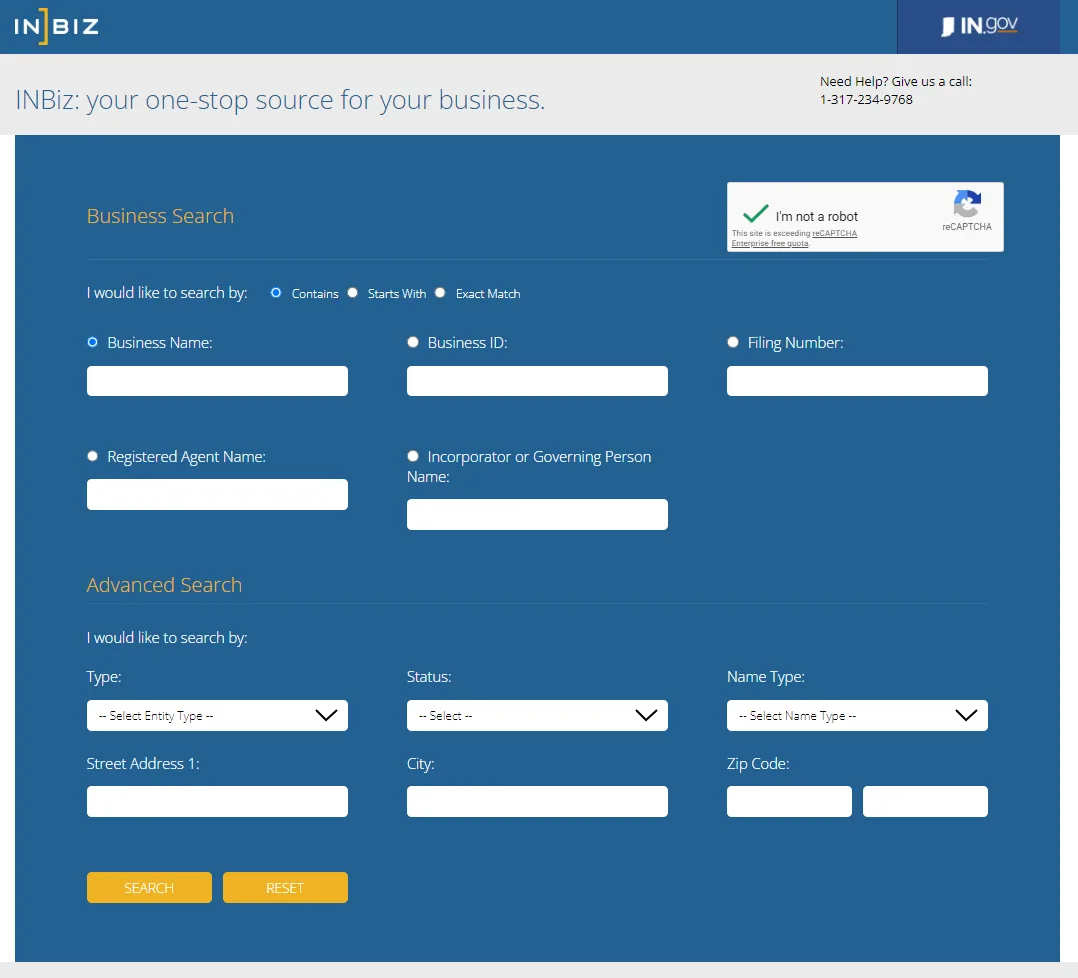
Your name has to end in “LLC” or “Limited Liability Company” and be distinguishable from every entity on the state record. Run the Indiana business name search first, since a near-match is the top reason a filing bounces back. You can check availability with the state’s online business search tool in minutes. Reserving a name is optional and rarely necessary.
Step 2: Appoint an Indiana registered agent
Indiana requires every LLC to name a registered agent with a physical street address in the state, reachable during business hours; a PO box won’t do. You can serve as your own agent for free, or hire a service to keep your home address off the public record. Paid agents usually run $100 to $300 a year.
Step 3: File the Articles of Organization on INBiz
This is the filing that creates the LLC. You submit the Articles of Organization (Form 49459) and pay the Indiana LLC filing fee of $95 online or $100 by mail.
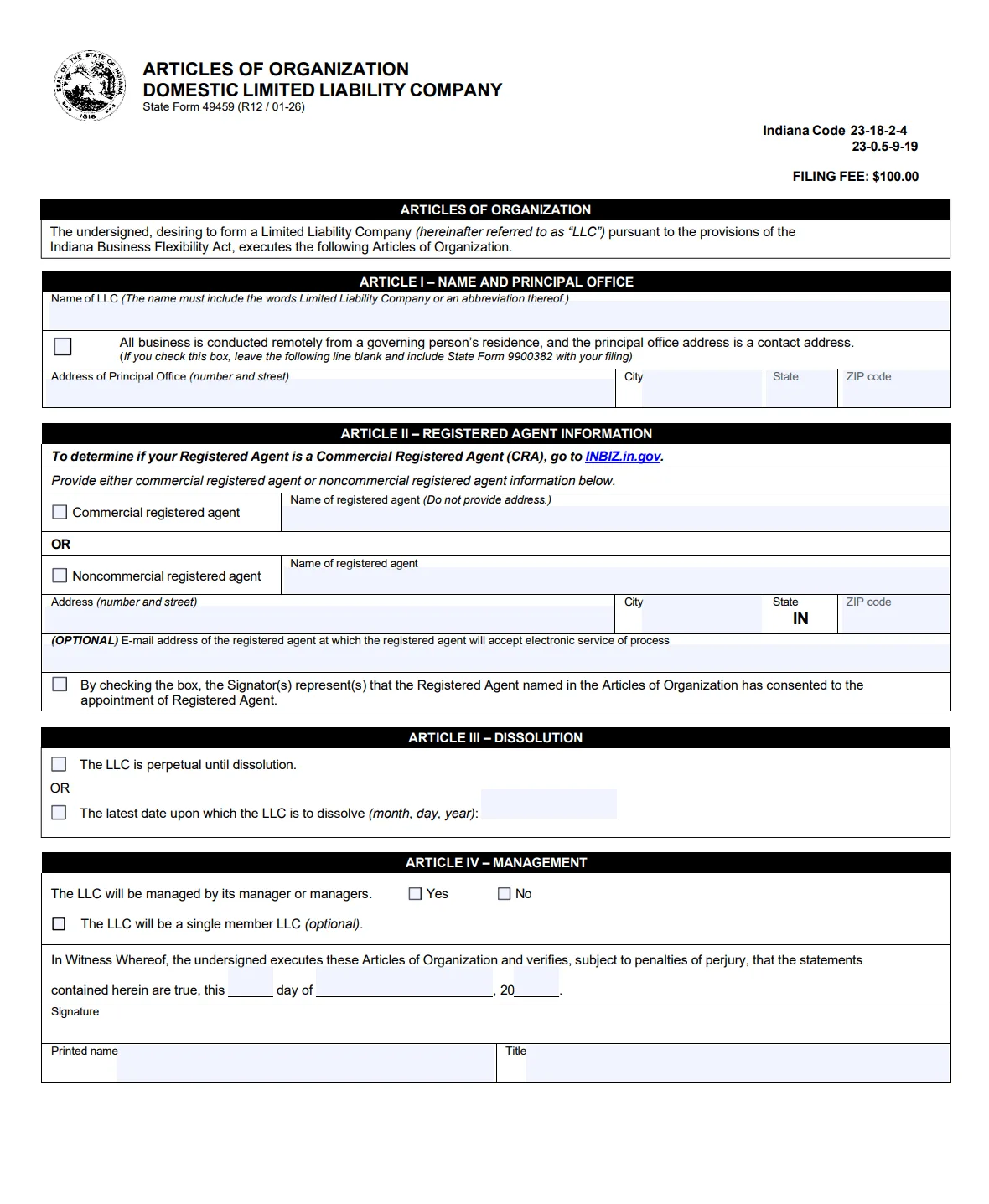
You can file the online application through INBiz, and most approvals post within a business day.
You’ll also decide whether the LLC is member-managed or manager-managed; owner-run LLCs are typically member-managed. Indiana has no expedited tier, since online filing is already quick, while mailed forms can take a week or more. If timing matters for a bank or a contract, here is how long Indiana LLC approval takes.
Every week someone asks me how to get an LLC in Indiana for free, and the honest answer is that the $95 INBiz fee is the floor; nobody waives it. A paid service charges that same $95 plus a markup to click buttons you can click yourself. The one upgrade worth paying for is a registered agent if you don’t want your home address public.
Step 4: Create an operating agreement
Indiana doesn’t require an operating agreement, but skipping it is a mistake for anyone serious. The document sets out ownership splits, voting, profit shares, and what happens if a member leaves. It matters even for a single-member LLC, since it proves the business is a separate entity. Adapt an Indiana operating agreement template to your members.
Step 5: Get an EIN from the IRS
Your EIN is the federal tax ID your LLC needs to open a bank account, hire, and file taxes. It’s free, straight from the source: apply for an EIN on the IRS website. Form the LLC first, then request the EIN, so the name on both records matches. Our EIN guide for LLC owners covers the single-member quirks.
Step 6: Register for state taxes and open a bank account
Once the LLC exists, open a dedicated business bank account so personal and company money never mix. If you sell taxable goods, register with the Indiana Department of Revenue for a Registered Retail Merchant Certificate before your first sale. With the EIN, the approved Articles, and your operating agreement, that bank setup is usually same-day.
Use Northwest when the registered agent service is the part you actually need.
Indiana’s INBiz filing is quick, but every LLC still needs a registered agent with a physical Indiana address. Northwest can handle the formation and agent role together if you want privacy support instead of listing your own address.
How much does an LLC cost in Indiana? The $95 fee and $32 report
So when people ask how much does an LLC cost in Indiana, you’ll pay $95 to file online ($100 by mail), one time. After that, the only required state cost is the $32 biennial report, about $16 a year. Here’s the thing: that’s the whole mandatory bill.
Indiana LLC ongoing costs: the biennial Business Entity Report
Indiana runs its reporting on a two-year cycle, which is unusual. You’ll file a Business Entity Report every two years, due in your formation anniversary month, for $32 online or $50 by mail. You file it with the Secretary of State; our Indiana biennial report guide walks through the screens.
Miss the deadline and Indiana can administratively dissolve the LLC after a written notice and a 60-day cure period. The state charges no franchise or privilege tax on LLCs, so that’s the whole recurring state bill.
The Business Entity Report is the part of Indiana compliance I see people misread most often. They expect an annual report, set a yearly reminder, then find the real deadline lands every two years in their formation month. Miss it, and the state can dissolve the LLC.
What taxes does an Indiana LLC pay? Sales, income, and county rates
By default the IRS treats your LLC as a pass-through, so profits land on members’ personal returns. Most state obligations run through the Indiana Department of Revenue, and the 2026 rates are flat. You can confirm them on DOR’s current rate and fee page.
| Tax | Rate (2026) | Applies to | Paid to |
|---|---|---|---|
| State individual income tax | 2.95% flat | Pass-through profit on members’ returns | Indiana DOR |
| Local county income tax | 0.5% to 3% | Members, by county of residence | Indiana DOR |
| Sales and use tax | 7% | Taxable goods and some services | Indiana DOR |
| Corporate income tax | 4.9% | Only if the LLC elects C corp taxation | Indiana DOR |
| Franchise tax | None | Not applicable | Not applicable |
Indiana doesn’t add local sales tax, so a sale in Indianapolis is taxed exactly like one in a small rural county. You can elect S corp or C corp treatment later if the numbers favor it, but that’s a tax choice, not a different entity.
Do you need a business license or permit in Indiana?
Indiana has no general statewide business license, which surprises people from stricter states. Licensing is local and industry-specific instead: a city permit, a health or contractor license, or a professional credential. If you sell taxable goods, you’ll register with the Indiana Department of Revenue for a Registered Retail Merchant Certificate, a one-time $25 fee per location on INBiz. The catch: that registration has to come before your first taxable sale, not after.
Filing a DBA in Indiana
To trade under a name different from your legal LLC name, file a Certificate of Assumed Business Name, Indiana’s version of a DBA. It runs $20 online or $30 by mail through INBiz, and it never expires once accepted. Banks freeze deposits when the name on your checks doesn’t match a name on record, so file the assumed name before you invoice under it.
Why form an LLC in Indiana? Low fees, biennial reporting, no franchise tax
For a business based in the state, the advantages of an Indiana LLC are concrete. The filing fee is modest, the report falls due half as often as in most neighbors, and there’s no franchise tax. Add a flat 2.95% income tax and one-day approvals, and once you’re formed, ongoing compliance is minimal. For a company run in Indiana, that comes down to the biennial report and any tax registrations.
When clients ask whether Indiana is a good state to form in, I point to the math. For a company run inside Indiana, this mix is hard to beat.
That does not mean Indiana is a privacy state. Your registered agent and the state both know who owns the LLC.
Where Indiana LLC owners slip up
The mistakes here are specific to how Indiana runs things, not the generic warnings you’ll find elsewhere. The biennial deadline catches the most people, because owners assume the report is annual and miss the every-two-years cadence.
- Treating the $95 fee as recurring; the only repeat state cost is the $32 report
- Confusing the Secretary of State filing with Department of Revenue tax registration; they’re separate
- Operating in another state without registering there as a foreign LLC
- Skipping the operating agreement, then struggling to prove ownership to a bank
Indiana LLC FAQ
These are the questions Indiana founders search before and after filing, answered with the real numbers and offices.
How much does an LLC cost in Indiana?
It costs $95 to file your Articles of Organization online through INBiz, or $100 by mail, one time. The only ongoing state cost is the $32 biennial report; a registered-agent service or name reservation is optional.
Can you start an LLC in Indiana for free?
No, and any site promising a “free” Indiana LLC is hiding the state fee. The $95 INBiz filing fee is mandatory and goes to the Secretary of State, not a middleman. What’s free is doing it yourself instead of buying a package, and acting as your own registered agent at no cost.
Does Indiana require an annual report for LLCs?
No. Indiana uses a biennial Business Entity Report, due every two years in your formation anniversary month, for $32 online or $50 by mail. This is the most common compliance trap in the state, since owners set yearly reminders and miss the real two-year deadline that leads to dissolution.
Do I need to file a BOI report for my Indiana LLC?
Not as of 2026. FinCEN’s March 2025 rule exempts entities formed in the United States, so a domestic Indiana LLC has no federal beneficial-ownership report to file. The requirement still reaches certain foreign companies registered to do business here. The rule is interim, so confirm with FinCEN before you assume it hasn’t changed.
Can I be my own registered agent in Indiana?
Yes. Any Indiana resident with a physical street address in the state can serve as their own agent, as can the LLC’s own members. The tradeoff is that the address becomes public record, and someone must be reachable during business hours. If privacy or travel is a concern, a commercial agent is the usual fix.
Does Indiana have an LLC franchise tax?
No. Indiana charges no franchise tax or annual privilege tax on LLCs, a real edge over states like California. Profits pass through to members and face the flat 2.95% state income tax plus any local county rate. The only recurring state cost tied to the entity is the $32 biennial report.
- SBA, 10 steps to start your business
- Indiana Secretary of State, Business Services Division
- INBiz, Indiana’s business one-stop portal
- INBiz Fee Calculator
- Indiana Department of Revenue, Sales Tax and the RRMC
- Indiana Department of Revenue, tax rates and fees
- IRS, Apply for an Employer Identification Number
File your Indiana LLC on INBiz with Harbor Compliance
Harbor Compliance helps you prepare and file your Indiana LLC, appoint a registered agent, and handle the state setup steps without getting lost in the INBiz process.

Hello,
My name is Gobail Manfred. I am looking for an honest and reliable professional to handle payroll and HR services for my business. I would be glad if you could get back to me so we can discuss this further.
Thank you,
Gobail Manfred
570-273-8503