

Figuring out how to start an LLC in Ohio comes down to one document and one fee as of 2026. You file Form 610 with the Ohio Secretary of State for $99. Ohio calls your registered agent a statutory agent, and ordinary Ohio LLCs file no annual report, which keeps yearly upkeep lighter than most states.
Your Ohio LLC: where to file, the $99 fee, and no annual report
- Where to file: Form 610, the Articles of Organization, with the Ohio Secretary of State, online or by mail.
- Filing fee: $99 to the state, plus an optional $39 to reserve the name first.
- Timeline: roughly 3 to 7 business days standard, faster with paid expedite.
- Statutory agent: required, with a physical Ohio street address, never a P.O. box.
- Ongoing: no annual report; the Commercial Activity Tax applies only past $6 million.
- Who it’s for: anyone forming a domestic LLC in Ohio can use this. Out-of-state owners can file here too, but still need an Ohio statutory agent.
- Contacts: Ohio Secretary of State, Business Services Division, Columbus; portal Ohio Business Filings at bsportal.ohiosos.gov; business line 1-877-767-3453.
Why form an Ohio LLC: a $99 setup, no annual report, and CAT only past $6 million
An LLC gives you liability protection: your home and savings sit behind the business, not inside it. In Ohio that shield costs $99 once, with no yearly report to keep it alive. For a small business in Columbus, that’s a low bar.
People often search how to incorporate in Ohio when they really want an LLC. Incorporating builds a corporation with a board and shareholders; an LLC is simpler and fits most small businesses. Ohio isn’t a Delaware-style tax play, so form here because you operate here.
How to file your Ohio LLC: Form 610, a statutory agent, and the $99 fee
Here’s the actual sequence. The Ohio LLC requirements are short: a distinguishable name, a statutory agent, Form 610, and the fee. The whole filing runs through the Ohio Secretary of State, online or on paper.
Step 1: Name the LLC and run the Ohio business search
Your name has to carry an LLC marker: LLC, L.L.C., limited liability company, limited, ltd., or ltd. It also has to be distinguishable upon the record from every name already on file. Before you commit, search the Ohio business name database first.
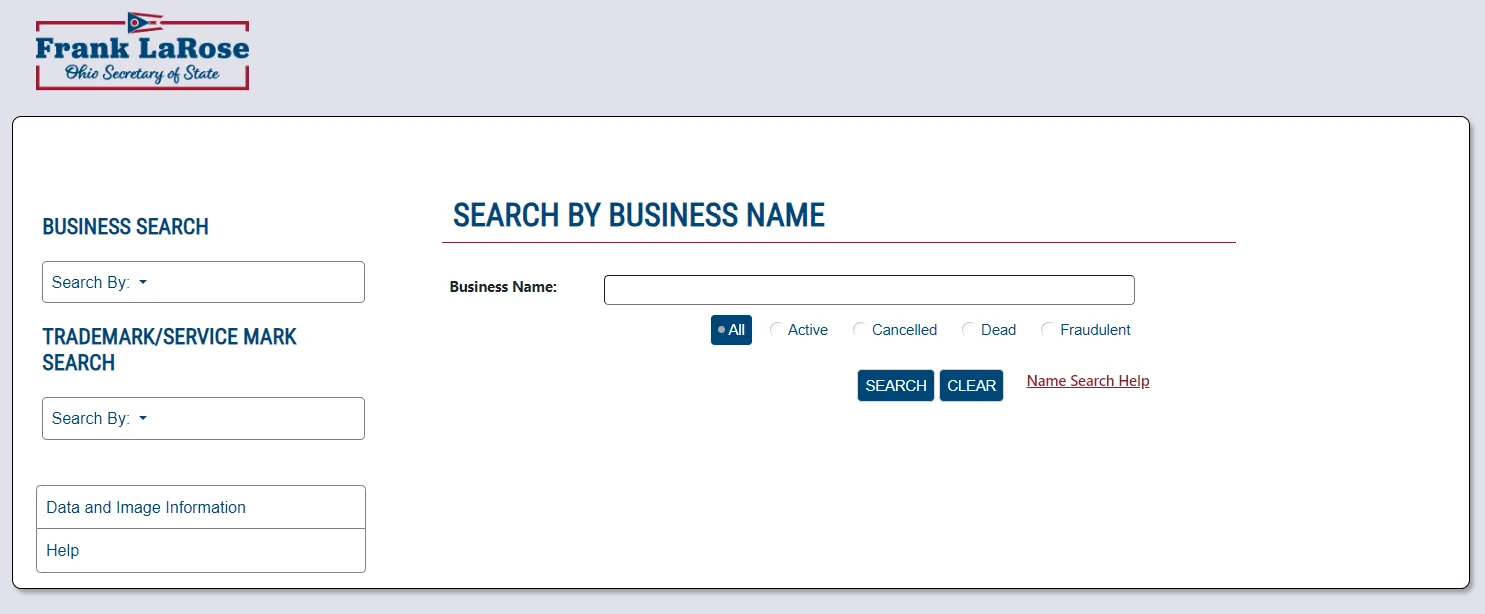
Not ready to file? Reserve the name. Ohio’s Form 534B holds it for 180 days for $39. The state’s own name availability guide spells out what counts as distinguishable.
Step 2: Appoint an Ohio statutory agent (a P.O. box won’t do)
Ohio uses the term statutory agent for what other states call a registered agent. The agent accepts legal papers and must be an Ohio resident or an entity with an Ohio street address. A post office box doesn’t qualify.
You can be your own agent if you live in Ohio and accept your address on the public record. No Ohio address? Hiring an Ohio statutory agent service solves it.
Step 3: File Form 610 with the Ohio Secretary of State
The formation document is Articles of Organization for a Domestic Limited Liability Company, better known as Form 610. You file it online through Ohio Business Central or by mail to Columbus. That makes your Ohio LLC registration official.
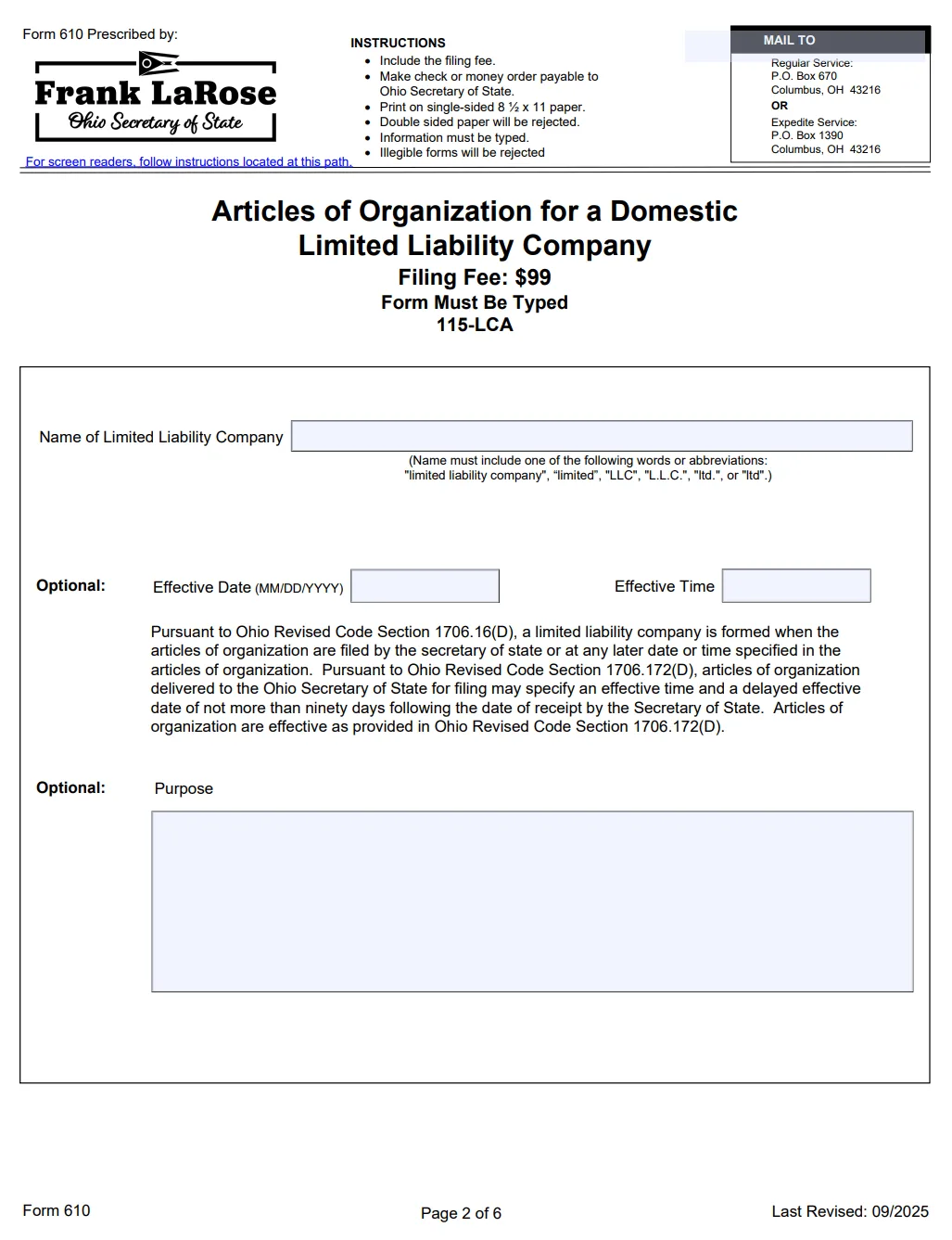
The filing fee is $99, and standard processing runs about 3 to 7 business days. Need it sooner? Expedite runs $100 (two-day), $200 (next-day), or $300 (four-hour), the last two by walk-in. Here’s how long Ohio filings take in practice.
Step 4: Put an operating agreement in writing
Ohio doesn’t make you file an operating agreement, and it isn’t part of Form 610. State law still treats it as the rulebook for how members run the LLC. Skip it and default rules fill the gaps.
Even a single-member LLC benefits. Start from an Ohio operating agreement template and adapt it.
Step 5: Get your EIN from the IRS
Once the LLC exists, get your federal tax ID. The EIN is free from the IRS, and you’ll need it for a bank account, payroll, and most tax filings.
A single-member LLC with no employees can often use the owner’s SSN federally, but you’ll want an EIN for a bank account or payroll. File the LLC first, then the EIN; the names must match.
Step 6: Open a bank account and check local licenses
With the EIN and stamped articles, open a business bank account to keep personal and company money apart. Ohio has no single statewide business license, but your activity might need one: a retailer needs a vendor’s license; licensed trades have their own boards.
Use Northwest if the statutory agent address is your weak spot.
Ohio will not accept a P.O. box for the statutory agent. Northwest is most useful when you want Form 610 handled with a real Ohio agent address instead of putting your home address on the public record.
What you’ll pay to start an Ohio LLC: $99 to file, $39 to reserve a name
Straight answer to how much is an LLC in Ohio: $99 to file Form 610, full stop. Reserving the name first is an optional $39. There’s no annual report fee, so the recurring state cost for most owners is zero.
Can you do it for free? Not quite: the $99 state fee is unavoidable. You can still form an LLC in Ohio for free of service markups by filing direct.
No annual report for Ohio LLCs: the CAT and the $6 million line
Here’s where Ohio gets easier than most states. Ordinary Ohio LLC annual fees with the Secretary of State don’t exist; there’s no annual or biennial report to file. That’s why Ohio skips the LLC annual report other states impose, though tax and licensing duties still apply.
What can apply is the Commercial Activity Tax, Ohio’s gross-receipts tax run by the Ohio Department of Taxation. For 2025 and forward, you owe $0 at or below $6 million in Ohio taxable gross receipts. Past that, it’s 0.26% on receipts above $6 million.
Ohio also scrapped the CAT annual minimum tax for periods starting in 2024, so small LLCs aren’t charged just for existing; the few businesses over $6 million file quarterly.
What gets Ohio LLC filings rejected: name clashes, P.O. box agents, and the CAT surprise
The top refiling reason is a name that isn’t distinguishable from one already on the Ohio record; a trailing “LLC” won’t rescue a near-copy. Next is the agent address, since a P.O. box bounces the filing. Run the name search and confirm a real Ohio street address before paying.
The costlier slips: reading “no report” as “no tax” and ignoring the CAT, or skipping the operating agreement until members clash.
Ohio LLC questions: cost, statutory agents, and forming from out of state
A few things come up on almost every Ohio filing, worth settling before you submit Form 610.
How much does it cost to start an Ohio LLC?
The only required cost is the $99 filing fee for Form 610, plus an optional $39 to reserve the name first. Skip the $300 “formation packages” that just add a markup to the same $99 filing.
Can I start an Ohio LLC for free?
No, and any “free” offer is hiding the state fee. The $99 goes to the Ohio Secretary of State no matter who submits the form. You skip service markups by filing yourself, but the $99 is fixed.
Does Ohio require an annual report for LLCs?
No, and that’s a real reason people form here. Ordinary Ohio LLCs file no annual or biennial report, so there’s no recurring form to forget and no late fee. Only professional associations and limited liability partnerships file biennially.
What is a statutory agent in Ohio?
It’s Ohio’s name for a registered agent: the contact that accepts lawsuits and official mail for your LLC. It needs a physical Ohio street address, not a P.O. box, or the filing gets rejected.
Can I be my own statutory agent?
Yes, if you live in Ohio and keep regular hours at a street address. The trade-off is privacy: that address goes public, open to process servers. Home-based owners usually pay a commercial agent instead.
How long does it take to form an Ohio LLC?
Standard service is about 3 to 7 business days after the state receives Form 610. Expedite costs $100 for two-day, $200 for next-day, or $300 for four-hour, the last two by walk-in. Most filers don’t need it.
Can I form an Ohio LLC if I live in another state?
You can, since there’s no residency rule for members. But you still need an Ohio statutory agent, and operating from another state usually means registering there as a foreign LLC too. It rarely pays unless Ohio is your base.
Does Ohio allow series LLCs?
Yes, when your Articles of Organization state that the company may hold one or more series of assets. It’s a niche tool for separating real estate or business lines; a single business rarely needs it.
- IRS: Limited Liability Company (LLC)
- Ohio Secretary of State: business filing forms and fee schedule
- Ohio Secretary of State: Form 610, Articles of Organization
- Ohio Business Filings portal
- Ohio Secretary of State: business name availability guide
- Ohio Revised Code, Chapter 1706
- Ohio Department of Taxation: Commercial Activity Tax
File Your Ohio LLC Form 610 with Harbor Compliance
Harbor Compliance helps you form your Ohio LLC with organized filing support, compliance guidance, and tools built for business owners who want the process handled correctly from the start.