


How much does an LLC cost in 2026? Your total LLC cost includes your State filing fees typically range from $40–$500, with most states falling between $50–$200. Notable outliers include: Massachusetts ($500), Tennessee ($50 per member, minimum $300, maximum $3,000), California ($70 filing fee plus $800 franchise tax), and Texas ($300). A few states offer lower fees: Kentucky ($40), Arizona ($50), and Colorado ($50).
Optional items, like a registered agent (~$50–$300/year), operating agreement templates, and name reservation, can raise the first-year spend, while your EIN is free if you apply directly with the IRS. Below you’ll find a state-by-state breakdown and practical ways to reduce LLC costs without risking compliance.
How Much Does It Cost to Start an LLC? (2026)
State filing fees and annual renewal costs for all 50 states + DC. Click any state for a full cost breakdown.
| State | Filing Fee | Annual Fee |
|---|---|---|
| Alabama | $200 | $50min/yr |
| Alaska | $250 | $100/2yr |
| Arizona | $50 | $0 |
| Arkansas | $45 | $150/yr |
| California | $70 | $800/yr |
| Colorado | $50 | $25/yr |
| Connecticut | $120 | $80/yr |
| Delaware | $110 | $400/yr |
| Florida | $125 | $138.75/yr |
| Georgia | $110 | $60/yr |
| Hawaii | $50 | $15/yr |
| Idaho | $100 | $0 |
| Illinois | $150 | $75/yr |
| Indiana | $95 | $31/2yr |
| Iowa | $50 | $30/2yr |
| Kansas | $160 | $50/yr |
| Kentucky | $40 | $15/yr |
| Louisiana | $100 | $35/yr |
| Maine | $175 | $85/yr |
| Maryland | $100 | $300/yr |
| Massachusetts | $500 | $500/yr |
| Michigan | $50 | $25/yr |
| Minnesota | $155 | $0 |
| Mississippi | $50 | $0 |
| Missouri | $50 | $0 |
| Montana | $35 | $20/yr |
| Nebraska | $100 | $13/2yr |
| Nevada | $425 | $350/yr |
| New Hampshire | $100 | $100/yr |
| New Jersey | $125 | $75/yr |
| New Mexico | $50 | $0 |
| New York | $200 | $9/2yr |
| North Carolina | $125 | $200/yr |
| North Dakota | $135 | $50/yr |
| Ohio | $99 | $0 |
| Oklahoma | $100 | $25/yr |
| Oregon | $100 | $100/yr |
| Pennsylvania | $125 | $7/yr |
| Rhode Island | $150 | $50/yr |
| South Carolina | $110 | $0 |
| South Dakota | $150 | $55/yr |
| Tennessee | $300 | $300min/yr |
| Texas | $300 | $0 |
| Utah | $59 | $18/yr |
| Vermont | $155 | $45/yr |
| Virginia | $100 | $50/yr |
| Washington | $200 | $60/yr |
| Washington DC | $99 | $300/2yr |
| West Virginia | $100 | $25/yr |
| Wisconsin | $130 | $25/yr |
| Wyoming | $100 | $60min/yr |
The True Cost of Starting an LLC in 2026
Launching an LLC isn’t just about a one-time filing fee; there are ongoing expenses that pop up every year or at key stages of growth. While these fees can feel like obstacles, they often provide valuable legal protections. This section breaks down the core outlays, why cost to start an LLC can differ between states, and typical price ranges across the nation.
Understanding LLC Filing Fees
When you form an LLC with the state, you generally file Articles of Organization and pay a state filing fee. These costs required to form an LLC cover official administration. For some states, this sum is quite low; for others, it can be more than a few hundred dollars. Typically:
- The minimum LLC filing fee can be as low as $35 and commonly falls between $40–$500 (most states $50–$200) in many states (with a nationwide average around $132).
- Additional fees might apply if you request expedited filing or form a foreign LLC.
- Some states have separate charges if you must also meet a publication requirement (for example, an LLC in New York or a notice for LLC in Nebraska).
Understanding your state’s baseline helps you gauge whether you should consider an alternative business structure or location to keep expenses manageable.
Why LLC Costs Vary by State and Business Needs
These differences don’t hinge solely on geography. Each jurisdiction sets unique rules for state filing fees and overall compliance. That’s why an LLC in New Mexico might cost less than an LLC in New York or LLC in Colorado. Also, depending on the complexity of your company, like if it has multiple members or you’re planning advanced ventures, your LLC operating agreement or licensing obligations may require more investment. If you foresee expansions, a robust setup at launch may also save you from additional costs down the road.
$100 filing + $60 annual report
DE: $110 + $150 agent + $400 tax
TX: $750 foreign + $150 agent
Average Cost of Starting an LLC Across the U.S.
While there’s no single average cost that fits every region, fees tend to fall within a broad bracket:
- $50 to $150 in states known for affordability
- $200 to $500 in higher-cost jurisdictions or those with a publication requirement
- Occasionally $0 when a state temporarily waives fees (e.g., California did so from July 1, 2022–June 30, 2023), though that’s rare today
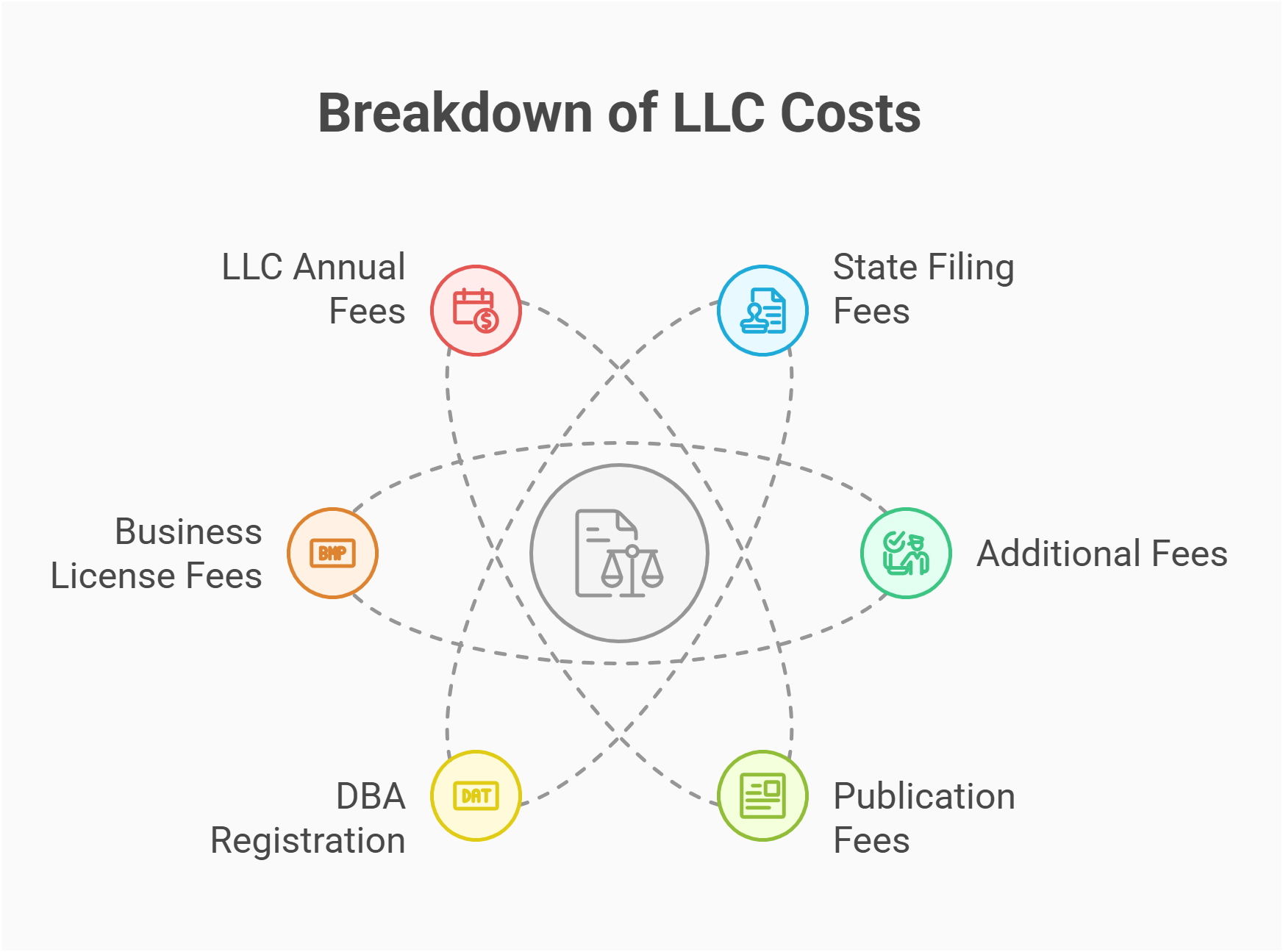
Below are some typical line items you’ll see across the country:
- Initial LLC formation filing (your Articles of Organization)
- Optional DBA or trade name registration
- Local business license or permit fees
- LLC annual fee or recurring annual report / periodic report charges
By clarifying these charges in advance, you can realistically forecast the cost to form an LLC and minimize sticker shock, especially once you factor in a registered agent service and any annual report obligations.
Business credit — you also inherit potential pitfalls. The LLC might have hidden debts, pending lawsuits, or outdated tax filings. A negative reputation can hamper future growth. Knowing these issues, you must carefully evaluate every aspect, from outstanding tax liabilities to intangibles like staff morale or prior management mishaps. Proper due diligence is key to ensuring you buy a strong foundation rather than a sinking ship.
Business Banking Setup: While not technically LLC formation costs, new LLCs should budget for business banking. Many banks offer free business checking with minimum balance requirements ($500-$5,000) or charge monthly fees of $10-$30 without minimums. Merchant accounts for credit card processing typically charge 2.5-3.5% per transaction plus monthly fees. Shop around - online banks and credit unions often offer better terms for new businesses.
Filing Fees for LLCs: A State-by-State Comparison
Although your baseline cost to create an LLC largely depends on location, certain states stand out for affordability, while others demand heftier sums. The list below shows which ones rank as the cheapest for LLC formation and the priciest, followed by filing fees for all 50 states in 2026, so you can see at a glance whether your LLC filing fee might cost more or less than you’d expect.
Cheapest States to Start an LLC: Where to Save Money
Some states truly shine in cost-effectiveness for new or small business setups. According to current data (updated for 2026), these are 10 budget-friendly picks, balancing a low Articles of Organization fee with manageable annual report or recurring costs:
- LLC in Kentucky — $40 state filing fee; $15 annual report.
- LLC in Michigan — $50 Articles of Organization; $25 annual statement.
- LLC in Missouri — ~$50–$51 filing; no annual report for LLCs.
- LLC in Iowa — $50 formation fee; $30 biennial report (online).
- LLC in Montana — $35 formation; $20 annual report (2026 report was temporarily waived).
- LLC in New Mexico — $50 filing; no annual report requirement.
- LLC in Arizona — $50 Articles of Organization; no annual report for LLCs.
- LLC in Mississippi — $50 formation fee; annual report due but $0 fee.
- LLC in Hawaii — $50 filing; $15 annual report.
- LLC in Colorado — $50 formation; $25 periodic report.
Note: Even if your home state isn’t on this list, sometimes it’s better to file where you operate, especially if forming an out-of-state LLC triggers extra compliance or corporate income tax obligations.
Note: Even if your home state isn’t on this list, it’s often best to form an LLC where you operate. Registering an out-of-state LLC usually triggers foreign LLC registration, extra filings, and taxes in your home state — erasing any upfront savings. For example, Delaware has a modest $110 filing but a $400 franchise tax each year (up from $300 starting with the 2026 tax year); Wisconsin charges about $130 to file online; Arkansas has a low $45 formation fee but a $150 annual franchise tax.
Start Your LLC Today
Launch your LLC effortlessly with Northwest Registered Agent. Simplify filings and secure compliance with expert support.
States with the Highest Filing Fees: What to Expect
On the flip side, states like California or Massachusetts carry notably higher up-front costs.
For example, California Franchise Tax ($800/year): California imposes an $800 minimum annual franchise tax on all LLCs. Important: The first-year exemption for new LLCs that existed from 2021-2023 has expired. As of 2024 and continuing into 2026, new California LLCs must pay the $800 franchise tax in their first year. Additionally, LLCs with California-source income exceeding $250,000 owe an additional fee ranging from $900 to $11,790 based on revenue tiers.
Meanwhile, Massachusetts charges $500 to file a Certificate of Organization (and $500 for the annual report thereafter). Bear in mind that a higher filing fee doesn’t always translate to better benefits; it’s often tied to local tax structures or franchise-tax rules.
Filing Fees in All 50 States (2026)
LLC filing fees range from $35 (Montana) to $500 (Massachusetts), with a national average of $132. Annual renewal costs vary even more, from $0 in states like Ohio and Missouri to $800/yr in California. Use the interactive state-by-state comparison above to sort by cost and find your state's exact numbers.
A few patterns worth calling out from the data:
States with $0 annual fees aren't always the cheapest overall. Ohio charges $99 to file but nothing annually; Texas costs $300 upfront but $0/yr for most LLCs (under the $2.65M revenue threshold). Your break-even depends on how long you plan to operate.
Biennial states save you time, not always money. Alaska ($100 every 2 years), Indiana ($31 every 2 years), and New York ($9 every 2 years) file less often, but Alaska's $250 filing fee offsets that convenience. Check whether your state reports annually or biennially before comparing totals.
"Filing fee" doesn't always mean the same thing. Nevada's $425 is actually three separate charges bundled together. California's $70 filing fee looks low until the $800 franchise tax hits. Always add up every required payment for year one, not just the Articles of Organization fee.
For expedited processing, most states charge $50-$100 to cut turnaround from weeks to days. A few states like Virginia and Kansas already process online filings same-day at no extra cost, so check your state's standard timeline before paying for speed you don't need.
Additional Costs When Forming an LLC
Beyond the mandatory state fees, a few optional or secondary expenses can pop up, especially if you’re leveraging professional help or require certain documents. Common add-ons covered here include a registered agent service and an LLC operating agreement, with a look at whether they’re worth the price, plus when an EIN matters.
Local Business Licenses: Beyond state LLC formation, many cities and counties require separate business licenses or permits. Costs typically range from $25-$500 annually depending on location and business type. Some jurisdictions also impose gross receipts taxes or business privilege taxes. Check with your city clerk's office and county business licensing department for local requirements. These costs are often overlooked in LLC formation budgets.
Registered Agent Fees: What to Know Before You Choose
A registered agent service typically handles official mail, ensuring you never miss lawsuits or government notices. The cost might be:
- $0 if you act as your own agent (but that can hamper privacy)
- $100–$300 per year if using a professional agent
- Possibly higher for premium coverage, like 24/7 phone support
Most business owners prefer a professional to keep personal addresses off public records. Plus, you avoid risking loss of good standing if you’re unavailable to receive crucial documents.
Operating Agreement Costs: DIY vs Legal Services
While not always mandatory with the state, an llc operating agreement clarifies membership roles and distributions. Below is a table contrasting the standard approaches:
| Option | Approx. Cost | Best For |
|---|---|---|
| DIY (Free Template) | $0 – $50 | Single-member LLCs with simple structures |
| Online Legal Service | $50 – $200 | Basic customization with built-in disclaimers |
| Attorney-Drafted | $500 – $2,000+ | Multi-member LLCs needing profit sharing, voting rights, dissolution terms |
For many small business owners, a template suffices, but if your LLC has multiple partners or intricate profit-split structures, paying an attorney might ensure airtight clarity. For many small business owners, a template suffices, but if your LLC has multiple partners or intricate profit-split structures, attorney fees for creating an LLC might ensure airtight clarity.
EIN Registration: Is It Really Free Through the IRS?
EIN (Employer Identification Number): Obtaining an EIN is completely free when you apply directly through the IRS website (irs.gov/businesses/small-businesses-self-employed/apply-for-an-employer-identification-number-ein-online). The online application takes about 10 minutes, and you receive your EIN immediately.
Warning: Many websites charge $50-$150+ for EIN applications - this is unnecessary. These third-party services simply submit the same free IRS form on your behalf. Always apply directly through IRS.gov to avoid paying for a free service.
Some third-party platforms charge extra to “get an EIN,” but you can always do it yourself. An EIN is required if you have employees, and it’s commonly used for business banking; some banks let sole proprietors or single-member LLCs open accounts using an SSN, but having an EIN can expand your options. If you plan to have your LLC taxed as an S corporation, you’ll use IRS Form 2553 to make that election. Apply only on IRS.gov to avoid unnecessary fees or misleading ads.
Hidden Costs You Shouldn’t Overlook
A handful of smaller or less obvious expenses can take new owners by surprise. These may not appear at initial formation but pop up as your enterprise grows or changes. Planning for them — like a business license, an LLC operating agreement, or a trademark — means fewer stress points and a more realistic forecast.
Business Licenses and Permits: Are They Mandatory?
In most states, certain professions—like contractors, real estate agents, or health providers—need state or local licenses. Even everyday services might require a local permit. To inspire your naming process, explore our LLC names examples to find the perfect name for your business. These fees can be minimal or quite steep, depending on your field. Some municipalities require a city business license that you renew annually, though renewal rules and costs vary by location. If you skip these, you risk fines or forced closures, so confirm requirements with local offices.
Trademarking Your Business Name: How Much Does It Add?
If your brand is unique or national in scope, a trademark can protect it. As of 2026, the USPTO uses a single base application fee of $350 per class (Sections 1 or 44), with possible extra charges if your application is incomplete or uses free-form identifications—attorney help adds more. This replaces the old TEAS Plus/Standard split. Filing with the USPTO is optional for starting an LLC but smart if you plan multi-state expansion.
Premium LLC Formation Services: Are They Worth It?
Numerous providers bundle convenience features like expedited filing, compliance reminders, or specialized docs. Some owners value these perks; others view them as upsells. If you’re comfortable filing yourself, skipping add-on packages can slash costs. If you’re short on time or prefer a hands-off approach, an LLC formation service can be worth paying for to reduce errors and keep deadlines on track.
Affordable LLC Setup
ZenBusiness helps you form and maintain your LLC without breaking the bank. Save time and cut costs with their streamlined services.
Ongoing Costs of Maintaining an LLC
Forming your company is just the first step. You’ll likely face recurring fees, which can include an annual report, a franchise tax, or renewal costs. Understanding them ensures you can maintain an LLC in good standing year after year.
Annual Report Fees: How They Vary by State
Annual Report/Franchise Tax Costs:
- $0: Ohio, Missouri, Arizona (no annual report for domestic LLCs)
- $9-$50: New York ($9 biennial)
- $25-$100: Colorado ($25, changed July 2024), Wyoming ($60 minimum)
- $100-$200: Florida ($138.75), Arkansas ($150 franchise tax, due May 1), Alaska ($100 biennial)
- $300+: Delaware ($400 annual tax, no report), California ($800 minimum), Massachusetts ($500)
- Special: Montana ($0 if filed before April 15; $35 if late), Nevada ($350 total: $150 annual list + $200 business license)
Note: "Annual report" vs "franchise tax" vs "business license" varies by state.
Franchise Taxes: States That Require Them
A handful of states impose a franchise tax separate from income tax. An LLC in California owes an $800 annual tax regardless of income.
Texas Franchise Tax: Texas LLCs with annualized total revenue at or below the "no tax due" threshold of $2.65 million (for report years 2026–2027) owe no franchise tax but must still file a Public Information Report (or an Ownership Information Report); Texas discontinued the No Tax Due Report starting with the 2024 report year. This threshold is adjusted periodically; verify the current amount at the Texas Comptroller's website before filing.
An LLC in Delaware pays a flat $400 annual alternative-entity tax, and Tennessee imposes franchise & excise taxes (franchise tax 0.25% of the base, $100 minimum). High-tax regions can push yearly costs to $0–$800+ depending on state.
Compliance Costs: Staying in Good Standing
Beyond paying renewals, you may need to update your Articles of Organization (e.g., name change), confirm your registered agent/address, or file a short statement of information/annual update. Skipping these can lead to fines or administrative dissolution (which can trigger ongoing penalties and tax liability); dissolved entities often must reinstate and pay delinquent fees before resuming normal business. Plan for these minor filings to protect your liability shield and avoid interruptions.
LLC Dissolution Costs: If your business doesn't work out, formally dissolving your LLC costs $0-$100 in most states. However, failing to properly dissolve means you'll continue owing annual fees and franchise taxes until the state administratively dissolves your LLC - often after years of accumulated penalties. California, for example, will continue charging the $800 franchise tax until you file Articles of Dissolution. Always budget for a clean exit.
Cost Breakdown for Online LLC Formation Services
Multiple online services compete to help you start an LLC, each offering a variety of plans. Some keep it bare-bones; others add advanced features for an extra fee. Understanding what these packages include — like a registered agent service, LLC formation service, or document add-ons — can keep you from overspending.
Comparing Popular Platforms: LegalZoom, ZenBusiness, Harbor Compliance, Rocket Lawyer
LegalZoom
Known for brand recognition. They’ll file your Articles of Organization and can bundle a registered agent service and compliance subscriptions. Expect additional offers such as compliance alerts or legal plans, which can raise the overall price compared with budget providers.
ZenBusiness
Offers LLC formation service with clear tiers (Starter/Pro/Premium) and a user-friendly dashboard. Higher tiers may add items like an operating agreement, EIN, and annual report support, often at lower overall pricing than legacy brands.
Harbor Compliance
Tailored for heavier compliance needs, especially in regulated industries. Their registered agent service ties into software for reminders (e.g., annual report deadlines) and broader compliance management; formation help and expedited filing options are available.
Rocket Lawyer
Focuses on ongoing legal services via membership, plus LLC formation with an option for a $0 first filing (state fees extra). Useful if you want broader documents, like an operating agreement, and access to attorneys; discounted registered agent service is available to members.
Standard Plans vs Premium Features: Which Offers Better Value?
Many providers’ base packages cover essential tasks, like verifying the process to start your LLC and filing your Articles of Organization, while skipping niceties like an official binder or expedited shipping. If you prefer a quick, no-frills approach, standard tiers might suffice. Premium plans may add ongoing compliance reminders, business website tools, or document management. Weigh convenience against paying for benefits you could replicate yourself with a simple LLC formation service setup.
How to Avoid Upsells and Hidden Fees in Online Platforms
A little vigilance keeps you from paying for extras you don’t need with a cost to form an LLC package. Watch for “free” offers tied to memberships, add-ons to registered agent service, and post-purchase subscriptions.
To dodge surprising charges:
- Inspect the checkout screen carefully for pre-checked add-ons.
- Understand cost to maintain after year one (some freebies expire).
- Compare final totals across at least two platforms.
- Look for disclaimers on “free” filings that require a monthly membership (e.g., first filing $0 with membership).
A little vigilance ensures you pay only for the cost to form an llc service you genuinely want.
Reducing LLC Costs Without Sacrificing Quality
While forming an LLC can be pricey, you can cut corners responsibly. Options include a do-it-yourself approach to llc formation, budget-friendly agent services, and unique state programs that lighten the financial load.
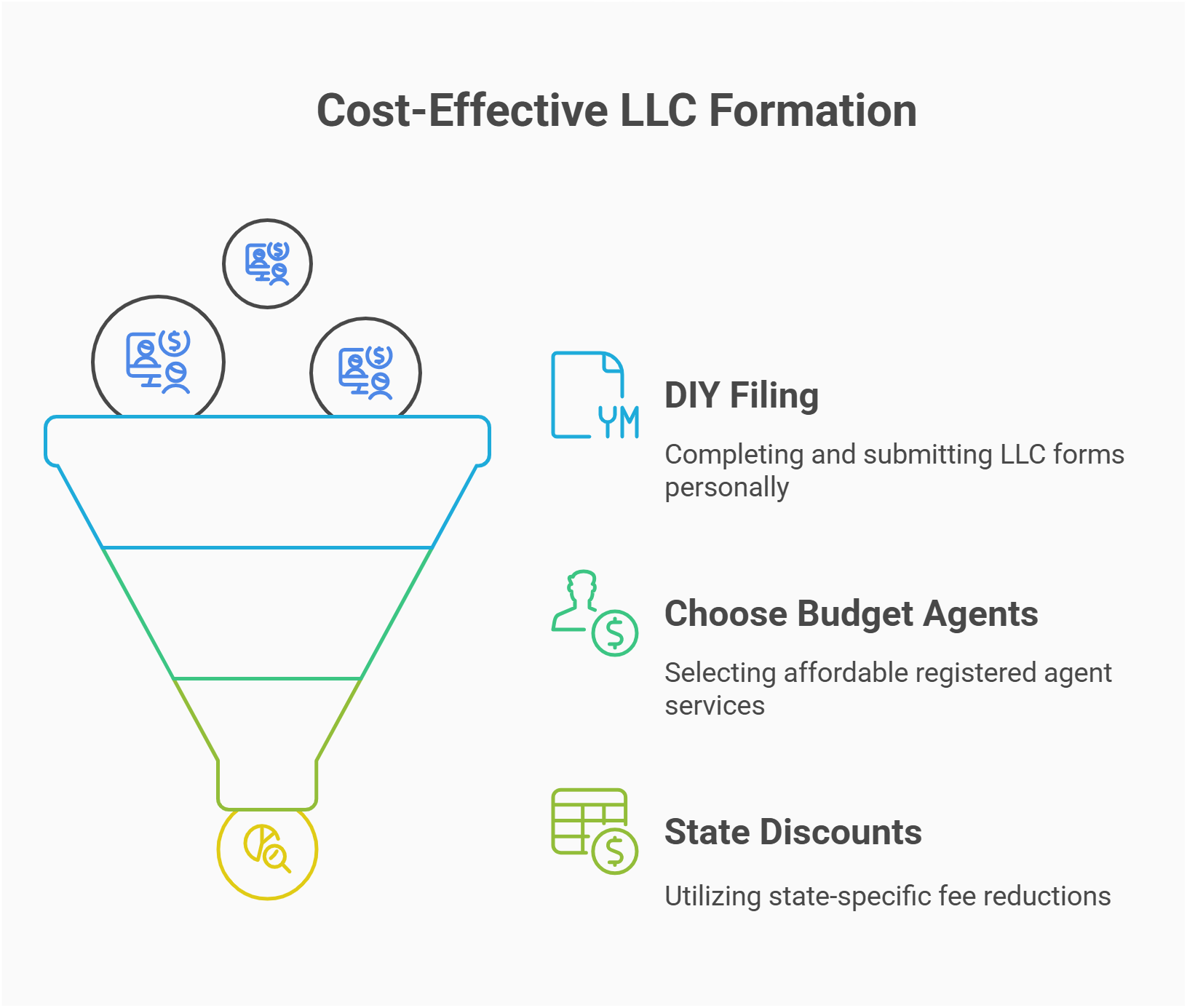
Filing Your LLC Yourself: Steps and Potential Savings
By skipping a middleman, you handle the process to start your business personally:
- Gather and complete your articles of organization from the official website
- Submit them through your state’s e-file system or mail them in
- Pay the standard state filing fees directly—no markup
- Confirm receipt from the state, finalizing your registration
- Create or sign an llc operating agreement
This self-service route typically saves you ~$50–$300 compared to some formation services. However, it might take a bit more time to research state forms. If you’re looking to minimize expenses, consider using a cheap LLC service that offers essential features without unnecessary add-ons.
Name Reservation (Optional): If you're not ready to file your full LLC formation but want to secure a business name, most states offer name reservation for $10-$75. This holds your name for 30-120 days depending on the state. Name reservation is separate from and additional to formation fees. If you're ready to form immediately, you can skip this step and the name is secured when you file your Articles of Organization.
Choosing Affordable Registered Agent Services
If you prefer not to handle official mail at your home or office, consider a cheaper agent service. Many reputable options run about $100–$125/year (e.g., $119–$125 from well-known providers), while some “$0” promos require other paid add-ons later. Prioritize fast document forwarding, clear pricing, and accurate filings to keep your LLC in good standing.
Taking Advantage of State-Specific Discounts
Some states occasionally promote new businesses with reduced state filing fee periods. For example, an LLC in Colorado could be formed for $1 during the fee-relief program starting July 1, 2022; that program ended, and Colorado now lists standard fees again (e.g., $50 to file Articles of Organization; $25 periodic report). Always check your state’s official site for current pricing before you file.
Advanced Strategies for Cost Management
For some businesses, even small cost differences can add up. Entrepreneurs operating across state lines—or seeking the most favorable tax environment—may consider more intricate tactics. This part covers multi-state LLC planning, when a foreign LLC filing is triggered, and ways to reduce burdens from franchise tax and overhead.
Forming an LLC in a Cost-Friendly State: Pros and Cons
Registering in a low-fee place, like an LLC in New Mexico or an LLC in Wyoming, can shrink initial outlays (New Mexico filing ≈ $50; Wyoming filing ≈ $100). Yet if your physical operations remain in another jurisdiction, you’ll usually need to register there as a foreign LLC, which brings its own fees and paperwork. This can still be beneficial, but weigh upfront savings against ongoing compliance in both states; many owners find the extra filings outweigh short-term breaks.
Multi-State LLC Costs: How to Optimize for Savings
Expanding beyond your home base may require separate filings, each with unique annual report or franchise tax obligations. If you plan to do business in multiple areas, consider:
- Centralizing operations in the most efficient state you can realistically operate from (staff, logistics, taxes).
- Using local contractors instead of hiring employees when appropriate, but know that employees or a physical office typically trigger foreign LLC registration. States define “doing business” differently; e.g., Texas lists activities that don’t require registration, while California treats “repeated and successive transactions” as transacting intrastate business.
- Checking revenue thresholds that drive franchise tax (e.g., Texas’s $2.65 million (2026–2027).
Clarity on these points helps you avoid surprise filings and fees.
Leveraging Tax Deductions to Offset LLC Formation Expenses
Tax Deductibility: Under IRS rules, you can deduct up to $5,000 in startup costs and $5,000 in organizational costs in your first year of business, provided total costs in each category don't exceed $50,000. Amounts exceeding these thresholds must be amortized over 180 months (15 years). Organizational costs include state filing fees, registered agent fees, and legal fees for drafting formation documents. Startup costs include market research, advertising, and training. Consult a tax professional for your specific situation.
For most LLCs taxed as partnerships, separate organizational expenses may also get a first-year $5,000 deduction (with the same phase-out) and 180-month amortization. Track every dollar — filing fees, a basic LLC operating agreement, early legal/accounting — for potential write-offs.
Special Cost Considerations for Different Business Types
Not all LLCs operate the same. If you’re in real estate, e-commerce, or freelancing, each domain has distinct cost variables. Understanding these can help tailor your budget and ensure your llc with the right strategy for your field, whether that means a tighter LLC operating agreement or smarter tax planning.
Real Estate LLCs: Unique Fees and Expenses
Real estate often calls for specialized business license requirements and robust insurance to shield personal assets. Expect:
- Additional local business license or property-use permits
- Higher landlord insurance premiums if you’re renting out properties (often ~25% more than homeowners insurance)
- Potential foreign LLC registration if you own or manage income-producing property across state lines
These add up, but many investors pay them to limit personal liability and isolate different properties via separate LLCs. In states like California, operating in-state can also trigger the $800 franchise tax even if you formed elsewhere, so factor that into multi-state plans.
E-Commerce Businesses: Costs to Start and Scale
Digital sellers might face fewer location-based rules, but you’ll likely invest in:
- E-commerce platform fees (e.g., Shopify/Amazon) and payment-processor charges
- Sales tax registrations where you have nexus (post-Wayfair economic-nexus standards)
- Marketplace rules where the platform, as a marketplace facilitator, collects/remits tax on your sales
A well-structured e-commerce LLC helps you stay organized for taxes, inventory, and expansions — start with clear records and confirm where you must collect/remit sales tax.
Freelancers and Gig Workers: Is an LLC Financially Viable?
Freelancers often begin as a sole proprietorship because it’s quick and cheap. But as your gig grows, LLC liability protection may be worth modest annual state filing/report fees. Evaluate revenue stability, your risk profile (client contracts, IP, etc.), and whether a simple registered agent service plus basic compliance keeps you protected without overspending.
Expert Insights: Is Starting an LLC Worth the Cost?
While fees can appear daunting, forming an LLC typically pays off in liability protection and tax flexibility. A few deeper considerations follow, from immediate protections to the break-even point on your LLC expenses.
Balancing the Benefits of Liability Protection Against Costs
One major perk of an LLC is protecting personal assets from business lawsuits. If your brand fails or faces claims, the corporate veil usually shields your home or savings. To preserve that shield, keep finances separate (business bank account), use an LLC operating agreement, and follow basic compliance. Weighing that peace of mind against a few hundred in fees usually leans in favor of forming an LLC.
Business Insurance: While LLC structure provides liability protection, many businesses also need insurance. General liability insurance typically costs $300-$1,500/year for small businesses. Professional liability (E&O) insurance ranges from $500-$3,000/year depending on industry. Some contracts, leases, or licenses require proof of insurance. While not an LLC formation cost per se, insurance should be part of your first-year business budget.
Tax Advantages of an LLC: Do They Justify the Expenses?
For many, an LLC is taxed via pass-through taxation, bypassing entity-level corporate income tax in most cases. Some owners elect LLC taxed as an S corporation to reduce self-employment tax by taking a reasonable salary plus distributions (file Form 2553). Though the LLC annual fee is an outlay, the right election can offset it—an accountant can confirm if the S-corp route fits your revenue and payroll realities.
ROI Analysis: How Quickly Can You Recover LLC Costs?
If you anticipate robust revenue soon after launching, the money spent on your Articles of Organization and setup can return quickly via brand credibility or contract eligibility. Many vendors prefer contracting with a formal business entity, viewing it as more professional. In some industries, that structure helps you land bigger deals that overshadow the initial startup fees, accelerating payback on your LLC costs.
Frequently Asked Questions About LLC Costs
Still wondering if a do-it-yourself approach is feasible or if each state’s fees differ drastically? Below are concise, high-impact answers to common questions about the cost to form an llc. Each is designed to pop up in Google’s featured snippet, giving you quick clarity on forming your LLC in 202.
Can I Start an LLC for Free?
In most states, there’s no entirely free route to create an LLC because a state fee is mandatory. A few states might waive or temporarily reduce filing fees, but it’s rare to have zero outlay for llc formation. You might see ads for “free” or “$0” LLC formation services, yet they usually pass along the required state filing fees plus upsell extras like an llc operating agreement or registered agent service. If the state itself doesn’t impose charges, you still have to handle potential annual report or permit expenses. So, free of formation service fees is extremely uncommon.
What Happens If I Don’t Pay Annual LLC Fees?
Failing to pay your annual fee often leads to administrative dissolution (which can trigger ongoing penalties and tax liability). This means your LLC is no longer recognized with the state—you lose liability protections, and operating under that company name can become illegal. Additionally, your business may incur late penalties, making it cost to maintain even higher when you eventually remedy the lapse. If you ignore repeated notices, your bank accounts could be frozen, and you might be forced to refile from scratch. Timely compliance ensures the LLC stays in good standing, safeguarding your personal assets and brand reputation.
Are LLC Costs Tax-Deductible?
Startup and formation expenses can typically be deducted, up to certain caps, on your federal taxes. The internal revenue service treats many LLC fees as organizational costs, which you may also write off partially in the year incurred, with the remainder amortized over time. Beyond direct cost of filing, you could potentially deduct your llc formation service charges, annual fees, or even aspects of your business license. However, all deductions must be “ordinary and necessary” for operating your small business. Confirm specifics with a tax professional or the IRS guidelines to maximize savings.
How Do Filing Fees Compare for Foreign vs Domestic LLCs?
When you form an llc in your home state, you pay domestic fees. Once you expand or do business beyond your primary location, you often register as a foreign llc in other states. Foreign LLC Registration: If you form an LLC in one state but conduct business in another, you must register as a "foreign LLC" in each additional state. Foreign registration fees are often equal to or higher than domestic formation fees - for example, California charges $70 for foreign registration plus the $800 annual franchise tax. You'll also need a registered agent in each state (additional $50-$300/year per state) and must file separate annual reports. Multi-state operations can easily double or triple your total LLC costs.
Is It Cheaper to Use an Online Service or Do It Myself?
If you’re comfortable with official forms and process to start the LLC, a DIY approach might save you $50 to $300 in service fees. All you pay is your state fees. However, mistakes during the application or compliance updates can be costly if you’re unsure about the correct procedures. Online providers, though they charge for convenience, often reduce the chance of errors and handle your formalities quickly. For owners short on time or worried about compliance intricacies, paying extra for a reliable platform or professional can be well worth the investment.
Do I need to pay the 800 LLC fee the first year?
In California, known for a mandatory $800 franchise tax, new LLCs historically have to pay this minimal tax each year they’re active. Recent legislation at times waived or delayed the llc annual fee for first-year entities, but policies shift. Check the California Franchise Tax Board’s current rules to confirm. Some owners opt to wait until near year-end to file or choose another state. Nonetheless, if you’re actively conducting business in California, you generally can’t dodge the $800 payment for every year, unless state law provides a temporary exemption.
Why are LLC so expensive?
LLC costs can feel high due to state filing fees, recurring charges like annual report or franchise tax, and the optional services that many owners buy—like a professional agent or advanced formation packages. States impose these fees to fund administrative overhead and ensure compliance. For example, the cost to form an llc in some states is steep because local governments rely on registration income. Additionally, specialized licenses or city-level taxes can stack up. While forming an LLC isn’t always cheap, its liability protections and potential tax benefits often justify the investment.
- California: Verify the $800 franchise tax and fee tiers on the Franchise Tax Board website
- Delaware: Check current LLC fees and the $400 annual tax through the Division of Corporations
- New York: Review the publication requirement and formation process on the Department of State site
- New York: Confirm the $9 biennial statement fee for ongoing compliance
- Texas: Find LLC filing fees and requirements from the Secretary of State
- Texas: Verify the $2.65M no-tax-due threshold with the Comptroller's office
- Wyoming: See current business filing fees on the Secretary of State portal
- Florida: Review LLC formation and annual report fees through Sunbiz
- Nevada: Understand the $150 annual list + $200 license requirement in the Nevada Revised Statutes
- IRS: Apply for your EIN online for free - skip third-party services
- IRS: Review startup cost deduction rules in Publication 535
- FinCEN: Check the BOI small entity compliance guide to confirm U.S.-formed LLCs are now exempt
Navigate LLC Costs Easily
Harbor Compliance provides tailored solutions to manage your LLC expenses and maintain compliance. Start your business with confidence.