

Anyone working out how to start an LLC in Kentucky runs into the same number first: $40, the filing fee the Secretary of State charges as of 2026.
That part is genuinely cheap. What the filing page won’t mention is the second filing Kentucky wants at the county level. Or the $175 tax that lands whether your LLC earns anything or not.
Starting a Kentucky LLC: the $40 filing and the two bills that follow
You form a Kentucky LLC by filing Articles of Organization (Form KLC) with the Kentucky Secretary of State for $40, then recording a copy with the county clerk where your registered office sits. After that, a $15 annual report is due between January 1 and June 30 each year, and the LLET minimum is $175.
- Who this is for: anyone handling a new Kentucky LLC registration from scratch. An LLC that already exists in another state files something else, the Application for Certificate of Authority for a Foreign Business Entity, at $90.
- Where to file: Office of the Kentucky Secretary of State, Division of Business Filings, Frankfort. File online through the FastTrack Online Filings Index. Phone: 502-564-3490.
Kentucky LLC vs sole proprietorship vs corporation: who pays the LLET
The Limited Liability Entity Tax reaches business entities that Kentucky law protects from liability, and that rule drives the entity math here. An LLC has that protection, so it owes the tax. So does a corporation. A sole proprietorship has no shield to tax, which is the practical difference.
For most Kentucky owners the trade is an easy one. $175 a year is what separates a business debt from your house, and the sole proprietorship that saves you the $175 draws no such line.
One piece of vocabulary worth fixing: there’s no such thing as a Kentucky limited liability corporation. The Secretary of State registers limited liability companies, and Form KLC uses the company wording throughout.
Kentucky LLC requirements: what Form KLC asks for and what it costs
Kentucky’s formation document is short. The Kentucky LLC requirements fit on a single page: four pieces of information and one payment, on the Articles of Organization the Secretary of State codes as Form KLC.
| What Form KLC asks for | The Kentucky rule | Cost |
|---|---|---|
| LLC name | Ends in limited liability company, limited company, LLC or LC; distinguishable from every name on the Secretary of State’s record | $0, or $15 to reserve for 120 days |
| Registered agent and registered office | A Kentucky street address, no PO boxes, plus the agent’s written consent | $0 if you serve yourself |
| Principal office mailing address | May sit inside or outside Kentucky | $0 |
| Member-managed or manager-managed | Stated on the form at the time you file | $0 |
| Filing fee | Paid to the Secretary of State with the Articles | $40 |
The fee schedule lists no expedited option for LLC formation, so there’s no premium tier to weigh and no way to buy a place at the front of the queue. Veteran-owned businesses are the one exception to the $40 itself. The KLC instructions waive the fee, and it isn’t a technicality; KRS 14A.2-165 puts that exemption in statute.
How to start an LLC in Kentucky: 8 steps from the name search to the LLET
Kentucky LLC formation runs through two state offices, plus one county courthouse. The Secretary of State handles the filing, the county clerk records it, and the Department of Revenue handles everything that comes after.
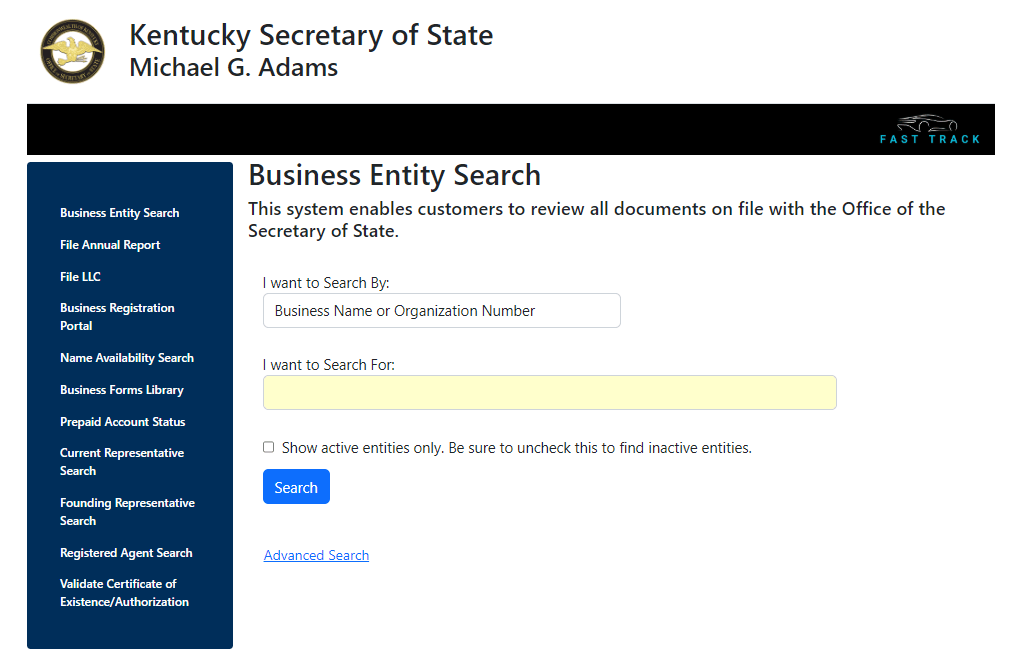
Step 1: Search the name on the Kentucky Business Entity Search
Kentucky wants your name to end in one of four things: limited liability company, limited company, LLC or LC. Abbreviate the middle one and the state’s own form tells you to write it LTD CO, which is the sort of detail that sends a filing back.
Run the name through the Kentucky business entity search before you commit to signage or a domain. The Secretary of State’s system includes a Name Availability Search, and the test is whether your name is distinguishable from what’s already on record. Our Kentucky entity search walkthrough covers what that means in practice.
Not ready to file yet? The Reservation or Renewal of Reserved Name form, coded RES, holds a name for 120 days for $15.
Licensed professionals take a different form. A professional LLC files the Professional Service version of the Articles, and the name has to carry PLLC, PLC, professional limited liability company or professional limited company.
Step 2: Name a Kentucky registered agent with a real street address
Every Kentucky LLC keeps a registered office in the state and a registered agent at that address, under KRS Chapter 14A. The address has to be a street address. The KLC form puts it in capitals: no post office box numbers.
Your Kentucky registered agent can be you, if you live here, or a Kentucky business, or an out-of-state company authorized to operate in Kentucky. Whoever it is has to consent in writing, either by signing the Articles or by attaching a signed consent to them.
Here’s what people underestimate. That registered office address goes on the public entity record, so a home-based owner is publishing a home address. That, more than the mail handling, is what a commercial registered agent service is actually selling. We compare the Kentucky agent options and what they charge if the address matters to you.
Step 3: File Form KLC with the Secretary of State for $40
This is the filing that creates the company. The Articles of Organization go to the Division of Business Filings, either through the FastTrack screen called Form a New Limited Liability Company or by mail to Frankfort.
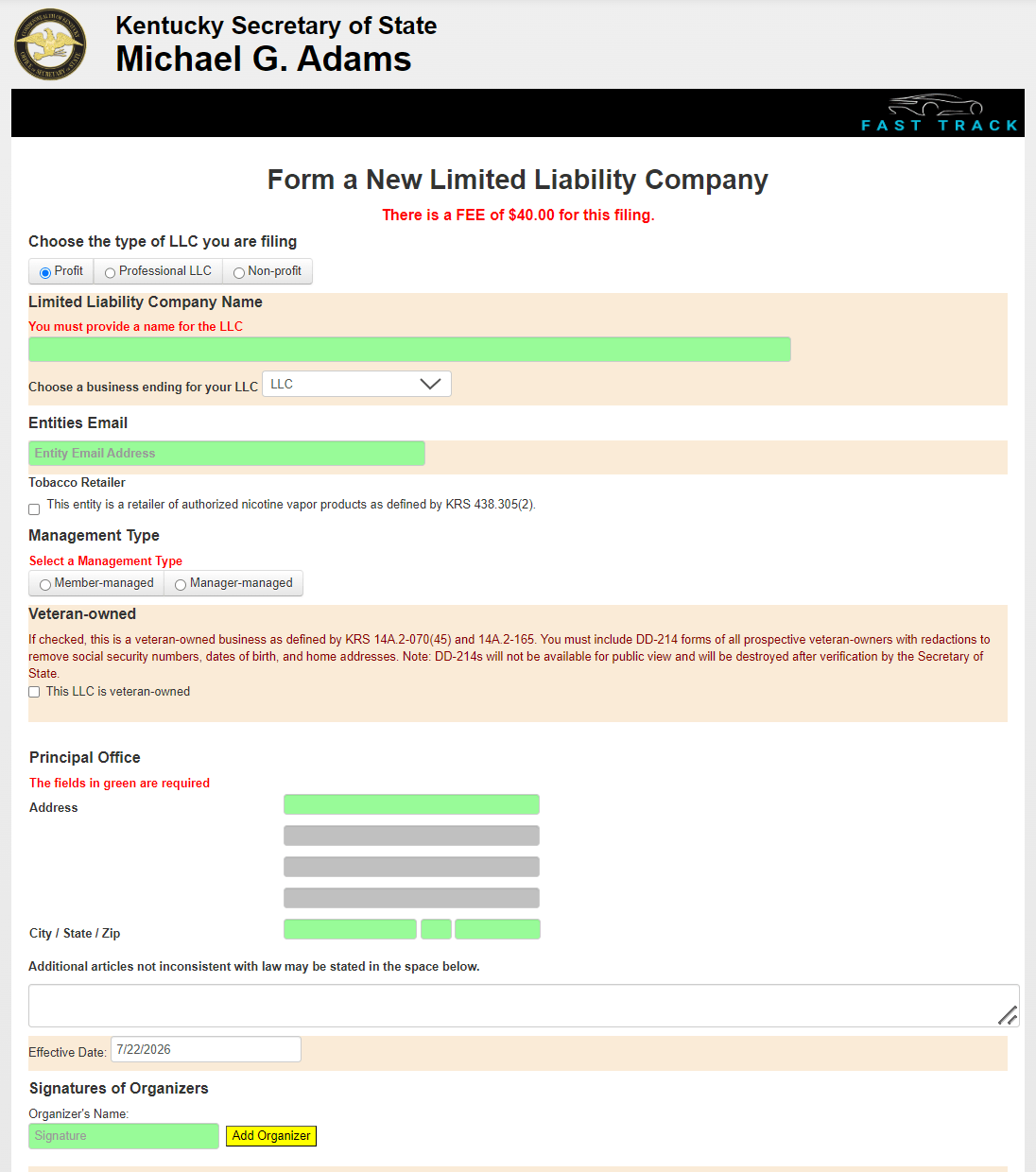
Filing your Kentucky LLC online costs the same $40 as mailing it, and the state’s own FastTrack LLC formation page is where that happens. No formation service gets a different price than you do. The company exists at the date and time the filing is accepted, unless you write a later effective date on the form.
How long approval takes is the question we get most, and the Secretary of State’s filing pages don’t put a number on it. Anyone quoting you an exact turnaround is working from their own averages; what actually drives your Kentucky timeline is a separate piece.
Step 4: Record a copy with your county clerk
KRS 14A.2-040 requires an exact or conformed copy of your Articles of Organization to be filed with the county clerk of the county where your registered office sits. The verb the statute uses is shall. Most Kentucky formation guides leave the step out altogether.
The Secretary of State’s own form points you there: once the filing is accepted, print a copy from sos.ky.gov and take it to the county courthouse. The clerk charges a recording fee set by KRS 64.012, so call the recording department for the current amount before you drive over.
One relief in the same statute: annual reports don’t go to the county clerk. Only the formation documents and later changes to them do.
The county clerk copy is the most-skipped step I see in Kentucky, and I have never once seen a formation ad mention it. Filers finish on FastTrack, receive their stamped Articles, and assume that is the end of the process. Then, two years later, a lender or title company looks for the county record and finds nothing.
I recommend printing the accepted Articles during the week you form the LLC and taking them to the courthouse in the county where the registered office is located. It is a twenty-minute errand that can prevent an awkward phone call years later.Step 5: Put a Kentucky operating agreement in writing
Kentucky doesn’t require one, and it isn’t part of what you file. What KRS Chapter 275 does instead is more useful: section 275.003 gives a written operating agreement contractual force over how members, managers and the company deal with each other.
Skip it in a single-member LLC and the statute’s defaults become your rules. Skip it in a two-member LLC and you’ve handed a statute the profit split, the exit terms and the deadlock question. Our Kentucky operating agreement guide covers the clauses worth arguing over now rather than later.
Step 6: Get your EIN after the LLC exists
Order matters here. Form the LLC first, then apply to the IRS for the EIN, because the name on the application has to match the name the Secretary of State has on file.
Do it backwards and the fix goes through the IRS, not the Secretary of State. Our guide to applying for an LLC EIN walks through the application itself.
Step 7: Register with the Department of Revenue through the One Stop Business Portal
Formation and taxes run through different Kentucky systems, and this is where the $40 stops being the whole story.
Registering with the Secretary of State is enough, on its own, for the Kentucky Department of Revenue to treat a company as doing business in Kentucky. In most cases that means a Kentucky return for the year you register. Revenue does carve out entities that registered against possible Kentucky business and had no activity at all, though it can ask you to confirm that in writing. The Kentucky One Stop Business Portal handles the tax-side registration; FastTrack only forms the entity.
Nothing in the $40 covers business licenses or permits. Those are a separate question, and the answer depends on what you do and where you do it.
Step 8: Open the bank account and keep the LLC in good standing
Most banks ask for three documents: the filed Articles, the IRS EIN letter and, for multi-member LLCs, the operating agreement. Gather all three before the appointment.
Good standing in Kentucky has to be kept up, filing by filing. The June 30 annual report and the LLET are what hold it, and both are covered next.
Form the LLC with a Kentucky registered office already in place.
Northwest can file the Articles of Organization and provide the Kentucky street address needed for your registered office. You will still need to record the accepted Articles with the appropriate county clerk.
How much is an LLC in Kentucky? $40 to file, about $190 a year after that
The Kentucky LLC cost to open the doors is $40, paid once to the Secretary of State, plus the county clerk’s recording fee. That’s the formation bill for a standard domestic LLC filed by its own owner.
From the second year, budget around $190: the $15 annual report plus the $175 minimum LLET, assuming gross receipts stay under $3 million. A paid registered agent is the only other line most owners hit, and it’s optional. The full Kentucky cost breakdown prices out the rest.
Kentucky LLC annual fees: the June 30 report and the $175 LLET minimum
Two obligations recur, and they go to two different Kentucky agencies. Kentucky LLC annual fees are small; missing them is what gets expensive.
The Secretary of State takes the annual report. The window opens January 1 and closes June 30, the fee is $15, and your first one isn’t due until the year after you organize. Form in November and your first report is due the following June.
Miss June 30 and the Secretary of State lists the entity as inactive; domestic LLCs are then administratively dissolved. The state’s annual report page sets out the window, and our June 30 filing walkthrough covers what the form asks you to confirm.
The Department of Revenue takes the LLET. Because the tax attaches to entities with liability protection rather than to profit, the minimum still applies in a year with no revenue. What you owe above that depends on size.
| Total gross receipts or gross profits | What the LLET costs |
|---|---|
| $3 million or less | The $175 minimum |
| Between $3 million and $6 million | A sliding-scale calculation |
| Above $6 million | The lesser of 0.095% of Kentucky gross receipts or 0.75% of Kentucky gross profits |
Which return you file depends on your member count. A single-member LLC owned by an individual files Form 725; two or more members file Form PTE. Both carry the LLET, and both are due on the 15th day of the fourth month after your tax year ends. The Department of Revenue’s LLET page holds the current figures.
Worth flagging what Kentucky doesn’t ask for: newspaper publication. New York and Arizona owners pay for legal notices before their LLC is fully settled, and Kentucky has no equivalent step at formation.
The LLET is the Kentucky fact I end up explaining most often, and the conversation almost always happens in April, which is the worst month to hear about an unexpected obligation.
The amount is not a penalty, and it is not determined by whether the business had a good year.
Where Kentucky LLC owners go wrong: PO boxes, the county clerk, and June 30
Kentucky filings come back for a short list of reasons. Boost Suite’s editorial team sees the registered-office line trip up more Kentucky filers than anything else on Form KLC.
- A PO box in the registered office field: Kentucky wants a street address, and the form says so in capitals.
- Skipping the county clerk copy: the Secretary of State accepts the filing without it, so nothing tells you it’s missing.
- Treating $40 as the annual cost: the filing fee happens once. The recurring pair is $15 and $175.
- Missing June 30: a six-month filing window is exactly why it gets forgotten in month five.
- Assuming no revenue means no filing: the LLET minimum applies at zero income, and Revenue generally expects a return for the year you register.
- Paying $300 for a $40 filing: the state’s price doesn’t change based on who types it. Our Kentucky formation service comparison shows what those packages actually include.
June 30 is the date I would put on every Kentucky owner’s wall. I once had a client discover that his LLC had been administratively dissolved when a lender pulled the Secretary of State record in the middle of an application, all because of a missed $15 report.
Kentucky LLC questions: the fee, the FastTrack filing, and the LLET
These come up on nearly every Kentucky formation call. Figures below are current as of 2026 and come from the Secretary of State and the Department of Revenue.
How much does it cost to start an LLC in Kentucky?
$40 to the Secretary of State, once, plus the county clerk’s recording fee. Nothing else is required to form the company. From the year after formation you add $15 for the annual report, and the $175 LLET applies from the year you register.
Can I start an LLC in Kentucky for free?
No. Kentucky charges $40 for the Articles of Organization, and the state keeps that money, so no formation service can waive it for you. A free LLC in Kentucky does exist in one case: veteran-owned businesses are exempt from the filing fee under KRS 14A.2-165. Everyone else pays $40.
Can I file my Kentucky LLC online with the Secretary of State?
Yes. FastTrack’s Form a New Limited Liability Company screen takes the Articles and the $40 together, and it’s the state’s own system rather than a reseller. Mail filings to the Division of Business Filings in Frankfort still work. Either route, the county clerk copy comes afterward.
How long does it take to get an LLC in Kentucky?
The Secretary of State’s filing and fee pages give no processing-time commitment and list no expedited option, so any exact figure you’ve been quoted is somebody’s average. What the state does put in writing is the effective date: your LLC exists at the date and time the filing is accepted, unless you specify a later one.
Does every Kentucky LLC pay the $175 LLET?
The LLET applies to entities that Kentucky law protects from liability, which describes every LLC. At $3 million or less in gross receipts or gross profits, that means the $175 minimum, profitable year or not. Above $3 million the sliding scale takes over, and above $6 million it becomes a percentage calculation.
Do I need an operating agreement for a Kentucky LLC?
Not to form one. Kentucky doesn’t require it, and it isn’t part of what you file. Skipping it is still a poor trade: KRS 275.003 gives a written agreement contractual force, and without one the statute decides questions you’d rather decide yourself.
Can my Kentucky LLC be taxed as an S corp?
Yes, and it changes nothing at the state counter. The S election is a federal classification you make with the IRS; the entity you formed in Kentucky is still an LLC. The Articles, the county clerk copy, the June 30 annual report and the LLET all still apply.
Should I file my Kentucky LLC in December or wait until January?
January, usually. Two Kentucky rules collide at year end. Your first annual report isn’t due until June 30 of the year after you organize. But Revenue treats registration with the Secretary of State as doing business in Kentucky for that year. File on December 20 and you’ve bought eleven days of existence plus a Kentucky return covering that year. Form KLC lets you name a delayed effective date, so a December filer can lock the name now, set January 1, and start the tax clock clean.
- KRS 14A.2-040, Filing of documents by county clerk
- Fees, Kentucky Secretary of State
- Form a New Limited Liability Company, Kentucky Secretary of State FastTrack
- Articles of Organization, Profit Limited Liability Company (Form KLC)
- Kentucky Business Entity Search
- Annual Reports, Kentucky Secretary of State
- Corporation Income and Limited Liability Entity Tax, Kentucky Department of Revenue
Looking for an overview? See Kentucky LLC Services
Start Your Kentucky LLC with ZenBusiness in 2026
ZenBusiness helps you navigate each step of forming a Kentucky LLC, from preparing your formation documents to supporting ongoing compliance.