

A registered agent (RA) address is perfect for receiving lawsuits and official state notices, but it isn’t a universal business address. Most agencies treat “registered office,” “principal/physical address,” and “mailing address” as different fields with different purposes. Use the RA address only where rules call for service of process; use your real operating location for IRS, banking, most licenses, and Google. Mixing these up leads to rejections, delays, or unwanted public exposure.
Registered Agent Address vs Physical & Mailing Address: What’s the Difference?
Before you fill out any form, identify which “address” the form is actually asking for. These three look similar, but they serve different purposes and are treated differently by agencies.
- Registered office address:
The in-state street address of your registered agent where service of process and state notices are delivered during business hours. It exists to receive legal documents reliably and “may, but need not be,” a place where the company actually does business. - Physical address (a/k/a principal place of business / principal office):
The real street location where you primarily operate. The Internal Revenue Service (IRS) treats this separately from your mailing address on Form SS-4 and expects a real street address for the principal location (not a P.O. Box). - Mailing address:
Where you want mail delivered. It can differ from your physical location, but some platforms (e.g., Google Business Profile) won’t accept a PO Box or remote mailbox as your business “location.”
Quick comparison:
| Address type | Purpose | Who asks for it | Must be in-state? | Public on state site? | Accepts PO Box? |
|---|---|---|---|---|---|
| Registered office address | Accept service of process & official notices | Secretary of State at formation/registration | Yes (for that state) | Often yes (agent address appears in public records) | No, statutes expect a street registered office in-state. |
| Physical address | Identify the principal operating location | IRS, banks, many licensing bodies | No | Varies by state (often public) | No, IRS requires a real street address for the principal/physical field. |
| Mailing address | Receive mail reliably | IRS (separate from physical), vendors, some licenses | No | Sometimes | Yes for mail delivery; but not accepted as a business “location” by Google. |
Why This Matters for Compliance and Privacy
Using the wrong address in the wrong field can cause real problems. Here’s how it plays out and where the rules come from:
- Public exposure vs. privacy.
States publish your agent’s listing; in California, the agent for service of process is searchable via the Secretary of State’s portal. If you don’t want home details public, don’t confuse principal office with the registered office address. - IRS precision.
EIN applications require a true physical address for the principal location and provide a separate line for the mailing address; the instructions warn not to use a PO Box for the physical field. - Platform eligibility.
Google Business Profile requires a precise address (or service-area rules) and states that P.O. boxes or remote mailboxes aren’t acceptable as your business location. Listing a mailbox can lead to suspensions. - Mailbox ≠ legal location.
USPS’s Premium PO Box “street addressing” makes deliveries easier, but the Customer Agreement says you may not use that street-style address as your physical residence or place of business in legal documents.
Use Northwest’s Registered Agent address for your business
Northwest gives you a real business address through their Registered Agent service, ideal for privacy and compliance.
When You Can Use a Registered Agent Address
You can use your registered agent address any time a filing asks for the registered office address or the location designated to receive service of process. That address exists so courts and agencies can reliably deliver legal documents during business hours; it isn’t a universal substitute for your principal physical address.
Use your agent’s address in these cases (and why it’s correct):
- State formation or foreign registration.
If the form requests “registered office” or “agent for service of process,” list your agent’s in-state street address. Delaware’s LLC statute, for example, requires a registered office in Delaware and notes it “may, but need not be” a place of business, confirming it’s a service address (6 Del. C. §18-104). - Annual reports or change-of-agent filings.
When you update the registered office address or switch registered agents, states expect a real, in-state street address (not a P.O. Box). Florida’s Sunbiz instructions explicitly require a physical street address for the registered agent. - Court and state service.
Lawsuits and statutory notices are directed to the registered office address by design. Your agent keeps business-hours availability there so legal documents are accepted without delay.
When You Shouldn’t Use the Registered Agent Address
Your registered office address is perfect for service of process, but it’s the wrong choice in several high-stakes contexts. The common thread: these uses require your actual physical address (or a clearly permitted mailing address) that identifies where you operate, not where registered agents accept legal documents.
Use your own address (not the agent’s) in the situations below, each one is grounded in current, authoritative rules:
- EIN / IRS principal location (Form SS-4).
Form SS-4 separates mailing (Line 4) from the street/physical address (Line 5). In the Instructions for Form SS-4 (Rev. Dec. 2025), the IRS warns: “Don’t enter a P.O. box” for the street/physical field. Line 6 then asks for the county and state where your principal business is located. This is meant to identify where you actually operate, not where your registered agent accepts legal documents. - Bank account onboarding: CIP / Know Your Customer (KYC).
U.S. banks must follow the Customer Identification Program rule (31 CFR §1020.220) and FFIEC guidance, which require obtaining and verifying a customer’s physical residential or business physical address or other physical location (risk-based verification). An RA address generally won’t satisfy the customer’s physical address requirement for opening accounts. - Business licenses & permits.
Requirements vary by jurisdiction, but agencies commonly ask for the business location where regulated activity occurs. Current guidance from the Small Business Administration (SBA) emphasizes that licensing depends on your location and business activities. Practically, that means a real operating address is often required; an RA address is rarely accepted as the licensed premises. - Google Business Profile (GBP).
Google requires a precise address for storefronts or service-area rules for field-only businesses. P.O. boxes or mailboxes at remote locations aren’t acceptable as a business location. Listing an RA or mailbox as your location risks suspension. - Principal office fields that forbid P.O. Boxes.
Some states explicitly block P.O. Boxes in the principal office line and expect a street address (e.g., Florida Sunbiz). That field identifies your business address, not the registered office address. - Treating a mailbox as your “place of business.”
USPS’s Premium PO Box “Street Addressing” helps with package delivery but cannot be used as your physical residence or place of business in legal documents. It doesn’t convert a mailbox into a principal place of business.
Common Pitfalls That Trigger Rejections
Before you submit anything, scan for these easy-to-miss issues. Each can trigger rejections, delays, or visibility loss.
- Record mismatches across agencies
Listing your registered agent service for the state filing but a different mailing address at the IRS, and another address at the bank, creates inconsistent records. At minimum it slows verification (CIP); at worst, you miss important notices. - Public exposure you didn’t intend
In states like California, the agent’s name and physical address are public; confusing “principal office” with registered office address can put the wrong address in public search. - Local SEO suspensions
Using a mailbox/virtual office as your Google location violates policy and can suspend your profile, even if mail is deliverable there. Stick to a staffed, real location or use service-area rules. - PO Box “street addressing” misunderstandings
A street-styled PO Box is still a PO Box for legal/banking purposes; USPS forbids treating it as a real place of business in legal docs. - Assuming “agent address = OK everywhere.”
Statutes like Wyoming’s require the registered office to be a street address in-state for service of process. It is useful, but not a substitute for your operating location on other filings.
Alternatives If You Don’t Want to Use Your Home Address
You don’t have to put your residence on public or banking records. Below are compliant, real-world alternatives, and exactly what each one can (and cannot) do for your business address, mailing address, and registered office address.
Commercial Virtual Office (Leased Suite with On-Site Access)
A true virtual office that provides a lease or license, staffed reception during business hours, and the ability to meet clients can often serve as your operating (physical) location for everyday use. Banks still must verify a real street address under the Customer Identification Program (CIP), so keep your lease and proof of access handy; regulators expect banks to form a “reasonable belief” they know your true location. For licenses that are tied to a premises, make sure your activities are permitted at that site.
Coworking Space with Mail Handling
If you regularly work from a coworking location and receive mail there, it can function as your principal operating site. As with virtual offices, banks will verify a physical street address (not a mailbox), and licensing agencies care about where regulated activity occurs. Confirm the space allows your specific use (e.g., retail vs. office).
Virtual Mailbox / CMRA – for Your Mailing Address
Commercial Mail Receiving Agencies (CMRAs) are excellent for privacy and reliable delivery. You’ll complete PS Form 1583 and provide ID, and the CMRA will handle forwarding. Use this as your mailing address, not as your physical address for IRS or banking. U.S. Postal Service rules govern CMRAs and do not convert them into your place of business.
PO Box & USPS “Street Addressing” – Delivery Convenience Only
A PO Box is great for mail security. USPS also offers “Street Addressing” so private carriers can deliver to the box using a street-style line. However, USPS’s own Customer Agreement says you may not use that street-style line as your physical residence or place of business in legal documents, it’s for delivery only. Google Business Profile also rejects PO Boxes and remote mailboxes as a business location.
An LLC can use a PO box, but only where a form asks for a mailing address. Florida’s Articles of Organization show the split: under Fla. Stat. § 605.0201(2), the articles list a street address and a mailing address for the principal office, plus a Florida street address for the registered agent. Florida’s articles of organization form (CR2E047) bans P.O. boxes only in Article III, the registered agent’s Florida street address.
Keep (or Add) a Registered Agent Service – for the Registered Office Address Only
A commercial registered agent gives you an in-state registered office address dedicated to service of process and official state notices. It’s the correct address for formation, foreign registration, and agent-related filings. It does not replace your IRS principal physical address (Form SS-4 tells you “Don’t enter a P.O. box” for the street/physical field) or the physical address banks must verify under CIP. If you’re new to the concept, this primer on the registered agent meaning in LLC compliance explains why states require one. And if you’re ready to compare options, here’s a guide to the best registered agent services for LLCs, covering cost, privacy features, and compliance guarantees.
Protect your privacy with a Registered Agent from ZenBusiness
ZenBusiness provides a reliable Registered Agent address so you don’t have to use your home or office as your public business address.
State-Level Nuances (Quick Guide)
State laws are broadly similar, but wording and emphasis differ. Use this quick guide to understand what regulators actually require for the registered office address and how public the listing is in each example below.
- Delaware (DE):
Must maintain a registered office in Delaware; it “may, but need not be” a place of business. Statute also clarifies that “registered office” means the address of the registered agent that accepts service of process. - California (CA):
- You must designate an agent for service of process; the agent’s name and address are publicly available via bizfile Online (state search portal). Expect that listing to be visible.
- Florida (FL):
The registered agent must have a physical street address in Florida; “Do not list a P.O. Box.” Sunbiz repeats this in formation/annual instructions. - Wyoming (WY):
The registered office must be at a street address in Wyoming and a physical location where the agent (or a person tied to the agent) can accept service of process during business hours. - Illinois (IL):
Each Limited Liability Company (LLC) must continuously maintain a registered agent and registered office in Illinois, and the registered office must be an Illinois street address (a P.O. Box alone is not acceptable). - Georgia (GA):
The agent’s address must be a street address in Georgia where the agent can be personally located; a P.O. box or “mail drop” may not be used.
Use your registered office address for state filings tied to service of process; keep your physical address for principal/operating-location fields. When in doubt, the state’s own guidance and statutes above control.
How to Update or Fix Addresses Later
Address clean-up is mostly a synchronization exercise: decide which address plays which role, then push that change everywhere that matters (state, IRS, bank, licenses, and Google), so your records match.
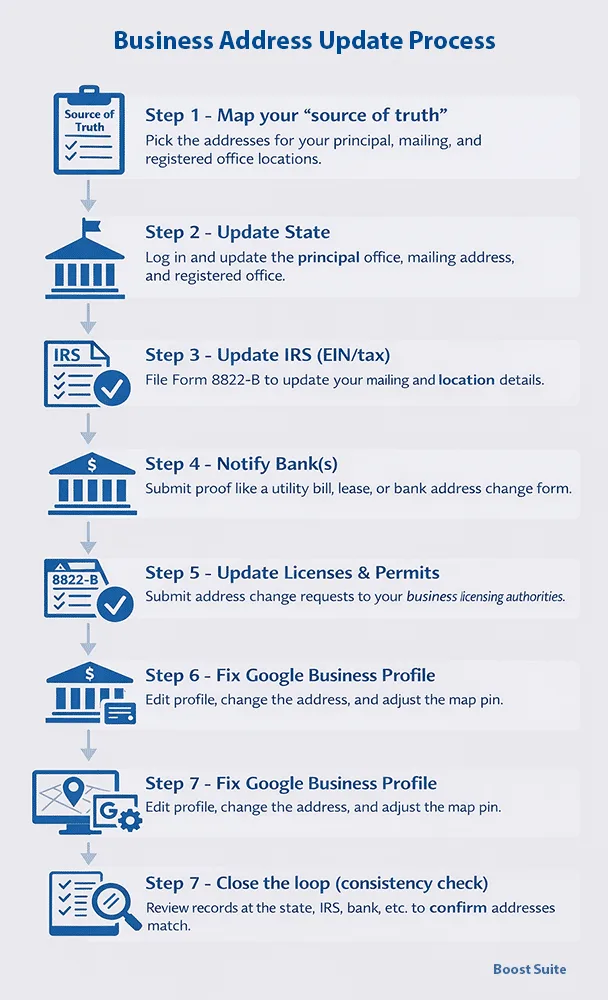
Step 1 – Map your “source of truth.”
Pick the address you’ll use as your physical address (principal operating location), your mailing address, and your registered office address (via a registered agent service). Write these down, you’ll reuse them consistently.
Step 2 – Update the state first (entity record).
Most states let you update the principal office/mailing address online and file changes to the agent/registered office by form.
- Florida (Sunbiz): Online update for principal office or mailing address; P.O. Box is acceptable for the mailing address field. Agent/registered office changes require the appropriate form and fee.
- Delaware: Changing your registered agent or registered office address requires a dedicated “Change of Agent” filing with the Division of Corporations (forms provided by the state).
- California: Use a Statement of Information to report address changes; the Secretary of State advises filing an updated statement when information changes between regular filing windows.
- Wyoming: Use the state’s Registered Agent Information Update (or Appointment of New Registered Agent and Office) and pay the listed fee.
Step 3 – Update the IRS (EIN/tax).
For businesses with an EIN, file Form 8822-B to change your business mailing address or your business location (principal place of business). IRS guidance also lists alternative methods (e.g., letter) if appropriate. Remember: responsible party changes must be reported within 60 days.
Step 4 – Notify your bank(s).
Banks are required to maintain accurate customer records under the Customer Identification Program (CIP). Be ready to provide proof of your physical address (e.g., lease or utility) when you change it; institutions test against FFIEC/FinCEN standards.
Step 5 – Update licenses & permits.
Local/state licensing often ties the license to the physical business location. Check your issuing agency’s portal and submit the address amendment or reissue request (requirements vary; SBA emphasizes location-based licensing rules).
Step 6 – Fix Google Business Profile.
Edit your Business Profile and update the location; Google’s help center details how to change the address and adjust the map pin. (PO Boxes/remote mailboxes aren’t valid as locations.)
Step 7 – Close the loop (consistency check).
Re-read your state record, IRS notice of change, bank profile, license certificates, website footer, and invoices to confirm the same business address appears in the right places. And that your mailing address and registered office address are only used for their proper roles.
Pro tip:
Put a 15-minute, quarterly reminder on your calendar to review state records and your annual report draft. It’s easier to maintain a registered agent, principal office, and mailing address correctly than to clean up misaligned data later.
Conclusion
You absolutely can use a registered agent and their registered office address to handle service of process and state notices. But for everything else that identifies where you actually operate (IRS EIN records, banking, most licenses, and Google listings), plan on providing a real physical address and use a mailing address where appropriate.
If you remember just three rules, you’ll stay compliant and protect your privacy:
- Right role, right address
Agent address for service of process; your street address for “principal place of business”; a CMRA/PO Box for mailing address only (when allowed). - Keep records in sync
Update the state, then the IRS (Form 8822-B), then banks, licenses, and Google. So every system shows the same business address. - Review annually
Use your annual report prep as a quick audit to catch changes early and avoid mismatched filings, delayed mail, or verification hiccups.
Follow that framework and you’ll balance privacy with clean, verifiable records (no surprises when a regulator, bank, or customer checks your address). And if you’re just setting up your business structure, our step-by-step LLC formation guide walks you through formation, address requirements, and compliance so you start on the right foot.
Frequently Asked Questions about Business Address
A registered agent is your official point of contact with the state, while your business address is where you actually operate and your mailing address is where you receive mail. The FAQs below give quick answers first, then a short explanation so you can choose the right address with confidence.
Is a registered agent address public?
Usually yes. States publish the agent’s name and registered office address in business lookups (see any state’s business entity search for examples), so courts can serve legal documents reliably. Expect that listing to be searchable (e.g., California’s bizfile shows the agent for service of process). This transparency supports due process but may reduce privacy. Use a commercial agent if you don’t want your home listed.
Can I use a registered agent address for my EIN application?
Often no for the principal/physical location; sometimes acceptable as your mailing address. The IRS separates the physical/principal location from mailing on Form SS-4 and warns, “Don’t enter a P.O. box” in the street/physical field. Use a real operating address for Line 5 (physical), and put the agent or mailbox (if desired) on the mailing line.
For more context, see this detailed guide on using a registered agent address for an EIN application, which explains exactly where the IRS permits it and where it doesn’t.
Can my registered agent be the owner of my LLC?
Yes, if they meet the state rules: an in-state street address and availability during business hours to accept service of process. Many owners appoint themselves when they live in the state; others hire a commercial provider for privacy and continuity. Check the exact terms where you file (some states use “resident agent” or “statutory agent,” same function). If you’re weighing that choice, this guide on acting as your own registered agent explains the pros, cons, and compliance risks of handling the role yourself.
Does my LLC need a principal office?
In many states, yes. The filing asks for a principal office or principal place of business. That location can be a home office, leased office, or coworking you actually use. It’s separate from the registered office address, which exists solely for service of process and official notices from the state.
Can I use my home address for my LLC?
Yes in most states. It’s common for small firms and freelancers. Consider privacy (it may appear on public databases) and local zoning/lease restrictions. If you want to keep your residence private, use a commercial registered agent for the registered office address and consider a compliant office or coworking for your public business address. And when you’re preparing filings, it helps to look at examples of compliant LLC names to understand how other companies balance creativity with state rules.
Can I use a PO Box or UPS Store as my LLC address?
Usually only for mailing address purposes. A mailbox (CMRA or PO Box) doesn’t satisfy the “principal/physical location” for IRS or banks, and Google won’t accept mailboxes as a business “location.” USPS’s “street addressing” helps delivery but doesn’t convert a mailbox into your physical address for legal or banking.
Does the registered agent have to be in the same state?
Yes, one agent per state of registration, at an in-state street address, available during business hours. This ensures someone local can accept lawsuits and statutory notices. If you operate in multiple states (foreign qualification), you’ll appoint an agent in each state where you’re registered to do business.
Can I list the same address for registered agent and business address?
Only if forms permit and the address truly serves both roles. Most companies keep them separate: the agent’s registered office address for service of process, and a distinct physical address for the principal place of business. Mixing roles can cause rejections or mismatched records across state, IRS, banks, and licenses.
Will a virtual address work as my legal business address?
Sometimes, as a mailing address or, if it’s a true office with on-site access and a lease, as your operating site. Banks still must verify a real physical address under CIP rules, and many licenses require a staffed, compliant premises. Vet the provider carefully and keep proof of use (lease, access terms).
How do I change my registered agent or principal office?
File the state’s amendment/statement (or dedicated Change of Agent form), then update the IRS with Form 8822-B, plus banks, licenses, and Google so everything matches. For example, Florida’s Sunbiz supports online address updates and specific agent-change filings with a fee. Consistency prevents verification delays and missed mail.
- Internal Revenue Service (IRS): Instructions for Form SS-4 (“Don’t enter a P.O. box”)
- Internal Revenue Service (IRS): Form SS-4 (Rev. Dec. 2025) (PDF)
- FFIEC: BSA/AML Examination Manual (CIP overview)
- U.S. Postal Service: Commercial Mail Receiving Agency – PS Form 1583
- U.S. Postal Service: Premium PO Box Service Agreement (PDF)
- U.S. Postal Service – PostalPro: Premium PO Box Street Addressing
- U.S. Small Business Administration: Apply for licenses and permits
- U.S. Small Business Administration: Pick your business location
- Google: Guidelines for representing your business on Google
Harbor Compliance offers a professional address for your business
Use Harbor Compliance’s Registered Agent address as your official business contact to meet state requirements and protect your privacy.