
Illinois Secretary of State, Department of Business Services
Illinois Secretary of State Business Search by Name, Officer or Manager
The Illinois Secretary of State business search is Business Entity Search, free and without an account; one form covers corporations, not-for-profits, limited partnerships and limited liability companies, so an Illinois LLC search and a corporation search are the same query. It finds a company by name, 8-digit file number or registered agent, and by the name of a corporation’s president or secretary or an LLC’s manager.
Search Illinois businesses
Illinois onlyOne distinctive word finds more than the full legal name.
Try:
Eight Ways to Search the Illinois Secretary of State’s Records
An Illinois business search started on the SOS site always ends at this form: on the Secretary of State’s Business Search page, the buttons for searching the database, buying a Certificate of Good Standing and checking a name all lead to Business Entity Search.
Step 1: Choose the Search Method First
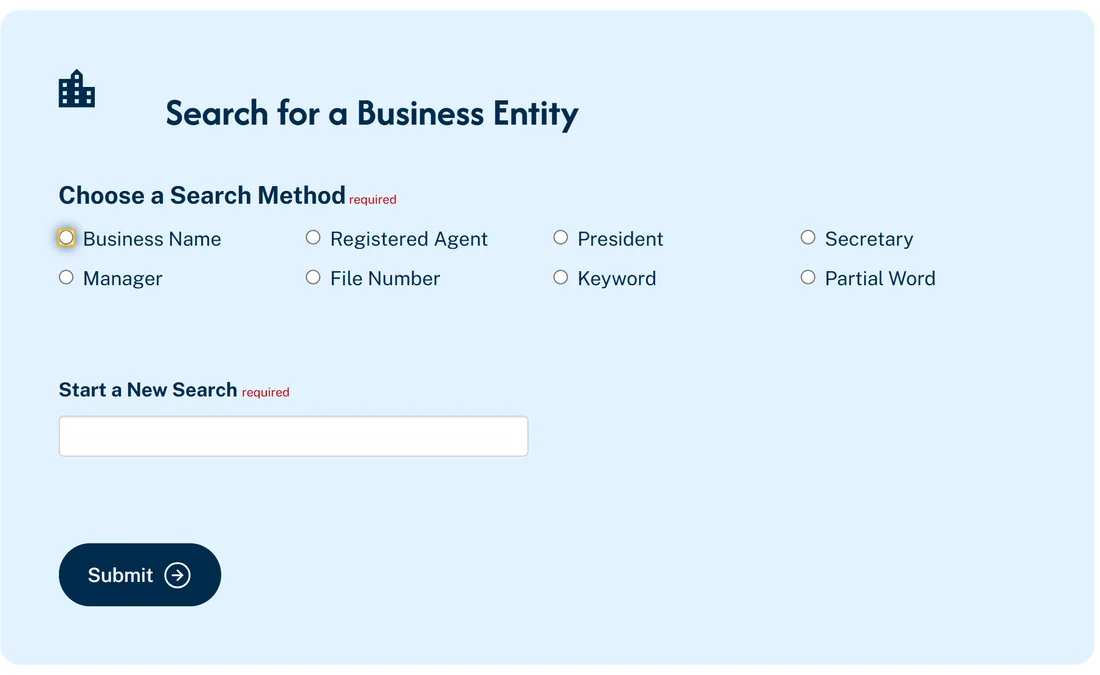
Choose a Search Method is required, with eight choices: Business Name, Registered Agent, President, Secretary, Manager, File Number, Keyword and Partial Word. The box, Start a New Search, takes 30 characters. Manager splits into last name, first name and middle initial, or a business name, since an LLC’s manager can be another company.
Step 2: Match the Start of the Name, a Word or a File Number
The Secretary of State’s help for these methods describes Business Name as a match from the start of the name, so a few distinctive first words are enough; Keyword finds one whole word anywhere in the name, and Partial Word the beginning of a word anywhere. A company missing under Business Name (a leading “The”, a first word spelled differently) can turn up under Keyword. File Number is the direct route: an Illinois business entity search by the 8-digit file number (10843481 for Walgreen Co.) opens a single record.
Step 3: Read the File Detail Report
The File Detail Report gives the official name, date of formation or registration, jurisdiction, registered agent and registered office, status, the president and secretary of a corporation and the managers of an LLC. Copies of filed documents, including an LLC’s articles of organization, are ordered from the Department of Business Services through its Copy Request forms, $25 for a certified copy of an LLC document. The state offers the form for individual searches only, and copying or downloading results in bulk is prohibited; the Secretary of State instead publishes free bulk data files for LLCs and corporations, with names, agents, managers and assumed names.
Presidents, Secretaries and LLC Managers Are Public in Illinois
An Illinois corporation’s record names its president and secretary with their addresses, and an LLC’s names each manager, including a member who has a manager’s authority. A member without that authority isn’t filed, and neither are shareholders. The manager of Chicago Cubs Baseball Club, LLC, for instance, is itself an LLC.
Those names come from the annual report, which asks an LLC for “the name and business address of all of the managers and any member having the authority of a manager” (805 ILCS 180/50-1) and a corporation for its directors and officers. The Person tab above finds companies by an officer’s, manager’s or agent’s name.
Registered Agent and Registered Office
Every Illinois company keeps a registered agent at a registered office in Illinois: an Illinois resident or a company authorized to do business in the state, at a street address (a P.O. box alone isn’t accepted) where the Secretary of State sends all its mail. The Registered Agent search method finds companies by their agent’s name. An agent that resigns leaves an LLC 60 days to name a new one before it turns NGS (805 ILCS 180/50-15). An LLC changes its agent online for $25, and a company left without one is eventually dissolved.
Goodstanding, NGS or Involuntary Dissolution: Illinois Statuses
NGS, short for Not-In-Goodstanding, is how a delinquent company shows: an LLC that hasn’t filed and paid its annual report before the first day of its anniversary month, or hasn’t replaced a resigned agent in time (805 ILCS 180/50-15).
| Status | Meaning |
|---|---|
| Goodstanding | Filings and fees are current. |
| NGS | Not-In-Goodstanding: a report or fee is overdue. |
| Reinstated | Back after a dissolution or revocation. |
| Involuntary Dissolution | An LLC the Secretary of State dissolved. |
| Dissolved | A corporation that has been dissolved. |
| Revoked | Authority withdrawn by the state; most Revoked corporations were formed in another state. |
In the Secretary of State’s own LLC data file, nearly as many records show Involuntary Dissolution as Goodstanding, so a familiar name can belong to a company that no longer exists. An administratively dissolved LLC continues only to wind up its business (805 ILCS 180/35-30), and its name stays unavailable to other companies for 3 years after the notice of dissolution (805 ILCS 180/35-37).
The $75 Annual Report, Due Before the Anniversary Month
Illinois LLCs and corporations file an annual report every year before the first day of their anniversary month, the month they were formed; an LLC organized on March 10 files before March 1 each year, and can file up to 60 days earlier. The fee is $75, plus franchise tax for a corporation, whose first $10,000 of tax liability has been exempt since January 1, 2025.
A pre-filled report goes to the registered agent about 45 days before the due date, and filed online it’s processed in real time. An LLC that hasn’t filed by the due date turns delinquent; 60 days later a $100 penalty applies, and if nothing is fixed within 120 days of the delinquency, the LLC is administratively dissolved. Reinstatement costs $200 with every overdue report and penalty, plus $100 for each year of delinquency after the first, and an online reinstatement covers at most six overdue reports. How to file the $75 report: the Illinois LLC annual report walkthrough.
The Secretary of State’s scam warnings name two paid solicitations: “Corporate Meeting Minutes”, asking $148.67 for an “Annual Statement” no Illinois law requires, and “IL Certificate Service”, asking $87.25 for an “Illinois Certificate of Status” that the state sells as a Certificate of Good Standing for $25.
Illinois Good Standing Certificates Print at Once, $25
The Certificate of Good Standing costs $25 for a corporation or LLC and $5 for a not-for-profit. It’s bought from the company’s File Detail Report by card and printed immediately, from the receipt page or the emailed link, for any company that meets the state’s requirements.
Each certificate carries an Authentication Number, which anyone can check on the Secretary of State’s certificate authentication page; the number is valid for one year from the date of issuance.
Is the Name Free? Illinois Checks LLCs Against Corporations Too
An LLC name has to be distinguishable from every LLC, corporation, reserved name and assumed name on the Secretary of State’s records, so an existing corporation’s name blocks a new LLC. In the Business Entity Search tool, which doubles as the name availability tool, a “no records found” result on the exact name means the name may be available; the Department keeps the final say until the articles, a reservation or an assumed name application is filed.
Adding LLC, Limited or Company, or changing an article, a tense or singular to plural, doesn’t make a name distinguishable. Form LLC-1.15 reserves a name for 90 days at $25, and county assumed names of sole proprietors don’t count against it. A cleared name can still collide with a registered mark, which the trademark side of choosing a name addresses.
Where an Illinois DBA Is Filed: Springfield or the County
An LLC adopts an assumed name with the Secretary of State, for a fee that runs from $150 down to $30 depending on the year in a five-year cycle, and the state’s free bulk data files list them for every LLC. A sole proprietor or general partnership files instead with the County Clerk of every county it does business in, then publishes a notice once a week for 3 weeks (805 ILCS 405/1); those DBAs never appear in the state’s search, and in Chicago they’re searched in the Cook County Clerk’s assumed business name search.
No Illinois EIN Lookup: MyTax Verifies a Number It Already Has
There is no public EIN lookup in Illinois: the Secretary of State’s files hold no EIN, and the Department of Revenue’s MyTax Illinois offers Verify a Registered Business only by a number already known, an Account ID, a Federal Employer ID (FEIN), a License Number or a Direct Pay Permit ID, never by name.
A business registers with the Department of Revenue on Form REG-1 and receives its Certificate of Registration and Illinois account ID, one to two business days after an online application. For another company’s number, where else a company’s EIN is printed covers bank and tax records.
Chicago, CyberDrive and Other Illinois Search Questions
Where are Chicago businesses looked up?
A corporation or LLC based in Chicago is registered with the Secretary of State and found in its Business Entity Search like any other. The Cook County Clerk keeps the assumed names of Chicago-area sole proprietors and general partnerships.
What happened to the CyberDriveIllinois business search?
The Corporation/LLC Search that ran under the CyberDriveIllinois banner is now part of Business Entity Search, at apps.ilsos.gov/businessentitysearch, which also covers limited partnerships.
Where is an Illinois professional license checked?
Professional and occupational licenses are checked in the Department of Financial and Professional Regulation’s License Look Up. Businesses otherwise register with the Department of Revenue, and counties, cities and villages set their own licenses.
Why can’t a newly formed Illinois company be found yet?
Online Articles of Organization are reviewed within 10 business days, or 24 hours for $250, and the Secretary of State’s pages don’t say how soon an approved filing shows in the search.