

Forming a Washington LLC comes down to one main state filing, and you can handle it yourself. As of 2026, you file the Certificate of Formation with the Washington Secretary of State through the Corporations and Charities Filing System (CCFS) for $180. Most online filings clear in about five business days, then a $70 annual report keeps you in good standing.
Your Washington LLC: the office, the cost, the deadline
- Where you file: Washington Secretary of State, Corporations and Charities Division, online through CCFS at ccfs.sos.wa.gov.
- What you file: the Certificate of Formation with Initial Report.
- Real cost: $180 state fee plus a $20 online processing fee, so about $200 online as of 2026.
- How long it takes: roughly 5 business days online standard, or 3 business days expedited for $100.
- What’s due later: a $70 annual report every year, by the last day of your formation month.
- Who needs one: anyone running a business in Washington who wants their personal assets shielded from business debts.
- Contact: Washington Secretary of State, Corporations and Charities Division, via sos.wa.gov and the CCFS portal.
Forming a Washington LLC with the Secretary of State, step by step
Here’s the full process, start to finish. How to start an LLC in Washington (WA) breaks into six steps, and you can file every one of them yourself through the state and the IRS.
Step 1: Pick a name and clear it on CCFS Corporation Search
Your name needs a designator: Limited Liability Company, Limited Liability Co., L.L.C., or LLC. It also has to be distinguishable from existing names on the Secretary of State’s records.
Run it through Corporation Search on CCFS first, and search the Washington business-name database for near-matches before you commit. Restricted words like bank, trust, or cooperative need authorization.
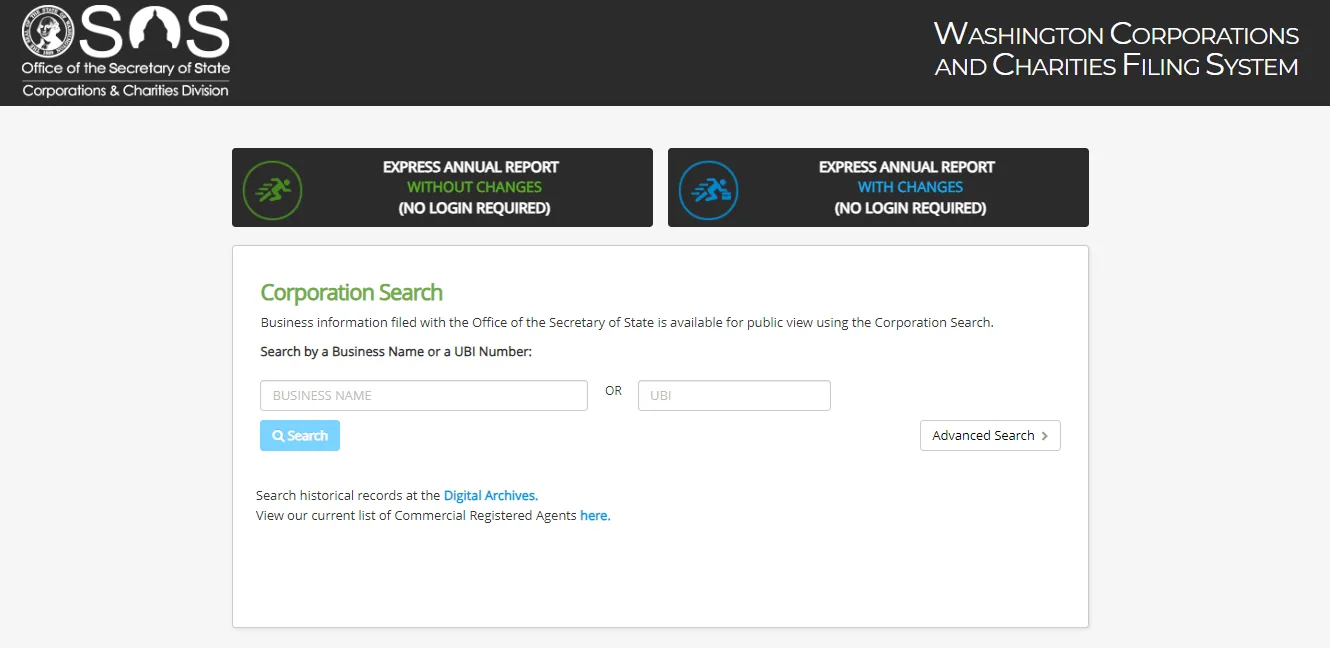
Found the one but not ready to file? A Name Reservation holds it for 180 days for $30; it doesn’t renew, so don’t lock it in too early.
Step 2: Appoint a Washington registered agent with a physical street address
Every Washington LLC needs a registered agent with a real street address in the state. PO boxes, private mailboxes, and virtual addresses don’t qualify.
The agent can be you, another member, or a commercial or noncommercial registered agent; they just have to consent in writing and stay reachable during business hours.
The catch: name a friend who moves or stops checking mail, and you can miss a lawsuit notice. Pick someone reliable.
Step 3: File the Certificate of Formation with Initial Report on CCFS
This is the filing that actually creates the company; it’s your official Washington LLC registration. Washington calls it the Certificate of Formation, bundled online as the Certificate of Formation with Initial Report, filed with the Washington Secretary of State through CCFS.
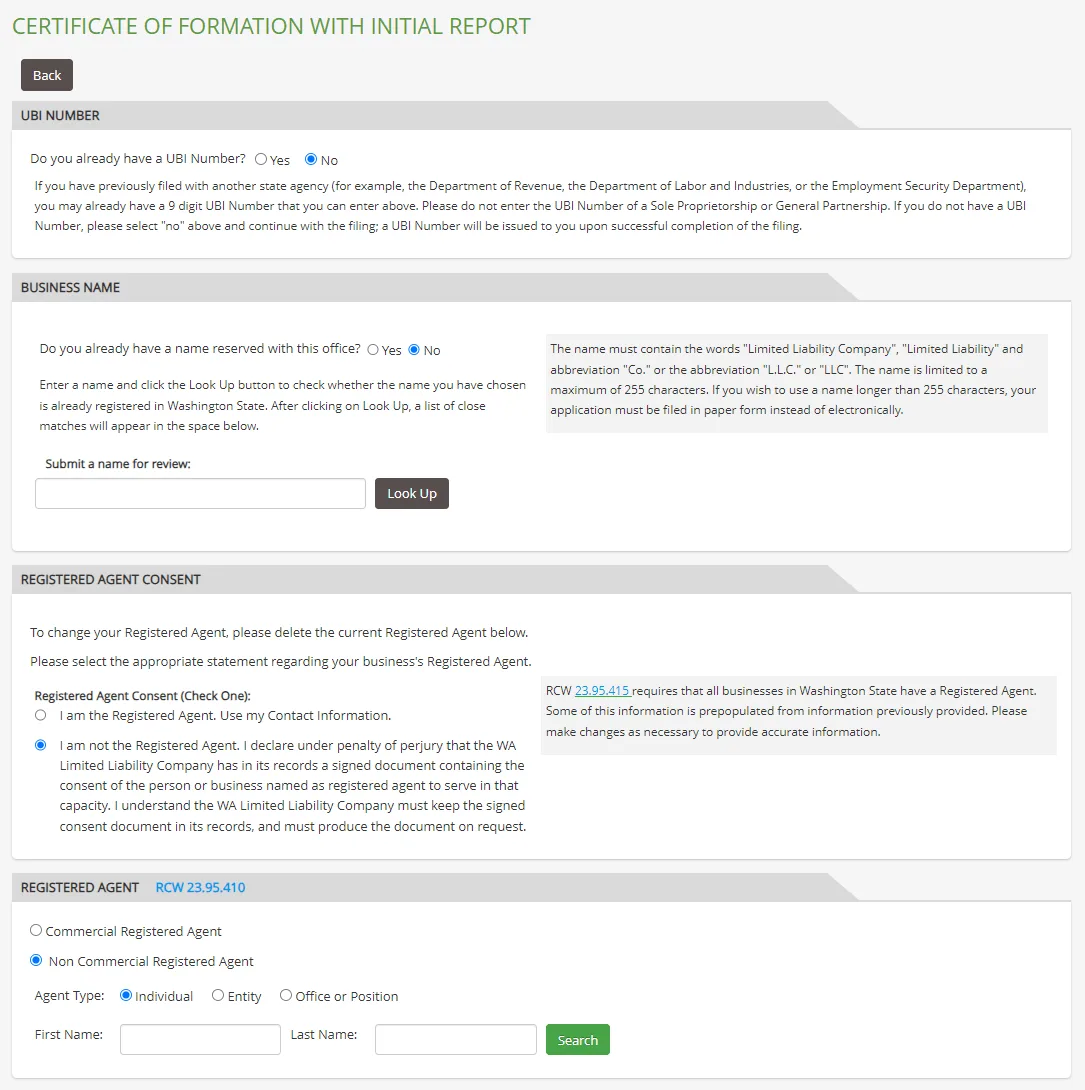
The state fee is $180, plus a $20 online processing fee, so budget about $200 as of 2026. Mail filing costs the same minus the online fee but takes around 15 business days instead of five.
The Initial Report is free when you file it with formation. Defer it and you’ve got 120 days to file it separately for $10. If timing is tight, here’s how long a Washington filing actually takes.
Step 4: Write a Washington operating agreement the state won’t keep
Washington doesn’t make you file an operating agreement, and the Secretary of State won’t keep one even if you upload it. That’s not a reason to skip it.
This document sets ownership percentages, voting, and what happens when a member leaves. For multi-member LLCs it’s the difference between a clean exit and a courtroom. Grab a Washington operating agreement template and adapt it to your members.
Single-member owners still want one; it backs up the liability separation a court looks for.
Step 5: Get your federal EIN from the IRS
Once the LLC exists, get your EIN from the IRS. It’s free, takes minutes online, and you’ll need it to open a bank account, hire, or file taxes.
Order matters here: form the LLC first, then apply, so the name on the EIN matches the Secretary of State record. Here’s how to get your EIN next.
Step 6: Register with the Department of Revenue and open accounts
Forming the LLC and operating it are two different things. Many Washington businesses also register with the Department of Revenue (DOR) through a Business License Application, depending on their activity. Then they open a business bank account using the EIN and the stamped Certificate of Formation.
More on licenses, trade names, and permits below. First, the costs.
Use ZenBusiness if you want the Washington filing and compliance pieces kept together.
Washington lets you file the Certificate of Formation and Initial Report yourself on CCFS. ZenBusiness makes more sense when you want formation help, a registered agent option, and compliance reminders in one workflow.
What a Washington LLC really costs in 2026
Here’s what a Washington LLC actually costs in 2026, mandatory fees first.
How much is an LLC in Washington? The state filing fee is $180, plus the $20 online processing fee on CCFS, so about $200 online as of 2026, per the Secretary of State fee schedule.
After that, the one recurring cost is the $70 annual report. Optional extras run $100 for expedited service, $30 for a name reservation, or a registered-agent fee if you hire one.
The short version: you don’t need to spend more than the state’s own fees to get registered.
Washington LLC annual report and B&O tax: the recurring obligations
Two ongoing obligations matter in Washington, and they come from two different agencies. Here’s what hits your calendar after formation.
| Obligation | What it is | Cost or rate (as of 2026) | Filed with |
|---|---|---|---|
| Annual report | Keeps the LLC active and your UBI live | $70, plus $25 if late | Secretary of State, via CCFS |
| B&O tax | Tax on gross business income | 0.471% retailing; 0.484% manufacturing or wholesaling; 1.5% to 2.1% services | Department of Revenue |
| Sales and use tax | Collected on taxable retail sales | Varies by location | Department of Revenue |
| State income tax | None in Washington | $0 | N/A |
The $70 annual report and its formation-month deadline
Your Washington annual report is the main piece of your ongoing LLC annual fees, and it’s due every year by the last day of the month you formed in. Form on March 12, and every March 31 becomes your deadline.
The fee is $70 through CCFS; miss it and a $25 delinquency fee applies, with administrative dissolution if you keep ignoring it. You can file up to 180 days early. Walk through filing your Washington annual report when yours comes due.
B&O tax: a gross-receipts tax instead of an income tax
Washington has no state income tax and no flat LLC franchise tax. What it does have is the B&O tax (Business and Occupation tax), charged on gross receipts with no deductions for costs, reported to the Department of Revenue.
Rates depend on your activity: retailing runs 0.471%, while services start at 1.5% and climb. A 2026 surcharge adds 0.5% for businesses grossing over $250 million, which won’t touch a normal small LLC.
Business licenses, trade names, and permits for a Washington LLC
Registering the LLC is one thing. Operating it legally usually takes a license, and sometimes a trade name or a permit on top.
Whether you need a Washington business license depends on your activity, and many LLCs do. You’ll need one through the Department of Revenue’s Business License Application if you have employees, make taxable retail sales, or gross $12,000 or more a year. A specific state or city endorsement can also trigger it.
Cities like Seattle, Tacoma, and Spokane add their own license endorsements, which the state’s Business Licensing Service can often bundle into the same application. Industry permits for food, contracting, or childcare come from the agency that regulates them, not the Secretary of State.
Registering a trade name (DBA) in Washington
Want to operate under a name other than your LLC’s legal name? Register a trade name, Washington’s version of a DBA, with the Department of Revenue rather than the Secretary of State. It’s a small add-on, filed on the same Business License Application instead of as a separate Secretary of State step.
Why owners choose a Washington LLC, and where it falls short
The main reason owners choose an LLC is limited liability: run properly, a Washington LLC keeps your home and savings separate from business debts and lawsuits. That’s why even one-person businesses file. The Washington small business figures count 533,681 firms with no payroll, more than three-quarters of the state’s 695,695 small businesses.
No state income tax helps too, though the B&O tax means Washington is income-tax-free, not tax-free.
Privacy is moderate, not total: CCFS records are public and searchable, so Washington isn’t an anonymous-LLC state. Licensed professionals such as doctors, lawyers, and accountants form a PLLC, the professional version, instead of a standard LLC.
Mistakes that get a Washington LLC rejected or dissolved
A handful of avoidable errors cause most of the refilings and lost good standing in Washington.
First on the list is the name-availability screen on CCFS: owners pick a name that isn’t distinguishable, and the filing bounces. The rest cluster around a few familiar traps:
- Using a PO box or virtual address for the registered agent.
- Assuming $180 covers the online filing, when it’s $180 plus the $20 online fee.
- Forgetting the deferred Initial Report’s 120-day clock.
- Confusing the filing fee with B&O tax; they’re unrelated and come from different agencies.
- Missing the annual report because the deadline is your formation month, not a fixed statewide date.
Washington LLC questions owners actually ask
Quick answers to the cost, tax, and timing questions Washington owners raise most.
How much does it cost to start an LLC in Washington?
$180 to the Secretary of State, plus a $20 online processing fee on CCFS, so about $200 to file online as of 2026. Mail filing skips the $20 but takes roughly 15 business days. After formation, plan on $70 a year for the annual report. You don’t need a paid formation package; those just add a markup on fees you can pay directly to the state.
Can I start a Washington LLC for free?
Not entirely. The state’s $180 fee is mandatory, and there’s no waiver for a standard LLC. What you can skip is the paid formation service. Filing the Certificate of Formation yourself on CCFS costs only the state fees, nothing more. The “free LLC” offers online still pass the $180 to you, usually with a service markup or a registered-agent subscription attached.
How long does it take to get an LLC in Washington?
Standard online filings finalize in about five business days as of 2026. Need it sooner? Expedited service is $100 and runs about three business days. Mail filings take roughly 15 business days, so the portal is almost always the faster route. For a fuller timeline by filing method, see the timing guide linked earlier.
What document do I file to form a Washington LLC?
The Certificate of Formation, filed online as the Certificate of Formation with Initial Report. Washington does not use “Articles of Organization,” the term many other states use, so don’t go hunting for that form here. The Secretary of State processes it through CCFS, and your LLC legally exists the moment that certificate is filed.
Does a Washington LLC pay a franchise tax?
No. Washington’s main state business tax is the B&O tax, not a franchise or privilege tax, and there’s no state income tax either. The B&O is charged on gross business income rather than profit. That means a Washington LLC can owe tax even in an unprofitable year if it has taxable receipts. It catches a lot of new owners off guard, so build it into your numbers from day one.
Can a married couple form one Washington LLC together?
Yes, and Washington’s community-property status matters here. A spouse-owned LLC is common, but watch one detail. IRS qualified joint venture rules say a business owned through an LLC does not qualify for the qualified joint venture election, even in a community-property state. So a married-couple Washington LLC generally files as a partnership, or as a corporation if it elects that, not as two sole proprietorships. Confirm the treatment with a tax pro before you file your first return.
Can licensed professionals form a PLLC in Washington?
Yes. Washington authorizes the Professional Limited Liability Company for licensed fields like law, medicine, and accounting. The members usually have to hold the same Washington professional license, and you form it through the Secretary of State much like a standard LLC. If your work requires a state license to practice, the PLLC is the right entity for you, not a regular LLC.
- IRS Publication 334: Tax Guide for Small Business
- Washington Secretary of State: Start a Domestic WA LLC Online
- Washington Secretary of State: Fee Schedule and Expedited Service
- Washington Secretary of State: Registered Agents
- Washington Secretary of State: File an Annual Report Online
- Washington Department of Revenue: Business and Occupation Tax
Launch Your Washington LLC with Bizee
Bizee helps you get your Washington LLC off the ground with filing support, business name tools, and a simpler path through the formation steps.