
How to Start an LLC in Texas (Step-by-Step Guide 2026)

| Updated March 26, 2026

To start an LLC in Texas in 2026, you file a Certificate of Formation with the Texas Secretary of State, appoint a Texas registered agent, then handle your EIN and tax setup. Texas is straightforward, but the details that trip people up are processing time expectations and the annual franchise tax filing requirement. In this guide, we keep it practical so you can move from “idea” to “approved LLC” without guesswork.

📘 In Brief
  • Name check: screen availability in SOSDirect ($1 per search).
  • Registered agent: required, with a physical Texas street address.
  • File Form 205: $300 Texas SOS filing fee.
  • After approval: get your EIN (free) and save your operating agreement for banking and ownership rules.
  • Stay compliant: franchise tax filing cycle is due May 15 each year (next business day if needed).
Quick Facts About Forming a Texas LLC
Filing fee $300 (Certificate of Formation, Form 205)
Processing time Varies by workload. Electronic filing is generally faster than mail. Expedited options are available (next day or typically 2 to 3 business days, depending on the option you choose).
Annual filings No separate Secretary of State annual report. Most LLCs must file the Texas franchise tax report each year, and many must submit a Public Information Report (PIR) due on the same deadline (May 15).
Registered agent required Yes. The registered office must be a physical Texas address where the agent can be served during business hours.
Business license No statewide “general business license.” Requirements depend on your industry and location (city, county, and state agency rules).
Management structure Member managed or manager managed (you choose at formation and list the initial governing person(s)).
Filing office Texas Secretary of State

What Is an LLC and Why Start One in Texas?

An LLC is often the simplest “real business entity” upgrade for founders who want liability protection without jumping straight into corporate formalities. In Texas, the LLC is a distinct entity type recognized under state law, and it can be structured to run like a hands-on owner business or a manager-led operation, depending on how you want to operate day to day.

Definition and Key Features

A limited liability company (LLC) is a business structure created under state law that blends key traits of corporations and partnerships, especially limited liability with flexible management. Texas explicitly treats the LLC as its own type of entity, not a corporation and not a partnership.

Here are the core features most Texas founders care about:

  • Limited liability: owners (members) are generally not personally liable for business debts and obligations.
  • Flexible management: you can be member-managed or manager-managed depending on who will run operations.
  • Company agreement (operating agreement concept): an internal agreement sets rules for ownership, roles, profit splits, voting, and exit terms. Texas law recognizes a “company agreement” as the governance foundation.
  • Registered agent required: Texas LLCs must maintain a registered agent and a registered office in Texas, generally a physical address for service of process.
  • Tax classification flexibility (federal): for federal tax, an LLC is “allowed by state statute,” and then classified under IRS rules based on members and elections.

Benefits of an LLC in Texas

A Texas LLC is popular because it gives you a solid “business setup” without forcing corporate-style complexity.

Here are the benefits founders usually feel right away:

  • Liability protection: an LLC generally helps protect your personal assets from business debts and lawsuits.
  • Flexible control: you can run it yourself (member-managed) or appoint managers, and Texas requires you to state that structure in the formation filing.
  • Tax flexibility (federal): many LLCs keep the default setup at first, and you can elect different tax treatment later if it makes sense.
  • Cleaner operations: it is easier to separate business money, sign contracts under the company, and look more established with banks and vendors.
💡 Our advice
If you are already taking payments or signing contracts, form the LLC early, then calendar the Texas franchise tax filing cycle so you do not miss the May 15 deadline.

LLC vs. Sole Proprietorship vs. Corporation

If you want a fast way to choose, compare them by risk protection and admin workload:

Structure Best for Liability Admin level
Sole proprietorship Testing a low-risk idea fast No liability shield Low
LLC Most small businesses that want protection + flexibility Usually limits personal liability Medium
Corporation Investor-focused plans or more formal governance needs Usually limits personal liability Higher
Note: even with an LLC, you still need to stay on top of the franchise tax filing cycle.
❓ Questions to Ask
  • Am I taking on real risk soon (clients, contracts, employees, debt, or products)?
  • Will anyone else own a percentage, or help run the business, and do we need roles in writing?
  • Do I want flexibility to keep taxes simple now, with options later if growth changes the math?
  • Am I ready to handle Texas franchise tax filings each year and keep records clean?

Start Your Texas LLC for $0 + State Fees

ZenBusiness makes it easy to file your Certificate of Formation, appoint a registered agent, and get your EIN – without hidden costs.

Step-by-Step Guide to Starting an LLC in Texas

When starting an LLC in Texas, the process is straightforward: pick a compliant name, appoint a registered agent, file Form 205 with the Secretary of State, then handle your EIN and basic setup. Below is a simple step-by-step walkthrough so you can form the LLC correctly and avoid the most common filing mistakes.

Step 1 – Choose a Name for Your Texas LLC

Selecting a strong LLC name is a key early step. In Texas, your name must be distinguishable in the Secretary of State’s records, and you must include an LLC designator like “LLC” or “Limited Liability Company.” Also, remember that a name search is only a screening step. The SOS notes that a final determination is not made until your document is received and processed.

Texas LLC Naming Rules and Restrictions

Texas requires that your LLC name be distinguishable from existing entities and certain reserved or registered names on file.
If your name suggests a regulated activity, you may need approvals or licensing. We recommend treating “restricted terms” as a compliance item: confirm requirements before you build branding around the name.

How to Check Name Availability (SOSDirect Search)

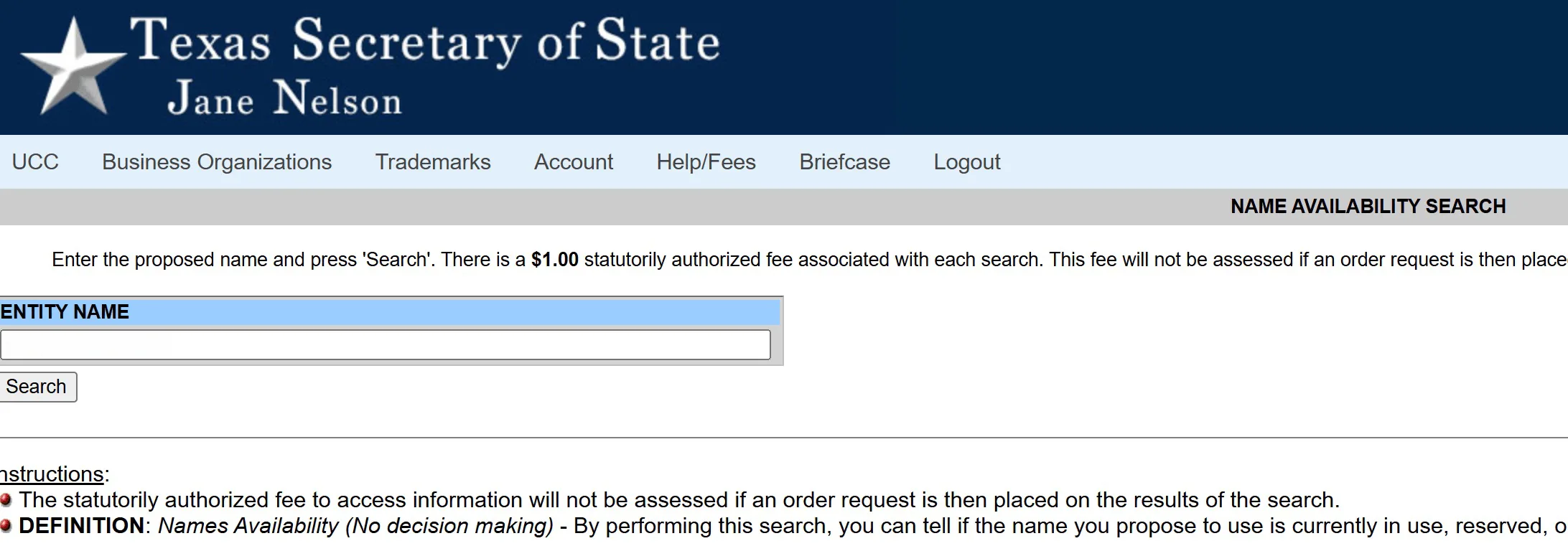
You can screen name availability through SOSDirect. SOSDirect is available 24/7 and charges a $1 fee per search.
If no close match appears, that is a good sign, but it is not a guarantee. The SOS explains that you should not make financial commitments based on preliminary clearance because the final decision happens during processing.

To make this step easier, use an official llc business search in Texas tool that highlights potential conflicts.

Reserving Your LLC Name in Texas

If you are not ready to file yet, you can reserve the name for 120 days by filing Form 501. The filing fee is $40 (credit card payments have a 2.7% convenience fee).
If you plan to form your LLC soon, filing now is usually simpler than reserving.

Step 2 – Appoint a Registered Agent

Think of your registered agent as your LLC’s “front door” for legal mail. Texas requires every LLC to list a registered agent and a physical Texas street address where that agent can accept service of process during normal business hours.

Before you lock it in, make sure this is true:

  • The agent is a Texas resident or a business authorized in Texas (your LLC cannot be its own agent).
  • The agent has actually agreed to do the job. Texas requires consent, and you should keep it in your records.
  • The address is a real place where someone can be served, not a P.O. box.
💡 Our advice
If you are often out, traveling, or you simply do not want your home address tied to the LLC, using a registered agent service keeps things cleaner and more reliable. For help selecting the right service, check this list of the best registered agent in Texas for small business owners.

Step 3 – File the Texas Certificate of Formation

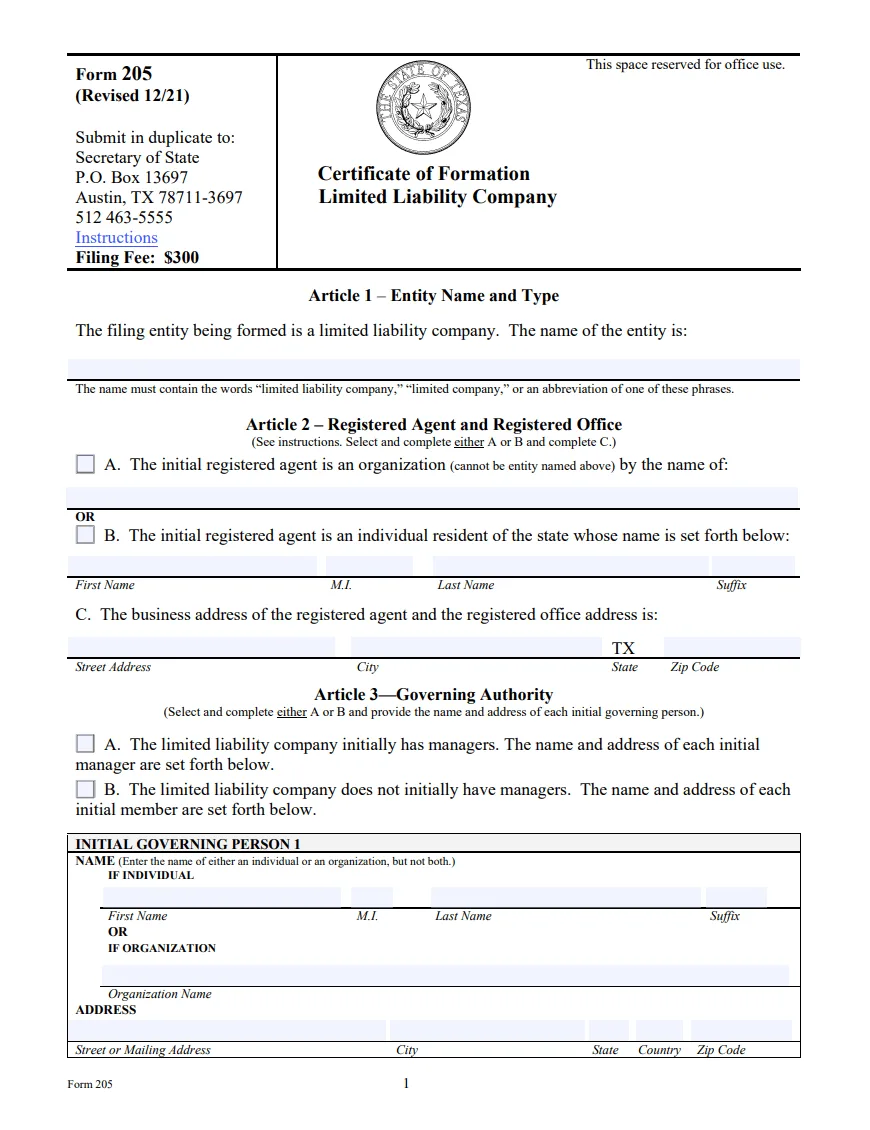
This is the step that officially creates your Texas LLC (Texas calls it a Certificate of Formation, but in other states you may see the same concept referred to as a Certificate of Organization or Articles of Organization, so the wording alone should not throw you off). You file Form 205 (Certificate of Formation) with the Texas Secretary of State and pay the $300 state fee. If you pay by credit card, Texas adds a 2.7% convenience fee.

Have these ready before you start the form:

  • LLC name (must include “LLC” or “Limited Liability Company”)
  • Registered agent + registered office (physical Texas street address)
  • Management type (member-managed or manager-managed)
  • Organizer details (who is submitting the filing)

Processing time: varies by workload. If you need speed, Texas Express standard expedite is $50 per document plus the filing fee and is typically processed within 2 to 3 business days.

Step 4 – Create an LLC Operating Agreement

Texas does not require you to file an operating agreement with the state, but it is one of the smartest things you can do after your LLC is approved. Texas law calls this a company agreement, and it can be written, implied, or oral. We still recommend a written version because it is easier to prove, easier to follow, and easier for banks and partners.

Before you draft it, decide what you want to be “true” when money or decisions get stressful. Then write it down.

At minimum, we suggest covering:

  • Ownership and contributions (who owns what, and who put in what)
  • Profit splits and payouts (when distributions happen and how they are calculated)
  • Management and authority (member-managed vs manager-managed, who can sign contracts)
  • Voting rules (what needs a vote, and what is day-to-day)
  • Member changes (adding a member, removing a member, buyout terms)
  • Disputes and exit plan (deadlocks, dissolution, what happens if someone leaves)
💡 Good to know
Texas specifically recognizes that a single-member LLC’s company agreement is still enforceable, even though only 1 person is a party to it.

Step 5 – Obtain an EIN for Your Texas LLC

An Employer Identification Number (EIN), also called a tax id number, is commonly needed to open a business bank account, hire employees, and handle federal tax filings. You can apply directly on the IRS website, and it is free.

Why get an EIN:

  • Separate business and personal tax administration
  • Payroll setup if you hire employees
  • Banking and payment processors often require it

Once you secure the EIN, keep it safe. This number remains vital for filing your tax return and public information report each year.

Step-by-Step Guide to Starting an LLC in Texas
1) Choose an LLC Name
  • Must include “LLC” or “Limited Liability Company”
  • Check availability on Texas SOSDirect
2) Appoint a Registered Agent
  • Receives legal documents for your LLC
  • Needs a physical Texas address + business-hour availability
3) File the Certificate of Formation
  • File with the Texas Secretary of State (SOSDirect or mail)
  • $300 filing fee
4) Create an Operating Agreement
  • Not required, but strongly recommended
  • Defines ownership, management, and profit split
5) Get an EIN
  • Free via the IRS
  • Needed for taxes, bank account, and hiring

If you want a broader overview beyond Texas, explore this full breakdown on how to create an llc from start to finish.

🧾

Field Note: Aaron Kra’s Texas LLC Filing Checklist (2026)

I see Texas filings get slowed down for the same practical reasons. It is usually not a “Texas is slow” problem. It is a details problem, and you can fix it before you pay and submit.

What I learned the hard way: The fastest Texas filing is the one you do once. I have watched founders lose days because the registered agent address format did not match what the agent provided, or because they selected the wrong management structure and had to clean it up later.

My 3-minute pre-submit checklist (what prevents most delays)

Before I submit Form 205, I run this checklist. It is small, but it prevents the most common rework.

1) Registered agent details (copy exact, do not improvise)

  • I ask the agent or service for the exact legal name they want used.
  • I copy the registered office exactly as provided, including suite formatting.
  • I confirm it is a real Texas street address for service of process.
  • I keep written proof that the agent consented, then store it in my records.

2) Management choice (decide first, then fill the form)

  • I decide member-managed vs manager-managed before touching the filing.
  • If there are multiple owners, I align signing authority with the operating agreement.
  • I make sure the names listed match how we plan to run the LLC day to day.

3) Name screening (use it, but do not treat it as final approval)

  • I screen the name in SOSDirect, then I also test close variations.
  • If results are close, I change the stem words, not just punctuation.
  • I do not order branding or signage until the filing is accepted.

4) Proof packet (so banking does not stall)

  • I save the submission confirmation and the filed copy in 2 places.
  • I get the EIN right after approval and keep it with the filed documents.
  • If a bank is strict, I order certified copies instead of delaying the account.

What I do right after approval (to stay in good standing)

Once the LLC is approved, I do these 2 things immediately so the company stays clean long-term.

  • I set the annual compliance reminders for the Texas Comptroller filing cycle, so we do not miss the May deadline.
  • I keep one simple “LLC folder” with the filed formation, EIN, operating agreement, and any bank-required documents.

How Much Does It Cost to Start and Maintain an LLC in Texas?

Texas LLC costs are usually simple: 1 main state filing fee to start, then ongoing compliance that is mostly about filing the right reports on time (even when you owe $0). The optional costs come from speed (expedite tiers), document copies, and whether you pay for a registered agent or a formation service.

Cost category Typical amount Notes
State formation filing (required) $300 Certificate of Formation (Form 205).
Registered agent (required) $0 DIY or ~$100–$200 per year You must have a Texas registered agent and physical registered office. Paying a service is optional.
EIN (IRS) $0 Free directly from the IRS.
Operating agreement (recommended) $0 DIY or ~$100–$200+ Not filed with the state, but useful for ownership rules and banking.
Texas franchise tax filings (annual) Tax varies, often $0 if below threshold Annual reports are due May 15. Many LLCs still must file even if no tax is due.
Local permits or licenses (if applicable) Varies No statewide “general business license,” but local and industry rules can apply.

If you want a line-by-line budget and the most common “surprise fees,” see this Texas LLC cost breakdown.

Texas LLC Formation Costs (State Fees & Optional Services)

For most founders, putting together a formation budget is pretty straightforward. There’s one required state fee you can’t avoid, and then a handful of optional add-ons depending on how you file and what you might need later on. If your priority is keeping service fees low, compare budget-friendly LLC formation options before you pick a provider.

Required state fee (this applies to everyone):

You’ll pay $300 to file the Certificate of Formation (Form 205). That’s the main cost to officially create your Texas LLC, no way around it.

Common optional add-ons (only if you actually need them):

  • Name screening via SOSDirect:
    SOSDirect is available 24/7 and charges $1 per search. That doesn’t sound like much, but if you’re trying out a bunch of name ideas, those small fees can stack up quicker than expected.
  • Name reservation:
    You can reserve a business name for $40, and it’ll be held for 120 days. This is helpful if you’ve picked the perfect name but aren’t quite ready to file your LLC yet.
  • Assumed name (DBA):
    Filing an assumed name certificate with the Secretary of State costs $25. Depending on how your business operates, you might also need to file at the county level, so keep that in mind.
  • Expedited handling (Texas Express):
    If you’re in a hurry, expedited processing is available for $50 per document (on top of the regular filing fee). Most are processed within 2–3 business days, though same-day and next-day options exist for certain filings.
  • Copies and proof documents:
    Sometimes banks or vendors will ask for official paperwork. The Texas SOS charges $15 per certificate, and certified copies cost $1 per page plus that same $15 certificate fee.
  • Credit card convenience fee:
    Paying by credit card? There’s a 2.7% convenience fee added to your total. It’s not huge, but it’s something to factor into your overall cost.

Annual Costs, Taxes, and Franchise Fees

Texas does not have a typical “annual report fee” with the Secretary of State for LLCs, but most LLCs still have an annual compliance cycle through the Texas Comptroller.

Here is how to think about ongoing costs:

  • Registered agent: Required. If you hire a commercial registered agent, this is usually your most predictable annual out-of-pocket cost (pricing varies by provider). Texas SOS requires the registered office to be a physical street address for personal service during normal business hours.
  • Franchise tax reporting: Due May 15 each year (or next business day if it falls on a weekend or holiday). Even when you owe $0, you may still need to file.
  • No tax due threshold (2026 report year): $2.65 million in total revenue for the 2026 report. If you are below this threshold, you generally file a No Tax Due report.
  • PIR or OIR filing: The Public Information Report (PIR) or Ownership Information Report (OIR) is due on the same deadline as the franchise tax report.

Maintaining Your Texas LLC in Good Standing

Staying in good standing in Texas is mostly about 2 things: keeping your registered agent valid and hitting the Comptroller deadlines every year. We recommend treating this like a repeating annual checklist, not something you scramble for in May.

Do You Need a Business License for Your Texas LLC?

Texas does not issue a statewide “general business license,” but many businesses still need permits or registrations based on what they do and where they operate. The state’s Business Permit Office helps businesses navigate licensing and permits, but it does not issue permits itself.

Start with these steps:

  • Check industry permits (state level)
  • Check city and county requirements
  • Sales tax permit (if applicable)

Texas LLC Tax Requirements (Franchise Tax & Sales Tax)

When it comes to taxes, most Texas LLCs deal with two things: franchise tax reporting and sales tax (if applicable).

Franchise tax basics (for most LLCs):

  • Reports are due every year by May 15 (or the next business day if it falls on a weekend/holiday).
  • For the 2026 report year, the no tax due threshold is $2.65 million in total revenue.
  • The PIR (Public Information Report) or OIR (Ownership Information Report) is due at the same time.

Sales tax basics (only if it applies to you):

  • You’ll usually need a permit if you sell, lease, or rent taxable goods, provide taxable services, or owe use tax on out-of-state purchases.
  • The permit itself is free, though in some cases the Comptroller might require a security bond.

We recommend setting 2 reminders: one for franchise tax and PIR/OIR prep in April, and one for the May 15 filing deadline.

How to Open a Business Bank Account for Your LLC

Most banks want proof your LLC exists, proof of who has authority, and a tax ID for the account. Requirements vary, but these are commonly requested:

  • Your filed formation document (Certificate of Formation) or the SOS evidence of filing.
  • An EIN from the IRS (free when you apply directly with the IRS).
  • Your company agreement (operating agreement concept) and a resolution or statement of authority if more than 1 person can sign.
  • Sometimes a Certificate of Fact – Status (Texas’s version of a “good standing” style certificate).
💡 Good to know
If a bank asks for “good standing,” they often mean a Texas Certificate of Fact – Status. Texas issues this through the Secretary of State as official evidence the entity exists or is authorized to transact business in Texas.

Launch your Texas LLC the smart way with Bizee

Bizee takes care of your Texas LLC formation, from filing paperwork to helping you stay on top of compliance and tax requirements, so you can focus on running your business smoothly.

Who Can Form an LLC in Texas?

Texas makes this part very flexible. The organizer does not need to live in Texas, and ownership can include individuals or other entities.

Here are the practical rules:

  • Organizer eligibility: An organizer can be a natural person 18 or older, or a corporation or other legal entity. There are no residency requirements for the organizer.
  • Members (owners): Members can be individuals, partnerships, corporations, and other legal entities.
  • Registered agent must be Texas-based: The registered agent must be either a qualifying entity registered to do business in Texas or an individual resident of Texas, and the registered office must be a physical street address for service during business hours.

FAQs About Starting an LLC in Texas

Below is a concise set of answers addressing the top queries around starting an llc in the Lone Star State. Each response is straightforward, focusing on what you need to know to form your LLC swiftly and confidently.

How Long Does It Take to Form an LLC in Texas?

It depends, but online filing is usually the fastest.
Processing time varies, but electronic filing is usually the fastest. Texas SOS encourages electronic filing through SOSDirect or SOSUpload, and SOSDirect can provide evidence of processing in real time. If you need speed, Texas Express offers standard expedited processing that is typically completed within 2 to 3 business days, plus next-day and same-day options for many document types when received by the noon cutoff. Build in buffer time during peak seasons.

Can I Start an LLC in Texas Online?

Yes, you can file online through SOSDirect.
Texas lets you file your LLC formation online through SOSDirect. It is available 24/7 and supports filing formation documents, checking name availability, and receiving evidence of processing. After approval, you still need to handle the real setup work: keep a company agreement in your records, get an EIN, and maintain a registered agent and physical registered office in Texas.

What Are the Best LLC Formation Services in Texas?

There is no single best, choose based on support and total cost.
There is no official “best,” so we recommend picking based on your needs: privacy, support, and compliance reminders. You can file yourself through SOSDirect, but many founders use services like Northwest Registered Agent, ZenBusiness, Bizee, or LegalZoom for guided filing and add-ons. Compare year-2 registered agent pricing, what is included versus upsells, refund policies, and whether the dashboard clearly tracks Texas franchise tax and report deadlines.

Can I Change My LLC Name After Registration?

Yes, file an amendment with the Texas SOS.
In Texas, you typically change an LLC’s legal name by filing a Certificate of Amendment (Form 424) with the Secretary of State and paying the amendment filing fee. After the state approves it, notify the IRS of the name change using the method that matches your tax filing, and remember you generally do not need a new EIN for a simple name change. Then update your bank, contracts, and invoices.

How Do I Keep My LLC Compliant in Texas?

Keep your registered agent active and file on time every year.
To stay compliant, keep a valid registered agent and physical registered office in Texas, and file your franchise tax report each year by May 15, or the next business day if it lands on a weekend or holiday. Most LLCs also must file a Public Information Report or Ownership Information Report on the same deadline. We also recommend saving proof of filings and updating addresses and agent details quickly to avoid penalties.

References

Stay Compliant from Day One in Texas

Harbor Compliance handles every step: formation, franchise tax, and registered agent service – so you stay legally protected.

Leave a Comment

  • Aaron Kra Boost Suite

    Aaron Kra, JD, Founder and Editor-in-Chief of Boost Suite, is a recognized authority on LLC formation, registered agents, and small-business compliance.
    A graduate of the University of Texas School of Law (ABA-accredited), he founded Boost Suite to turn complex state rules into plain-English, step-by-step guidance. For 9+ years, he has helped entrepreneurs with entity selection, registered-agent requirements, and multi-state compliance, and he leads the site’s legal/tax review.


    Previously, Aaron practiced business law in Austin (LLC/PLLC formations, conversions/domestications, UCC-1 filings, multi-state registrations) and completed a year-long secondment with a national registered-agent provider, working with filing clerks in 25+ states. At Boost Suite, he checks each guide with official US sources and updates everything when necessary. Read moreAUTHTOROIRN about Aaron Kra and Boost Suite.

Disclaimer: The information provided on this page is for general educational purposes only and should not be considered legal or tax advice. Laws and regulations differ by state or country, may change over time, and always depend on your personal circumstances. The comments section is designed for readers to share insights and personal experiences, but these do not replace professional guidance. For personalized advice regarding legal or tax matters, please consult with a licensed attorney, CPA, or qualified advisor. To learn how we select partners, vet sources, and keep content accurate, see our editorial policy.