

An EIN number lookup is not the same for every business. The best method depends on whether you are researching a public company, a nonprofit organization, a private LLC or corporation, or trying to recover your own EIN. Some EINs can be traced through public records, while others are only available through tax documents or direct confirmation from the business.
Mastering EIN Number Lookup Fundamentals
Before you start an EIN number lookup, it helps to know one important thing: there is no single public database that lists every business EIN. The best method depends on the type of entity you are researching, whether it is a public company, a nonprofit organization, or a private business. Your reason for searching also matters, because finding an EIN is different from verifying one.
What Is an EIN and Why It Matters
An Employer Identification Number (EIN) is a nine-digit federal tax ID issued by the Internal Revenue Service (IRS) to identify businesses and certain other entities for tax filing and reporting. It can apply to an Limited Liability Company (LLC), corporation, trust, estate, or nonprofit organization. In everyday use, an EIN helps confirm the correct legal entity for tax, banking, and compliance purposes.
Key Terms: EIN, FEIN, and Federal Tax ID
EIN, FEIN, and Federal Tax ID often cause confusion, but they represent closely related concepts crucial for business verification.
| Term | Meaning |
|---|---|
| EIN (Employer Identification Number) | The 9-digit number the IRS uses to identify a business for federal tax purposes. |
| FEIN (Federal Employer Identification Number) | Simply another name for the same EIN. |
| Federal Tax ID | A broader label that often refers to an EIN, although it can sometimes include other taxpayer ID numbers. |
You may also come across related terms such as Form SS-4 and EIN Prefix.
Form SS-4 is the IRS application used to request an EIN.
An EIN Prefix refers to the first two digits of the EIN. Today, those digits reflect the IRS campus that assigned the number or whether the EIN was requested online, so they should not be treated as a reliable indicator of the business’s location.
In most business contexts, all three terms point to the same IRS-issued identifier. For a public company, you might also see a Central Index Key (CIK) in Securities and Exchange Commission (SEC) records. It is not the same as an EIN, but it is useful for finding the right filings faster in EDGAR.
Find or Apply for an EIN
ZenBusiness makes EIN registration easy, helping you secure your tax ID for business operations.
EIN vs. Other Tax IDs (SSN, ITIN, TIN)
Many business owners and freelancers get confused to know which tax ID they actually need. An EIN identifies a business but a SSN or ITIN identifies an individual. To add to that, sometimes IRS uses the umbrella term TIN (Taxpayer Identification Number) which can be used for any of them.
It is important to know the difference as incorrect uses of the number on tax forms, loan applications, and bank paper work could delay, cause a rejected filing, or worse, compliance penalties. For example, a sole proprietor might start out using their SSN for business taxes, but once they hire employees or open a business bank account, they’ll need to switch to an EIN. Non-U.S. residents, on the other hand, often need an ITIN just to file taxes, and may also apply for an EIN if they operate a U.S. business.
| ID Type | Who Uses It | Purpose |
|---|---|---|
| EIN (Employer Identification Number) | Businesses, nonprofits, trusts, estates | Tax reporting, hiring employees, opening business bank accounts |
| SSN (Social Security Number) | U.S. individuals | Personal income tax filing, Social Security benefits |
| ITIN (Individual Taxpayer Identification Number) | Nonresident aliens, dependents, others ineligible for SSN | Filing U.S. taxes without an SSN |
| TIN (Taxpayer Identification Number) | Umbrella term (includes SSN, EIN, ITIN) | IRS identifier for any taxpayer (individual or business) |
EIN Number Lookup by Organization Type
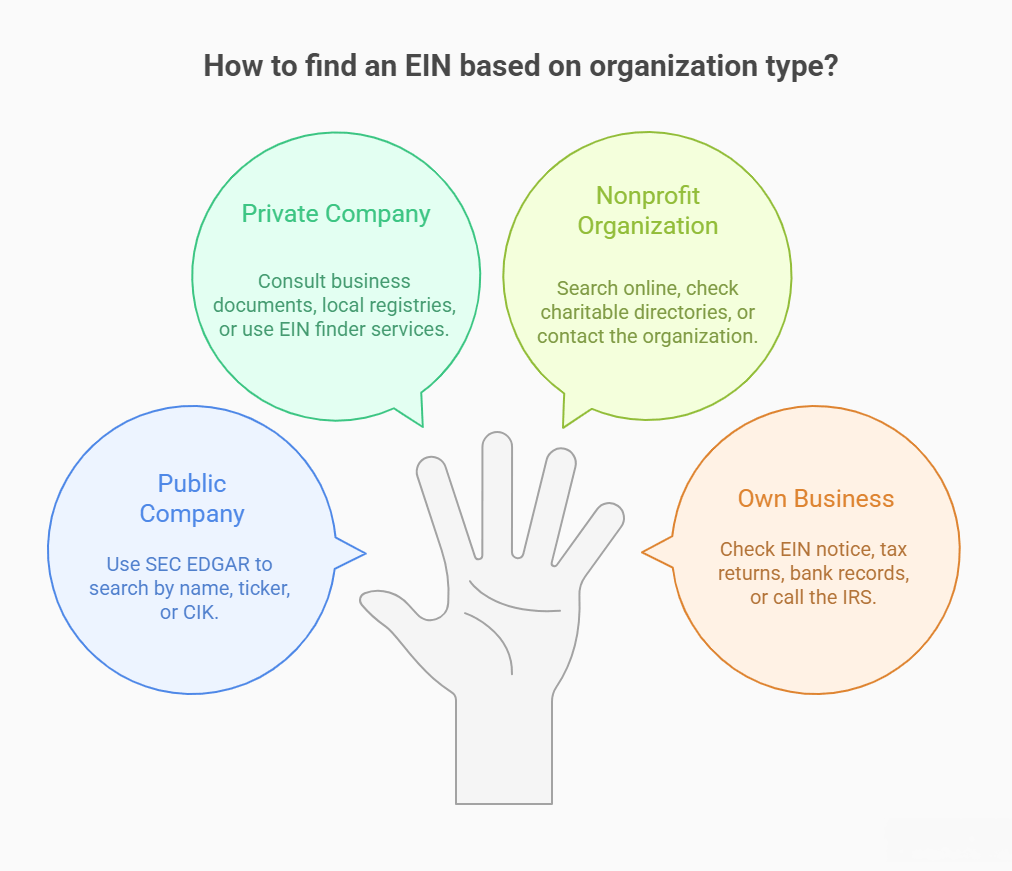
EIN lookups are not one-size-fits-all. The best method depends on the type of organization you are researching, since different entities share (or don’t share) EIN information in different ways.
How to Find the EIN of a Public Company
For a public company, start with the SEC’s EDGAR search tools. You can search by company name, ticker, or CIK, then review the company’s filings and entity page. In many cases, EDGAR is the most reliable starting point because it is the official federal filing system for public-company disclosures.
Use this approach:
- Search the company in SEC EDGAR by name, ticker, or CIK.
- Open the company’s filings or entity page and look for identifying details.
- Cross-check the result against the company’s legal name and latest filings before relying on it.
How to Find EIN of a Private Company
Locating the EIN for a private business entity can require additional legwork, since confidential records are not always publicly disclosed. Start by consulting any available business documents such as contracts, invoices, or older tax returns you might have. If the target is a real estate firm or another closely held company, check local registries or licensing information.
For businesses needing clarification, find out whether you can use a registered agent address for EIN to simplify registration.
Follow these steps for extra clarity:
- Ask for Official Documentation: Tax forms or a formal partnership agreement may mention the ein of a company.
- Contact the Business Directly: Polite inquiries can sometimes yield the number if there’s a legitimate need.
- Use an EIN Finder Service: Certain third-party sites offer advanced ein search and tin match features for a fee.
Exercise caution and verify authenticity when sourcing private EIN data.
How to Find EIN of a Nonprofit Organization
A tax exempt organization typically publishes its EIN in publicly available documents or donor communications. Because nonprofits often share details for transparency and donor confidence, you may locate their EIN faster than you would for a private, for-profit group.
Here’s where to look:
- Search Online using the nonprofit’s official website, annual reports, or tax return (Form 990).
- Check Charitable Directories that list nonprofit profiles and contact data.
- Contact the Organization to see if they share EIN data in newsletters or donation receipts.
Each method can help you confirm if the nonprofit truly holds the tax exempt organization status they claim.
How to Find Your Own Business’s EIN
If you need your own EIN, the IRS says to start with the notice issued when you applied, then check past business tax returns, your business bank records, and any state or local license applications. If you still cannot find it, the IRS says authorized callers can contact the Business & Specialty Tax Line to retrieve it after identity verification.
Use this order:
- Call the IRS Business & Specialty Tax Line if you still cannot locate it.
- Check your original EIN notice and prior tax returns.
- Review your business bank account setup records.
- Check state or local license paperwork.
EIN Number Lookup Methods and Tools
Whether you want to confirm a tax identification number for compliance or simply need quick details for business verification, there are various strategies. You might rely on official IRS solutions, private search platforms, or publicly accessible resources. The right choice depends on your budget, security preferences, and how detailed your query is.
Using Official IRS Resources for EIN Search
Instead of relying on a generic IRS “company and person lookup” idea, it is better to use the IRS resource that matches your actual case. For nonprofits, that is Tax Exempt Organization Search. For your own lost EIN, the IRS directs you to your EIN notice, tax returns, bank records, license records, or the Business & Specialty Tax Line. And for TIN Matching, the IRS makes clear that the service is limited to payers or their authorized agents who submit information returns.
Using Third-Party EIN Search Services Carefully
Third-party databases can sometimes help you triangulate business information, especially when they index public filings or archived records. Still, they should be treated as secondary sources, not final proof. A result from a paid lookup tool is most useful when you can verify it against a W-9, Form 990, SEC filing, or another primary record. This matters even more for a private LLC or closely held corporation, where inaccurate listings can circulate for years. That caution also aligns with the rewrite brief’s focus on stronger accuracy and entity-based trust signals.
Manual Search Techniques and Public Records
When automated tools do not give you a clear answer, manual research can still help. The best manual methods are usually document-based: archived contracts, lender paperwork, procurement files, court exhibits, public filings, or licensing documents tied to the legal entity name. These records may not always display the EIN directly, but they can help you confirm the correct organization, legal name, and context before you request or verify the tax ID through a primary source.
Step-by-Step EIN Search Process
When you need to confirm or discover an EIN, a methodical approach can save time and prevent errors. Below is a detailed guide to streamline your journey:
Confirm whether the entity is a nonprofit, sole proprietorship, or corporation, as disclosure rules vary.
Collect key details such as business name, address, and prior filings to refine your search.
Search the SEC website for corporations or nonprofit 990 forms for tax-exempt organizations.
Examine previous tax returns, loan documents, or state business filings for EIN traces.
Use IRS tools or private databases, including TIN match services, for validation.
Reach out via email or phone for EIN confirmation, especially for smaller businesses.
Consult an accountant, attorney, or EIN specialist for expert guidance if needed.
By following these steps, you’ll reduce the risk of incomplete information and increase your odds of success in tracking down the correct EIN. A common question is, can I use a registered agent address for EIN? Understanding the rules can help businesses establish their tax identity correctly.
Troubleshooting and Advanced Strategies
Even with thorough methods, you may encounter obstacles during an ein search. In these instances, consider advanced options such as cross-referencing multiple public or private databases or consulting legal experts. Taking a measured approach can help you confirm or disprove any potential misinformation. For a step-by-step guide, check out how to get an LLC started to ensure a smooth registration process.
What to Do When an EIN Is Not Found
In rare cases, your ein application details may be missing, or you might face an unresponsive entity. If you misplaced ein data, check old email threads or call the IRS to retrieve ein records. The IRS can also verify ein authenticity if you have the right to request that information. When no references emerge, you may need to confirm if the entity is truly registered as a business entity. If you still come up empty-handed, consult a professional to explore alternative routes and verify the business’s legitimacy.
Verifying and Validating EIN Information
Once you have an EIN in hand, it’s smart to check ein status for accuracy. Data mismatches can hamper business credit applications, cause issues with business tax returns, or delay official transactions. You can verify ein details through official IRS channels or by reviewing IRS correspondence, such as an ein confirmation letter. Consistent validation ensures that you’re working with accurate data for all tax return filings and financial dealings. Ensure accuracy and consider optional rush services to speed things up.
Verify a Business EIN Fast
Northwest Registered Agent assists with EIN lookups and ensures your business stays compliant.
Common Mistakes in EIN Lookup or Usage
Some mistakes show up again and again in EIN research:
- Sharing an EIN too casually.
If the number is misused, it can create tax and identity-theft problems for the business. - Confusing an EIN with an SSN or ITIN.
They are different taxpayer identifiers and should not be used interchangeably. - Relying on unverified third-party lookup sites.
Official sources and primary documents are stronger than scraped databases. - Assuming every registry displays EINs.
Many state registries confirm existence, but not the EIN itself. For private companies, a W-9 or direct request is usually more realistic. - Skipping cross-checks.
A single database hit is not enough when names, structures, or addresses have changed.
Security Risks & EIN Fraud: Protecting Your Business Identity
In the wrong hands, your EIN can facilitate identity fraud, while it may not feel as sensitive as your social security number. A stolen or counterfeit EIN can be utilized by criminals to establish business bank accounts or apply for loans. They can also file fraudulent tax returns, all in your company’s name.
If your EIN is exposed, you could face financial loss, damaged credit, and months (or years) of recovery. Your EIN should be protected just like your other personal information in most cases.
Here are the biggest risks to watch out for:
- Business identity theft: Scammers can use a valid EIN to impersonate your company, open fake vendor accounts, or apply for financing you’ll never see.
- Fraudulent tax filings: Stolen EINs are sometimes used to file false tax returns or claim improper refunds.
- Fake EIN lookup tools: Some shady sites pose as legitimate search tools just to collect sensitive business data from unsuspecting users.
- Public record exposure: Your EIN may appear in required documents (like IRS filings or SEC disclosures), but posting it in unsecured PDFs or casual listings only makes it easier to steal.
- Internal misuse: Employees with access to your EIN could abuse it if you don’t have strong controls in place.
Legal and Compliance Considerations
When conducting EIN lookups, keep legal compliance top of mind. Each entity’s data usage guidelines and privacy standards can vary, so always review any disclaimers or policies to confirm you have the right to obtain the information. If you’re setting up a domestic LLC, understanding EIN requirements is essential for compliance and smooth operation. Misuse of confidential data can invite legal consequences and jeopardize your standing with government agencies.
Privacy and Responsible Use of EIN Information
The safest approach is to use EIN information only when you have a legitimate business, tax, or compliance reason to do so. In practice, that often means collecting a TIN through Form W-9 for information-return reporting, checking SEC filings for public companies, or reviewing IRS records that are already public for tax-exempt organizations. For private businesses, avoid assuming the EIN is public just because the company exists; many private-company EINs are not broadly published.
Best Practices for Maintaining EIN Accuracy
To keep your own EIN records accurate and easy to recover later:
- Review annual tax filings and internal records to make sure the business name and EIN still match.
- Keep your IRS notice, prior returns, and latest W-9 in one secure place.
- Update the IRS when your mailing address, location, or responsible party changes.
- Limit unnecessary sharing so fewer outdated copies circulate.
Staying organized matters because inconsistencies in the surrounding business details, not just the EIN itself, are often what make lookups feel unreliable.
How to Update or Correct EIN Information
Sometimes when you search for a company’s EIN, the number is valid but the surrounding details, such as the business name, mailing address, or responsible party – appear outdated. This can create confusion when you’re trying to verify an entity’s legitimacy. In these cases, the issue isn’t with the lookup process itself, but with the company’s IRS records being out of date.
If you notice discrepancies, the business owner (not the person searching) is responsible for correcting them with the IRS. Common updates include:
- Business address or responsible party changes (filed with IRS Form 8822-B)
- Business name changes (reported on the current tax return or by letter)
- Entity type changes (sometimes requiring a new EIN instead of an update)
FAQ: Top Questions on How to Find a Company’s EIN
Below, you’ll discover concise answers to the most frequent EIN lookup questions.
How do I search for an EIN by company name online?
To search for ein by a company name, start by identifying the organization type:
– Public company: Use the SEC EDGAR search (name, ticker, or CIK) and check filings for the EIN.
– Nonprofit: Use the IRS Tax Exempt Organization Search (TEOS) and related Form 990 records.
– Private company: There’s no complete public EIN database—best options are a current Form W-9, existing documents, or requesting it directly from the company.
Which websites offer reliable EIN lookup services?
If you need to look up an EIN, official sources are usually the best place to begin. For public companies, the SEC’s EDGAR database is one of the most trustworthy options. If you’re checking a nonprofit, the IRS is typically the better source for records, EIN recovery guidance, and other tax ID information.
You’ll also find third-party lookup websites online, and some can be useful for verifying public details. Still, it’s better to treat them as a helpful extra step, not your final source. When it comes to private businesses, a document like a W-9 is often much more reliable than a general lookup website.
What should I do if I cannot locate a company’s EIN?
If you can’t find a company’s EIN, start by checking the business name carefully. Make sure you’re searching the company’s legal name, not just its DBA or brand name, since that can easily throw off your search.
From there, use the source that makes the most sense for the type of business you’re looking into.
If you’re trying to recover your own business EIN, the IRS recommends checking the original notice sent when you first applied. You can also look through past business tax returns, bank records, or state and local license documents. And if none of those turn it up, an authorized person can contact the IRS Business & Specialty Tax Line for help.
Are there any legal concerns with using EIN lookup tools?
Yes, there can be. Just because some EIN details appear in public records doesn’t mean every EIN is public or every lookup tool is reliable. Some services also have strict access rules. For example, the IRS TIN Matching service is limited to eligible payers and authorized agents. That’s why it’s smarter to rely on official records or primary documents instead of assuming every online database is complete or compliant.
How can I verify that an EIN number is accurate and current?
The easiest and most reliable move is to match the EIN with a primary document, ideally a recent Form W-9. That form is specifically used to give the correct taxpayer ID to whoever is requesting it. If it is your own EIN, double-check it against your IRS notice, past tax returns, or your business bank records. If you are an eligible payer or authorized agent, the IRS TIN Matching Program can confirm a name and TIN match before you file, but it is not a public lookup tool.
Do EINs Expire?
No, once the IRS assigns an EIN to a business, that number stays with the entity permanently. It does not “expire” like a license or subscription. In some cases, the IRS can deactivate an EIN if it is no longer needed, but that is different from an EIN expiring on its own.
Can Two Businesses Share the Same EIN?
Legally distinct entities generally should not use the same EIN. The IRS says a new EIN is typically required when the entity’s ownership or structure changes. At the same time, the IRS also says a sole proprietor does not need a new EIN just because they own multiple businesses, which means the answer depends on whether those operations are separate legal entities or simply multiple activities under the same owner. For an LLC, corporation, or partnership that is legally separate, do not assume another business can use the same EIN.
Is there a free EIN search by company name?
Many people look for an EIN search by company name or even an EIN search by company name free, but the answer depends on the type of business. For a public company, you may be able to find the right record through SEC EDGAR. For a nonprofit organization, the IRS Tax Exempt Organization Search and Form 990 records are usually the best free sources. For a private company, there is no complete public database, so a true EIN lookup free option is often limited unless you already have access to a Form W-9, prior tax documents, or direct confirmation from the business.
- Internal Revenue Service: Employer Identification Number
- IRS Pub. 1635 (PDF): Understanding Your EIN
- Internal Revenue Service: About Form SS-4, Application for Employer Identification Number (EIN)
- Investor.gov (SEC): Using EDGAR to Research Investments
- Internal Revenue Service: General Instructions for Forms W-2 and W-3 (2025)
- Internal Revenue Service: TIN Matching (e-Services) (validate name/TIN combos) + program PDF
- Taxpayer Advocate Service (IRS): TAS Tax Tip: Employer Identification Numbers
- Cornell LII: 26 CFR § 301.6109-1 – Identifying numbers
Simplify EIN Registration & Compliance
Harbor Compliance guides you through EIN applications and ensures proper tax filing.