

A Wisconsin LLC gets filed with the Department of Financial Institutions, not a Secretary of State, and that one detail trips up more first-time owners here than anything else. As of 2026, the Articles of Organization cost $130 online, and in most cases the DFI accepts the filing on receipt. Here’s the real path, step by step and fee by fee.
Where your Wisconsin LLC gets filed, and what the DFI charges
The short version before the detail:
- Filing office: the Wisconsin Department of Financial Institutions (DFI), not the Secretary of State.
- Document: Form 502, Articles of Organization, through Business Entity File Online.
- Filing fee, 2026: $130 online, or $170 by paper.
- Speed: online filings are usually accepted on receipt; paper has no published standard turnaround.
- Recurring duty: a Wisconsin annual report every year, $25 online.
- Who needs one: anyone running a business in Wisconsin who wants liability protection without forming a corporation.
- Contact: DFI Division of Corporate & Consumer Services, through the Business Entity File Online portal.
How to start an LLC in Wisconsin: the seven DFI filing steps
Figuring out how to start an LLC in Wisconsin comes down to seven concrete moves, and you can do every one yourself. Most of it happens in a single online session with the DFI. The state fee is the same whether you file or pay someone to file for you.
Step 1: Name the LLC and clear it on CRIS
Your name has to include a designator: limited liability company, limited company, LLC, or LC, with Ltd. and Co. allowed as shorthand. Before you settle on one, run it through the Wisconsin business name search on the DFI’s CRIS database.
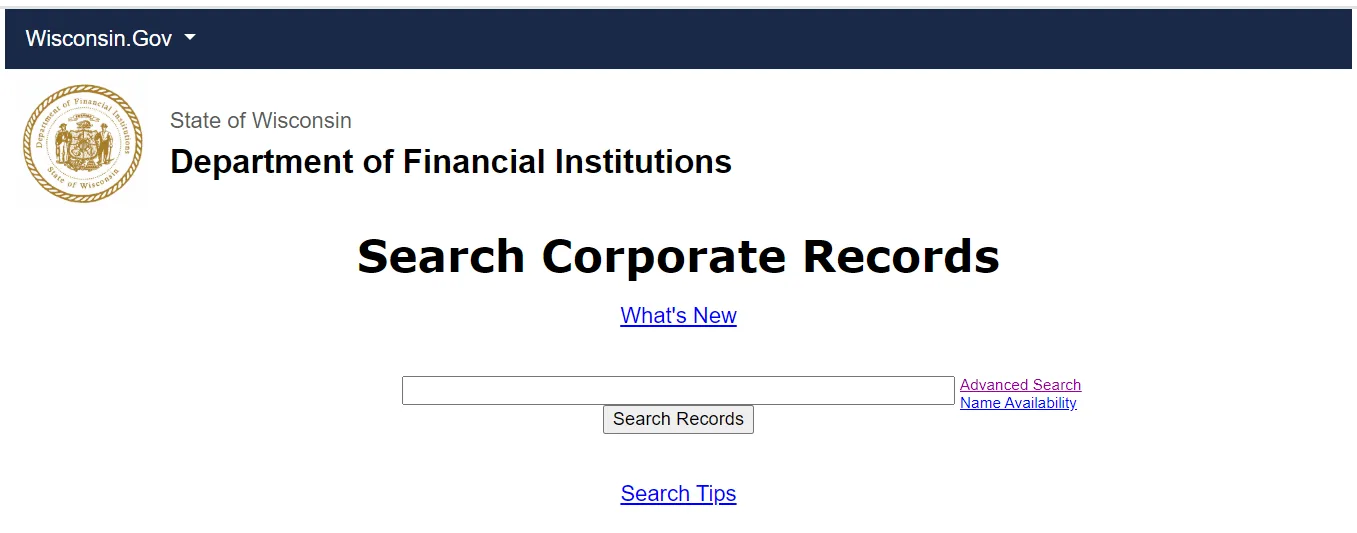
DFI counts every result as tentative until a filing is examined and stamped FILED. So a name that looks open can still get bounced. Not ready to file yet? Form 1 holds a name for 120 days for $15, as of 2026.
Step 2: Appoint a Wisconsin registered agent
Every Wisconsin LLC needs a registered agent with a real street address in the state, never a P.O. box or a mailbox service. It can be you, another member, or a hired service, but the LLC can’t act as its own agent.
Form 502 asks for the agent’s email too, since that’s where the DFI sends annual report notices and service of process. No Wisconsin address, or you’d rather keep yours off the public record? A paid agent is the one service genuinely worth it.
Step 3: File Form 502, your Articles of Organization
This is the filing that actually creates the company. You submit Form 502, the Articles of Organization, through DFI’s Business Entity File Online portal for $130, or by paper for $170, as of 2026.
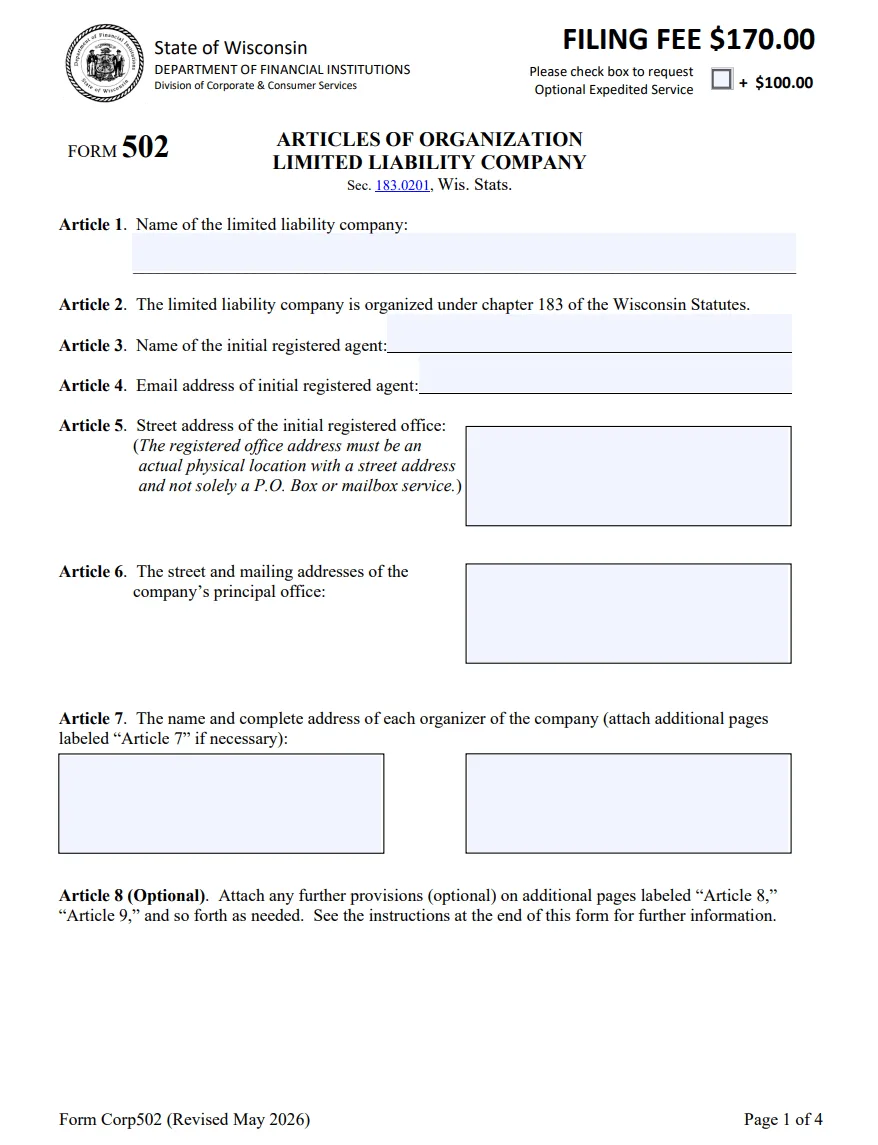
Online filings are usually accepted on receipt, with notice back right away. DFI publishes no standard paper turnaround, so online wins when timing counts; this is how long a Wisconsin LLC takes to clear in practice.
In a hurry? Expedited service adds $100 for next business day, $250 for four-hour counter handling, or $500 for one-hour service, as of 2026.
The first thing I tell every Wisconsin client: you’re not filing with a Secretary of State. Wisconsin runs business formation through the Department of Financial Institutions, and folks lose days hunting on the wrong website. File Form 502 online with the DFI, pay the $130, and you’ll usually have acceptance before you close the tab. Bookmark the DFI page, not some generic state portal.
Step 4: Write an operating agreement Wisconsin won’t ask for
Wisconsin won’t make you file an operating agreement, and Form 502 has nowhere to attach one. It still matters, because state law treats your LLC as member-managed unless a written agreement hands control to named managers.
For a solo owner, it sets the rules before you ever bring in partners or sell. For several members, it governs voting, profit splits, and exits. Build yours from a Wisconsin-specific operating agreement, not a generic template off the web.
Step 5: Get your federal EIN from the IRS
Once the LLC exists, grab an EIN from the IRS. It’s free, the online application takes minutes, and you’ll need it for a bank account, payroll, and federal taxes.
Form the company first, so the name on the EIN matches your DFI record exactly. When you’re set, here’s how to get an EIN without the usual rejections.
Step 6: Register for Wisconsin taxes with the Department of Revenue
If you’ll sell taxable goods, hire staff, or collect sales tax, you register separately with the Department of Revenue. Wisconsin Business Tax Registration sets up the seller’s permit and withholding accounts, and it’s a different filing from your DFI formation.
Not every LLC needs it. A consultant with no taxable sales and no employees often skips it, while a retailer registers before the first sale. Skipping it when you owe sales tax is how penalties start.
Step 7: Open a bank account and check your federal reporting
With DFI approval and your EIN in hand, open a dedicated business bank account. Keeping company and personal money apart is what stops your liability shield from cracking in a dispute.
One federal item sits outside the DFI’s lane: beneficial ownership information reporting under the Corporate Transparency Act. The DFI doesn’t administer it and points filers to FinCEN, so confirm the current CTA reporting requirement directly with FinCEN rather than relying on a summary here.
Northwest works well if you want the Wisconsin agent and filing handled together.
You can file Form 502 yourself through DFI, but the registered agent, street address, and email still need to be right before you submit. Northwest can form your Wisconsin LLC and include registered agent service, so those details are not pieced together at the last minute.
Wisconsin LLC cost: the $130 filing fee and what recurs
The straight answer to how much an LLC costs in Wisconsin: $130 to file Form 502 online with the DFI, or $170 on paper, as of 2026. Both numbers match what DFI lists on its published corporation fee schedule.
After that, there’s one required recurring cost, the $25 annual report each year online. Everything else, an expedite, a name reservation, a paid agent, is optional.
The cheapest mistake in Wisconsin is paying $170 on paper when the same filing is $130 online and, in most cases, clears on receipt. The second is handing a formation mill $300 to click buttons you can click yourself. The state fee doesn’t change based on who hits submit. If you want to know which services actually earn their keep, we reviewed the Wisconsin formation options, and most of what you’d pay for is a registered agent you might not even need.
Wisconsin LLC annual report and taxes: Form 5, $25, no franchise tax
Every Wisconsin LLC annual report is filed on Form 5 with the DFI, for $25 online or $40 on paper, as of 2026. You can’t skip it, and a missed report puts your good standing on the line.
The due date is where Wisconsin gets specific. Your report is due during the calendar quarter that matches your formation anniversary, not on one statewide date.
| Formed between | Annual report due by |
|---|---|
| January 1 and March 31 | March 31 |
| April 1 and June 30 | June 30 |
| July 1 and September 30 | September 30 |
| October 1 and December 31 | December 31 |
Those quarter rules come straight from DFI’s annual report instructions. Set a reminder the day you form; here’s the Wisconsin annual report filing walkthrough, start to finish.
Wisconsin’s quarterly deadline catches people who borrowed a friend’s date from another state. Form in August and your report is due September 30 every year, not next spring. I’ve watched owners get administratively dissolved over a $25 form they just forgot. The day your filing is accepted, write the quarter-end on your calendar and treat it like rent.
What taxes does a Wisconsin LLC pay?
Wisconsin charges no separate LLC franchise or privilege tax just for existing, the kind of flat yearly entity tax you’ll find in states like California. Your LLC is taxed instead on how it’s classified for federal purposes.
| If your LLC is taxed as | Wisconsin return | Note, as of 2026 |
|---|---|---|
| Single-member, disregarded | Owner’s individual return | No separate state LLC return |
| Partnership (multi-member) | Form 3, Wisconsin Partnership Return | Optional 7.9% entity-level tax via Schedule 3-ET |
| C corporation | Form 4 or Form 6 | Corporate franchise/income rate 7.9% |
| S corporation | Form 5S | Optional 7.9% entity-level tax |
There’s one more line to watch. The Wisconsin Economic Development Surcharge hits businesses at $4 million or more in gross receipts and, since 2013, no longer touches LLCs taxed as partnerships. The classification rules above come from Wisconsin DOR Publication 119.
Wisconsin business licenses, permits, and DBAs: what an LLC doesn’t cover
Forming the LLC and getting a business license in Wisconsin are two different jobs. Wisconsin has no single general state business license, so what you need depends on your trade and your city.
A restaurant needs health permits, a contractor needs trade credentials, a retailer needs that seller’s permit from the Department of Revenue. The DFI filing on its own doesn’t authorize regulated work, so check your municipality and your industry board early.
A DBA, called a registered firm name or trade name in Wisconsin, is a separate step again. You register one only when you want to trade under a name that differs from your exact LLC name; run the business under its own name and you need none.
Is Wisconsin a good state to form an LLC? The real advantages
For a business that truly operates here, Wisconsin is a quietly good place to form. The filing fee sits mid-range, the online system is quick, and there’s no separate LLC franchise tax nibbling at thin early margins.
The practical edge is speed. An online Form 502 that clears on receipt beats the multi-week queues you hit in slower states. Boost Suite’s editorial line is plain: file directly with the DFI and skip the markup that formation packages bake in.
Here’s the catch worth flagging. Wisconsin is a marital-property state, so a married couple co-owning an LLC can’t simply treat it as a standard qualified joint venture. That setup needs a federal classification analysis, so check the treatment with a tax professional before you bank on the easy route.
Where Wisconsin LLC filings go sideways
Most Wisconsin filing problems are easy to dodge. The biggest is trying to register your Wisconsin LLC with the Secretary of State, an office that doesn’t handle business formation here at all.
Right behind it: paying $170 on paper when online is $130. Then missing your quarterly Form 5 window, listing the LLC as its own registered agent, or treating a DBA or city license as though it formed the company. Each is a fast fix early, and a costly one once it festers.
Wisconsin LLC FAQ
A handful of questions come up on nearly every Wisconsin formation, and the honest answers don’t always match what the ads promise.
Can I start an LLC in Wisconsin for free?
Not entirely, but closer than the ads suggest. The $130 online state fee is unavoidable, because it goes to the DFI, not to any middleman. What’s free is the labor. You file Form 502 yourself, act as your own registered agent if you qualify, pull a no-cost EIN from the IRS, and draft your own operating agreement. A “free LLC” offer usually just absorbs the typing and recovers the cost through registered-agent renewals later. File direct, and the only money leaving your pocket is the state’s.
How long does it take to get an LLC in Wisconsin?
Online, often minutes. DFI states that online filings are, in most cases, accepted on receipt, with notice back immediately. Paper is slower, and the DFI publishes no standard turnaround, which is exactly why the online route is worth it. If you truly can’t wait, expedited service runs from $100 for next business day up to $500 for one-hour counter handling.
Can I be my own registered agent in Wisconsin?
Yes, within one limit. You can serve as your own agent if you’re a Wisconsin resident with a physical street address in the state, and you’re reliably there during business hours. The LLC itself can’t be its own agent, and a P.O. box won’t qualify. The real trade-off is privacy and availability: your address goes on the public record, and you have to be present to accept service of process. Owners who travel or work from home usually hand this to a paid agent.
Can a married couple run a Wisconsin LLC together?
They can, but the tax side isn’t automatic. Because Wisconsin is a community-property state, a married couple’s LLC doesn’t drop neatly into the usual federal qualified joint venture election the way a non-entity spousal business might. The IRS applies special rules to married-couple state-law entities in community-property states, so the correct classification turns on your specific facts. Have a tax professional confirm how the LLC should file before your first return, rather than assuming the simplest treatment carries over.
Is Wisconsin an anonymous LLC state?
Not really. Wisconsin gives you some privacy, because the DFI doesn’t make you list every beneficial owner just to form the LLC. But Form 502 still puts your registered agent, registered office, principal office, and organizer on the public record, and the annual report names at least one member or manager. If genuine anonymity is the goal, Wisconsin is the wrong state for it.
Does Wisconsin offer a series LLC?
Not as a distinct filing, based on the DFI’s current formation menu, as of 2026. Wisconsin’s Chapter 183 mentions series of interests in some contexts, but that isn’t the same as the protected-series LLC systems running in Delaware, Texas, or Illinois. Need a series structure to wall off assets? Confirm it with counsel first; the standard Form 502 won’t create one.
- IRS, Election for Married Couples Unincorporated Businesses
- Wisconsin DFI, Business Entity File Online
- Wisconsin DFI, Corporation Fees
- Wisconsin DFI, Articles of Organization (Form 502)
- Wisconsin DFI, Annual Report Instructions (Form 5)
- Wisconsin DFI, Business Entity FAQs
- Wisconsin DOR, Publication 119 (Limited Liability Companies)
Form your Wisconsin LLC with ZenBusiness
ZenBusiness makes it easier to launch your Wisconsin LLC by helping you prepare and file your formation documents with the Wisconsin DFI, so you can start your business with confidence.