

A business purpose statement, also known as a limited liability company purpose statement, LLC purpose statement, or LLC business activity purpose, is an important part of the LLC formation process.
State-Specific Requirements for Business Purpose Statements
Requirements for business purpose statements vary significantly by state. Most states, including California, Texas, and Florida, accept general purpose statements where you can simply indicate ‘any lawful purpose.’ However, some states prefill broad language (for example, New York’s “any lawful act or activity”), while others ask for a short “general character of the business” line (Massachusetts).
Before drafting your purpose statement, check your state’s specific requirements on the Secretary of State website or other official state filing office portal. Some states provide a checkbox on the formation documents, while others require a written statement. A handful of states, including Arizona and Nevada, use NAICS codes instead of written purpose statements. Understanding your state’s expectations upfront saves time and prevents filing rejections that can delay your Limited Liability Company (LLC) formation by weeks.
LLC Purpose Clause in Ohio, Illinois, and Florida
Ohio doesn’t require a purpose clause. Under Ohio Revised Code § 1706.16, the Articles of Organization must give the LLC’s name and its statutory agent, with the agent’s signed acceptance, and may add any other matters the organizers choose. The Purpose field on Form 610 is marked optional, so it can be left blank or filled with a short line describing the business.
Illinois is the opposite case: 805 ILCS 180/5-5 makes the purpose a required item, and allows it to be stated as the transaction of any or all lawful business for which limited liability companies may be organized under the Act. The Articles of Organization (Form LLC-5.5) print that wording already, with room below for a narrower purpose. A professional LLC has to name the professional service it will provide.
Florida’s Articles of Organization (form CR2E047) have no purpose field. The six articles cover the name, the principal office, the registered agent, the people authorized to manage the LLC, an optional effective date, and “other provisions, if any.” A Florida LLC that wants a purpose statement on record adds it under Article VI.
General LLC Purpose Statement Examples
As I’ve already mentioned, many states that only require a general business purpose statement allow you to simply check a box indicating your company’s purpose. However, if there’s a field for you to write in your LLC’s purpose, the level of specificity you use to create your business purpose statement is up to you.
Here are some general business purpose statement examples:
“The purpose for which this LLC is formed is for any and all lawful purposes and business activities permitted by limited liability companies according to the laws in the state of ____.”
“The purpose for which this company will be organized is lawful business transactions, as well as any and all lawful purposes that are allowed to limited liability companies in accordance with _____ state law.”
“This LLC is organized for any and all lawful business activities that a limited liability company is permitted to perform according to the state laws in ____.”
“For any and all lawful activities for which limited liability companies can be organized in ___.”
You can use any of these general business purpose examples or their variations. They all essentially convey the same message, just in different ways.
Specific Business Purpose Statement
If your state requires a specific business purpose statement rather than a general purpose statement, you have a few options.
- A few words
- A phrase
- A complete sentence
None of these options for business purpose statements are better or worse than the others. However, choosing a complete sentence could provide a more clear purpose and establish clear goals, which is a good way to protect your business in the event that it faces legal troubles in the future.
Business Purpose Examples in a Few Words
- Coffee shop
- Gym, fitness center, or yoga studio
- Online retail
- Pizza shop, cafe, or restaurant
- Business consulting
- Computer repair services
- Shipping and logistics
Business Purpose Examples in a Phrase
- Freight services nationwide for the furniture industry
- Frozen yogurt shop, as well as packing and shipping operations
- The manufacturing and logistics of medical supplies and devices
- The sale, purchase, and investment of real estate in the state of ____
Business Purpose Examples in a Complete Sentence
- “The business activities of this LLC will involve the research and development of new and innovative block-chain technologies, as well as an online publication and a paid subscription newsletter.”
- “The purpose of this business is to provide online courses for programmers in several formats. In addition, this business will serve as a national referral network for recruiting.”
- “The purpose of this LLC is to acquire land and construct new homes, as well as selling and transferring various types of property rights and contracts in the state of ____.”
It’s important to note that you can enter more than one sentence in your business purpose statement. I mostly list one-sentence statements here because that’s the format many businesses adopt, but you can add as many as you’d like for the sake of specificity.
Why Does My Company Need a Purpose Statement?
Your business purpose statement matters for two critical reasons. First, most formation forms include a purpose line as part of your formation documents (and it is often broad or even prefilled). Second, it provides operational clarity and can help keep your filings and real-world activities consistent for practical needs like opening a dedicated business bank account or licensing.
Members can vote to dissolve an LLC that’s no longer serving its stated purpose, but liability protection generally depends on how the LLC is operated (for example, avoiding fraud and keeping proper separation), not on whether the purpose sentence is highly specific.
What’s the Difference Between Vision, Mission and Purpose Statement?
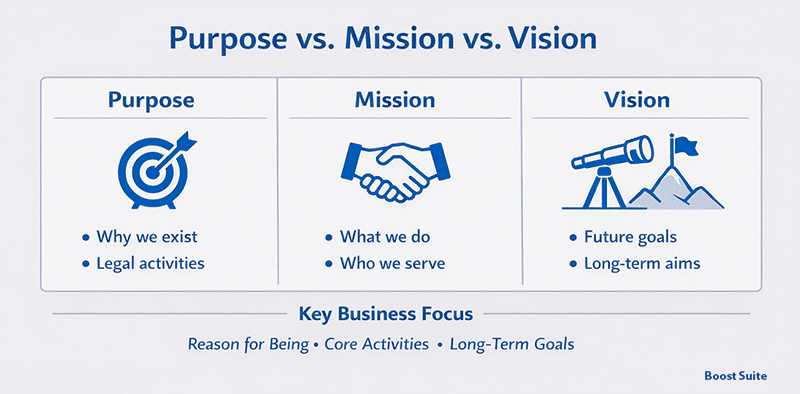
While the terms ‘vision,’ ‘mission,’ and ‘purpose’ often get used interchangeably, there’s a key distinction when forming your LLC. Your business purpose statement (required for state filing) explains why your company legally exists and what activities it will conduct. This differs from your mission statement (what you do and for whom) and vision statement (your long-term goals). For LLC formation purposes, focus on crafting a purpose statement that satisfies state requirements while providing liability protection.
Vision
A company’s vision is what it strives to be. It’s the goal that everyone is working towards. It can give everyone working at the company a clear idea of where they should aim their focus to help the company achieve its goals and stay aligned with its core values.
According to a widely shared story from JFK’s 1962 visit to NASA, when the president asked a janitor about his job, the man reportedly replied, ‘I’m helping put a man on the moon’—illustrating how a clear company vision aligns every team member toward the same goal. This illustrates that a company’s vision is the foundation necessary to give each employee an idea of the direction your organization is headed.
Mission
A company’s mission statement should define what the organization does, who it does it for, and the main business objective behind those activities. Of course, you can add an explanation about the benefits your company provides to your company mission statement as well.
Mission statements don’t have to be dramatic or wordy. In fact, OzHarvest’s mission is simply “Fight food waste.” It’s simple, direct, and to the point, describing exactly what the company does.
Your company’s mission can direct its operations because if your mission is to provide fresh, seasonal produce, then this mission will affect business decisions, such as where you purchase your produce and when you rotate your stock.
Purpose
Your company’s purpose statement provides an explanation for why it exists (and in a broader entity context this is often discussed as a corporate purpose). It’s different from the mission statement, which explains what your company does and for whom.
You can decide to have both a mission statement and a purpose statement, or decide to operate with only a purpose statement. This decision depends on how much importance you place on your mission and vision statements, as well as the nature of your business and the services you provide.
Where Your Purpose Statement Appears in Formation Documents
Your business purpose statement gets documented in your Articles of Organization (also called Certificate of Formation in some states), which is the primary document you file with your state to create your LLC (a corporation usually uses Articles of Incorporation instead). This is a permanent public record accessible through your state’s business entity database.
Most states include a designated field or section labeled ‘Purpose of the LLC’ or ‘Nature of Business’ on their formation forms. In states that use online filing systems, you’ll typically find this field on page 1 or 2 of the digital form. For paper filings, it usually appears in the middle section after company name and registered agent information.
If you’re using a formation service, they’ll guide you through filling out this field. If filing yourself, download your state’s official formation form from the Secretary of State website, where you’ll see exactly where the purpose statement belongs.
Need help filing your LLC?
If you want a cleaner filing process and fewer upsells, Northwest can help you set up your LLC and keep your documents organized from the start.
Which Is Better: A General or a Specific Business Purpose?
In most instances, one isn’t any better than the other in the eyes of government agencies. It typically depends on how much work you want to put into developing your purpose (and many founders choose broader wording when launching a startup that may pivot early). But there’s one specific instance where writing a more specific purpose statement can really benefit your company, and that’s when you need clearer wording for practical reasons like licensing, banking, contracts, or internal alignment. This quick comparison helps: LLC vs business license requirements.
It can be quite easy to focus on creating a great company that competes with other businesses in the area and successfully makes money, and completely forget about protecting your liability protection in the process. A vague business purpose clause does not, by itself, make members personally liable; veil-piercing usually turns on alter-ego factors (e.g., commingling funds or fraud), and modern LLC statutes broadly allow “any lawful business,” so operating within the law and keeping clean separateness is what preserves liability protection.
A too-narrow purpose statement usually does not destroy your LLC liability protection by itself, but it can create practical problems if your business expands beyond what you filed. In that case, you may need to amend your formation documents, and you may face extra questions from banks, licensing agencies, or contract partners.
So creating a clear and concise business purpose statement is crucial for future business success.
Even though writing a specific business purpose appears to mean that you must specify which business activities you’ll conduct, you need to ensure that you leave room for business growth and innovation. If your business offers other services in the future, you’ll be thankful for this foresight.
An example of leaving room would be:
“The purpose of this LLC is to buy and sell real estate, as well as any and all lawful activities allowed by LLCs in the state of ___.”
In this example, the particular business activity of the company is specified, but it leaves room for other activities as well.
- Do you need maximum flexibility to add new lines of business soon?
- Are you in a licensed profession that must specify services?
- Will a concise activity + “any lawful activities” tail cover realistic pivots?
Can I Change My LLC’s Purpose Statement in the Future?
Although nearly any bit of information you include with your formation documents seems like it’s set in stone upon filing, purpose statements aren’t.
Many states collect a brief purpose or, more commonly, an NAICS code to classify your industry; how that data is used varies by state.
The fact is that an LLC usually grows and changes over time, so it could have more than one purpose at any given time, or the business purpose of your company could change from the original purpose statement as the scope of business activities expands.
The good news is that most states will allow you to change your company purpose statement with an amendment to your LLC Articles of Organization.
Another important thing you should remember if you’re changing your company’s purpose is that you’ll also need to make an amendment to your LLC operating agreement. This typically requires members (and managers, if manager-managed), following the operating agreement, to approve whether to amend the document and accept the new purpose statement.
If you are not sure which structure you chose, use this member-managed vs. manager-managed breakdown.
NAICS Code Used for LLC Business Purpose Statement
In some states you aren’t required to make either a general or a specific statement but are instead required to designate the reason your company exists by selecting the appropriate NAICS (North American Industry Classification System) code.
Some states or agencies may also ask for an NAICS code to classify your industry (and federal agencies such as the Internal Revenue Service (IRS) may use business activity information for tax-administration purposes), but it does not replace your legal authority to engage in lawful business. The NAICS system is used by federal statistical agencies to classify business establishments for data collection and analysis.
This six-digit numeric code is used by federal statistical agencies as a standardized classification system for businesses, and it’s maintained by the Office of Management and Budget in partnership with Statistics Canada and Mexico’s INEGI. If a form asks you to choose one, follow these NAICS code lookup steps.
Conclusion
Your company’s business purpose statement is as important as many of the other decisions you’ll make for your company while filing your Articles of Organization and forming your business. It’s crucial that you choose the wording of your business purpose carefully to avoid future legal woes, but in general most states don’t strictly regulate purpose statements, so you can create a purpose statement of only a few words if you choose. Even better, you can amend your purpose statement whenever you want to, so even though careful thought should be given to your business purpose, it’s not something that’s set in stone or permanent, so there’s no undue stress involved.
While you’re learning about business purpose statements and filing your formation documents, check out my article about How to Form an LLC.
And if you’d like to learn more about LLC formation services, read my article about the Best LLC Services.
FAQ: LLC Business Purpose Statements, NAICS Codes, and PLLC Rules
Choosing the right purpose line for your filing? This FAQ connects directly to the examples above and explains when a general “any lawful purpose” clause is accepted (e.g., Delaware), when the state pre-fills the language (e.g., California Form LLC-1), when licensed professions must name the service in a PLLC, how NAICS codes classify your industry without replacing purpose text, and how to amend your purpose later if your activities expand.
Do I need a specific business purpose for LLC in California?
In California, the Articles of Organization (Form LLC-1) include a fixed clause allowing “any lawful act or activity.” You generally do not customize the purpose text on the form.
What’s the difference between an NAICS code and a purpose statement?
An NAICS code classifies what industry you’re in for statistical/administrative use. A purpose statement is a short description of what your company is formed to do; some states accept a very broad statement, and some ask you to pick an NAICS code as well.
When must I use a PLLC and specify the professional service?
If you’re in a licensed field (e.g., law, medicine, engineering), your state may require a Professional LLC and a purpose that names the licensed service. Check your state’s professional-entity rules before filing.
Can I change my LLC’s purpose later?
Usually yes. You can file a certificate of amendment to update the Articles of Organization and also revise your operating agreement to keep everything consistent.
What happens if I start doing business activities outside my stated purpose?
If you listed a specific purpose and later expand into new activities, you may need to amend your Articles of Organization so your public filing better matches what the business is actually doing. In many states, a broad purpose clause such as “any lawful business, purpose or activity” is already acceptable, which is why many LLCs use flexible language from the start. Amendment fees vary by state (for example, California’s LLC-2 amendment form lists a $30 filing fee.
Can a vague purpose statement hurt my LLC?
Usually not in a major legal sense, especially because many states already allow very broad purpose language. Delaware, for example, allows an LLC to carry on “any lawful business, purpose or activity.” A broad purpose is often perfectly acceptable. The more practical risk is that an overly narrow purpose may create extra admin work later if you expand into new activities and need to update your filing.
Is my business purpose statement public information?
Yes. Your Articles of Organization, including your purpose statement, become part of the public record once filed with your state. Anyone can access this information through your Secretary of State’s business database. This is why some entrepreneurs prefer general purpose statements. They provide privacy about specific business plans while still meeting legal requirements.
If you want to confirm what shows up publicly, run a quick state business entity lookup.
- The Delaware Code Online: §18-106 (Nature of business permitted) “any lawful business.”
- California Secretary of State: Form LLC-1 (Articles of Organization)
- California Secretary of State: Form LLC-2 (Amendment)
- Secretary of the Commonwealth of Massachusetts: Massachusetts Certificate of Organization (field: “general character of the business”)
- U.S. Census Bureau – NAICS: Introduction to North American Industry Classification System (NAICS)
- New York Dept. of State: Forming a Limited Liability Company in New York
Start your LLC with Bizee
If you want a budget-friendly way to form your LLC, Bizee can help you get started with a simple filing process and optional add-on support as your business grows.