

A North Carolina LLC starts with one filing: Articles of Organization, sent to the North Carolina Secretary of State for $125 as of 2026. The bigger surprise tends to come later, in the $200 annual report due every April 15. This guide walks the full sequence and the real requirements, from clearing your name to registering for the state taxes that actually apply to you.
Where you file a North Carolina LLC, what it costs, and what comes next
- Filing office: North Carolina Secretary of State, online through Online Services / Business Registration.
- Document: Articles of Organization.
- Filing fee: $125 as of 2026.
- Faster options: $100 for 24-hour processing, or $200 for same-day if the office has it by noon.
- Recurring: a $200 annual report, due April 15 every year.
- Publication: none; North Carolina requires no newspaper notice to form an LLC.
- State tax: no separate LLC franchise tax on a default pass-through; corporate rules apply only if you elect corporate treatment.
- Who it fits: anyone operating here; out-of-state owners can file too, but still need an in-state registered agent.
- Contact: North Carolina Secretary of State Business Registration, sosnc.gov, (919) 814-5400.
How to Form a North Carolina LLC: Filing Articles of Organization with the Secretary of State
There’s not much to how to start an LLC in North Carolina: one state filing, no publication step, and a short list of follow-ups once the state approves you. Work them in this order and you’ll skip the back-and-forth that slows people down.
Step 1: Name your LLC and clear it in the Business Registry
North Carolina wants a proper designator on your name. It has to include the words limited liability company or an abbreviation like LLC or L.L.C., per G.S. 55D-20, and it can’t suggest a purpose the law doesn’t permit.
Before you commit, search the name in the NC Secretary of State Business Registry and check exact and close matches. A name conflict is a common reason a filing gets rejected, so this quick search saves a round trip.
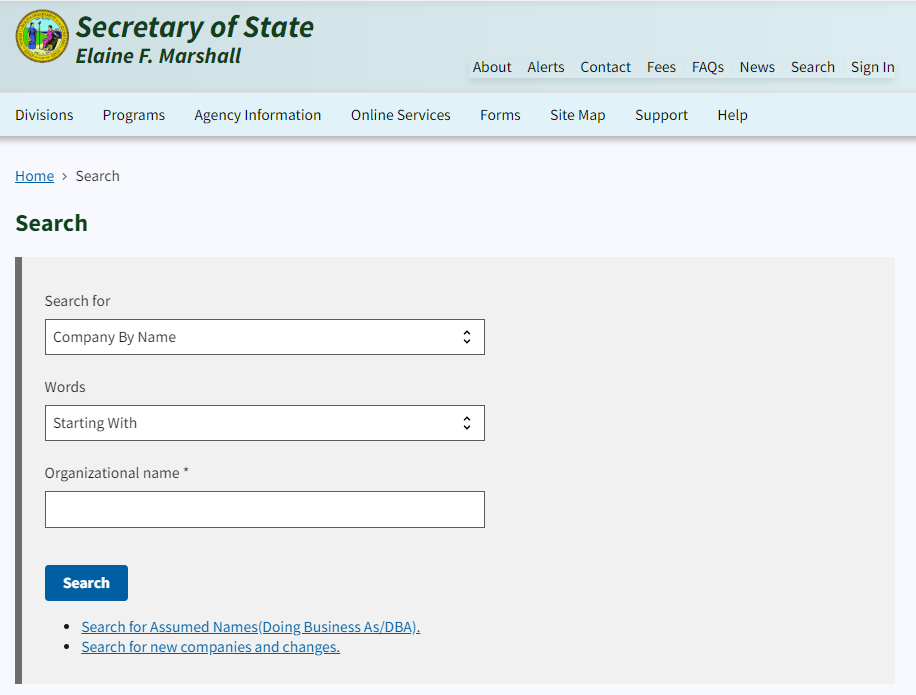
If you’re not ready to file, a $10 Application for Reserved Name (G.S. 55D-23) holds your pick for a nonrenewable 120 days. Our North Carolina business entity search walkthrough shows you how to read the results.
Step 2: Appoint a North Carolina registered agent
Every North Carolina LLC needs a registered agent and a registered office in the state, under G.S. 55D-30. The agent accepts legal service and official mail, and the registered office has to be a physical street address in North Carolina.
You can act as your own agent if you’re an in-state resident with that office address, which the statute allows. Plenty of owners hire a North Carolina registered agent service instead, to keep a home address off the public record and avoid missing a notice while they’re away.
Step 3: Decide member-managed or manager-managed
Your filing asks who runs the company. A member-managed LLC is run by the owners themselves, which suits most single-owner and small businesses. A manager-managed LLC hands daily authority to appointed managers, which fits when some members are passive investors.
There’s no extra fee either way, and no wrong answer. Just match the structure to how decisions actually get made, because switching later means amending your operating agreement.
Step 4: File your Articles of Organization with the North Carolina Secretary of State
This filing is what legally creates the company. Submit your Articles of Organization to the North Carolina Secretary of State Online Services portal with the $125 fee (G.S. 57D-1-22). The form asks for the LLC name, the registered office and agent, the county, and whether each signer is a member or organizer.
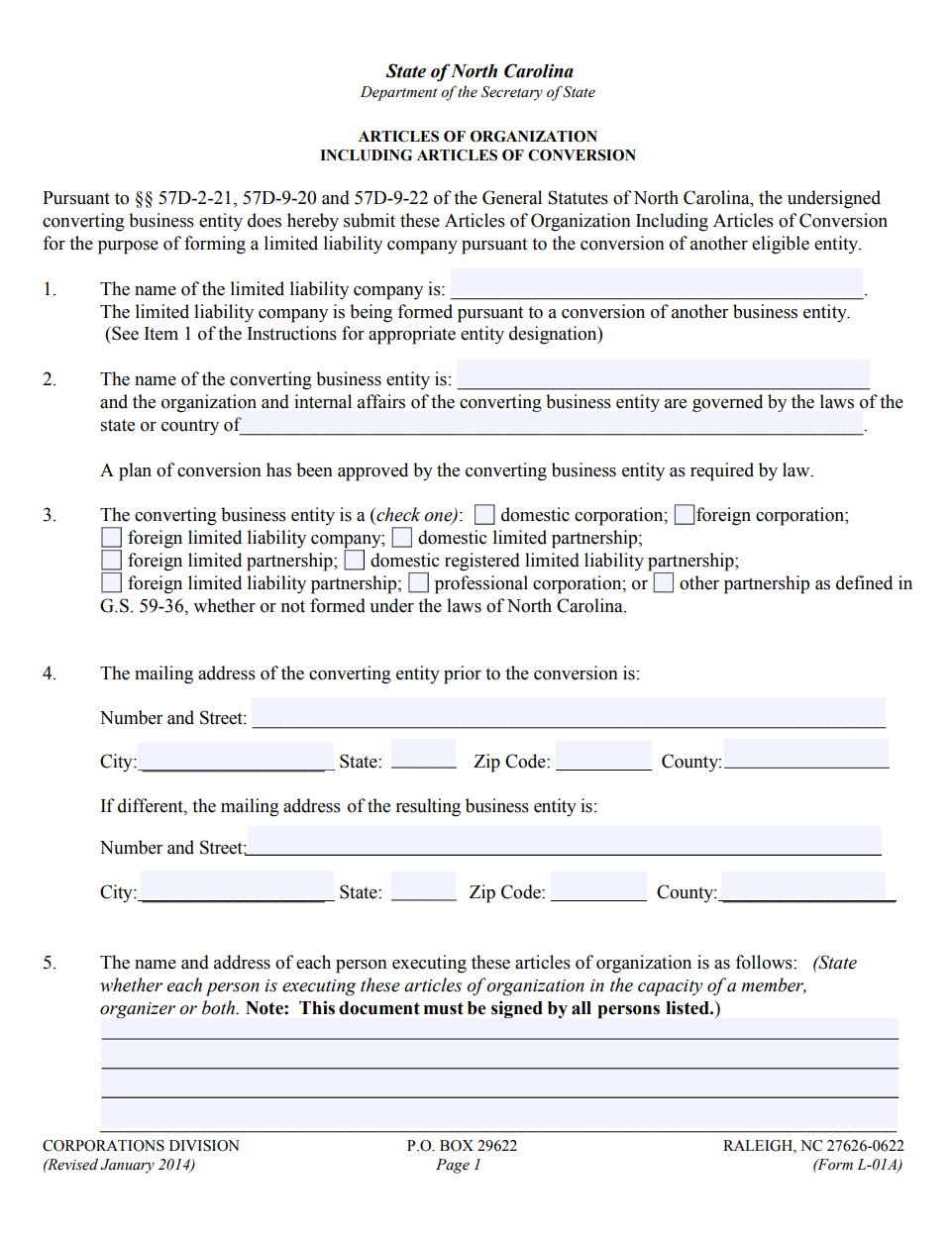
Online filing beats mail for speed and tracking. When a closing or loan deadline is tight, the statutory expedites help (G.S. 55D-11): $100 buys 24-hour processing, and $200 buys same-day service if the office has your documents by noon. Filing those Articles is the step that creates your North Carolina LLC registration with the state.
Step 5: Create your operating agreement
North Carolina doesn’t require you to file an operating agreement, and the statute even recognizes written, oral, or implied ones. Don’t take that as a reason to skip it. In practice, your bank will usually ask for one, and so will most partners and investors.
A solid North Carolina LLC operating agreement sets ownership percentages, profit splits, voting rights, and what happens when a member exits. For a single-member LLC, it also reinforces the legal line between you and the company that your liability protection depends on.
Step 6: Get your federal EIN from the IRS
Form the LLC first, then apply for the employer identification number. The order matters, because the EIN attaches to your registered legal name, and the IRS itself says to form with the state first. The IRS EIN application is free and issues your number on the spot online.
You’ll need it to open a bank account, hire, or file taxes as anything beyond a sole proprietor. The full walkthrough lives in our guide to getting an EIN without paying a markup for it.
Step 7: Register with the North Carolina Department of Revenue if a tax account applies
Filing with the Secretary of State doesn’t register you for state taxes. That’s a separate step at the North Carolina Department of Revenue, tied to the tax accounts your business actually needs. You register when you collect sales and use tax, withhold from employee wages, or owe another covered state tax.
Use the NCDOR Online Business Registration system to set up your account ID number; the paper route is Form NC-BR, which covers withholding and sales and use among other accounts. A solo LLC with no employees and no taxable sales may have no account to open yet, so match the registration to what you actually do.
Step 8: Open a business bank account and keep clean records
Bring your stamped Articles, your EIN, and your operating agreement to the bank. A dedicated business bank account keeps personal and company money apart, and that separation is what protects the liability shield your LLC exists to give you.
Commingling funds is how owners quietly undercut their own protection. Set up real bookkeeping from day one, even as a single member; a separate card and a simple ledger are enough to start.
Northwest is useful when the North Carolina address is the part slowing you down.
The Secretary of State form is short, but it still needs a registered office, registered agent, county, and signer role before you can submit. If you do not want to use your home address or chase those details separately, Northwest can form the LLC and include registered agent service in the same order.
How Much a North Carolina LLC Costs
Totaling the North Carolina LLC cost is simple. You pay $125 to form, and the only fee that comes back around is the $200 annual report. Here’s the full fee picture as of 2026.
| Item | Amount (2026) | When it applies |
|---|---|---|
| Articles of Organization filing fee | $125 | Once, to form |
| Name reservation | $10 | Optional, holds a name 120 days |
| Expedited filing | $100 (24-hour) or $200 (same-day) | Optional, if you need speed |
| Annual report | $200 | Every year, due April 15 |
| Foreign LLC Certificate of Authority | $250 | If formed elsewhere, operating in NC |
Most people won’t touch the optional fees at all. On timing, rather than trust a fixed standard processing number, check the current estimate for how long a North Carolina LLC takes to approve, since the state publishes turnaround times that move with its workload.
How a North Carolina LLC Is Taxed
By default, a North Carolina LLC pays no tax of its own. North Carolina LLC taxes run on a pass-through basis: profit flows to the owners and lands on personal returns, so the company itself isn’t taxed at the entity level. How the IRS classifies your LLC drives the rest.
| Federal tax election | How North Carolina treats it |
|---|---|
| Single-member (disregarded) | Profit reported on the owner’s personal NC income tax return |
| Multi-member (partnership) | Profit passes through to each member’s personal return |
| S corporation | Pass-through; can reduce self-employment tax on part of the profit |
| C corporation | Entity pays NC corporate income tax of 2.00%, plus franchise tax |
Only that last row carries an entity-level bill. Elect C corporation treatment and the North Carolina Department of Revenue applies a 2.00% corporate income tax plus a franchise tax of $1.50 per $1,000 of tax base, with a $200 minimum. Most small owners never get there. Sales tax and payroll withholding are separate again, and they run through your NCDOR account. Your exact tax depends on how the IRS classifies the LLC and what you actually do in the state, so confirm your setup with an accountant.
The North Carolina Annual Report: $200, Due April 15
The North Carolina annual report is the recurring filing. It’s due by April 15 every year, costs $200, and goes to the Secretary of State (G.S. 57D-2-24). Your first one is due April 15 of the year following the year you formed.
The report keeps your company details current: registered agent, registered office, and principal officials. The requirement covers LLCs other than professional ones, so a PLLC follows a different rule. For the form fields and what reinstatement looks like after a missed deadline, see our North Carolina annual report guide.
Business Licenses, Permits, and Assumed Business Names (DBA)
Forming the LLC and being cleared to operate are two different things. North Carolina has no single statewide business license, which surprises owners coming from states that do.
What you actually need depends on the work. Some professions require a state license, and certain counties or cities add a local privilege license or permit, all laid out on North Carolina’s official business guide. You’ll usually settle it with a quick call to your city or county office.
If you’ll trade under a name other than your LLC’s legal name, North Carolina calls that an assumed business name, or DBA. You file an Assumed Business Name Certificate with your county Register of Deeds, not the Secretary of State, and the fee is set locally.
Why Form Your LLC in North Carolina Instead of Delaware or Wyoming
A lot of online advice points new owners toward Delaware or Wyoming. For a business that actually operates in North Carolina, that’s usually a detour that costs more than it saves.
What makes forming an LLC in North Carolina appealing is concrete: a $125 filing fee, no publication step, and no separate LLC franchise tax on a default pass-through. The corporate rate is only 2.00% if you ever elect that path. The state also runs free Small Business Centers, where counselors help with planning at no charge. The North Carolina small business statistics give a sense of the odds those counselors work with: 79.5% of new businesses in the state survive their first year, and 54.4% are still operating after five, above the national average.
Common North Carolina LLC Mistakes
A handful of errors show up again and again, and they’re all avoidable with a little timing.
- Picking a name that clears your head but not the Business Registry, then waiting on a refile
- Mixing up the one-time $125 filing fee with the recurring $200 annual report
- Assuming a default LLC owes North Carolina franchise tax, when that only applies to corporate-taxed entities
- Listing a P.O. box where the state expects a physical registered-office address
- Forgetting to register with NCDOR before you’re collecting sales tax or running payroll
- Skipping the operating agreement your bank later asks to see
North Carolina LLC FAQ
Straight answers to the questions that come up most when you form a North Carolina LLC.
How much does it cost to start an LLC in North Carolina?
It’s $125 to file your Articles of Organization, and that’s the only mandatory cost to form. After that, plan on $200 a year for the annual report. Optional costs include $10 to reserve a name ahead of filing, $100 or $200 to expedite, and a registered agent if you hire one. A default LLC has no separate franchise tax to budget for. So if you handle everything yourself, your true first-year minimum is the $125 filing fee, with the $200 report arriving the following April.
Can you start an LLC in North Carolina for free?
No, and any site advertising a way to start an LLC in North Carolina for free is shading the truth. The $125 state filing fee is mandatory, and the Secretary of State charges it whether you file yourself or pay a service to do it. What is genuinely free is cutting out the middleman: file the Articles yourself, act as your own registered agent, and get your EIN straight from the IRS at no cost. The ‘free’ formation services bury that $125 inside a package and add their own charges on top, so always read the total before you click.
How long does it take to form an LLC in North Carolina?
Online filings clear faster than mailed ones, and North Carolina backs that up with statutory expedites: 24-hour processing for $100, or same-day for $200 when the Secretary of State has your filing by noon. Standard, non-expedited timing moves with the state’s workload, so it isn’t a fixed number you can count on year-round. The Secretary of State actually tells filers to check the current turnaround on its site before submitting, so look there before you promise a date to a bank or a partner. Pay to expedite only when you’re genuinely on the clock.
Does a North Carolina LLC pay franchise tax or an annual fee?
Both halves matter here. A default North Carolina LLC pays no franchise tax, because the state’s corporate franchise tax reaches LLCs only when they elect to be taxed as a corporation. What every LLC does owe is the $200 annual report, filed with the Secretary of State and due April 15. Elect C corporation treatment and the picture shifts: then the 2.00% corporate income tax and the franchise tax apply at the entity level. For most small owners running a pass-through LLC, that annual report is the only recurring state obligation.
Can I be my own registered agent in North Carolina?
Yes. North Carolina lets you serve as your own registered agent if you’re a resident with a physical in-state street address where you can accept legal service during business hours. The trade-offs are real, though. Your address becomes part of the public record, and you have to be reliably available, which is hard if you travel or work from job sites. Owners who value privacy or flexibility can hire an agent. There’s no wrong answer here, only a choice you should make on purpose rather than by default.
Do I need a business license or a DBA for my North Carolina LLC?
Possibly, and they answer different needs. North Carolina has no general statewide business license, but your specific industry, county, or city may require a license, permit, or local privilege license, so check all three before you open. A DBA is separate: if you’ll trade under a name different from your LLC’s legal name, file an assumed business name certificate with your county Register of Deeds. Skipping either one is an enforcement risk that lands on you, not the state, and licensing snags have a way of surfacing at the worst possible moment.
How is a single-member LLC taxed in North Carolina?
By default, the IRS treats a single-member LLC as a disregarded entity, so the profit lands on your personal North Carolina income tax return rather than a separate company return. You’ll also owe federal self-employment tax on that profit. As your income grows, an S corporation election can trim the self-employment portion, which is worth modeling with an accountant before you elect. Either way, you still register with NCDOR if you sell taxable goods or have employees, even when the income itself passes through to you.
- SBA: Register Your Business
- North Carolina Secretary of State: Business Registration
- North Carolina Secretary of State: LLC Fee Schedule
- N.C. Gen. Stat. Chapter 57D: North Carolina Limited Liability Company Act
- North Carolina Department of Revenue: Corporate Income and Franchise Tax Rates
- North Carolina Department of Revenue: Business Registration
- IRS: Apply for an Employer Identification Number (EIN)
Launch Your North Carolina LLC the Smart Way with Bizee
Turn your 2026 business plan into a real North Carolina LLC with Bizee’s easy filing support, clear guidance, and tools built to help new owners get started faster.