

A North Carolina LLC takes 10 to 15 business days to clear the Secretary of State as of 2026. That is the processing time the Business Registration Division posts on its own homepage, and it runs about double what most formation guides quote. Knowing which number the state actually stands behind is what lets you promise a date to a bank or a landlord.
North Carolina LLC filings take 10 to 15 business days as of 2026, online or by mail, because both routes share one processing queue at the Business Registration Division; expedited service costs $100 for 24 hours or $200 for same day, and filing online before noon is the fastest route.
Anyone working to a fixed date should plan around the expedited cut-offs rather than the standard queue.
Portal: sosnc.gov online filing
Phone: 919-814-5400
Entity creation in North Carolina runs 10 to 15 business days
The Business Registration Division posts processing times of 10 to 15 business days for entity creation on its landing page, checked in August 2026. It applies to the Articles of Organization that form a North Carolina limited liability company, whether they arrive through the portal or in an envelope. If the paperwork itself is still coming together, the guide to starting a North Carolina LLC covers what goes on the form.
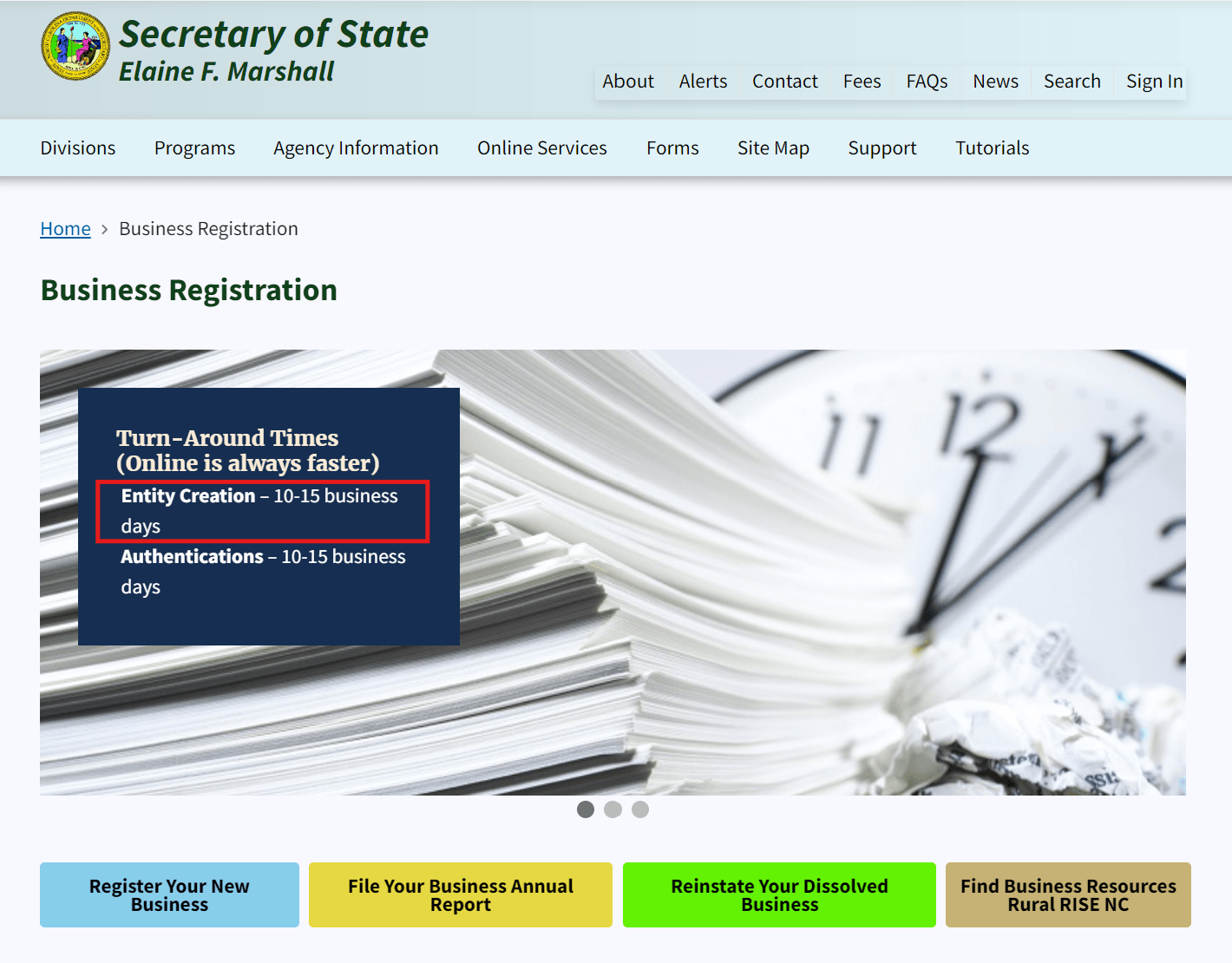
The state also publishes a faster figure elsewhere, and the two have never been reconciled. A portal guide page on the same website describes processing times as usually 5 to 7 business days. Where two official numbers disagree, the safer one to build a date around is the longer.
| Filing route | Turnaround the Division publishes |
|---|---|
| Online, standard | 10 to 15 business days |
| Mail, standard | 10 to 15 business days |
| 24-hour expedite | Examined within 24 hours of receipt |
| Same-day expedite | Examined by 5 p.m. if received by noon |
The banner is a live figure rather than a fixed standard. It is worth opening on the day you file, because the posted turnaround has not always matched the number in the state’s own portal guide.
Business days are not calendar days, and North Carolina counts them strictly. Converted, the processing window lands at roughly two to three calendar weeks once weekends and state holidays drop out. That places North Carolina toward the slower half of the country for standard entity creation.
North Carolina splits two ideas that most states blur. The expedited tiers guarantee an examination deadline, meaning a decision by a fixed hour, while the 10 to 15 day figure describes entity creation from end to end. A decision is not an approval, and here you can pay for the first and not receive the second.
North Carolina answers the turnaround question twice: 10 to 15 business days on the Division’s landing page and 5 to 7 business days in its own portal guide. I’ve been burned before by quoting the shorter number. When I see two official numbers on the same state site, I assume at least one has stopped being maintained, and nothing on the site tells me which one.
A 10–15 business day queue makes getting the filing right more important.
Northwest handles the formation paperwork and registered agent coverage, helping keep your North Carolina filing straightforward without adding another avoidable delay to an already long processing window.
How the filing channel and cut-off times affect your start date
Choosing to file online rather than by mail does not move you up the queue, it moves the day you enter it. North Carolina publishes a single processing time covering both routes, noting only that online is always faster. What actually separates them is transit and the rule that decides your submission date.
Anything submitted after 5 p.m. or on a weekend counts as received the next business morning at 8:00 a.m.
A Friday evening filing therefore starts processing on Monday. Filing documents before mid afternoon on a weekday is the difference between losing nothing and losing a weekend.
Paper filings pay transit twice, since the returned copy has to travel back to you. The Division also keeps two separate addresses that are not interchangeable. Regular mail goes to Post Office Box 29622 in Raleigh, while overnight and courier deliveries go to 2 South Salisbury Street.
Sending an overnight package to the post office box quietly undoes the reason you paid for overnight.
North Carolina guarantees expedited filings within 24 hours or the same day
Expedited service in North Carolina sits in statute rather than in office policy. Under G.S. 55D-11, the Secretary of State shall guarantee the expedited filing of a document that arrives in proper form with the applicable fees. That wording is why the deadlines below are enforceable rather than aspirational.
One constraint catches people out. A filer may request expedited service only at the time the document is submitted, so the option disappears the moment your filing enters the queue. On paper it goes on the BE-01 cover sheet, and online it is a field in the examination method step.
Set against a standard queue measured in weeks, the surcharge compresses that wait into a single day. The North Carolina LLC cost breakdown shows where the fee sits in the wider filing budget.
24-hour service costs $100 and runs from the time of receipt
The $100 tier guarantees the document will be reviewed and filed, or rejected, before 24 hours expire from the time it was received. Documents qualify when they arrive between 8:00 a.m. and 5:00 p.m. Weekends and holidays are excluded from the count.
Same-day service costs $200 and requires delivery before noon
The $200 tier requires the document to reach the office before 12 noon on the day the service is requested. The Division then guarantees a decision before 5:00 p.m. that same day. Miss noon by a few minutes and the fee buys nothing until tomorrow, which is documented on the Division’s expedited filings page.
What causes a North Carolina filing to be rejected
A refused filing comes back within five days of receipt, with the date of refusal and a brief written explanation, under G.S. 55D-15. That deadline cuts both ways. It also means silence past the fifth day is usually a good sign rather than a worrying one.
Rejection gets expensive once you have paid to rush. The Division treats a rejection notice as fulfilment of the expedited request, and states that no refunds of the expedited fee are issued once a document has been processed. You lose the surcharge and go back to standard processing.
Address verification stops more North Carolina filings than most filers expect. The Division checks every mailing address on the documents, including the registered office, against the United States Postal Service database of valid addresses. When the software reports an address as undeliverable it contacts you, and the filing waits until you confirm or correct it, as the Division’s filing tips explain.
Name conflicts are the older and more familiar problem, and the cheapest to avoid. The North Carolina business entity search queries the same database the examiner will use, so running it twice before filing costs nothing.
Registered agent details cause trouble more quietly, because the Division reads a variant spelling of an agent’s name as a change of agent. What matters more is appointing a registered agent in North Carolina who is genuinely reachable at the listed address.
Two provisions in Chapter 55D exist to stop small errors costing a full cycle. The Secretary of State may correct apparent errors and omissions on a submitted document, but only where the filer has authorized the correction. Granting that authorization up front turns a would-be rejection into a same-day fix.
The second is advisory review under G.S. 55D-12. For $200, the Secretary of State examines a document before submission and reports within 24 hours on anything failing North Carolina’s filing requirements. It costs the same as same-day service and buys certainty instead of speed.
I have rarely paid for North Carolina’s advisory review, and I want to be clear about why. At $200, it costs exactly what same-day service costs. For an ordinary Form L-01, I would rather read the address field twice and do the same basic check for nothing. I save that $200 review for documents someone else drafted, where an extra set of eyes can actually earn its keep.
Harbor Compliance is a strong fit if you want professional help getting your North Carolina filing details right before submission, especially the address and registered agent information that can hold a filing up.
Avoid Filing Mistakes with Harbor ComplianceWant a closer look first? See our Harbor Compliance review.
Where to download your stamped Articles of Organization
Approved documents wait in your online account instead of arriving by email. The Division puts it plainly: orders will not be e-mailed to you. You retrieve them by signing in, opening Check My Orders, then Entity Invoice Status, then the invoice number.
The window is what catches people. Documents stay available for thirty days from the date of the order, after which getting a copy becomes a paid request. Downloading on the day of approval takes a minute and removes the risk, as the Division’s order retrieval page sets out.
What you download is the filed document itself. The Secretary of State files a document by endorsing it with the word Filed alongside the official name and title, plus the exact date and time. That timestamp is your formation moment, not the day you happen to open the file.
One automatic email does exist, and it is easy to mistake for an approval notice. The Division sends a message to the address on the entity’s record whenever that record changes, as an anti-fraud measure. An address typed wrong at formation sends those alerts somewhere you will never see them.
The thirty-day download window is what actually costs my clients money. Someone files, gets busy, then comes back weeks later for a bank appointment only to find that the free copy is gone and a paid order has taken its place. The frustrating part is that the document itself never changed. Only the window for downloading it for free did.
Next steps after approval, and how long each one takes
The EIN is the quick one. The IRS issues it immediately at the end of the free online application, though the EIN tool keeps its own hours: weekdays 6 a.m. to 1 a.m. Eastern, Saturday 6 a.m. to 9 p.m., Sunday from 6 p.m. An approval that lands on a Friday evening still leaves several hours that night, and the North Carolina EIN walkthrough covers the application itself.
State tax accounts are a separate registration from the formation filing. Businesses that will withhold income tax or collect sales tax register with the North Carolina Department of Revenue, which issues most electronic applications an account number instantly. That step only matters once the business is actually operating.
Banks rarely ask for the stamped Articles of Organization. What they usually want is a certificate of existence, which is what North Carolina calls the document other states label a certificate of good standing. It is a separate order from the same Business Registration account, available once the entity is on the register.
Nothing at all is owed to the state during your formation year. North Carolina imposes no publication requirement and no initial report, so the first annual filing does not fall due until the following April. What the members agree between themselves is never filed with the Secretary of State either, so drafting it adds zero days to the timeline.
License requirements are the loose end. What applies depends on the trade and the locality, and each runs on a schedule of its own. None of it affects when the limited liability company itself comes into existence, only when it can start operating in a given trade.
Common North Carolina LLC timing questions
These come up once the main timeline is settled, usually when someone else’s calendar starts driving the filing date. Each one covers ground the sections above do not.
Can you set a future start date for a North Carolina LLC?
Yes, and the state caps how far ahead you can reach. A document may specify a delayed effective date, and North Carolina limits that to 90 days after the filing date. Form L-01 has a field for it, and naming a date without a time makes the LLC effective at 11:59:59 p.m. that day.
When does a new LLC appear in the North Carolina public register?
The entity joins the public register the moment the document is endorsed, not when you download your copy. That gap matters when a bank or a counterparty is verifying you before your own paperwork is in hand. The Division runs a dedicated search for newly registered companies and recent changes, which is where a brand new record surfaces first.
What happens if you spot an error after approval?
You file articles of correction rather than starting over. The correction takes effect as of the original document’s effective date, so your formation date generally holds. The correction itself rejoins the standard processing queue, which is the real argument for one more proofread before submission.
Is there anything to renew after the first year?
Nothing renews. The company exists until it is dissolved, and the only date on the calendar is the report North Carolina wants every April 15, and only from the year after creation.
- North Carolina Secretary of State, Business Registration Division
- Choose the Examination Method, North Carolina processing times
- Expedited Filings, Business Registration Division manual
- To View or Check Orders
- Filing Documents with the Business Registration Division
- North Carolina General Statutes, Chapter 55D, Article 2
- Annual Report Due Dates, North Carolina Secretary of State
Looking for an overview? See North Carolina LLC Services
File Your North Carolina LLC with Bizee
Bizee helps prepare and submit your North Carolina LLC formation documents correctly, so you can get into the state’s processing queue without unnecessary filing delays.