

Starting a Utah LLC as of 2026 means one thing most guides get wrong: there’s no Secretary of State to file with. Utah routes business formation through the Department of Commerce, Division of Corporations and Commercial Code, and the formation document costs $59. The Division approves most online filings the same day. The steps below run from name search to your first renewal.
Where you actually file a Utah LLC (hint: not the Secretary of State)
You form your company by filing a Certificate of Organization with the Division of Corporations and Commercial Code through the online Business Registration System, paying the $59 fee, with most filings approved the same day and an $18 renewal due every year in your formation anniversary month.
The essentials, in short:
- Filing office: Utah Department of Commerce, Division of Corporations and Commercial Code, Salt Lake City
- Document: Certificate of Organization, which is Utah’s name for the Articles of Organization
- Filing fee: $59, with optional expedited handling for $75
- Processing: the Division reports most filings approved instantly, the rest within two to four business days
- Recurring: $18 Annual Report/Renewal, due in your anniversary month
- Publication: none, since Utah asks for no newspaper notice
- Who it’s for: first-time founders, side-business owners, and anyone tired of paying a service to click the same buttons they could click themselves.
- Contacts: file at businessregistration.utah.gov; call (801) 530-4849 or (877) 526-3994 toll-free, 8:00 a.m. to 5:00 p.m. Mountain, Monday through Friday.
How to start a Utah LLC, from name search to Certificate of Organization
Six steps, and most owners handle every one of them without a lawyer. This is how to start an LLC in Utah the direct way, filing with the state yourself instead of paying a formation service a markup. Each step names the real Utah office, form, and fee, so you know what you’re paying for and when.
Step 1: Search and lock in your name
Your name has to clear two tests before Utah will take it. It must be distinguishable on the Division’s records, and it has to carry a valid designator: LLC, L.L.C., L.C., limited liability company, or limited company. Run your pick through the business entity search on Utah’s live business records first. A near-match with an existing entity is the most common reason a filing bounces.
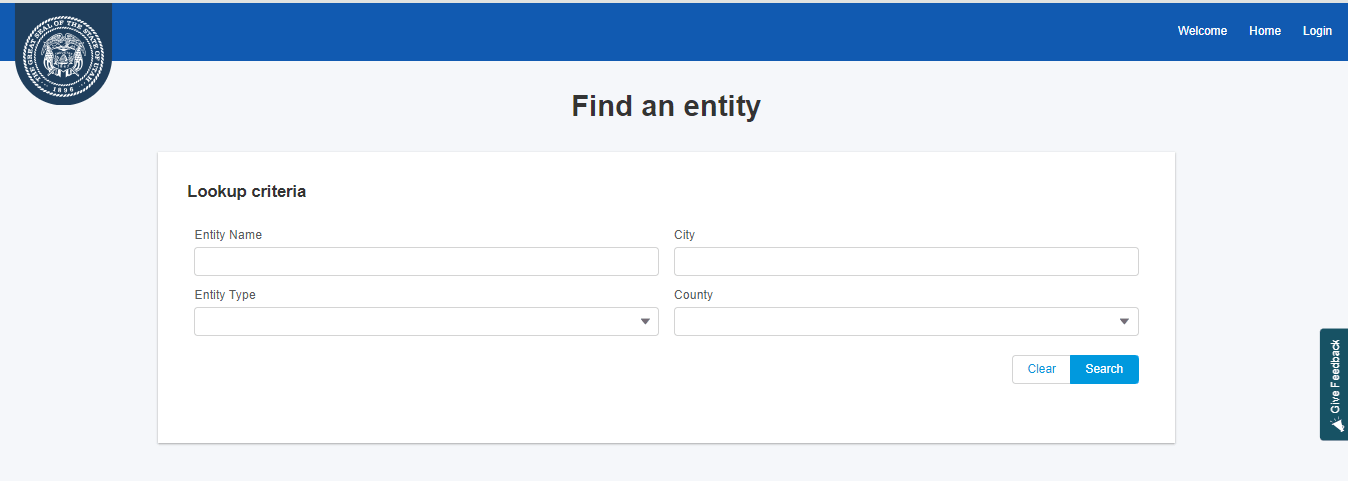
Utah also blocks names that imply a government agency or misuse terms like corporation or incorporated. If you’re not ready to file yet, a Name Reservation holds your choice for 120 days for $22.
Step 2: Appoint a registered agent with a Utah address
Every LLC needs a registered agent with an actual street address in the state, never a P.O. box. The agent can be you, another member, or a commercial service; Utah recognizes both commercial and noncommercial agents, and the filing affirms the agent has consented to serve. Plenty of owners act as their own agent to save money, which works fine if you keep regular hours at that address. If you’d rather not list your home, a commercial agent with a Utah address is the one paid service that earns its fee. Same goes if you’re forming from out of state.
Need a Utah street address or more privacy? ZenBusiness can serve as your LLC’s registered agent.
Get a Utah Registered AgentStep 3: File the Certificate of Organization through the Business Registration System
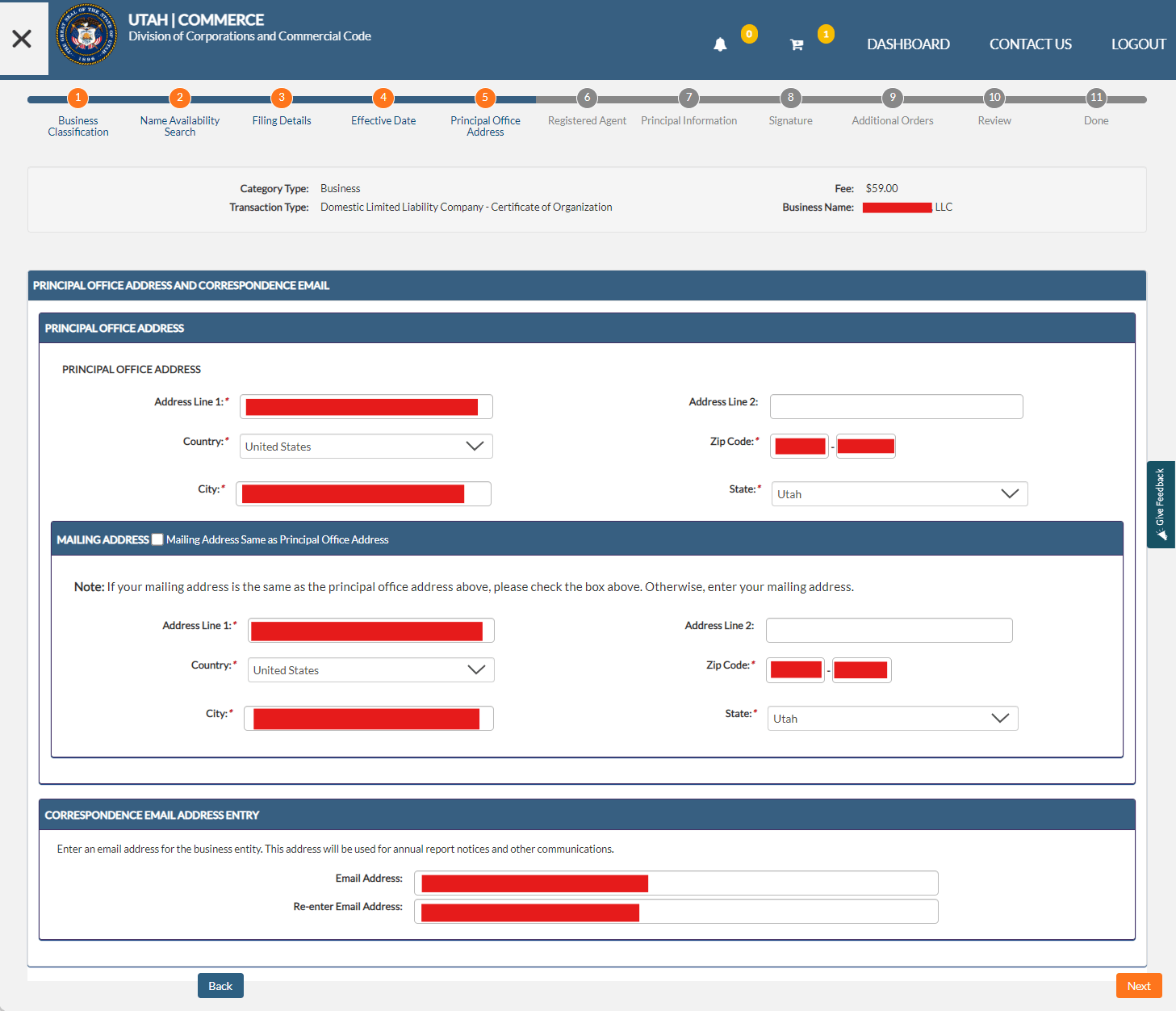
This is the filing that creates the company. You’ll submit it online through the Business Registration System, which requires a free UtahID login first, then pay the $59 fee on Utah’s domestic LLC filing page. The Division reports that most submissions are approved instantly, with anything flagged for review clearing in two to four business days. Utah also sells expedited processing for $75, though it publishes no guaranteed formation turnaround, so treat that as priority handling rather than a promised deadline.
Step 4: Put an operating agreement in writing
Utah doesn’t make you file an operating agreement with the state, and plenty of single-owner LLCs skip it. That’s a mistake. Utah law recognizes and enforces it, and it settles who owns what, how profits split, and what happens if a member leaves. Even solo, a signed agreement helps prove the LLC is separate from you personally. Start from a Utah-specific template rather than a generic one found online.
Step 5: Get your EIN from the IRS
Once the LLC exists, apply for an EIN, the federal tax ID you’ll use to open a bank account, hire, and file taxes. It’s free from the IRS and takes minutes online. Apply after formation, so the name on your EIN matches the name the Division approved. Our EIN application walkthrough covers what changes for a single-member versus multi-member setup.
Step 6: Open a bank account and handle Utah taxes
With your approved Certificate and EIN in hand, open a business bank account to keep company and personal money separate. If you’ll have employees or sell taxable goods, register with the Utah State Tax Commission for the right accounts; a plain single-member service business usually won’t.
File the Certificate of Organization with a Utah agent address ready.
Utah requires a registered agent with a real in-state street address. Northwest can form the LLC and provide that Utah agent address, which is helpful if you do not want to list your home.
Your Utah pre-filing checklist: name, agent, UtahID, and $59
Line up four things before you start your Utah LLC registration and the filing goes in one sitting. Skip ahead and you end up with a half-finished draft and a name someone else grabbed. It’s the groundwork for running a Utah LLC without a costly re-file.
- Your cleared name: checked against the Division’s records and carrying a valid LLC designator.
- A Utah-address agent: a registered agent with a physical street address in the state and written consent to serve.
- A UtahID login: the free account you need to reach the online Business Registration System.
- The filing fee: $59 by card at submission, plus $75 more if you choose expedited handling.
How much does an LLC cost in Utah?
The math on how much an LLC costs in Utah is short. The state charges $59 to file your Certificate of Organization, and as of 2026 that’s the only mandatory cost of getting formed. After that, it’s $18 a year to keep the LLC active. Optional extras are a $22 name reservation and $75 expedited handling. Utah charges no franchise tax and no minimum annual tax just for existing, which makes it one of the cheaper states to keep a company running. The Division’s Fiscal Year 2026 fee schedule lists every line item.
Utah annual report and ongoing obligations
Utah has no franchise tax, but it does have a renewal you can’t ignore. Every LLC files a Utah annual report, officially the Annual Report/Renewal, once a year to stay in good standing. It’s due during the anniversary month of your formation, costs $18, and gets filed through the same Business Registration System you used to form. Our guide to the Annual Report and Renewal walks through the exact screens.
Here’s every recurring obligation a Utah LLC actually carries, with the 2026 figures from the Division’s fee schedule. Worth flagging how sharply the cost rises once you let the renewal slide.
| What Utah requires | When it’s due | Cost as of 2026 | Where it’s filed |
|---|---|---|---|
| Annual Report/Renewal | Anniversary month of formation, every year | $18, which includes a $5 state sign-on portal surcharge | Division of Corporations, Business Registration System |
| Late renewal | Once your anniversary month passes | $10 on top of the $18 | Same portal |
| Reinstatement | Only if the LLC lapses to expired status | $54 | Division of Corporations |
| Registered agent with a Utah street address | Continuously, from day one | $0 if you serve yourself | Kept current with the Division |
| State franchise or entity tax | Never, since Utah imposes none | $0 | Not applicable |
| Newspaper publication | Never, since Utah requires no notice | $0 | Not applicable |
| Pass-through withholding, nonresident members | With your annual Utah return | Utah’s current individual income tax rate | Utah State Tax Commission, form TC-65 |
On taxes, Utah keeps things simpler than most. There’s no state-level LLC tax charged just because you’re an LLC; your profits pass through to your personal return by default. Two things to watch. If your LLC has nonresident members, Utah may require pass-through withholding on Utah-source income, reported on form TC-65. The rate tracks Utah’s individual income tax rate, which the legislature has cut repeatedly in recent sessions. Check Publication 68 for your own filing year rather than trusting a figure you read anywhere. Electing corporate tax treatment pulls you into Utah’s corporate income tax rules instead, which is a conversation for an accountant.
Coming the other direction, a company formed in another state that operates here registers as a foreign LLC rather than forming fresh, and Utah charges the same $59 for it.
Where Utah owners slip up: wrong office, wrong document, missed renewal month
Most Utah filing problems trace back to the same handful of mix-ups, and the expensive ones aren’t the obvious ones.
Start with the money nobody talks about. Utah sells expedited processing for $75 per filing, and the checkout screen offers it right as you’re about to submit. But the Division already approves most online filings instantly, which means a large share of that $75 buys priority on a queue the filer was never in. Submit standard first; if your filing does get held for review, you’ll know within two to four business days and can decide then.
The classic mix-up is hunting for a Secretary of State portal that doesn’t exist. Utah business formation lives with the Division of Corporations under the Department of Commerce. The same confusion sends people searching “Articles of Organization” when Utah’s document is the Certificate of Organization. Both wrong turns land you on another state’s instructions.
Then there’s the renewal, and this is where the real math bites. Utah ties your deadline to your formation anniversary month rather than a fixed statewide date, so there’s no April 1 or May 15 that everyone reminds each other about. Miss it and the $18 renewal picks up a $10 late fee. Let the LLC actually expire and reinstatement runs $54, three times the renewal you skipped. That’s on top of a gap in your good standing record that lenders and banks can see.
The last one is quieter. A registered agent listed without a real Utah street address can get the appointment invalidated. A name that isn’t truly distinguishable from an existing entity gets the filing rejected outright. Punctuation changes and adding “Company” to a taken name won’t make it distinguishable. Check both before you pay, because the $59 is nonrefundable.
Utah LLC questions owners actually ask
These are the questions that come up most for Utah founders, pulled from what people actually search. Answers reflect the fees and Utah LLC requirements in effect as of 2026.
How much does it cost to start an LLC in Utah?
$59 to file the Certificate of Organization, and that’s the only required cost to form. Budget another $18 a year for the renewal. If you want it processed faster, expedited handling adds $75. Everything above that, agents, operating-agreement drafting, “compliance” packages, is optional.
Can you start a Utah LLC for free?
Not entirely. The $59 state fee is unavoidable, since that’s what the Division charges to file. But you can absolutely form a Utah LLC for free of any service markup by filing it yourself through the Business Registration System. The “free LLC” offers you see advertised still charge the state fee, and often bundle a paid agent or upsell on top.
How long does it take to get an LLC in Utah?
Often the same day. The Division reports that most online filings are approved instantly, with the rest inside two to four business days, though it publishes no guaranteed turnaround. Expedited service costs $75 and works as priority handling. Our page on how fast Utah approves filings breaks down timing by filing method.
Is it “Articles of Organization” or “Certificate of Organization” in Utah?
Certificate of Organization. Most states call the formation document Articles of Organization, but Utah uses Certificate of Organization in its statute and on the Business Registration System. If a template or guide says “Articles,” it wasn’t written for Utah.
Does a Utah LLC have to file an annual report?
Yes. Every LLC files an Annual Report/Renewal each year, due in the anniversary month of formation, for $18. There’s no skipping it; letting it lapse triggers a $10 late fee and eventually risks administrative dissolution. Utah is stricter here than states like New Mexico, which ask for no annual report at all.
Does Utah have a franchise tax or a state LLC tax?
No flat one. Utah charges no franchise tax and no annual entity tax simply for being an LLC, which is a real advantage over states like California and Texas. Your LLC’s income passes through to your personal return by default. The caveats: nonresident members can trigger pass-through withholding on Utah-source income via form TC-65, at Utah’s current individual income tax rate. Electing corporate tax treatment pulls you into Utah’s corporate income tax instead. Check Publication 68 for the rate that applies to your filing year, since Utah has cut it more than once recently.
Can a single-member LLC be formed in Utah?
Yes, and it’s the most common setup. A single-member LLC files the same Certificate of Organization and pays the same $59; Utah doesn’t treat solo owners differently at formation. For federal taxes, the IRS treats a single-member LLC as a disregarded entity by default, so its income flows onto your personal return unless you elect otherwise. You’ll still want an operating agreement, even as the only member, to reinforce the liability separation.
Does Utah require an operating agreement?
No. Utah doesn’t require you to file or even create one, but the state recognizes and enforces operating agreements, and skipping it is a common regret. It’s the document that governs ownership splits, management, and member exits. Put one in place even for a solo LLC.
Does Utah allow series LLCs and professional LLCs (PLLCs)?
Both. Utah recognizes the series LLC, which lets one LLC hold multiple protected series under a single filing, handy for owners holding several properties or business lines. Utah also allows the professional limited liability company, or PLLC, for licensed professions, with a name that carries “PLLC” or “P.L.L.C.” Most owners need neither, though it’s worth knowing Utah supports them.
Is a Utah LLC anonymous or good for asset protection?
Private at filing, but not anonymous. Utah’s Certificate of Organization doesn’t force you to list member names, so it shields more than many states do. Every LLC still has to name at least one governing person on its annual report, and the state’s business records are publicly searchable, so true anonymity isn’t realistic. On asset protection, what matters far more than the state you file in is keeping the LLC genuinely separate from your personal finances and carrying the right coverage; a lawyer and an insurance broker are better guides there than a formation page.
- IRS overview of the Limited Liability Company
- Utah Department of Commerce, Division of Corporations and Commercial Code
- Domestic Limited Liability Company filing information
- Utah Division of Corporations Fiscal Year 2026 Fee Schedule
- Utah Annual Report and Renewal guide
- Utah Revised Uniform Limited Liability Company Act, Title 48 Chapter 3a
- Utah State Tax Commission Publication 68, pass-through entity withholding
Start Your Utah LLC with Bizee
Bizee helps you handle each step of forming your Utah LLC, from preparing your filing to keeping your business launch organized and moving forward.