

A Maryland LLC starts at the State Department of Assessments and Taxation, not a Secretary of State, and that surprises most first-time owners. As of 2026, you file Articles of Organization with SDAT for $100, online through Maryland Business Express. Standard filings take six to eight weeks. Get the resident agent and the name right, and the rest moves quickly.
Maryland LLC: where to file and what it costs
The short version, if you’re forming in Maryland as of 2026:
- Where you file: SDAT Charter Division, online at Maryland Business Express.
- Formation document: Articles of Organization.
- Filing fee: $100 standard; $150 expedited; online card payments add a 3% service fee.
- Processing time: six to eight weeks standard; seven to 14 business days expedited.
- Recurring cost: the $300 Form 1, the Annual Report and Business Personal Property Return, due April 15.
- Who needs one: anyone who’s running a business in Maryland and wants liability protection.
- Contact: SDAT, 410-767-1340; businessexpress.maryland.gov.
How to start an LLC in Maryland: the 6 SDAT steps
This is how to start an LLC in Maryland without a refile, in the order SDAT actually wants things done. Each step names the real office, fee, or form.
Step 1: Name your Maryland LLC and clear it on SDAT
Your name has to include a designator: Limited Liability Company, LLC, L.L.C., LC, or L.C. It also has to be distinguishable from every active business already on file with SDAT.
Before you commit, run it through Maryland’s business entity search. Two businesses can’t share a name, and a near-match is a common reason filings bounce.
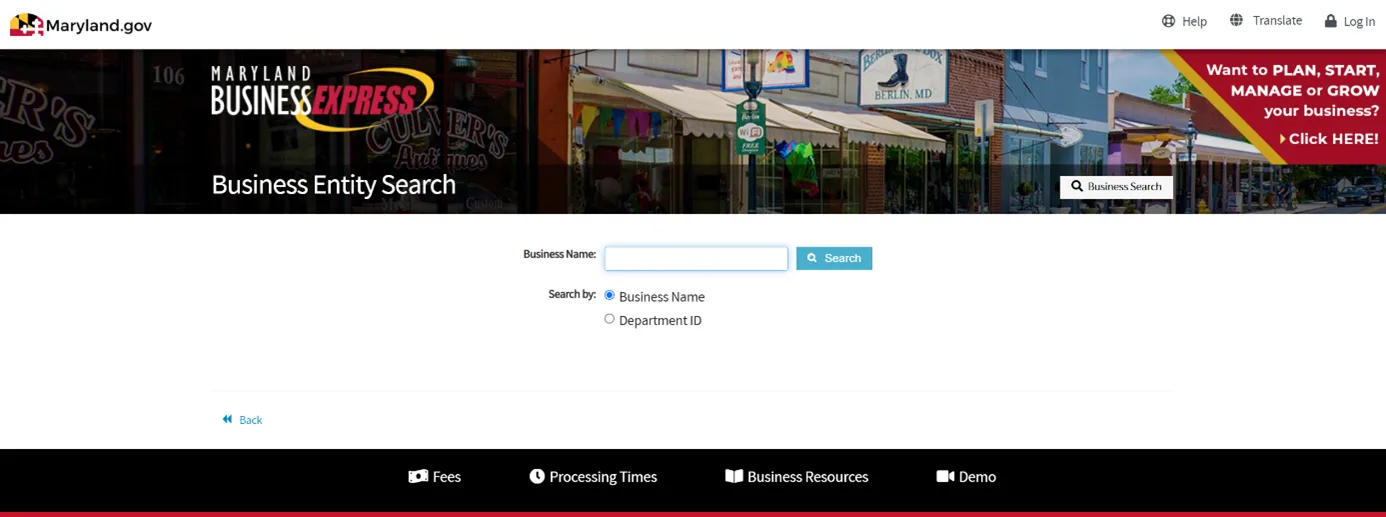
Not ready to file yet? You can hold a name with a Corporate Name Reservation Application for $25, which locks it for 30 days. Expedited reservation costs $20 more.
Step 2: Appoint a Maryland resident agent
Maryland calls it a resident agent, the same role other states call a registered agent. The wording is different; the job is identical.
The agent has to be a Maryland resident at least 18, or a Maryland corporation, LLC, or limited partnership. They need a physical street address in the state. A P.O. box won’t be accepted.
The agent also signs the Articles to confirm consent, so line them up before you file. You can serve as your own agent, or use a Maryland resident agent service if you’d rather keep your address private.
The resident agent box trips up more out-of-state owners than anything else on the Maryland form. I do not treat this as a quick address field, because Maryland will not let you use a P.O. box, and you cannot list your home address if you live in Virginia or DC.
Step 3: File your Articles of Organization with SDAT
This filing is what actually creates your company. Maryland’s formation document is the Articles of Organization, signed by an authorized person and filed with SDAT’s Charter Division.
Most people file online through Maryland Business Express; you can also mail the form to the Charter Division in Baltimore. The current SDAT Articles form spells out every field and fee.
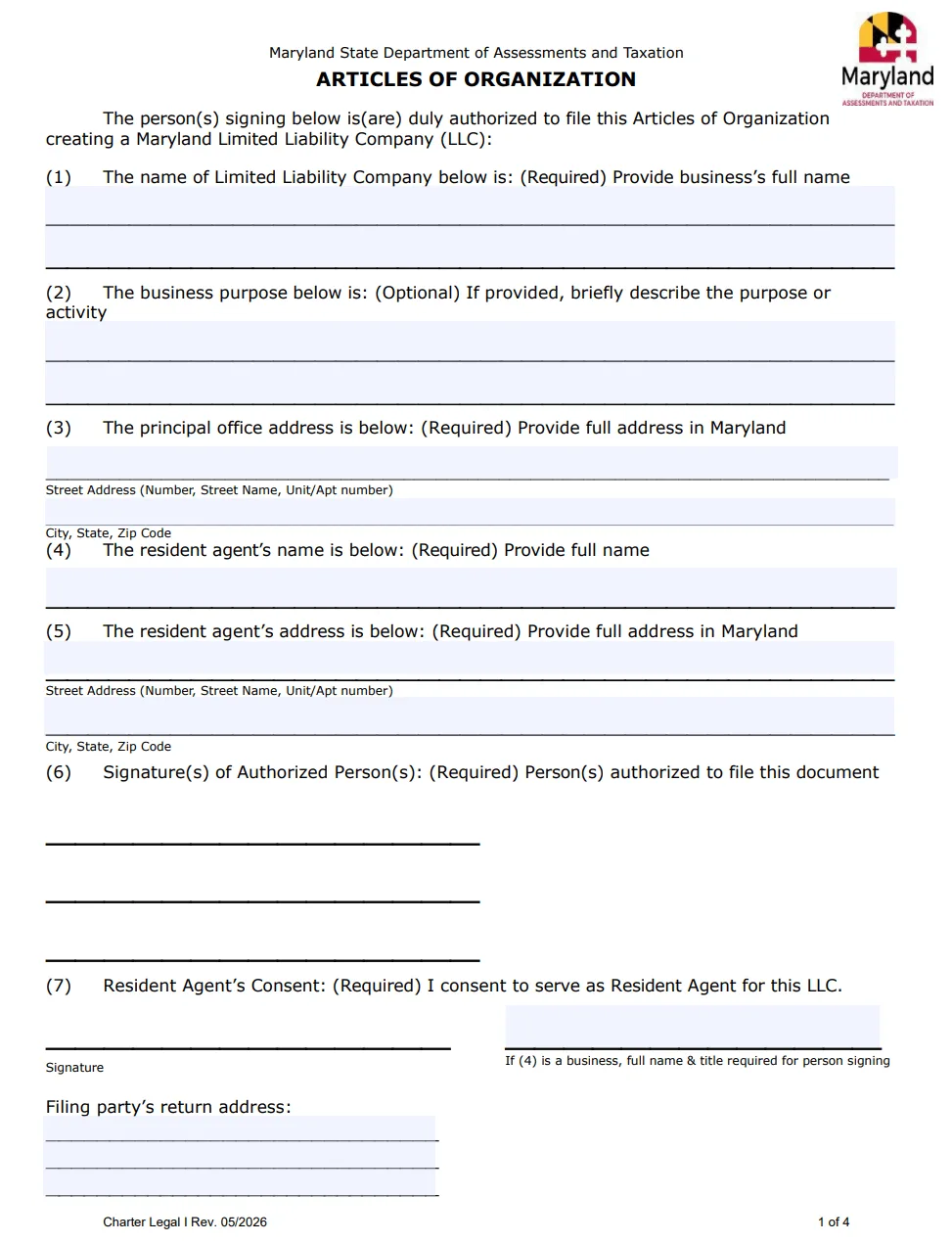
The standard Maryland LLC filing fee is $100, with a six to eight week wait as of 2026. Need it faster? Expedited service runs $150 and takes seven to 14 business days, and online same-day filing is $425.
Worth flagging: online card payments add a 3% convenience fee. For what affects your turnaround, see how long a Maryland LLC takes to form.
Step 4: Put your operating agreement in writing
Maryland doesn’t require an operating agreement, and the law says it doesn’t even have to be written. Don’t read that as permission to skip it.
The agreement sets ownership splits, voting, management, and what happens when a member leaves or wants out. Banks and investors routinely ask to see one before they’ll work with you.
Use a Maryland operating agreement template to start. Single-member LLCs need one too, because it’s part of what keeps the liability shield clean.
Step 5: Get your federal EIN from the IRS
Once the LLC exists, get your EIN from the IRS. It’s free, and you apply directly; nobody needs to charge you for it.
You’ll use it to open a bank account, hire, and file taxes. The name on the EIN has to match the name on your Articles, so form the LLC first, then apply through the IRS. Apply online and the number is issued immediately once approved.
If you’d rather follow a step-by-step walkthrough, here’s how to get your EIN after formation.
Step 6: Open a business bank account and register for taxes
With the Articles approved and the EIN in hand, open a dedicated business bank account. Mixing personal and business money is the quickest way to weaken the protection you just filed for.
If you’ll sell taxable goods or services, register for a sales and use tax license with the Comptroller of Maryland through Maryland Tax Connect. Registration is free. Most product sellers also need a trader’s license, which is the next section.
Northwest is useful when you want the agent consent and Articles handled in one pass.
Maryland’s form is not hard, but it depends on having the right resident agent, a qualifying street address, and the consent signature ready before SDAT sees the Articles. Northwest can form your Maryland LLC and include registered agent service so you are not piecing those details together yourself.
Maryland business licenses: the trader’s license and local permits
Maryland has no single statewide business license. What you need depends on what you sell and which county you operate in.
If you sell goods, you’ll need a trader’s license from the Clerk of the Circuit Court in your county. The fee scales with inventory value, from $15 to $800, and up to $2,125 in Baltimore City, per the Comptroller’s license rules.
Here’s the Maryland-specific catch: the Clerk won’t issue or renew a trader’s license if your SDAT filings aren’t current. Miss your annual report, and your license is stuck right along with it.
Regulated trades need more. Contractors, cosmetologists, real estate agents, and food businesses need occupational or professional licenses through the Maryland Department of Labor or the Maryland OneStop portal. Local zoning, health, or occupancy permits from the county can apply on top.
What a Maryland LLC costs: the $100 filing fee and the $300 report
If you’re wondering how much an LLC costs in Maryland, the headline is simple. Forming costs $100 as of 2026, and the main recurring cost is the $300 annual report due every April 15.
Beyond those two, budget for optional expedited fees, a resident agent service if you hire one, and any trader’s or professional license your work requires.
Bottom line: the state is cheap to enter; it’s the yearly $300 that catches people off guard.
Here is what the ads will not say: the $100 SDAT fee is identical whether you click the buttons yourself or pay someone $300 to do it for you. I would not pay a formation company just to submit the same Articles you can file directly with Maryland.
Maryland LLC taxes and the Form 1 annual report
Maryland has no LLC franchise tax and no privilege tax. Here’s what the Maryland LLC annual filing requirements actually involve, with the personal-property angle most guides don’t mention.
| Obligation | What it is | Cost (as of 2026) | When |
|---|---|---|---|
| Form 1 annual report | Annual Report and Business Personal Property Return, filed with SDAT | $300 | April 15 (60-day extension to June 15) |
| Business personal property tax | Local tax applied if your Maryland personal property exceeds $20,000 original cost | Varies by county | Filed with Form 1 |
| Sales and use tax | Comptroller account required if you sell taxable goods or services | Free to register | Ongoing |
| Pass-through entity tax | Form 510 if the LLC has nonresident members | 8.25% to 8.75% on Maryland share | With state return |
| Federal income tax | Default pass-through to members; corporate election optional | Per IRS | Annual |
The Form 1 is the one you can’t skip. Every Maryland LLC files it each year, active or not, using the 2026 Form 1 on Maryland Business Express.
Own under $20,000 in personal property statewide and you owe no personal-property tax, but you still file the Maryland annual report. Approved MarylandSaves employers can even get the $300 fee waived.
The $300 annual report is the number that blindsides Maryland owners. People form in spring, forget about it, then get hit the next April 15 with a fee three times what they paid to file.
What a Maryland LLC gets you that other states don’t
The strongest reason to form here isn’t a perk Maryland advertises; it’s a cost Maryland skips. There’s no annual franchise or privilege tax on Maryland LLCs, the kind Delaware and California charge their owners every year just to exist.
That gap adds up fast. A California LLC owes $800 before it earns a dollar, while a Maryland LLC owes nothing until the next April 15, and even then it’s only the $300 report. For a small business watching cash, that money stays in your account.
The basics still apply, too. You get a liability shield between business debts and your personal assets. The IRS taxes the LLC as pass-through by default, so profit hits your return once, not twice.
Two features go further than most states allow. A benefit LLC lets a mission-driven owner write a public purpose into the entity itself. The MarylandSaves program can wipe out that $300 report fee for employers who enroll in its retirement option.
None of this turns Maryland into a haven. The six to eight week wait is genuinely slow, and running the business from Virginia or DC usually means registering there as a foreign LLC anyway. Form in Maryland when Maryland is where the work actually happens. Across the state, the 696,710 small firms counted in Maryland’s small business statistics employ 1.2 million people, 47.9% of state employment in 2022.
Maryland LLC mistakes: P.O. boxes, name conflicts, and the April 15 trap
A handful of errors send Maryland filings back more than any others. Most take a minute to avoid.
- Listing a P.O. box for the resident agent: SDAT needs a physical Maryland street address, full stop.
- Choosing a name that isn’t distinguishable: if it sits too close to an existing SDAT record, it bounces, so search first.
- Missing the April 15 report: the $300 fee and your good standing both ride on it.
- Confusing the $100 filing fee with the $300 annual report: one is a one-time cost, the other is yearly.
- Assuming Maryland has a series LLC or PLLC: it doesn’t, though a standard LLC can render professional services with board rules still applying.
- Hunting for a Secretary of State filing: Maryland LLCs go through SDAT, not the SOS.
Starting a Maryland LLC: common questions
These are the questions Maryland founders actually search, answered with the real numbers and offices behind each one.
How much does it cost to start an LLC in Maryland?
It’s $100 to file the Articles of Organization with SDAT, as of 2026, plus the $300 Form 1 annual report every April 15 after that. A resident agent service, if you hire one, runs about $100 to $150 a year. With no franchise tax, the real first-year cost for most single-member LLCs is the $100 filing and an optional agent.
Can you start an LLC in Maryland for free?
Not entirely, and anyone advertising a free LLC in Maryland is bending the truth. The state’s $100 filing fee is mandatory; SDAT charges it whether you file yourself or pay a service. What you can skip is the markup. Filing direct on Maryland Business Express costs exactly $100. The “free” offers usually waive their own service fee, then bill you for the state fee plus a resident agent subscription. You can do the entire filing yourself for the state fee alone, though it’s worth comparing what each service charges if you want help.
How long does it take to form a Maryland LLC?
Standard processing is six to eight weeks as of 2026, slow next to most states. Expedited service at $150 drops it to seven to 14 business days, and online same-day filing ($425) is the fastest SDAT offers. If timing matters, file online and expedite.
Does a Maryland LLC have to file an annual report every year?
Yes, every year, with no exception for an inactive one. The filing is Form 1, the Annual Report and Business Personal Property Return, due April 15 to SDAT, with a $300 fee. It’s filed under your LLC’s SDAT Department ID. If you own more than $20,000 in business personal property in Maryland, you also complete the property sections and may owe local personal-property tax. A 60-day extension moves the deadline to June 15 if you request it on time. Skip the report and SDAT can forfeit your good standing, which is what a Certificate of Status later proves you’ve kept.
Do you file a Maryland LLC with the Secretary of State?
No, and this catches a lot of people. Maryland LLCs are not handled by the Secretary of State. You file with the State Department of Assessments and Taxation, specifically its Charter Division, through Maryland Business Express. Searches like “incorporate in Maryland” point to the same place, since SDAT handles LLCs and corporations alike.
Do you need a DBA or trade name for a Maryland LLC?
Only if you’ll operate under a name different from your LLC’s legal name. Maryland calls this a trade name, and you register it with SDAT as a separate filing from your Articles. Say your LLC is “Bay Holdings LLC” but you run a cafe branded “Pier Six Coffee”; the cafe name is a trade name. If you only ever use your registered LLC name, you don’t need one. Note the Clerk of the Circuit Court won’t put a name on your trader’s license until it’s registered with SDAT, either as the LLC or as a trade name.
Can you form a Maryland LLC if you live in another state?
Yes. Maryland law lets any person form an LLC, with no residency requirement for members. You still need a Maryland principal office address and a Maryland resident agent with a physical in-state address. The bigger question is whether you should. If you really run the business from Virginia, DC, or elsewhere, you’ll likely register that Maryland LLC as a foreign LLC at home too. That means two sets of filings and two sets of fees. Form in Maryland when Maryland is where you operate.
How is a Maryland LLC taxed, and can it elect S-corp status?
By default, a single-member Maryland LLC is taxed as a sole proprietorship and a multi-member LLC as a partnership, so profits pass through to members’ personal returns. Maryland imposes no entity-level LLC income tax on most small LLCs, though those with nonresident members file the pass-through entity return, Form 510, with the Comptroller. You can elect S-corp treatment with the IRS on Form 2553. It pays off once profit is high enough that payroll-tax savings beat the added cost, often past $40,000 to $50,000 in net profit. That election is federal, and Maryland follows your federal classification, so talk to an accountant before you make it.
- IRS, Get an Employer Identification Number
- SDAT, Articles of Organization for a Limited Liability Company
- Maryland Business Express
- SDAT, 2026 Form 1 Annual Report and Business Personal Property Return
- Maryland Business Entity Search
- Comptroller of Maryland, Business Income Tax Information
- Maryland Code, Corporations and Associations Section 4A-202
File your Maryland LLC with ZenBusiness
ZenBusiness makes the Maryland SDAT filing process easier by helping you prepare your Articles of Organization, submit the right details, and launch your LLC with fewer filing-day headaches.