

Usually, you can form a Limited Liability Company (LLC) without an operating agreement, but a few states require members to adopt a written one. In most states, you typically do not file an operating agreement with the state; you keep it with your core business records. It sets the framework for ownership, decision-making, money, and what happens if someone leaves. If you skip it, you rely on your state’s default rules, even when they do not reflect how you actually run the business.
Understanding the Operating Agreement
An operating agreement is the internal rules document that members use to set financial and management terms for the company. The SBA’s operating agreement overview describes it as a key internal record that outlines financial and functional decisions and governs internal operations.
Some statutes define the LLC Agreement broadly (for example, allowing written, oral, or implied terms).
Role of the Operating Agreement in LLC Business Structure
Treat the Operating Agreement as an internal playbook. It clarifies who can make decisions, who can sign on the LLC’s behalf, how money is handled, and what happens when people join or leave. If it is silent on an issue, the governing statute may fill in the gap, which can create surprises later.
Importance for Single and Multi-Member LLCs
Even with a single owner, an Operating Agreement improves organization and makes future changes easier (especially if you’re running a single-member LLC and want clean records from day one). For multiple owners, it is often the clearest way to prevent misunderstandings about money, control, and exits.
Here’s the quick scan of what it helps clarify:
| Situation | What it typically clarifies |
|---|---|
| Single-member | decision authority, how funds move, what happens if you add an owner later |
| Multi-member | ownership splits, voting, profit allocations, buyout or exit rules |
Legal Requirements for LLCs Regarding Operating Agreements
Whether you legally need a Governing Document depends on where you formed your LLC, so the only reliable way to answer “Do I legally need one?” is to check your formation state’s rules.
In most places, the Operating Agreement is not a public filing, so you keep it with your internal records. The Articles of Organization form the LLC, and any annual report or renewal is separate. In many places, you can form without a written operating agreement, but some jurisdictions mandate one.
State Laws and Operating Agreement Necessity
New York is a clear example of a formation requirement: the law requires a written operating agreement, and it can be entered into before filing, at filing, or within 90 days after filing (see the New York Department of State LLC formation guide).
By contrast, the SBA notes that these documents are generally internal records and are not filed with (or accepted by) the state.
Before assuming it is optional, here is what we check first:
- where you formed your LLC
- whether it must be in writing
- any timing rule, such as New York’s 90-day window
- whether your bank, lender, or investor expects an operating agreement even if the statute does not
If you formed in Florida and want a practical template plus a state-specific outline, see our Florida LLC operating agreement guide.
Default Rules in Absence of an Operating Agreement
Even when an Operating Agreement is not a formation requirement, the statute still supplies the baseline terms for how the LLC operates. That is why “we’ll decide later” can quietly become “we’re stuck with the statutory approach,” especially once more than one person is involved.
That’s why “we’ll decide later” can quietly become “the statute decides for us,” especially once there is more than one person involved.
Legal Liability and Protection within an Operating Agreement
The liability shield mainly comes from your state statute, not from the Operating Agreement. Delaware’s LLC Act says the entity’s debts are its own, and a member or manager is not personally obligated solely because of their role, but the same rule also notes you can still agree to personal liability under another agreement (for example, a guaranty).
Separately, some laws allow the operating agreement to shape internal protections like indemnification and limits on certain money-damages exposure, within boundaries the statute sets.
Form Your LLC with Northwest and Keep Control Clear
If you skip an Operating Agreement, your state’s default rules may decide how your LLC runs. Northwest helps you form your LLC with a clean, privacy-first setup and ongoing support so your records, authority, and compliance stay organized from the start.
Benefits of Having an Operating Agreement
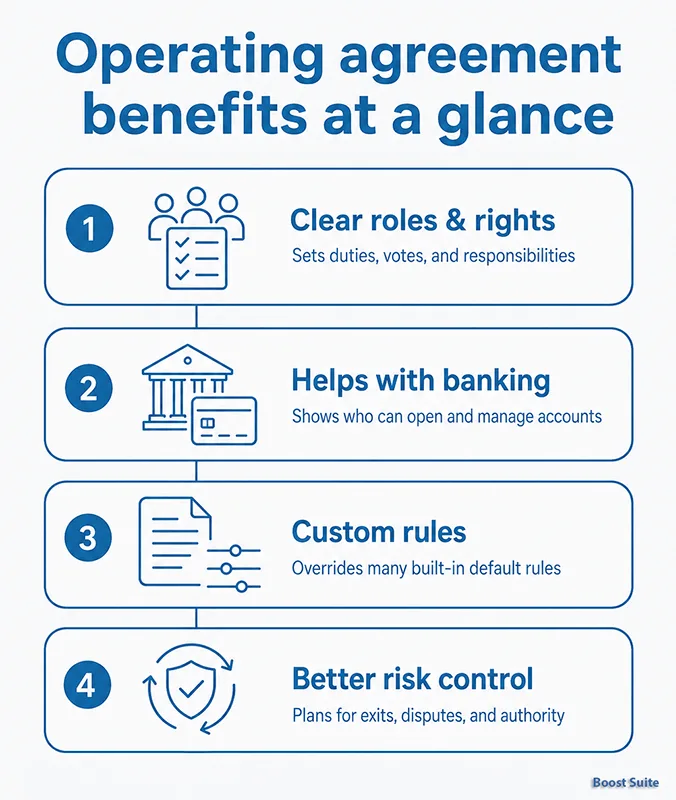
Even when your state does not force you to adopt one to form, an Operating Agreement is often the clearest way to set expectations and avoid “default rule surprises” later. It can help you avoid confusion when money or decision authority changes.
Clarity on Member Responsibilities and Rights
Clarity matters most when money, authority, or time commitments are uneven. That includes who does the work, who approves major moves, and how the business is managed when owners disagree. The SBA notes an operating agreement is used to spell out rules, provisions, and how internal operations are governed.
Before you list terms, it helps to cover the basics in plain language, such as:
- who can make which decisions, and when a vote is required
- how profits and losses are allocated, when distributions happen, and the basic tax expectations behind them
- basic accounting: who tracks income and expenses, and how reimbursements work
- what each owner is expected to do (or not do) day to day
- what happens if someone wants out, stops contributing, or passes away, or you want your will to control who receives their interest in the business
Opening a Business Bank Account
Even when the Operating Agreement is optional under your formation statute, banks often ask for proof of who has authority to act for the LLC. In practice, a signed Operating Agreement is one of the most common ways to show who the members or managers are and who can open accounts or sign on the company’s behalf. For example, Chase lists an Operating Agreement as a document that can be used to identify members or managers for an LLC.
If you do not have one yet, ask the bank what they will accept instead (some banks may accept other governance records depending on your setup). The point is to avoid a preventable account-opening delay when you are ready to separate business and personal finances.
Customization for Business Needs
Most LLC laws let you customize how things work internally, within limits. The Operating Agreement can override many built-in statutory defaults, but some topics are off-limits and certain updates may need to be in writing. Write specific approval thresholds for major actions so there is no guesswork.
Risk Management for Single and Multi-Member LLCs
An Operating Agreement helps manage internal risk by making authority and decision lines clear before there’s stress, which can protect you from internal chaos. It can spell out how the company is managed (member-managed vs manager-managed), who has authority to bind the business, and what approvals are required for major moves.
Delaware’s statute, for example, ties management and authority-to-bind to what the LLC agreement says (see Delaware LLC Act § 18-402).
Form Your LLC with ZenBusiness and Start with Clear Rules
An Operating Agreement helps prevent default-rule surprises and makes banking easier by showing who can act for the LLC. ZenBusiness helps you form your LLC, keep your setup organized, and stay on track with the documents and compliance steps that support smooth day-to-day operations.
Consequences of Not Having an Operating Agreement
Skipping it may not cause problems right away, but it can create uncertainty later. One reason owners get stuck later is that they never agreed on who decides what, how money moves, or what happens if someone wants out.
Potential Legal Risks and Personal Liability
The biggest real-world surprise is not internal paperwork, it is signing something that creates personal exposure. In general, people involved in an LLC are not personally liable for company debts solely because of their role, but they can still agree to personal liability in a separate contract.
Common examples include guarantees on loans, leases, or vendor accounts. Without clear internal authority and approval lines, someone may sign a deal the group did not expect, which can trigger disputes fast.
Piercing the Corporate Veil (Alter Ego risk)
Courts can sometimes set aside limited liability when a business is treated like the owner’s “alter ego”, for example when money is commingled, records are sloppy, or the company is not run as a separate entity. That is the basic idea behind piercing the corporate veil and related alter-ego theories.
A signed Operating Agreement does not guarantee protection by itself, but it is one of the clearest pieces of evidence that you treat the LLC as a real entity with its own governance. We recommend pairing it with the basics that judges and creditors look for: separate bank accounts, clean bookkeeping, and consistent records.
Default Governance Structures Imposed by States
If your agreement does not address an issue the statute covers, the law’s default rules usually fill the gap. That can be fine for a simple setup, but it often gets messy when there are multiple owners, uneven contributions, or changing roles.
Issues in Member Disputes and Conflict Resolution
Disputes usually start with ambiguity, not bad intentions. When expectations change, people often argue about voting thresholds, buyouts, and how changes are approved.
Before conflicts happen, it helps to settle these points in writing:
- how to handle deadlocks
- what triggers a buyout, and how the buyout price is determined
- what happens if an owner stops working but still wants distributions
- what happens if an owner dies and a will passes the interest to someone new
- how disputes are resolved
If you’re setting up shared ownership (co-founders, spouses, or investors), this multi-member LLC primer helps clarify the basics before you write the rules.
Steps to Create an Effective Operating Agreement
The Operating Agreement is usually an internal record (not a state filing), but it becomes a binding contract once members sign it, so it is worth doing carefully.
Before drafting, confirm the requirements where you formed your LLC, since a few jurisdictions require a written operating agreement.
If you want a faster start, use a simple template and customize it to match how you actually operate. Here’s a simple step-by-step guidance that works for most small businesses:
- Check your state requirement
Verify whether a written agreement is required and whether there is a deadline. - Write down ownership and contributions
List who owns what, what each person contributed (cash, assets, services), and what happens if someone contributes later. - Set who can make decisions and sign contracts
Decide who can sign leases, open bank accounts, hire vendors, and approve big purchases, and when a vote is required. - Define money rules in plain English
Cover how profits and losses are allocated, when distributions happen, and how taxes and reimbursements are handled. - Add exit and change rules
Spell out what happens if an owner wants out, dies, becomes inactive, and how you handle adding someone new, plus how amendments are approved. - Include dispute handling basics
Choose a process (for example, notice requirements, mediation or arbitration if you want it), so conflicts have a path instead of chaos. - Sign, store, and keep it updated
Once signed, treat it like a core record and update it when ownership, authority, or finances materially change.
Conclusion
In most states, you usually do not need an operating agreement to form an LLC, but a few states require members to adopt a written one.
Even when it is optional, it is often the simplest way to set clear rules for ownership, decision-making, money, and exits, instead of relying on state default rules.
If you are a single owner, it helps keep your records clean and makes future changes easier. If you have multiple owners, it is one of the best ways to prevent disputes before they start.
Frequently Asked Questions
Here are quick answers to the questions readers ask most when deciding whether they need an operating agreement.
Do I need an operating agreement for my LLC?
In most states, you can form an LLC without an operating agreement, but it is still one of the most useful internal documents. The SBA notes it outlines financial and functional decisions and, once signed, acts as a binding internal contract. A few states do require a written agreement, so check your formation state first.
Are operating agreements required by state law for LLCs?
Sometimes, New York law requires a written operating agreement and allows it to be entered into before filing, at filing, or within 90 days after filing. Many other states do not make it a formation requirement, but you still may need one for banking, lending, or investors.
Does an Operating Agreement need to be notarized?
Usually, no. An Operating Agreement is primarily an internal contract, so notarization is generally optional unless a bank, lender, or another party specifically asks for it. The more important step is to get the agreement signed and stored with your records so you can prove who has authority and what terms apply.
Do I send my Operating Agreement to the Secretary of State?
Almost never. In most states, an Operating Agreement is an internal record you keep in your files. For example, New York’s Department of State says the Operating Agreement is not filed with the Department, and California’s Secretary of State also notes that operating agreements are not filed. You typically file Articles of Organization to form, and keep the agreement privately.
What happens if my LLC does not have an operating agreement?
If you do not set your own terms, the statute in your formation state usually fills the gaps. Practically, that can affect voting, profit distributions, authority to act, and exit situations, especially once there is more than one owner.
Can a verbal agreement be sufficient for my LLC instead of a formal operating agreement?
In some jurisdictions, an LLC agreement can be recognized even if it is not written. The practical problem is proof: verbal terms are easy to misunderstand and hard to enforce later. If the law where you formed requires a written agreement, a verbal one will not meet that requirement.
How can I draft a good operating agreement for my limited liability company?
Keep it plain and cover the essentials: ownership, contributions, decision authority, money terms, exits, and how disputes get handled. The SBA notes that once members sign, it becomes a binding contract, so write it in clear language you can follow later.
- New York State Senate: NY Limited Liability Company Law § 417
- California Secretary of State: Starting a Business – Entity Types (LLC keeps Operating Agreement in records)
- California Legislative Information: Corporations Code § 17701.02 (Definition of “Operating agreement” incl. oral/record/implied)
- Missouri Revisor of Statutes (MO.gov): RSMo § 347.081 (Operating Agreement – “shall adopt”)
- Maine Legislature: 31 M.R.S. § 1531 (LLC agreement must exist)
- Delaware Code Online: Delaware LLC Act – Definitions
- Delaware Code Online: Delaware LLC Act § 18-303
Form Your LLC with Harbor Compliance and Start Organized
An Operating Agreement is easier when your LLC formation is clean from day one. Harbor Compliance helps you file accurately, set up the right structure, and keep key company records organized so your internal documents match your legal setup.