

A Washington LLC operating agreement is the internal contract that governs how a limited liability company runs. Washington uniquely lets it be oral, implied, or written under RCW 25.15.006(8). Without one, default rules in RCW 25.15 take over, and they rarely match what most owners actually want.
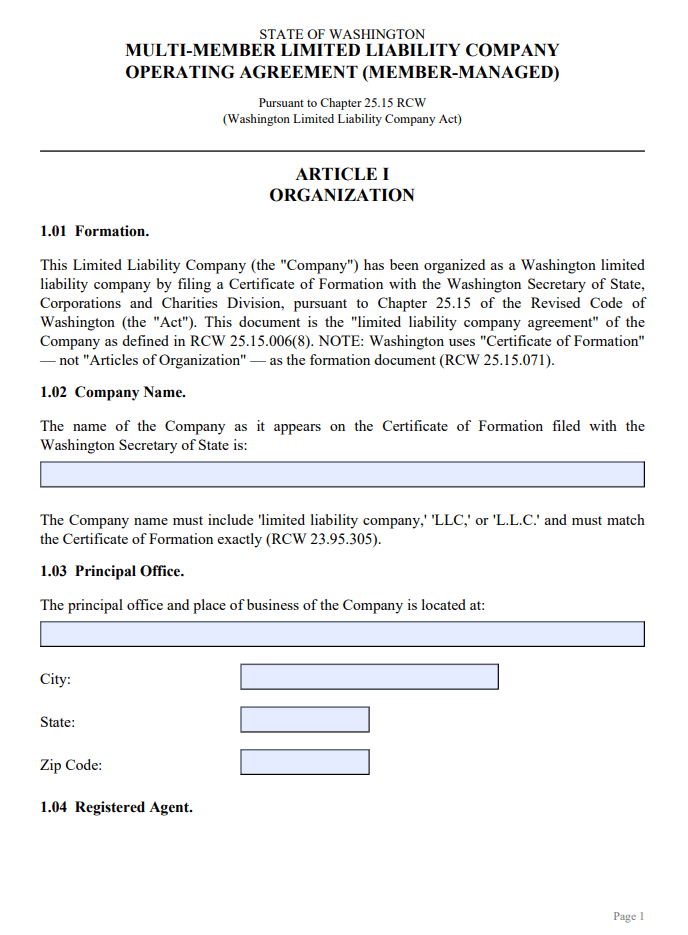
Download Boost Suite’s free Washington LLC Operating Agreement template
Choose the version that matches your Washington LLC structure and download it in PDF or Word format. Each template is designed to help you document ownership, management, and internal rules more clearly from day one.
Is an Operating Agreement Required for a Washington LLC?
Washington law doesn’t require a written operating agreement to form or maintain an LLC. Neither RCW 25.15 (the Washington Limited Liability Company Act) nor RCW 23.95 imposes that obligation. The operating agreement isn’t requested by the Secretary of State at any point: not with the Certificate of Formation (Washington’s term for what most other states call Articles of Organization), and not with any annual report.
What makes Washington unusual is the form the agreement can take. Under RCW 25.15.006(8), a limited liability company agreement can be:
- Written and signed: the standard practice for any LLC with members, banks, or investors
- Oral: verbal agreements between members are legally recognized
- Implied by conduct: consistent behavior over time can create binding terms
- Any combination of the above:
That’s flexible. The catch: oral or implied terms become a memory contest the moment members disagree. For the broader filing process, the 9-step Washington LLC formation guide covers the Certificate of Formation, registered agent, and initial report. Founders comparing turnaround options can also review current Washington LLC processing time for online and mail filings.
Why a Written Operating Agreement Still Matters in Washington
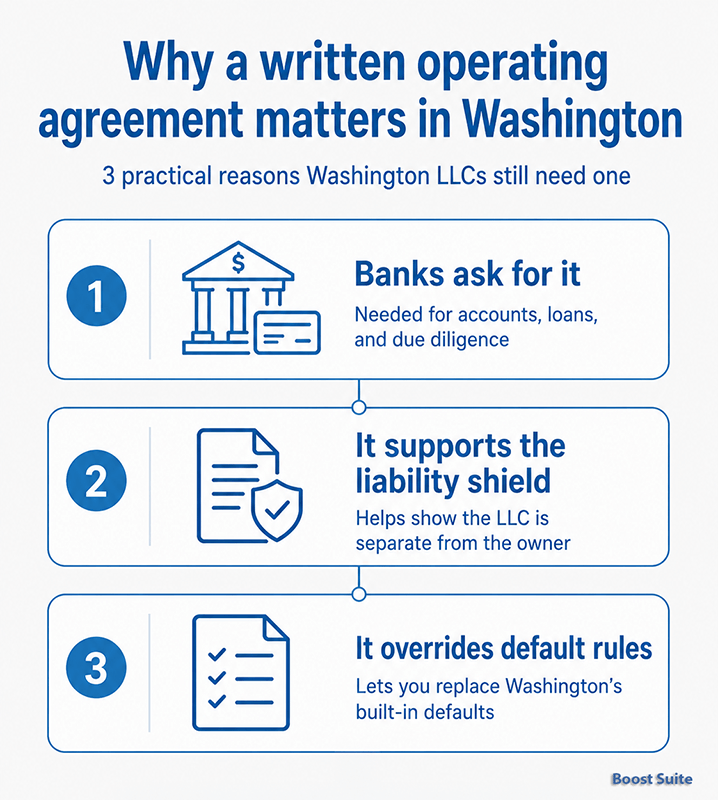
Flexibility on form doesn’t change the practical reality. Three concrete reasons keep the written operating agreement as standard practice for any Washington LLC.
Banks and Lenders Will Ask for It
Most Washington banks won’t open a business checking account for a multi-member LLC without a signed operating agreement. The same goes for credit unions, SBA lenders, and any investor running due diligence. Single-member LLCs sometimes get more flexibility, but the request still comes up. Skipping the document means going back to draft and sign one under pressure, often after the bank’s already started asking.
It Anchors Your Liability Shield
RCW 25.15.061 ties LLC veil-piercing to the same factors Washington courts apply to corporations. In Chadwick Farms Owners Ass’n v. FHC LLC, the Washington Supreme Court confirmed that veil-piercing is available where the entity has been used to violate or evade a duty. Failure to follow the agreement, or not having one at all, is repeatedly cited as a piercing factor by Washington business attorneys.
Single-member LLCs are particularly exposed here. Courts in Washington look harder for separation between the owner and the business entity: separate accounts, contemporaneous records, and a written agreement that confirms the LLC isn’t just an alter ego. For a single-member owner, the operating agreement is the first document to draft to keep personal and company business clearly separate.
It Overrides Default Rules That May Not Match Your Deal
Without a written agreement, RCW 25.15 fills in the silence. Default distribution rules allocate by agreed contribution value, member admission requires unanimous consent, and dissolution can be triggered by events most owners never anticipate. The next section walks through the defaults that apply when the operating agreement is silent or doesn’t exist.
Form the Washington LLC, then keep the agreement ready for banks and records.
Northwest can help file the Washington LLC and registered agent details cleanly, giving owners a solid formation record before the operating agreement documents member authority, liability separation, contribution values, and the default rules they want to replace.
Default Rules That Apply Without a Washington Operating Agreement
When a Washington LLC has no operating agreement, or when the agreement is silent on a topic, statutory defaults from RCW 25.15 govern. Several of these defaults surprise owners, especially around distributions and member exits.
| Topic | Default Rule (No Operating Agreement) | What Your Agreement Can Do |
|---|---|---|
| Management | Member-managed; majority of members decides ordinary matters (RCW 25.15.151) | Elect manager-managed structure; restrict authority for major decisions |
| Voting | Majority for ordinary acts; unanimous for amendments, new members, dissolution (RCW 25.15.121) | Set supermajorities, class voting, deadlock resolution |
| Distributions | Allocated pro rata by agreed contribution value | Custom percentages, tax distributions, priority returns |
| Dissociation | A member can withdraw at any time; no automatic buy-out | Define buy-sell triggers, valuation method, payout schedule |
| Dissolution | LLC dissolves if all members dissociate and no replacement is admitted within 90 days (RCW 25.15.265) | Continuation clauses, succession plans, replacement procedures |
Two examples worth flagging. If one member contributes $200,000 and another contributes $10,000 with no operating agreement, both still have to consent unanimously to admit a third member. The larger investor gets no extra weight under the statute, even though that’s rarely what either side expects.
The succession scenario hits single-member LLCs hardest. If a sole owner doesn’t plan ahead, the entity is at risk of statutory dissolution within 90 days of incapacity or death. Whether the company will survive depends on admitting a new member in time under RCW 25.15.265.
Nonwaivable Provisions Under RCW 25.15.018
Most of the LLC Act is what lawyers call “default” rules: provisions that members can rewrite in their operating agreement. Nonwaivable provisions are different. RCW 25.15.018 lists protections that the agreement cannot eliminate or weaken, no matter what the members agree to.
Key nonwaivable items include:
- The LLC’s power to sue and be sued: locked in by RCW 25.15.031
- Washington as the governing law: for entities formed in Washington (RCW 25.15.033)
- Core fiduciary duties and the duty of good faith and fair dealing: under RCW 25.15.038
- Liability for improper distributions: under RCW 25.15.231 and 25.15.236
- Minimum record-keeping and member inspection rights: under RCW 25.15.136
- The court’s power to dissolve and the obligation to wind up properly: under RCW 25.15.274 and 25.15.297
Drafting around these is fine. Trying to disclaim them isn’t. A clause that purports to eliminate fiduciary duties for managers, for example, won’t survive in court.
Practitioners draft Washington operating agreements with these limits in mind. In practice, attorneys carve the agreement around the nonwaivable list rather than against it.
Community Property and Spousal Consent for Married Washington Members
Washington is one of nine community property states, and that fact reaches directly into LLC ownership. Under RCW 26.16, property acquired during marriage is presumed community property of both spouses. A member’s LLC interest is generally treated as community property even when only one spouse is named in the records. The operating agreement and a separate spousal acknowledgment can change that treatment.
Washington-specific operating agreement templates handle this with a spousal consent or acknowledgment exhibit, often signed at the same time as the agreement itself. The exhibit typically addresses:
- Confirmation of community property treatment, or election to treat the interest as separate property:
- Agreement to be bound by transfer restrictions and buy-sell provisions:
- Waiver of management and information rights as a non-member spouse:
- Procedure on divorce, legal separation, or death of either spouse:
The omission cuts both ways. A spouse who signs preserves clarity for the LLC. Without that signature, a non-member spouse may surface years later with a community property claim that doesn’t go away easily during a divorce or estate settlement. For members of a Washington LLC building any meaningful business, this isn’t an optional clause.
Member-Managed vs. Manager-Managed Washington LLCs
Washington LLCs default to member-managed unless the Certificate of Formation or operating agreement specifies otherwise. The choice matters because Washington codifies statutory apparent authority. Under that statutory framework, third parties dealing with the LLC can rely on a member’s or manager’s authority to bind the company, regardless of internal restrictions in the agreement.
In practice, the management structure isn’t just an internal preference. It’s a public-facing signal to vendors, banks, and counterparties about who can sign what.
Member-Managed (RCW 25.15.151)
Every member is an agent of the LLC for ordinary-course matters. Day-to-day decisions go by majority of members. For small, owner-operated businesses where everyone is involved, this default works well.
The downside surfaces in larger LLCs. With each member able to bind the company on routine contracts, a single co-owner can commit the LLC to obligations the others didn’t approve. The operating agreement can require multiple signatures or member approval for high-value contracts internally, but outside parties may still rely on apparent authority.
Manager-Managed (RCW 25.15.154)
Authority is concentrated in one or more managers, who don’t have to be members and don’t have to be natural persons (an LLC or corporation can be the manager). Members who act solely as members lose agent status; only managers can bind the company in the ordinary course.
The structure suits LLCs with passive investors, professional management, or complex operations. For consistency, the Certificate of Formation should match the operating agreement on this point. Mismatches between the two documents have caused authority disputes in Washington state real-estate and lending transactions, where counterparties scrutinize signing power closely.
Provisions to Build Into a Washington Operating Agreement
Beyond the basics every operating agreement covers, Washington-specific drafting points stand out. The list below reflects what experienced Washington business attorneys consistently include for both single-member and multi-member LLCs.
- Capital contributions and ownership percentages with valuation method: including how future contributions are valued for membership interest adjustments
- Profit, loss, and distribution rules with tax distribution provisions: especially relevant given Washington’s B&O gross receipts tax exposure
- Voting thresholds for ordinary, supermajority, and unanimous decisions: going beyond the RCW 25.15.121 defaults
- Transfer restrictions and right of first refusal: with buy-sell triggers for death, disability, divorce, and bankruptcy
- Indemnification within RCW 25.15.041 limits as provided in the agreement: including advancement of expenses for managers acting in good faith
- Dispute resolution through mediation or arbitration in a Washington county: with governing law expressly set to Washington
- Dissolution and winding-up procedures: going beyond statutory triggers in RCW 25.15.265
- Spousal acknowledgment exhibit: for any married member, addressing community property under RCW 26.16
- Registered agent name and Washington street address: matching the Certificate of Formation
Confirming the LLC’s name on the agreement against the registered name with the Secretary of State avoids small mismatches that won’t be obvious until a bank rejects an account application. Don’t skip this. A Washington LLC name search confirms the exact registered name and the current formation status.
Build your Washington LLC with ZenBusiness and keep your records aligned
Your operating agreement should match your formation details from day one. ZenBusiness helps you file your Washington LLC, organize core company information, and start with records that support banking, ownership, and compliance.
Single-Member vs. Multi-Member LLCs in Washington
Washington applies the same statutory framework (Chapter 25.15 RCW) to single-member and multi-member LLCs. The substantive differences show up in what the operating agreement actually addresses.
Single-member LLCs focus on succession on death or incapacity, spousal acknowledgment for married owners, and provisions that document separation between owner and entity for veil-piercing protection. Voting clauses and member admission procedures aren’t typical; for a single-owner business, they don’t add value.
Multi-member LLCs add layers: voting thresholds, transfer restrictions among members, deadlock resolution, buy-sell triggers, and how losses are allocated when contributions are uneven. Tax distribution clauses matter when members are in different tax brackets or have different cash needs.
How to Adopt and Maintain Your Washington Operating Agreement
Adopting an operating agreement in Washington is a private process. There’s no notarization requirement, no filing fee, and no Secretary of State submission. The steps below cover what actually needs to happen.
- Draft using a Washington-specific template: one that references RCW 25.15, the Certificate of Formation, and (for married members) a spousal acknowledgment exhibit
- Have every member and applicable spouse review and sign: unsigned templates have no enforceability against parties who never signed
- Keep originals with company records, not with the Secretary of State: the document is internal and never gets filed
- Update on any change in members, management, capital contributions, or transfer rules: including admission of new members and management structure changes
- Coordinate with annual report obligations under RCW 23.95.255: a 2026 update to the reporting statute may affect timing details, so check current Secretary of State instructions; the annual report fee is $70
After signing, the operating agreement sits alongside the formation document in the company’s permanent records. Most Washington business banks will request a copy when opening accounts, and a Washington registered agent service often offers document storage as part of their standard service.
Operating agreements need maintenance, not just creation. Each Washington annual report filing is a natural moment to confirm whether members, managers, or capital structure have changed and whether the agreement still reflects what’s actually happening. After five years without updates, most agreements drift from the current business.
Choose the version that fits your LLC structure.
Washington LLC Operating Agreement FAQs
The questions below cover what Washington LLC owners ask most often after reviewing the body of this guide. Each addresses a practical or procedural detail not directly answered above.
How much does it cost to create a Washington LLC operating agreement?
Drafting an operating agreement has no state filing fee in Washington because the document isn’t filed with the Secretary of State. Costs depend on whether the owner uses a free template, a paid online service, or a Washington business attorney. Attorney drafting typically runs from around $400 for a single-member agreement to several thousand dollars for a multi-member agreement with custom buy-sell and tax distribution clauses.
What are the risks of relying on an oral operating agreement in Washington?
Oral agreements are legally enforceable under RCW 25.15.006(8), but proving the terms in court requires testimony, conflicting recollections, and often litigation. Without a written record, banks won’t accept the agreement, investors won’t fund the LLC, and disputes between members default to whatever the statute provides. The legal recognition of oral terms is real; the practical reliability isn’t.
Do banks in Washington require an operating agreement to open a business account?
Most Washington banks ask for a signed operating agreement when opening a business checking account for any multi-member LLC. Single-member LLCs sometimes open accounts without one, but the request comes up often enough that having a signed document ready saves time. Bank policies vary, so checking requirements with the specific institution before walking in is wise.
Do you file your Washington operating agreement with the Secretary of State?
No. The Washington Secretary of State doesn’t accept, request, or store operating agreements. The document is internal to the LLC and goes into the company’s records, not the public registry. Only the Certificate of Formation and annual reports are filed publicly under RCW 25.15 and RCW 23.95.255.
Does a Washington operating agreement need to be notarized?
Notarization isn’t required by RCW 25.15 or any Washington filing rule. Most Washington LLCs sign without a notary present. Some attorneys recommend notarization for multi-member agreements with significant capital contributions because it strengthens evidentiary value if the document is challenged later, but it’s optional.
Can I draft my own Washington LLC operating agreement?
Yes, owners can draft their own operating agreement. Templates from Boost Suite and other Washington-focused services provide starting points that reference RCW 25.15. Single-member agreements are typically straightforward to self-draft. Multi-member agreements with complex buy-sell, tax distribution, or manager compensation provisions usually benefit from attorney review.
How do I amend a Washington LLC operating agreement?
Amendments follow whatever procedure the agreement itself specifies. Most operating agreements require unanimous member consent for amendments, though some allow majority approval for routine updates. Once amended, the new version is signed by all required members, dated, and kept with company records. The Secretary of State doesn’t need to be notified.
How long should a Washington LLC operating agreement be?
There’s no required length. Single-member agreements often run 4 to 8 pages. Multi-member agreements typically run 15 to 30 pages depending on the complexity of capital structure, transfer rules, and buy-sell provisions. Length matters less than whether the agreement actually addresses how the LLC will be run.
- Washington Secretary of State: Fee Schedule
- RCW 25.15: Washington Limited Liability Company Act
- RCW 25.15.006: Definitions
- RCW 25.15.018: Effect of LLC Agreement; Nonwaivable Provisions
- RCW 25.15.061: Liability of Members and Managers
- RCW 23.95.255: Initial and Annual Reports
- Washington Secretary of State: Certificate of Formation Form
Start your Washington LLC with Harbor Compliance
A strong operating agreement works best when your Washington LLC is formed cleanly from the start. Harbor Compliance helps you handle the filing, organize key company details, and stay prepared for state compliance requirements.