

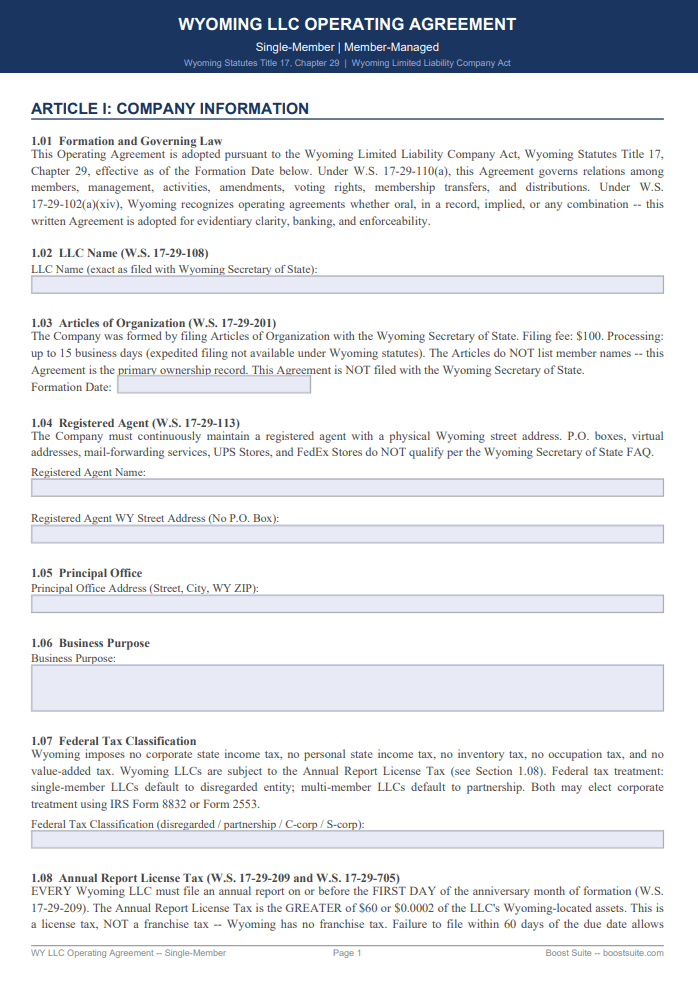
A Wyoming LLC operating agreement is the written contract governing how your business runs. Although Wyoming statutes recognize oral, written, and implied versions, a signed document is what banks, courts, and tax authorities rely on. Here’s what Wyoming law requires, what it doesn’t, and how to draft one.
Download Boost Suite’s free Wyoming LLC Operating Agreement template
Choose the version that matches your Wyoming LLC structure and download it in PDF or Word format. Each template is designed to help you document ownership, management, and internal rules more clearly from day one.
Does Wyoming Require an LLC Operating Agreement?
Wyoming doesn’t require an operating agreement to form an LLC. The state forms a Wyoming LLC the moment Articles of Organization are accepted by the Wyoming Secretary of State under W.S. 17-29-201. On the official Articles form, no operating agreement is requested or referenced.
The Wyoming Limited Liability Company Act still recognizes the document. Under W.S. 17-29-102(a)(xiv), an operating agreement is the agreement of all members of an LLC, including a sole member, governing the matters described in W.S. 17-29-110(a). The statute recognizes four forms:
- Oral agreements: Verbal arrangements between members.
- Agreements in a record: Signed written documents.
- Implied agreements: Patterns of conduct that show consent.
- Combined agreements: Any mix of the three above.
That statutory flexibility doesn’t translate to real-world acceptance. Banks, accountants, and Wyoming courts all expect a signed document. Without one, the gaps default to Title 17, Chapter 29, which rarely matches how founders actually want to run things. For the full filing sequence, the Wyoming LLC formation guide covers each step in order.
What a Wyoming Operating Agreement Actually Does
The short version: the operating agreement is the rulebook for the inside of a Wyoming LLC. Inside, it documents who owns what, who decides what, how money moves, and what happens when things change. Articles of Organization are public; the operating agreement isn’t. It stays with the company’s records.
Under W.S. 17-29-110(a), a Wyoming operating agreement governs:
- Member relations: Rights and duties between members and between members and the LLC.
- Manager rights and duties: If the LLC is manager-managed.
- Activities and conduct: What the company does and how.
- Amendments: The means and conditions for changing the agreement.
- Management and voting rights: Who decides what and by what threshold.
- Membership transfers: Who can sell, gift, or assign a membership interest.
- Distributions before dissolution: How profits and capital flow to members.
Anything outside this list (tax elections, dispute resolution venue, indemnification details) can still be added contractually. Beyond the statute, the agreement is also what banks request when opening a Wyoming LLC business account. It’s what the IRS expects to see if a multi-member LLC files Form 1065 partnership returns. For broader entity context, the Wyoming LLC overview covers formation, taxes, and ongoing compliance.
Form the Wyoming LLC, then keep the internal rules private and clear.
ZenBusiness can help with Wyoming LLC formation and registered agent setup, giving owners a clean public filing before the operating agreement documents ownership, manager authority, voting rights, transfers, and distribution rules in the company records.
Wyoming Default Rules Without an Operating Agreement: Four Statutory Traps
W.S. 17-29-110(b) is blunt: anything the operating agreement doesn’t address, Chapter 29 governs. Four defaults catch founders off guard.
| Topic | Wyoming Default | Statute | Operating Agreement Override |
|---|---|---|---|
| Distributions | Equal among members regardless of capital | W.S. 17-29-404 | Allocate by ownership %, capital, or custom formula |
| Management | Each member has equal management rights | W.S. 17-29-407 | Specify majority thresholds or weighted voting |
| Acts outside ordinary course | Require unanimous consent | W.S. 17-29-407 | Lower to majority or supermajority |
| Amendments | Require unanimous consent | W.S. 17-29-407 | Allow majority or supermajority amendments |
Founders comparing states for Wyoming LLC asset protection often assume the strong liability shield under W.S. 17-29-304 does the heavy lifting on its own. It doesn’t. While the shield handles external creditors, internal defaults still control how members get paid and how decisions get made.
Single-Member vs. Multi-Member Wyoming LLCs
Wyoming is one of the few states whose statute expressly includes a sole member in the operating agreement definition. That single phrase in W.S. 17-29-102(a)(xiv) changes the analysis for solo founders.
Single-Member Wyoming LLCs: Why Sole Owners Still Need One
On the surface, a single-member operating agreement looks redundant. Skipping it seems like a no-brainer: there’s no one to negotiate with, no votes to take. The document still does work that no other paperwork does:
- Bank onboarding: Most Wyoming banks ask for a signed agreement before opening a business bank account, even for solo LLCs.
- Ownership proof and privacy: Wyoming Articles of Organization don’t list members; the operating agreement is the cleanest record of ownership and keeps member identities private.
- Veil-piercing protection: Under W.S. 17-29-304, courts examine separation between the owner and the LLC. A signed operating agreement is hard evidence the owner treats the company as a distinct entity.
The Wyoming business entity verification tool shows what’s actually visible to the public, which underlines why an internal ownership record matters.
Multi-Member Wyoming LLCs: Customizing Money and Power
For two or more members, the operating agreement isn’t a nice-to-have. It’s the only document standing between the founders and W.S. 17-29-404’s equal-distribution rule. Priorities to nail down:
- Distributions: Pro-rata to capital, pro-rata to ownership, hybrid, or fully custom.
- Voting weight: Equal per member, weighted by ownership, or weighted by membership interest class.
- Transfer restrictions: Right of first refusal, drag-along, tag-along, and consent thresholds.
- Deadlock resolution: Buy-sell triggers, mediation clauses, or judicial dissolution paths.
Member-Managed or Manager-Managed: Picking the Right Setup
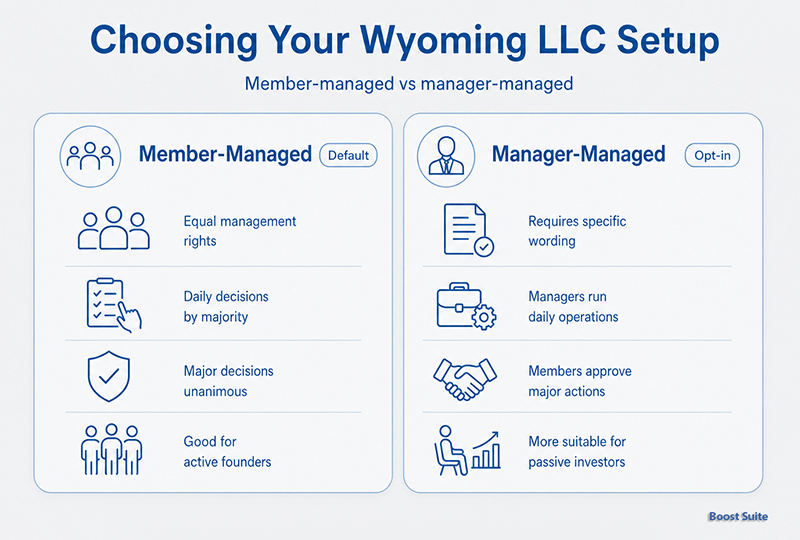
Wyoming’s default is member-managed. To switch to manager-managed, the LLC needs specific statutory language somewhere in the record.
Member-Managed: The Wyoming Default
If the Articles of Organization or operating agreement don’t say otherwise, W.S. 17-29-407 applies to every Wyoming LLC:
- Equal management rights: Each member has the same authority to act on behalf of the company.
- Ordinary-course decisions: Decided by majority of members.
- Acts outside the ordinary course: Require unanimous consent of all members.
- Operating agreement amendments: Require unanimous consent of all members.
This works for small LLCs with aligned founders. It breaks down fast when one member runs day-to-day operations and the others are passive investors.
Manager-Managed: The Statutory Opt-In
Manager-managed status doesn’t apply automatically. The Articles or operating agreement must use specific phrasing. Per W.S. 17-29-407(a), the accepted phrases are “manager-managed,” “managed by managers,” “management is or will be vested in managers,” or words of similar import. Loose phrasing doesn’t cut it. Once manager-managed status applies:
- Manager authority: Managers decide ordinary-course matters; members lose direct management rights.
- Manager fiduciary duties: Managers owe a duty of loyalty and a duty of care under W.S. 17-29-409, plus the contractual duty of good faith and fair dealing.
- Manager removal: Majority member consent removes a manager without notice or cause unless the agreement says otherwise.
- Major actions: Mergers, conversions, asset sales outside the ordinary course, and amendments still need all-member consent.
- Indemnification: Managers receive statutory indemnification under W.S. 17-29-408 when acting within their authority.
The catch: Wyoming’s statute lets manager-managed status sit in either the Articles or the operating agreement. The trade-off: if it sits only in the operating agreement, the structure stays private but third parties get no public notice.
Set up your Wyoming LLC structure correctly with Bizee
Whether your Wyoming LLC is member-managed or manager-managed, Bizee helps you file your formation documents properly and start your business with a clear legal foundation.
Provisions Wyoming Won’t Let Your Operating Agreement Override
W.S. 17-29-110(c) lists eight items that no Wyoming operating agreement can change. In practice, most competitor templates ignore them, and that leads founders to draft clauses that won’t hold up in court. The non-overridable list, drawn directly from the Wyoming Legislature’s Title 17 statute:
- Capacity to sue and be sued: The LLC’s right under W.S. 17-29-105 stands.
- Wyoming governing law: Internal affairs and member liability stay under W.S. 17-29-106.
- Court power: Authority granted to Wyoming courts under W.S. 17-29-204 can’t be stripped.
- Good faith and fair dealing: The contractual obligation under W.S. 17-29-409(d) survives any waiver attempt.
- Member duties and rights: W.S. 17-29-410 information and access rights can’t be unreasonably restricted.
- Court-ordered dissolution: Judicial dissolution grounds under W.S. 17-29-701(a)(iv) and (v) remain available.
- Winding up: The requirement to wind up under W.S. 17-29-702(a) and (b)(i) is mandatory.
- Direct member actions: A member’s right to bring an action under Article 9 can’t be unreasonably restricted.
Trying to draft around these provisions doesn’t void the rest of the agreement. It just renders the offending clause unenforceable. Worth flagging because plenty of recycled templates floating around online include language that quietly conflicts with one or more of these eight items.
What to Include in a Wyoming LLC Operating Agreement
A complete Wyoming operating agreement covers nine sections. Each one closes a gap in Chapter 29 that would otherwise default to a rule founders don’t want.
- Company information: LLC name (matching the Articles exactly), principal office, registered agent, and formation date.
- Members and capital contributions: Each member’s name, ownership percentage, and contribution (cash, property, services, or promissory notes under W.S. 17-29-402).
- Management structure: Member-managed or manager-managed, with the exact statutory language from W.S. 17-29-407(a) if opting into manager-managed.
- Voting and decision rules: Thresholds for ordinary-course decisions, major actions, and amendments. Override the unanimous default if the LLC has more than two members.
- Profit, loss, and distributions: How money flows. Override the equal-distribution default in W.S. 17-29-404.
- Transfer restrictions and buy-sell: Right of first refusal, consent requirements, transferable interest rules under W.S. 17-29-502, and charging order protection under W.S. 17-29-503.
- Dissociation and buyout: Triggers under W.S. 17-29-602, valuation method, and payout terms when a member exits.
- Dissolution and winding up: Custom dissolution events, plus the procedure under W.S. 17-29-702 for asset distribution.
- Amendments and signatures: Amendment threshold, signature blocks for all members (and managers, if applicable), and effective date.
The agreement should also reference the registered agent on file with the Secretary of State. Picking a Wyoming registered agent service that maintains a true physical address matters because W.S. 17-29-113 requires it, and PO boxes don’t qualify.
Form your Wyoming LLC with Northwest and keep your records aligned
Northwest helps you file your Wyoming LLC, organize key company details, and keep your formation documents consistent with the operating agreement your business depends on.
Wyoming Compliance Tied to Your Operating Agreement
Three Wyoming compliance items intersect with the operating agreement. None of them appear in the document itself, but the document should reference them so members know what’s required.
Annual report and License Tax: Every Wyoming LLC files an annual report with the Secretary of State on or before the first day of the anniversary month of formation under W.S. 17-29-209. That recurring filing, Wyoming’s annual report, keeps the LLC in good standing year to year. The Annual Report License Tax is the greater of $60 or $0.0002 of the LLC’s Wyoming-located assets. Miss the deadline by 60 days and W.S. 17-29-705 allows administrative dissolution. For exact filing windows, see Boost Suite’s Wyoming LLC processing time guide.
Registered office and agent: W.S. 17-29-113 requires every Wyoming LLC to maintain a physical Wyoming office and a registered agent who can accept service of process. According to the Secretary of State’s FAQ, PO boxes, virtual addresses, and mail-forwarding services don’t qualify. Founders comparing Wyoming LLC formation costs sometimes underestimate this annual line item. Across several years, that adds up fast.
2025 federal and state updates: Two changes hit Wyoming LLCs recently. Under FinCEN’s March 21, 2025 interim final rule, U.S. companies and U.S. persons are exempt from Beneficial Ownership Information reporting under the Corporate Transparency Act. Foreign reporting companies remain subject to separate rules. Wyoming’s HB0069, effective July 1, 2025, added foreign adversary ownership or control as grounds for administrative dissolution under W.S. 17-29-705.
Choose the version that fits your LLC structure.
Wyoming LLC Operating Agreement FAQs
The questions below come up most often during Wyoming LLC formations. Each answer cites the relevant statute or official Wyoming Secretary of State guidance where applicable.
Is an operating agreement required for a Wyoming LLC?
No. Wyoming forms an LLC by accepting Articles of Organization under W.S. 17-29-201. While the operating agreement isn’t required to form the LLC and isn’t filed with the Secretary of State, Wyoming statute still recognizes the document under W.S. 17-29-102(a)(xiv).
Do I file my Wyoming LLC operating agreement with the Secretary of State?
No. The operating agreement is an internal document. It stays with the LLC’s records and is shared only with members, banks, accountants, attorneys, and other parties who need to verify the company’s governance.
Can a single-member Wyoming LLC have an operating agreement?
Yes. W.S. 17-29-102(a)(xiv) expressly includes a sole member in the operating agreement definition. Single-member LLCs use the agreement for bank onboarding, ownership proof, and documenting the separation between owner and entity for veil-piercing protection.
Does a Wyoming operating agreement need to be notarized?
No. Wyoming statute doesn’t require notarization. Most LLCs sign the agreement in front of witnesses or notarize signatures voluntarily because banks and lenders sometimes ask for it.
Does Wyoming recognize oral or implied LLC operating agreements?
Yes. W.S. 17-29-102(a)(xiv) recognizes oral, written (in a record), implied, and combined operating agreements. In practice, banks, accountants, and courts expect a signed written document, so the statutory recognition rarely helps a member who tries to enforce a verbal deal.
What’s the difference between Articles of Organization and an operating agreement in Wyoming?
The Articles of Organization are public and form the LLC under W.S. 17-29-201. The operating agreement is private and governs how the LLC runs internally under W.S. 17-29-110(a). In short: one creates the entity, and the other governs it.
Can I amend a Wyoming LLC operating agreement after signing?
Yes. Amendment rules come from the agreement itself. Under W.S. 17-29-407, the default rule requires unanimous member consent, and the agreement can lower the threshold to majority or supermajority.
- IRS, Get an Employer Identification Number
- Wyoming Secretary of State, Wyoming Limited Liability Company Act and Close LLC Supplement
- Wyoming Legislature, Title 17 Statutes
- Wyoming Secretary of State, LLC Articles of Organization
- Wyoming Secretary of State, Business FAQs
- Wyoming Secretary of State, Annual Report Online Services
- Wyoming Legislature, HB0069 (2025 General Session)
- FinCEN, March 21, 2025 BOI Interim Final Rule
Form your Wyoming LLC with Harbor Compliance
Harbor Compliance helps you set up your Wyoming LLC with accurate filings and a solid compliance foundation, so your operating agreement and default rules work in your favor, not against you.