

A West Virginia LLC operating agreement governs how members run, fund, and exit the company. The state doesn’t require one, and you won’t file it with anyone. Skip the document, though, and Chapter 31B’s default rules take over. They rarely match how owners want to operate.
Download Boost Suite’s free West Virginia LLC Operating Agreement template
Choose the version that matches your West Virginia LLC structure and download it in PDF or Word format. Each template is designed to help you document ownership, management, and internal rules more clearly from day one.
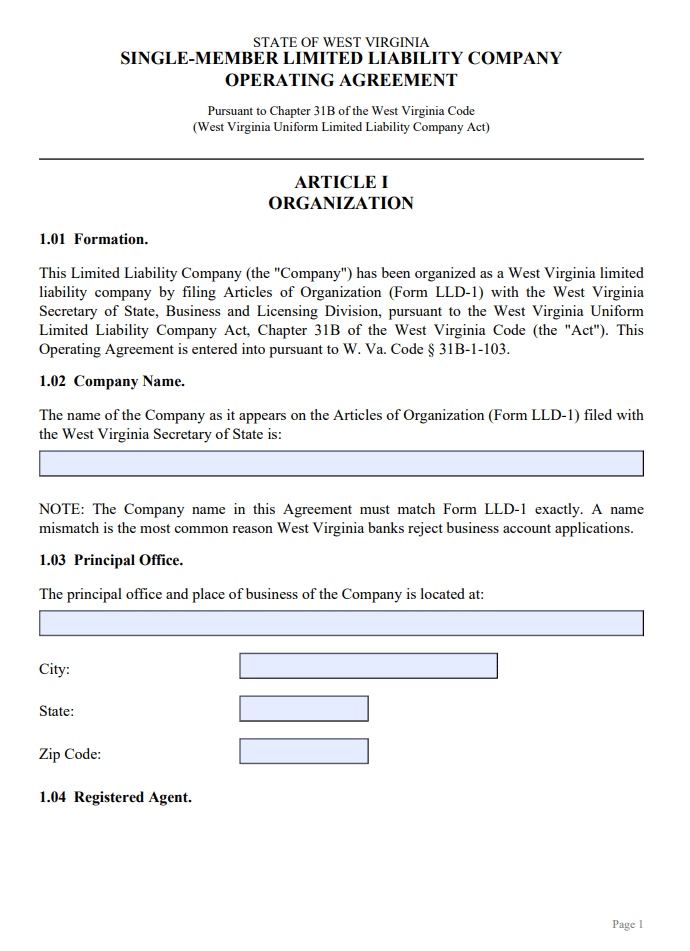
What is a West Virginia LLC operating agreement?
A West Virginia LLC operating agreement is a private contract among members that sets ownership percentages, voting thresholds, profit splits, management structure, and exit terms. Statute defines it at §31B-1-102 of the West Virginia Code. Unlike the Articles of Organization (Form LLD-1), it doesn’t get filed with the Secretary of State. Members keep it in the company records, signed and dated. It’s pulled out when something needs to be proved: a bank account, a partner buyout, or a court fight.
Does West Virginia require an operating agreement?
No. West Virginia Code §31B-1-103 authorizes members to “enter into an operating agreement, which need not be in writing,” but doesn’t mandate one. Single-member LLCs and multi-member LLCs both fall under the same rule.
In practice, every serious lawyer, bank, and investor will ask for a written copy before they release capital, open accounts, or recognize the company in litigation. Skipping the document doesn’t save anything; it just hands control of distributions, voting, and dissolution to the default rules in Chapter 31B.
The Chapter 31B default rules that can wreck your LLC
Chapter 31B of the West Virginia Code sets a complete shadow rulebook that runs your LLC the moment your operating agreement is silent or missing. Three of those defaults catch members off guard more than any others. In multi-member LLCs especially, the catch is real: dollars at stake compound the damage. If you’re starting a West Virginia LLC with even one co-owner, read this section twice.
Equal-share distributions, no matter who put in what
Under §31B-4-405, pre-dissolution distributions must be made in equal shares per member regardless of capital contributions, unless the operating agreement says otherwise. That’s not how most states work. In most other Revised Uniform LLC Act jurisdictions, including Delaware, the default is pro rata by contributions or by ownership percentages. West Virginia kept the original ULLCA equal-share rule. Picture two members: one contributed $200,000, the other contributed $10,000. Both get exactly half of any distribution unless the document says different.
Unanimous consent for decisions you didn’t think were major
§31B-4-404(c) requires unanimous member approval for a long list of items:
- Amending the operating agreement
- Amending the Articles of Organization
- Admitting a new member
- Making interim distributions or redemptions
- Using company property to redeem an interest subject to a charging order
- Consenting to dissolution
- Waiving the right to wind up
One holdout member can block any of these. For two-member LLCs, that’s a built-in deadlock risk; for larger LLCs, it can paralyze growth decisions. The agreement can lower these thresholds for most items. The §31B-1-103 non-waivable list still applies.
What happens when a member walks away
Chapter 31B treats member departure as a legal event with consequences. §31B-6-601 lists the events that cause dissociation:
- Expressed will to withdraw
- Transfer of all distributional interest
- Expulsion under the operating agreement or by unanimous member vote
- Certain bankruptcy filings
- Death of the member
- Incapacity
§31B-6-602 lets a member dissociate at any time by express will. The move is flagged as “wrongful” if it breaches the operating agreement or happens before the end of a term company. Wrongful dissociation triggers damages. Once dissociated, the former member loses voting rights and management authority. Under §31B-6-603, the dissociated member gets transferee status, which means distributions only.
| What §31B says by default | What a written operating agreement can change |
|---|---|
| Distributions split equally per member (§31B-4-405) | Pro rata by capital, by ownership %, or any custom formula |
| Major decisions need unanimous consent (§31B-4-404(c)) | Lower thresholds for most items, except the §31B-1-103 non-waivable list |
| Member’s death triggers transferee-only status (§31B-6-603) | Buy-sell mechanics, valuation formula, mandatory redemption |
| Charging order is the exclusive creditor remedy (§31B-5-504) | Procedures can be detailed, but creditor protections cannot be reduced |
Start the West Virginia LLC, then write the profit split clearly.
Bizee can help with West Virginia LLC formation and registered agent setup, giving members a clean filing record before the operating agreement replaces the default rules for equal distributions, unanimous consent, buy-sell terms, and member exits.
Single-member vs. multi-member operating agreements in West Virginia
Chapter 31B applies the same statutory framework to one-member LLCs and ten-member LLCs. §31B-2-202 allows “one or more persons” to organize an LLC. The West Virginia Code treats single-member and multi-member LLCs the same for liability protection. What changes is the drafting focus. Each setup has different threats to plan against, and the operating agreement should match the threat model.
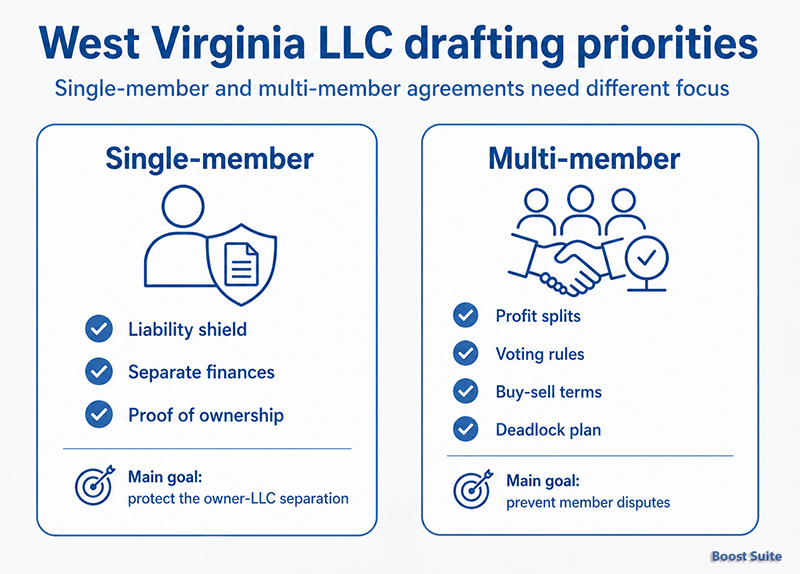
Single-member LLCs: the liability shield is the priority
For a sole owner, the operating agreement’s main job isn’t governance. It’s evidence. A signed agreement that documents the sole member’s identity, capital contributions, distributions, and bookkeeping practices helps demonstrate that the LLC and the owner aren’t legally the same entity. After SB 6 (2022), courts can no longer pierce the veil based on missing formalities alone, but capitalization and asset separation still matter. Confirm that the legal name in your agreement matches the name on file with the state by running a West Virginia business name search before signing.
Multi-member LLCs: profit splits, voting, and buy-sell mechanics
Multi-member agreements have to do real governance work because the §31B defaults rarely fit how owners actually agree to split things. Spell out distribution percentages, define voting thresholds (ordinary vs. major decisions), set valuation methods for buyouts, and write a deadlock-breaking mechanism. Without these, a 50/50 LLC that can’t break a deadlock often ends up in circuit court, where members must petition for judicial dissolution under §31B-8-801. That’s expensive, slow, and almost never produces the outcome either side wanted.
Member-managed vs. manager-managed: what changes in your operating agreement
Two documents control how a West Virginia LLC is managed: the Articles of Organization and the operating agreement. They have to match. Under §31B-2-203, Form LLD-1 requires the LLC to declare whether it’s manager-managed at the time of filing. If the form is silent, §31B-3-301 makes the LLC member-managed by default, and every member becomes an agent of the company. Switching this later means amending the Articles; you can’t fix it through the operating agreement alone.
| Feature | Member-managed | Manager-managed |
|---|---|---|
| Default election | Default if Articles are silent | Must be elected on Form LLD-1 |
| Agency authority | Every member binds the LLC for ordinary business | Managers bind the LLC; members do not solely by status |
| Ordinary decisions | Majority of members | Majority of managers |
| Major decisions (§31B-4-404(c)) | Unanimous member consent | Unanimous member consent (managers cannot override) |
| Operating agreement priorities | Clarify which decisions need majority vs. unanimous | Define manager appointment, removal, scope, fiduciary duties |
| Registered agent role | Required regardless | Same |
What every West Virginia LLC operating agreement should cover
The clauses below aren’t a generic operating-agreement checklist. Each one targets a specific Chapter 31B default that catches West Virginia LLC owners off guard. Drafters can audit any template against this list before signing, including the ones from Boost Suite, Northwest, and LLC University. Bottom line: if your agreement doesn’t address each of these, you’re relying on Chapter 31B.
- Company name and registered office: the name must match Form LLD-1 exactly, including punctuation and the “LLC” / “L.L.C.” designation under §31B-2-203
- Members and capital contributions: documents who contributed what, since §31B-4-405 ignores contributions and splits distributions equally by default
- Profit, loss, and distribution allocation: the override clause for §31B-4-405; pick a formula (pro rata, custom, hybrid) and lock it in
- Voting thresholds and reserved matters: modifies §31B-4-404(c) where allowed; lists which matters still require unanimity per the non-waivable §31B-1-103 floor
- Manager appointment, authority, and removal: required when Form LLD-1 elects manager-managed; defines scope, term, fiduciary duties, and how members reserve approval rights
- Transfer restrictions and admission of new members: sets right-of-first-refusal mechanics under §31B-5-501 to 503; without this, transferees get distributions but no votes
- Dissociation events and buyout mechanics: layers on top of §31B-6-601’s statutory triggers and §31B-7-701’s company purchase right; specifies valuation method
- Indemnification and reimbursement: §31B-4-403 already requires reimbursement for ordinary-course expenses; the agreement should clarify scope and add advancement provisions
- Dissolution and winding up: maps to §31B-8-801 to 803; defines what events dissolve the LLC and how assets get distributed
- Tax election clauses: S-corp, C-corp, or West Virginia’s elective Pass-Through Entity Tax (covered next)
Form your West Virginia LLC with Northwest and start with the right structure
Northwest helps you file your West Virginia LLC correctly from the beginning, so your company name, registered office, and formation details line up before you finalize the operating agreement clauses that control ownership, voting, transfers, and dissolution.
2026 changes every West Virginia LLC owner should know
Two regulatory shifts from 2022-2026 reshape how operating agreements should be drafted in West Virginia. Most consumer-facing guides haven’t caught up with them. Despite that gap, both have direct drafting consequences for new and existing LLCs. One’s already in effect for tax years; the other took effect on June 12, 2026.
The Uniform Protected Series Act (effective June 12, 2026)
In March 2026, West Virginia enacted SB 670. The bill adopted the Uniform Protected Series Act as new Article 14 of Chapter 31B (§31B-14-101 et seq.). The statute authorizes “series limited liability companies” and “protected series” with internal liability shields between series and the parent LLC. Real estate investors and asset-segregation strategies are the obvious users.
For LLCs that’ll use protected series after June 12, 2026, the operating agreement needs new provisions in five areas:
- Establishment and termination of each series
- Asset and member association
- Series-level governance
- Inter-series transactions
- The Act’s naming and reporting rules
The parent LLC’s operating agreement and each series’ internal documentation have to work together. Otherwise, the liability shields collapse.
Elective Pass-Through Entity Tax allocations
West Virginia’s elective Pass-Through Entity Tax has been available since tax year 2022 under SB 151. The top individual rate (5.12% for 2023 and beyond) applies at the entity level, and members get a corresponding credit on their personal income tax. For calendar-year LLCs taxed as partnerships or S-corps, the election is generally due by March 15 of the following year.
Multi-member operating agreements should now include clauses on whether and when to elect PTET. The clauses also need to cover who has authority to make the election, and how the entity-level income tax burden gets allocated among members. Without these clauses, an LLC can’t reach a fast decision when the deadline arrives. Miss March 15 and you lose the election for that year. That adds up fast for a profitable multi-member LLC.
How a written operating agreement strengthens your liability shield
After SB 6 (2022), §31B-3-303 explicitly states that failure to observe LLC formalities cannot, by itself, justify piercing the veil. That’s a big shift. Before SB 6, the Supreme Court of Appeals allowed veil-piercing under Kubican v. The Tavern, LLC. The test asked about “unity of interest and ownership” and treated missing formalities as evidence of fraud. SB 6 changed the analysis.
What still matters: capitalization, separation of personal and business assets, and clear documentation of the LLC’s existence and operations. A written operating agreement is the single most useful piece of that documentation for a single-member LLC. It’s often the only document that proves the company isn’t an alter ego of the owner.
Drafting, signing, and storing your West Virginia operating agreement
Most West Virginia LLCs handle this in one sitting after the Articles of Organization clear the Secretary of State. The sequence:
- Draft using a state-specific template: generic templates miss §31B specifics, so use one calibrated to the West Virginia Code or have a lawyer review it
- Confirm name match: the company name must match Form LLD-1 exactly; even a comma can cause bank rejection
- Sign and date: every member signs; for single-member LLCs, the sole member signs as both member and (often) sole manager
- Notarize only if required: Chapter 31B doesn’t mandate it, but some banks request notarized signatures when you open the account
- Store the originals: keep them in the company records along with the filing receipts and your records of West Virginia LLC formation costs
- Amend on consensus: any change requires unanimous consent under §31B-4-404(c) unless the agreement lowers the threshold
Timing tip: sign the operating agreement only after the Articles are accepted, not before. New owners can check current West Virginia LLC processing time before scheduling the signing meeting. If you used one of the best LLC services in West Virginia, confirm whether they delivered a signed agreement template or just the Articles. Worth flagging: even paid services often deliver only the state filing, so you’ll need to draft your own from a template.
Choose the version that fits your LLC structure.
West Virginia LLC operating agreement FAQ
These are the questions that come up most often after an owner has read through the basics, and they cover ground the body of this article doesn’t fully address. Each answer is short on purpose; the goal is to settle the question, not restart it.
Does my West Virginia operating agreement need to be notarized?
No. Chapter 31B doesn’t require notarization. Some banks ask for a notarized copy when you open a business account. Notarizing the signatures can prevent later disputes about authenticity, but it isn’t a legal requirement under West Virginia law.
Do I file my operating agreement with the West Virginia Secretary of State?
No. The operating agreement is internal. The only company-formation document filed with the Secretary of State is the Articles of Organization (Form LLD-1). Members keep the operating agreement in the company’s records.
Can a West Virginia operating agreement be oral and still hold up in court?
Yes, technically. §31B-1-103 says the agreement “need not be in writing.” Still, oral terms can’t be proven when members disagree, and courts default to statutory rules in the absence of written evidence. A written agreement is the only practical choice for any West Virginia LLC.
How do I amend a West Virginia LLC operating agreement once it’s signed?
Under §31B-4-404(c), amending the operating agreement requires unanimous member consent by default. The agreement itself can lower this threshold for most amendments, but only if it includes that language up front. Document each amendment in writing, and have all members sign and date the change you’re making.
Does a West Virginia LLC need an EIN before signing the operating agreement?
No. The Employer Identification Number from the IRS isn’t a prerequisite for signing. Most owners apply for the EIN after the Articles are accepted but before they open a business bank account. The operating agreement can be drafted and signed at any point in that sequence.
Do West Virginia banks require an operating agreement to open a business account?
Yes, in nearly every case. Most West Virginia banks ask for a signed operating agreement (and often a Certificate of Existence) before they’ll open a business account, even for single-member LLCs. Calling ahead saves a return trip. Banks typically want the signed operating agreement, the EIN letter from the IRS, and the certified Articles of Organization in one packet.
- West Virginia Legislature – SB 670 (Uniform Protected Series Act, 2026)
- West Virginia Code §31B-1-103 (Effect of operating agreement; nonwaivable provisions)
- West Virginia Code Chapter 31B (Uniform Limited Liability Company Act)
- West Virginia Code §31B-4 (Member relations; distributions; standards of conduct)
- West Virginia Secretary of State – Business & Licensing Division
- West Virginia Tax Division – Elective Pass-Through Entity Tax
Build your West Virginia LLC the right way with Harbor Compliance
Harbor Compliance helps you form your West Virginia LLC properly, from filing key documents to keeping your business aligned with state requirements after your operating agreement is in place.