

Vermont doesn’t force any LLC to sign an operating agreement. But 11 V.S.A. Chapter 25 fills every gap with default rules, and several of them surprise first-time owners. A written operating agreement is how owners take control before defaults bite.
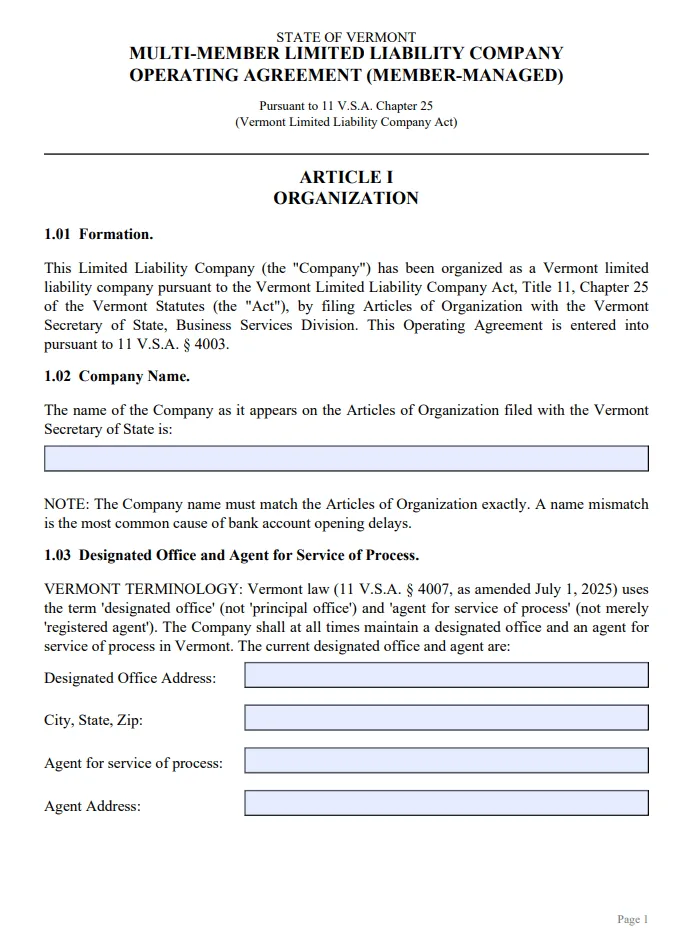
Download Boost Suite’s free Vermont LLC Operating Agreement template
Choose the version that matches your Vermont LLC structure and download it in PDF or Word format. Each template is designed to help you document ownership, management, and internal rules more clearly from day one.
Is a Vermont LLC Operating Agreement Required?
No. Vermont law doesn’t legally require an LLC to file or sign an operating agreement. Under 11 V.S.A. § 4003(a), the document governs internal affairs and the relationships among members, managers, and the company. Where it stays silent, Title 11, Chapter 25 supplies the default rules.
Vermont also recognizes pre-formation assent under § 4003(j), so oral or implied agreements can carry legal weight. That’s hard to enforce in practice. 2025 amendments to §§ 4007, 4023, and 4033 took effect July 1, 2025, and current Vermont LLC documents should reflect them.
Bottom line: a signed written agreement is recommended for both single-member and multi-member LLCs anyway. For founders still in formation, the guide to starting a Vermont LLC in five simple steps walks through the full filing sequence.
What Happens Without an Operating Agreement: Vermont’s Default Rules
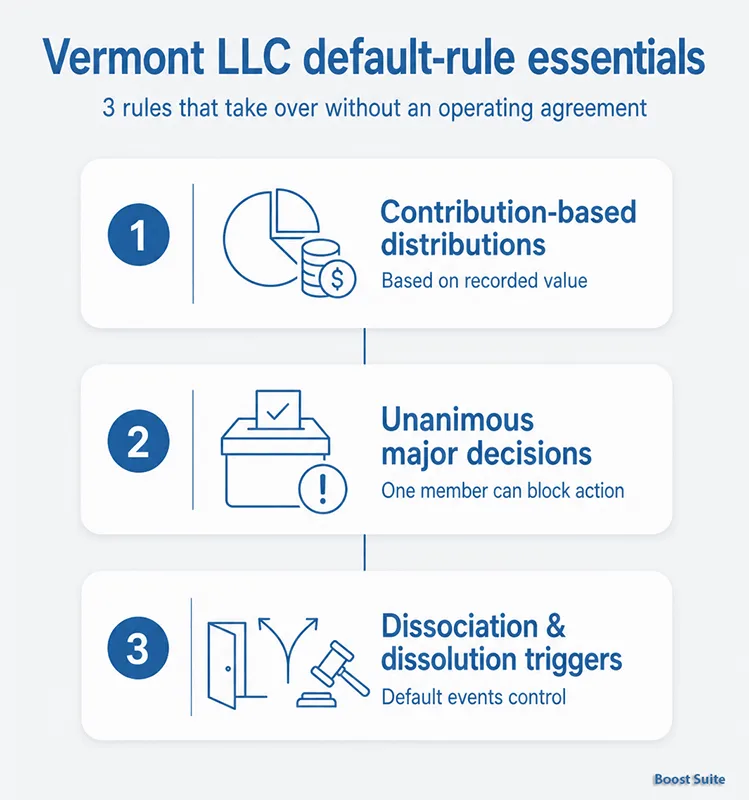
When the operating agreement is silent, the Vermont LLC Act fills the gap. Three areas catch unprepared owners off guard the most: distributions, voting thresholds for major decisions, and the events that trigger dissociation or dissolution.
Distributions Are Based on Contribution Value, Not Ownership Percentage
Vermont’s § 4055(a) allocates profits, losses, and pre-dissolution distributions in proportion to the agreed value of each member’s contribution as recorded in company records. Equal ownership doesn’t mean equal payout, and unequal contributions don’t necessarily mean payouts follow the percentage everyone assumed.
Picture two members who each own 50% of an LLC. They can still receive different distributions if their contribution values were different at the time of formation. The agreed-value rule looks back at what was recorded in the LLC’s internal books, not any verbal handshake.
An operating agreement that sets distributions by ownership percentage, by class, or by a custom formula overrides the default. Without one, Vermont judges read § 4055 literally.
Voting Rules and the Major-Actions Trap
In a member-managed Vermont LLC, § 4054(b) gives each member equal management rights regardless of contribution size. Ordinary business decisions pass by a majority of members.
But § 4054(d) flips the script for seven major actions. Without an operating agreement to lower the bar, every one requires unanimous member consent:
- Amending the operating agreement:
- Amending the Articles of Organization:
- Admitting a new member:
- Making interim distributions:
- Redeeming an interest subject to a charging order:
- Waiving the requirement to wind up:
- Disposing of all or substantially all company property:
The catch: a single holdout member can block any of these. The larger the LLC, the harder unanimous consent becomes. An operating agreement is the only place to set custom thresholds (supermajority, manager discretion, member-class voting).
Member Dissociation and Dissolution Triggers
A member can leave by express will under § 4082, but the dissociation can be ruled wrongful if it breaches the operating agreement or the Articles. Wrongful dissociation makes the leaving member liable to the LLC and the other members for damages.
Vermont § 4101 lists five dissolution triggers. Three are private: an event named in the operating agreement, member consent at the threshold the agreement specifies (or unanimous if silent), and 90 consecutive days with no members. Two are court-ordered: a Superior Court dissolution for unlawful or impracticable conduct, or fraudulent or oppressive management.
In writing, most of these defaults can be overridden. A few cannot, which is the next thing every Vermont LLC owner should understand.
Form the Vermont LLC, then document the contribution values clearly.
Northwest can help file the Vermont LLC and registered agent details cleanly, giving owners a proper starting point before the operating agreement sets contribution values, voting thresholds, distribution rules, and dissolution triggers.
Nonwaivable Provisions Your Operating Agreement Cannot Override
Vermont § 4003(b) lists eleven things an operating agreement can never change for limited liability companies, no matter how the document is drafted or who signs it. Most preserve fiduciary duty, court power, and statutory rights of non-members.
Among the items Vermont treats as untouchable:
- The LLC’s capacity to sue and be sued in its own name:
- The applicable governing law for a domestic Vermont LLC:
- The Superior Court’s power to order judicial dissolution under § 4101(a)(4):
- Fiduciary duties beyond the limits permitted by § 4003(c)-(f):
- The contractual obligation of good faith and fair dealing:
- Reasonable access to books, records, and information rights under § 4058:
Templates that try to waive every duty or strip out books-and-records rights won’t hold up in a Vermont court.
What to Include in a Vermont LLC Operating Agreement
A Vermont-specific operating agreement should address every area where Title 11, Chapter 25 supplies a default. Eight clauses cover the ground that matters most.
- Company name, designated office, and agent for service of process: The legal name must match the Articles of Organization exactly. Run the proposed name through a Vermont LLC name search before drafting; it’s the cheapest way to catch a conflict before a § 4023 rejection. Vermont’s statutory term under § 4007 is agent for service of process, not just “LLC registered agent.”
- Member identification and capital contributions: Record the dollar value (cash or property) each member contributed. Capital contribution records are what § 4055(a) reads from when a dispute arises.
- Profit, loss, and distribution allocations: Override the contribution-value default of § 4055(a). Specify whether distributions follow ownership percentage, contribution value, or a custom formula, and set timing for interim distributions.
- Management structure (member-managed or manager-managed): Vermont defaults to member-managed under § 4054(a). Manager-managed status requires explicit language in the operating agreement. Anything fuzzier won’t override § 4054(a).
- Voting thresholds and decision procedures: Override the unanimous-consent defaults of § 4054(d) for major actions you want to pass with a lower bar. Define quorum, voting rights, and tie-breakers.
- Transfer restrictions and member buyouts: § 4072 already restricts transferees from becoming members. The operating agreement tightens that with right-of-first-refusal terms, mandatory buyback events, and valuation methods.
- Member admission, dissociation, and dissolution events: Spell out how new members get added, what counts as wrongful dissociation, and which events trigger dissolution.
- Indemnification and dispute resolution: § 4060 already requires the LLC to indemnify members or managers in some circumstances. The OA can add insurance obligations, internal mediation, or arbitration clauses (§ 4103(b)(2)(E) explicitly allows arbitration during winding up).
| Issue | Vermont Default Rule (No OA) | With Operating Agreement |
|---|---|---|
| Profit and loss allocation | Proportional to agreed contribution value (§ 4055(a)) | Whatever members negotiate (per ownership %, equal split, by class) |
| Major-action voting | Unanimous consent required (§ 4054(d)) | Custom thresholds (majority, supermajority, manager discretion) |
| Management structure | Member-managed (§ 4054(a)) | Manager-managed if expressly stated |
| Transfer of interest | Transferee gets distributions only, not membership (§ 4072) | Right of first refusal, mandatory buyback, custom restrictions |
| Dissolution | All-member consent if silent (§ 4101) | Custom approval threshold, named events |
| Member dissociation | Statutory wrongful-dissociation rules (§ 4082) | Defined exit terms, valuation, buyout |
Single-Member vs. Multi-Member Vermont LLCs
Vermont allows one or more persons to form an LLC under § 4022(a). The IRS treats a single-member LLC as a disregarded entity by default, while a multi-member LLC defaults to partnership treatment. Either can elect corporate treatment using IRS Form 8832 or single-member LLC classification rules from the IRS. Vermont’s liability shield applies to both structures under § 4042, and failure to observe formalities alone isn’t grounds for piercing the LLC veil.
The single-member trap sits in a different statute. 11 V.S.A. § 4074(g) is where Vermont differs sharply from most states. For a multi-member LLC, foreclosure on a charging order transfers only the distributional interest to the buyer. For a single-member LLC, foreclosure transfers the entire interest, and the debtor is dissociated.
That’s a real asset-protection gap. Solo Vermont LLC owners with meaningful creditor exposure should pair the operating agreement with additional planning (a co-member with a real interest, a holding entity, or a trust).
Member-Managed vs. Manager-Managed: The Drafting Trap
Vermont LLCs are member-managed by default under § 4054(a). Manager-managed status only kicks in if the operating agreement expressly says so. The OA must use language like “manager-managed,” “managed by managers,” or “management is vested in managers.” Anything fuzzier defaults back to member-managed.
That’s a drafting trap on copy-pasted templates. A clause titled “Management” that lists managers without using the statutory phrasing won’t override § 4054(a). Vermont judges read the words on the page literally.
When manager-managed makes sense:
- Passive-investor LLCs: investors who don’t want operational decisions
- Outside-operator ventures: a CEO or GM running the business who isn’t a member
- Asset-holding LLCs: real estate, IP, or absentee-owner structures
Fiduciary duties shift with the structure. Under § 4059(i), non-manager members in a manager-managed LLC don’t owe fiduciary duties solely by being a member, subject to good-faith and fair-dealing duties.
Vermont’s L3C Disclosure Requirement
Vermont was among the earliest states to recognize the low-profit limited liability company (L3C). If the LLC is an L3C, the Articles of Organization must say so under § 4023(a)(6), and the company name must include the abbreviation “L3C” per § 4005.
An L3C operating agreement should track the §§ 4161-4162 charitable or educational mission requirements. A standard Vermont LLC template won’t include the L3C purpose language. If the LLC is meant to qualify for program-related investments from foundations, this section can’t be skipped.
Filing Costs, Annual Report, and the $250 Minimum Entity Tax
An operating agreement handles governance. Vermont’s filing fees handle the rest. Every LLC also files an annual report in Vermont between January 1 and March 31. A few common figures online are stale; here’s what the 2026 statute actually shows:
- Articles of Organization filing fee: $155 under § 4012(a)(1) (the older $125 figure still on some pages is stale)
- Domestic LLC annual report fee: $45 under § 4012(a)(15) (not $35)
- Foreign LLC annual report fee: $170 under § 4012(a)(16)
- Annual report deadline: within three months after the LLC’s fiscal year ends (§ 4033)
- Vermont minimum entity tax: $250 per year for any LLC taxed as a partnership under 32 V.S.A. § 5921, due on the federal return date
- Risk of administrative termination: missed annual reports can terminate the Articles of Organization under § 4034, and missing reports for five years costs the LLC its name
Worth flagging: Vermont’s annual report deadline tracks fiscal-year-end plus three months, not a fixed calendar date. An LLC with a June 30 fiscal year-end has until September 30 to file. That throws off owners expecting an April 15 or anniversary-date trigger. See Boost Suite’s breakdown of Vermont LLC processing time for current turnaround estimates.
Maintaining a continuous agent for service of process is a separate annual cost. That adds up fast across multiple states. Vermont income tax flows through to members at the personal level for partnership-taxed LLCs, so the $250 minimum sits on top of each member’s individual return.
Choose the version that fits your LLC structure.
Signing, Storing, and Amending Your Vermont Operating Agreement
Vermont doesn’t require notarization. Members sign the operating agreement (manually or electronically), the LLC keeps the executed original in its records, and copies go to anyone with information rights under § 4058. Single-member LLCs still need to sign one, even though there’s only one signature line.
Amendments default to unanimous member consent under § 4054(d). The OA itself can lower that threshold (majority, supermajority, manager discretion) but only if the original document expressly says so.
Vermont LLCs operating since the 2025 amendments (effective July 1, 2025) should review their operating agreements against §§ 4007, 4023, and 4033 to make sure the document reflects current law.
Frequently Asked Questions About Vermont LLC Operating Agreements
Common questions Vermont LLC owners ask after reading the statute. Each answer cites Vermont law where applicable.
Does a Vermont LLC operating agreement need to be notarized?
No. Vermont law doesn’t require notarization, and member signatures alone are enough. Some banks may ask for notarization on their own, but it isn’t a Vermont legal requirement.
Can a Vermont LLC operating agreement be oral, or does it have to be written?
Vermont § 4003(j) recognizes oral and pre-formation assent as binding, so an oral agreement can carry legal weight in theory. In practice, oral agreements are nearly impossible to enforce, and Vermont courts default to the statutory rules whenever the document’s terms aren’t proven. A signed written agreement is the only way an operating agreement legally holds up in court.
How is a Vermont operating agreement different from the Articles of Organization?
Articles of Organization are the public formation document filed under § 4023; they create the LLC and disclose name, designated office, agent, and L3C status. The operating agreement is internal, never filed publicly, and governs how members and managers run the company. Where the two conflict, § 4023(c) says the operating agreement controls between members, while the Articles control on third-party reliance.
Does Vermont require LLCs to publish a notice in newspapers like New York?
No. Title 11, Chapter 25 has no publication requirement. The newspaper-publication rule applies in states like New York and Arizona; Vermont has no equivalent.
Can the Articles of Organization include operating-agreement provisions?
Yes, but with limits. Under § 4023(b), Articles can include any provision an operating agreement could contain. Two caveats apply. First, the Articles can’t override nonwaivable provisions under § 4003(b). Second, where there’s a conflict, the operating agreement wins between members while the Articles win on third-party reliance per § 4023(c).
What’s the difference between a Vermont operating agreement and corporate bylaws?
Bylaws govern corporations; operating agreements govern LLCs. They serve similar internal-rules purposes but live under different statutes. Vermont corporations operate under Title 11A, while Vermont LLCs operate under Title 11, Chapter 25.
How often should a Vermont LLC update its operating agreement?
At every material change in members, managers, contribution values, or business activity, and after any Vermont legislative update touching the LLC Act. The 2025 amendments to §§ 4007, 4023, and 4033 are reason enough for older Vermont LLCs to review their existing agreements before the next annual report cycle.
- IRS, LLC filing as a corporation or partnership
- Vermont Statutes Online, Title 11, Chapter 25, Limited Liability Companies
- Vermont Statutes Online, Title 32, Chapter 151, Income Taxes
- Vermont Secretary of State, Domestic Formation, LLC
- Vermont Secretary of State, Fees and Statutes
- IRS, Single-Member Limited Liability Companies
Start your Vermont LLC with Harbor Compliance
A solid operating agreement is easier to build when your LLC is formed correctly from the start. Harbor Compliance helps you handle your Vermont filing, organize key business details, and keep your company on track with state requirements.