

A Tennessee LLC operating agreement is the internal contract that sets ownership, management, and profit splits for a limited liability company. Two parallel LLC statutes govern Tennessee LLCs, and which one applies depends on when the LLC was formed.
Download Boost Suite’s free Tennessee LLC Operating Agreement template
Choose the version that matches your Tennessee LLC structure and download it in PDF or Word format. Each template is designed to help you document ownership, management, and internal rules more clearly from day one.
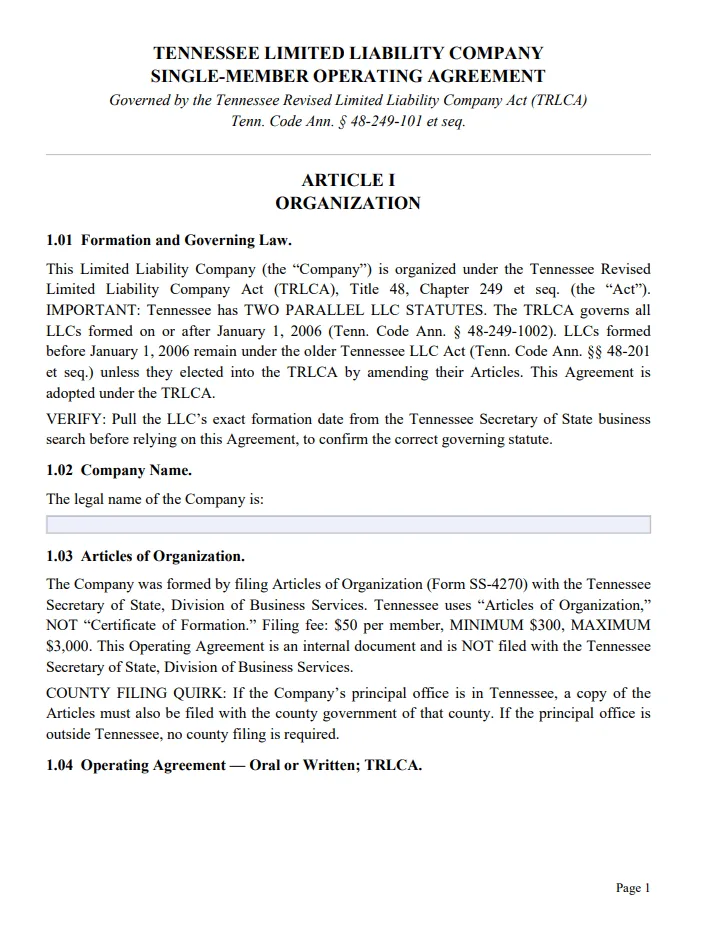
Tennessee’s Two LLC Acts: Which One Governs Your Operating Agreement
Tennessee is one of a handful of states still running two LLC statutes side by side. The Tennessee Revised Limited Liability Company Act (TRLCA), found at Tenn. Code Ann. § 48-249-101 et seq., became the default for any LLC formed on or after January 1, 2006. The older Tennessee LLC Act (Title 48, chapters 201-248) still applies to pre-2006 LLCs that didn’t opt into TRLCA.
That distinction isn’t trivia. Each act treats operating agreements differently:
- TRLCA (post-2006 LLCs): Members can adopt an oral or written agreement.
- Older Act (pre-2006 LLCs that didn’t opt in): A written agreement is mandatory for any board-managed LLC.
Tenn. Code Ann. § 48-249-1002 draws the line. Pre-2006 LLCs can elect into TRLCA by amending their Articles of Organization, but they don’t have to. Owners ready to form a Tennessee LLC today work under TRLCA by default.
Is a Tennessee LLC Operating Agreement Required?
For LLCs formed on or after January 1, 2006, a Tennessee LLC operating agreement isn’t legally required. Tenn. Code Ann. § 48-249-203 says members “may” enter into an operating agreement. Unless the Articles of Organization or an existing written OA require otherwise, the agreement doesn’t even have to be written. Oral and implied agreements are valid under TRLCA.
Older LLCs that never elected into TRLCA work under different rules:
- Board-managed legacy LLCs: A written operating agreement is mandatory under Tenn. Code Ann. § 48-206-101.
- Member-managed legacy LLCs: The OA stays optional, same as under TRLCA.
- Pre-2006 LLCs that opted in: TRLCA rules apply going forward.
Single-member LLCs get explicit recognition in TRLCA. Section 48-249-203 confirms that a single-member LLC can adopt an operating agreement, and once it does, the agreement binds both the member and the company. Worth knowing, since some online guides still claim SMLLCs can’t have one.
The bottom line for most modern Tennessee LLCs: an OA isn’t legally required, but skipping one is a bad bet. Banks routinely ask for it. Investors expect it. Without one, statutory defaults govern profit splits, voting, member duties, and dissolution.
Default Rules When You Skip the Operating Agreement
Without a written OA, the Tennessee Revised LLC Act fills the gaps with default rules. Some of those defaults work fine for owners. Others can wreck a partnership. Here’s how the OA-vs-no-OA picture compares for the issues that actually cause disputes.
| Issue | Default Rule (No OA) | With Operating Agreement |
|---|---|---|
| Profit and loss split | Equal shares per member | Custom split tied to capital contributions |
| Management voting | Majority of members for ordinary matters | Custom thresholds (supermajority, unanimous) for major calls |
| Adding new members | Statutory rules under TRLCA Part 5 | Custom approval process and contribution rules |
| Member departure | Default buyout under statute | Custom buy-sell terms and valuation method |
| Dissolution triggers | Events listed in § 48-249-601 | Custom triggers (deadlock, license loss, etc.) |
| Fiduciary duties | Loyalty + care under § 48-249-403 | Limits/modifications subject to § 48-249-205 carve-outs |
Equal-share profits and losses (§ 48-249-304)
Tenn. Code Ann. § 48-249-304 sets the rule clearly: when an LLC’s documents are silent, profits and losses are allocated equally among members regardless of how much each one contributed. Two members, 50/50. Three members, 33/33/33. Capital contributions don’t change the math by default.
That’s the catch most multi-member Tennessee LLCs don’t see coming. One member puts in $100,000, another puts in $5,000, and they’re both legally entitled to the same share unless the operating agreement says otherwise.
Voting rights and management defaults (§ 48-249-401)
Section 48-249-401 governs management defaults. In a member-managed LLC, each member has equal voting rights in management, and ordinary matters are decided by majority vote of members. In a manager-managed LLC, each manager gets equal rights and the majority rules. Neither default fits an LLC with weighted ownership.
The problem shows up in three-member LLCs where two minority owners can outvote the majority owner on day-to-day calls. A simple voting clause tied to ownership percentage avoids the issue.
Fiduciary duties and dissolution triggers (§§ 48-249-403, 601)
Members in a Tennessee member-managed LLC owe two statutory duties: the duty of loyalty and the duty of care, both defined in § 48-249-403. Holders of purely economic rights (no governance rights) owe no duties under the same section. The OA can narrow how those duties apply, but it can’t eliminate them entirely under § 48-249-205.
Dissolution events in § 48-249-601 cover the basics: the stated term expires, members vote to dissolve, the court orders dissolution, or all members leave. Custom triggers like manager deadlock or loss of a professional license aren’t covered by default.
What to Include in Your Tennessee Operating Agreement
A solid Tennessee LLC operating agreement maps the company’s structure, decisions, profit flows, and exit terms. The list below is the practical floor. Drop any of these and you’re letting statute fill the gaps with defaults you wouldn’t have picked yourself.
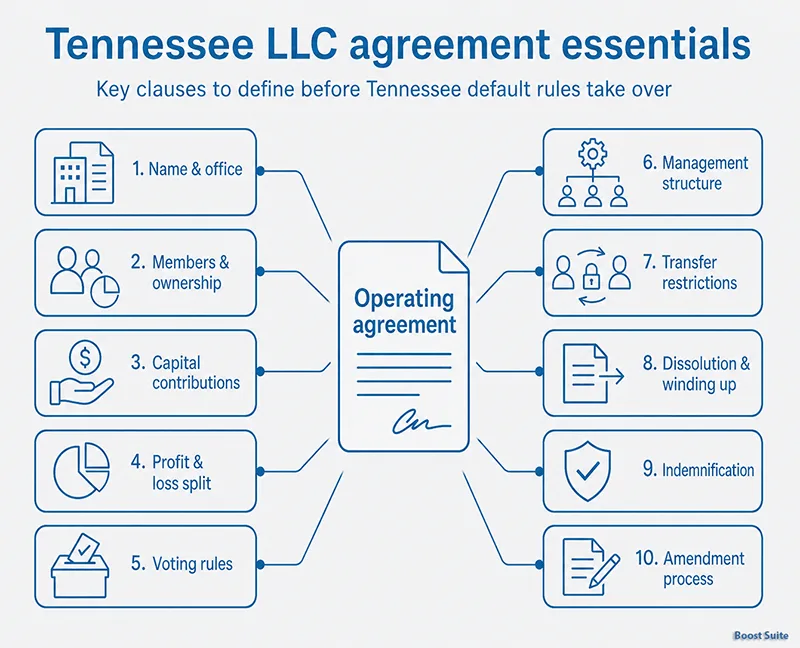
- Company name and principal office: Match the exact name on the Articles of Organization (Form SS-4270) filed with the state. Misalignment here is a top reason banks reject applications. Verify name uniqueness through the Tennessee business entity search before drafting anything else.
- Members and ownership percentages: List every member, the percentage interest each holds, and the date that interest was issued.
- Capital contributions: Document who put in what (cash, property, services), value at the time of contribution, and any future contribution obligations. Tennessee accepts all three contribution types.
- Profit and loss allocations: Override § 48-249-304’s equal-share default with a percentage-based or capital-account-based split that reflects the actual deal.
- Voting rights and thresholds: Distinguish ordinary decisions (majority) from major decisions like admitting members, amending the OA, or selling substantially all assets. These shouldn’t move on a simple majority vote.
- Management structure: Specify member-managed, manager-managed, or director-managed. The choice has to match Form SS-4270.
- Transfer restrictions: Add right of first refusal, buy-sell terms, and consent requirements for new members. Tennessee allows broad contractual control here.
- Dissolution and winding up: Layer custom triggers on top of § 48-249-601’s statutory list, then spell out the winding-up sequence and distribution priorities.
- Indemnification: Tennessee permits broad indemnification under § 48-249-115, with carve-outs for bad faith and willful misconduct (§ 48-249-205).
- Amendment procedure: State the vote required and whether amendments must be in writing. If you don’t include this clause, oral amendments stay valid under TRLCA.
Form the Tennessee LLC first, then draft the agreement around the filing.
Northwest can help file the Tennessee LLC and registered agent details cleanly, so the company name, management structure, and principal office match what your operating agreement says later.
Member-Managed, Manager-Managed, or Director-Managed: Tennessee’s Three-Way Choice
Most states give LLC owners two management options. Tennessee gives them three. Tenn. Code Ann. § 48-249-401 recognizes member-managed, manager-managed, and director-managed (also called board-managed) structures, and Form SS-4270 forces owners to pick one at filing.
That choice isn’t trivial. It changes who can bind the company, who votes on what, and which fiduciary duties apply.
| Structure | Who runs day-to-day | Default voting | Who can bind the LLC | Best fit |
|---|---|---|---|---|
| Member-managed | All members | Majority of members | Each member is an agent for ordinary matters | Most small Tennessee LLCs |
| Manager-managed | Appointed manager(s) | Majority of managers | Managers only; members can’t bind by default | LLCs with passive investors |
| Director-managed | Board of directors/governors | Majority of governors | Officers/directors per OA | LLCs needing corporate-style governance |
The agency rules in Tenn. Code Ann. § 48-249-402 confirm the table. In member-managed LLCs, members can bind the LLC for ordinary-course transactions. In manager-managed LLCs, that authority sits with managers, not members. In director-managed LLCs, the board exercises governance and officers handle day-to-day operations.
The director-managed model isn’t common, and it shouldn’t be the default pick. It works for LLCs with outside investors who want board seats, professional practices that need a governance layer, or family LLCs that want directors separate from owner-members. For everyone else, member-managed is simpler and cleaner.
Single-Member vs. Multi-Member Tennessee LLC Operating Agreements
TRLCA treats single-member and multi-member LLCs alike for most purposes, but the OA does very different work in each setup. Tenn. Code Ann. § 48-249-203 confirms that a single-member LLC can adopt an operating agreement between the member and the company, and that agreement binds both.
Single-member LLCs: the OA as liability evidence
For SMLLC owners, the OA earns its keep by documenting that the company is a real, separate entity. Courts in veil-piercing cases look for clear separation between the owner and the business:
- Separate bank accounts: business funds never mixed with personal funds.
- Separate principal place of business: ideally not the owner’s home address.
- Formal records: signed OA, capital contribution records, member resolutions.
- Documented contributions: money or property the owner put in, and when.
- Written governance: a real OA, not just a verbal understanding.
Skipping the OA isn’t fatal under Tennessee law. But it removes one of the strongest pieces of evidence that the LLC isn’t just the owner’s alter ego. Banks know this. Most will ask for the OA before opening a business account, even for a one-person LLC. For SMLLC owners, a written operating agreement is a no-brainer.
Multi-member LLCs: the OA as conflict prevention
Multi-member LLCs face a different set of stakes. The OA is what gets pulled out when:
- Distributions get disputed
- Voting deadlocks arise
- A member wants to leave or sell their interest
- The LLC needs to dissolve
The Tennessee Business Court has held that members can owe fiduciary duties to one another and can be held liable for breach, even though § 48-249-403 frames those duties as running to the LLC. That ruling makes a clear OA more important, not less.
Per-member fees: a Tennessee-specific cost factor
Tennessee charges per member, both at formation and annually:
- Articles of Organization: $50 per member, $300 minimum, $3,000 maximum.
- Annual report: Same structure, $50 per member, $300 minimum, $3,000 maximum.
Admission and withdrawal clauses in the OA carry direct cost implications because of this. That adds up fast for an LLC that grows year over year. A 7-member LLC that admits an 8th member doesn’t just deal with governance changes; the next annual report fee climbs by $50 too. That recurring filing is Tennessee’s annual report, due the first day of the fourth month after fiscal year-end. The Tennessee LLC formation timeline breakdown covers the full math.
Tennessee Franchise & Excise Tax: How It Shapes Your Operating Agreement
Tennessee runs a combined franchise and excise tax that hits most LLCs, including disregarded SMLLCs. Tax rates are flat:
- Franchise tax: 0.25% of Tennessee net worth, $100 minimum.
- Excise tax: 6.5% of Tennessee taxable income.
For tax years ending on or after January 1, 2024, Public Chapter 950 (HB 1893/SB 2103) eliminated the alternative property-based franchise tax measure. The base is now net worth only. The Tennessee Department of Revenue handles both filings. Filers get an automatic 7-month filing extension, but payment is still due on the original date.
That tax bill matters at the operating-agreement level because it affects what cash actually reaches members. An LLC that’s already distributed 100% of Q4 cash can find itself short when Form FAE170 comes due on April 15.
Two clauses make the difference:
- Tax distribution clause: Requires the LLC to distribute enough cash each year to cover members’ share of pass-through tax liability before any other distributions.
- Reserve clause: Holds back a percentage of operating cash to cover the LLC’s own franchise and excise obligations before any member distribution.
Annual report timing layers on top. Tenn. Code Ann. § 48-228-203 requires every Tennessee LLC to file by the first day of the fourth month after fiscal year-end. For calendar-year LLCs, that’s April 1. The fee follows the same per-member structure as formation.
Form Your Tennessee LLC with ZenBusiness
Tennessee’s franchise and excise tax can affect how your operating agreement handles reserves, tax distributions, and member payouts. ZenBusiness can help form your Tennessee LLC properly, so your filing details and internal agreement start on the same page.
How to Adopt and Amend Your Tennessee Operating Agreement
Adopting the company’s operating agreement is straightforward. Members sign the document, dated. The OA stays with the LLC’s records; it’s never filed with the Secretary of State. Form SS-4270 (the Articles of Organization) is the only formation document the state ever sees. Tennessee uses the term “Articles of Organization,” not “Certificate of Formation” as some other states do.
A few practical notes worth flagging:
- Coordinate the OA and Articles: Make sure the management structure (member, manager, or director-managed) and the LLC name match exactly across both documents.
- Document the registered agent: The OA should reference the LLC’s registered agent and address as listed on Form SS-4270. If the agent changes, update both.
- Keep the original signed copy: Banks, investors, and lenders ask for it. Some courts will too.
Amending the OA depends on what the OA itself says. Tenn. Code Ann. § 48-249-203 lets members amend by whatever process the OA specifies. If the original OA is silent on amendments, members can agree by majority vote unless the OA requires otherwise.
There’s a separate issue worth catching: amending the OA does not amend the Articles of Organization. Changes to the LLC name, management structure, registered agent, or principal office still require an Articles of Amendment filing. That filing has its own fee.
Need a starting point? Download Boost Suite’s free Tennessee operating agreement template (PDF & Word): Single-Member | Multi-Member | Manager-Managed.
Choose the version that fits your LLC structure.
Tennessee LLC Operating Agreement: Quick Answers
Tennessee LLC owners ask these questions most often once they’ve worked through the rules above. Each answer ties back to a specific statute, form, or filing rule.
Do I file my Tennessee operating agreement with the Secretary of State?
No. Tennessee LLCs file the Articles of Organization (Form SS-4270) with the Secretary of State, not the operating agreement. The OA is an internal document kept with the company’s records. It’s never filed with the state.
Does a Tennessee LLC operating agreement need to be notarized?
No statute requires notarization. Member signatures and dates are sufficient under Tenn. Code Ann. § 48-249-203. Some Tennessee LLC owners get the OA notarized anyway when they’re expecting institutional review (banks, lenders, investors), since notarization can speed up document acceptance.
What’s the difference between a Tennessee operating agreement and the Articles of Organization?
The Articles of Organization are the public formation document filed with the Tennessee Secretary of State on Form SS-4270. The operating agreement is the private contract among members governing internal affairs. If the two conflict, the Articles control until they’re amended.
Will a Tennessee bank require my operating agreement to open a business account?
Most Tennessee banks ask for it, including for single-member LLCs. Banks typically pair the OA review with a copy of the filed Articles, the EIN confirmation letter from the IRS, and a resolution authorizing whoever’s opening the account to act on the LLC’s behalf. Without the OA, expect delays.
Can a Tennessee operating agreement waive the duty of loyalty between members?
Not entirely. Tenn. Code Ann. § 48-249-205 lists nonwaivable provisions, including limits on eliminating personal liability for certain misconduct. The OA can narrow how the duty of loyalty applies to specific situations, but it can’t eliminate the duty itself.
Can I add or remove members from a Tennessee LLC by amending only the operating agreement?
Adding members usually requires both an OA amendment (to record the new member’s ownership and contributions) and a state filing if the change affects information in the Articles, such as the management structure. The next annual report filed with the Secretary of State also has to reflect the current member count, which drives the $50-per-member fee.
How long should a Tennessee LLC operating agreement be?
It varies. A clean single-member LLC OA can run 5 to 10 pages. A multi-member LLC with custom buy-sell terms, supermajority voting, and detailed dissolution provisions can easily run 25 pages or more. Length should match complexity, not pad for its own sake.
- Tennessee Department of Revenue, Franchise & Excise Tax
- Tenn. Code Ann. § 48-249-203 (operating agreement, Revised Act)
- Tenn. Code Ann. § 48-206-101 (operating agreement, older Act)
- Tenn. Code Ann. § 48-249-205 (waivable and nonwaivable provisions)
- Tenn. Code Ann. § 48-249-401 (management of LLC)
- Tennessee Secretary of State, Division of Business Services
Form Your Tennessee LLC with Harbor Compliance
Your operating agreement should match the LLC you put on record with the state. Harbor Compliance can help prepare and file your Tennessee formation documents, so your company name, registered agent, and core business details start clean.