

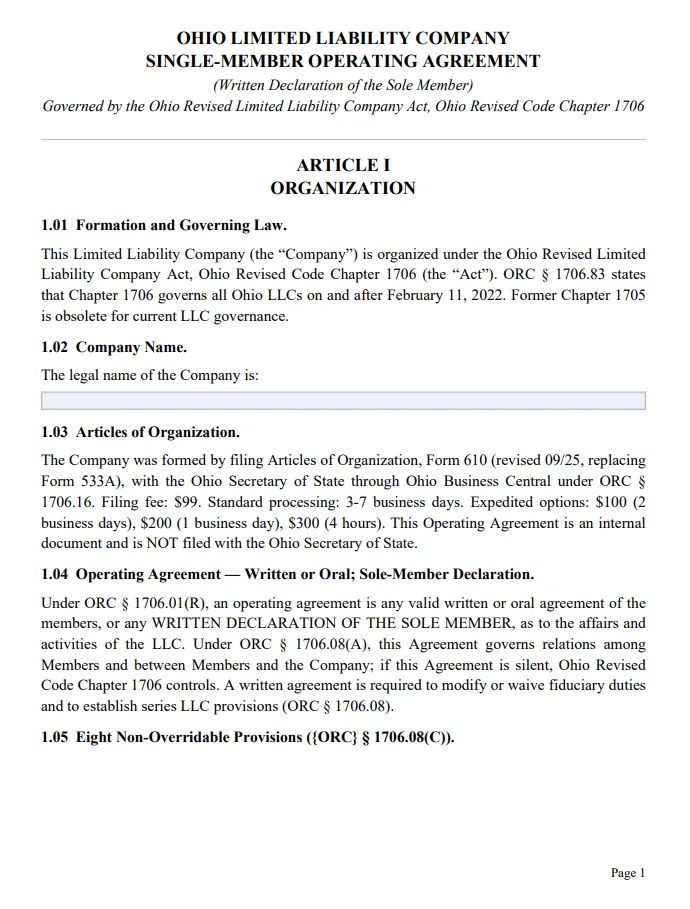
Ohio’s Revised Limited Liability Company Act recognizes written or oral operating agreements for multi-member LLCs and a written declaration for single-member LLCs. That sits in ORC § 1706.01(R). Most online guides miss this distinction. Free PDF and Word templates are below, followed by the Chapter 1706 rules that actually matter.
Download Boost Suite’s free Ohio LLC Operating Agreement template
Choose the version that matches your Ohio LLC structure and download it in PDF or Word format. Each template helps you document ownership, management authority, member rights, and internal rules more clearly from day one.
Required, written, or oral? How Ohio defines an operating agreement
An Ohio LLC doesn’t have to adopt an operating agreement, and the operating agreement never gets filed with the Secretary of State. The Articles of Organization are the separate formation document, and how to start an Ohio LLC in 5 simple steps walks through that side of the process. Under ORC § 1706.08(A), the operating agreement governs relations among members and between the members and the company. If the LLC doesn’t have one, Chapter 1706 fills every gap.
Ohio’s definition is broader than most competitor pages admit: ORC § 1706.01(R) treats an operating agreement as any valid written or oral agreement of the members, or any written declaration of the sole member. A multi-member LLC can technically run on an oral agreement, while a single-member LLC needs a written declaration.
A written agreement is still the right call. Several Ohio protections, including fiduciary duty modifications and series LLC designations under § 1706.76, require a written operating agreement under § 1706.08. In practice, banks and lenders ask for one before opening a business account.
Chapter 1706 defaults you inherit without an agreement
Here’s the thing: Ohio’s default rules kick in the moment an LLC skips the operating agreement. Some of them quietly reshape ownership economics in ways the members never agreed to out loud.
The biggest trap lives in ORC § 1706.29(A)(1): members share equally in pre-dissolution distributions unless the operating agreement says otherwise. Neither capital contributions nor cap-table percentages shift the rule. Between two members, the split is 50/50 regardless of who funded what.
Management works the same way. Under ORC § 1706.30(A), activities and affairs default to member direction. A majority of members decides day-to-day matters under § 1706.30(B), and every member has to consent to amend the agreement, file bankruptcy, or act outside the ordinary course under § 1706.30(C).
Two more defaults change what happens when things move. Under ORC § 1706.18, no one binds the LLC without authorization from the operating agreement, § 1706.30(A), a statement of authority, or other law. Automatic signing power isn’t a given here. Assignment works similarly: under ORC § 1706.341, assigning a membership interest doesn’t make the assignee a member or grant voting or information rights.
Here’s how the defaults compare to a drafted agreement:
| Topic | Chapter 1706 Default | With Your Operating Agreement |
|---|---|---|
| Distributions (§ 1706.29) | Equal shares among all members | Set by ownership %, capital, or custom formula |
| Management (§ 1706.30) | Member-managed oversight | Manager-managed with named authority |
| Ordinary decisions (§ 1706.30(B)) | Majority of members | Custom thresholds (two-thirds, supermajority) |
| Amendments (§ 1706.30(C)) | Unanimous member consent | Lower thresholds if the OA allows |
| Authority to bind (§ 1706.18) | Only via statute or statement of authority | Named officers, limits, signing caps |
| Transfer of interest (§ 1706.341) | Economic rights only, no governance | Buy-sell rights, approvals, rights of first refusal |
Eight things your Ohio operating agreement cannot override
Ohio is highly contractarian. That means the operating agreement can redraw almost everything: fiduciary duties, voting thresholds, distributions, management, transfer rights. Almost.
ORC § 1706.08(C) lists eight provisions an Ohio operating agreement cannot touch:
- The LLC’s status as a separate legal entity under § 1706.04(A).
- Restrictions on the rights of non-members, dissociated members, or assignees under Chapter 1706.
- The power of a court under § 1706.171.
- The implied covenant of good faith and fair dealing.
- Liability for a bad-faith violation of that implied covenant.
- The enforceability of contribution obligations under § 1706.281(A).
- The prohibition on bearer-form membership interest certificates under § 1706.341(D).
- The series LLC statement-of-limited-liability requirements under § 1706.761(B).
Items four and five matter most in practice. An Ohio operating agreement can waive or reduce the duty of loyalty and the duty of care, but it can’t eliminate the implied covenant of good faith or shield bad-faith conduct.
Item six is the trap for capital call clauses. A promise to contribute capital is only enforceable if it’s in a signed writing, per § 1706.281. Without that, oral commitments to fund later rounds don’t survive scrutiny.
Form the Ohio LLC, then write the duties and contribution rules carefully.
Northwest can help form your Ohio LLC with registered agent service, giving you a clean filing before the operating agreement sets voting thresholds, distributions, fiduciary-duty limits, contribution obligations, and series rules.
Single-member vs multi-member Ohio LLC operating agreements
These aren’t the same drafting task. A single-member LLC files a solo declaration. For multi-member LLCs, it’s a signed contract between owners.
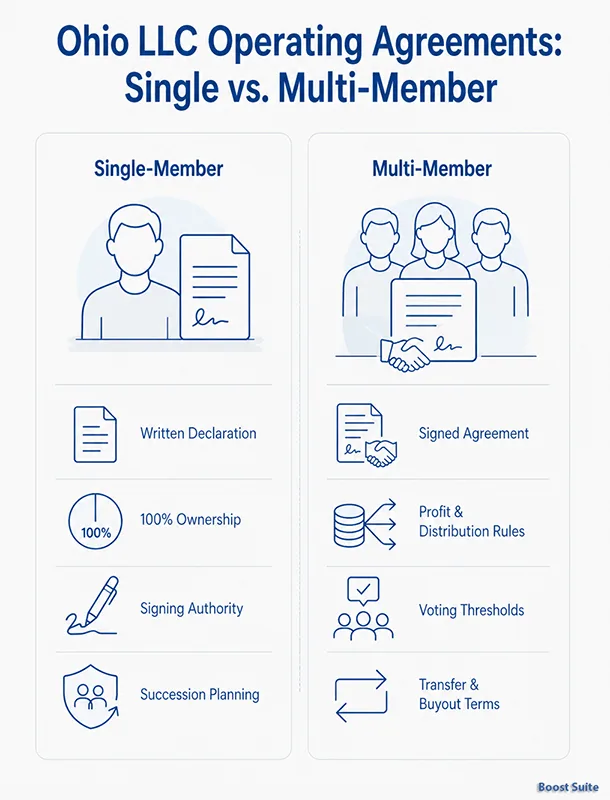
Single-member Ohio LLC operating agreement
A single-member Ohio LLC creates an operating agreement as a written declaration of the sole member, per ORC § 1706.01(R). ORC § 1706.081(D) confirms the document isn’t unenforceable just because only one person signs it.
The drafting priorities for a sole-member agreement are narrower than multi-member ones, but no less important:
- Sole member declaration and 100% ownership
- Separation between the member’s personal assets and LLC assets (supports liability protection under § 1706.26)
- Signing authority for contracts, loans, and bank accounts
- Default federal tax classification as a disregarded entity, unless the member files IRS Form 8832 or Form 2553
- Succession instructions if the member dies or becomes incapacitated (without them, the LLC faces dissolution under § 1706.47 within 90 days)
Banks and lenders ask for the signed document before opening a business account. A written declaration is a no-brainer for any sole member planning to transact under the LLC. Before drafting, confirm the LLC name is still available through the Ohio LLC name search, and match it exactly to the Articles of Organization.
Multi-member Ohio LLC operating agreement
A multi-member Ohio LLC needs a detailed written agreement because Chapter 1706 defaults can quietly wreck the economic deal the owners thought they had.
The Ohio-specific priorities for multi-member drafting:
- Distribution waterfall to override the equal-share default in § 1706.29(A)(1)
- Capital contribution schedule with signed commitments per § 1706.281
- Voting rules and consent thresholds (override the unanimous amendment default in § 1706.30(C) if preferred)
- Admission and transfer rules to control who joins and who leaves (§ 1706.27 and § 1706.341)
- Dissociation events and buyout rights under § 1706.411 and § 1706.412
- Fiduciary duty modifications under § 1706.08, § 1706.31, and § 1706.311, if the members want to reduce the duty of loyalty or duty of care
Formation services often bundle Articles of Organization filing with a basic operating agreement draft, which saves time for simple multi-member structures.
Member-managed, manager-managed, and Ohio’s authority-to-bind rule
Ohio’s default governance structure is member direction under ORC § 1706.30(A): all members oversee activities unless the operating agreement says otherwise. Switching to manager-managed means naming one or more managers and granting them that authority.
Here’s where Ohio gets unusual. Under ORC § 1706.18, no person has authority to bind the LLC except as the operating agreement, § 1706.30(A), a statement of authority under § 1706.19, or other law authorizes. A manager title doesn’t automatically confer signing power. Spell out who signs what.
Fiduciary duties default to the duty of loyalty and care for members in a member-managed LLC under § 1706.31, and for managers in a manager-managed LLC under § 1706.311. Any modification requires a written operating agreement, not an oral one.
| Topic | Member-Managed | Manager-Managed |
|---|---|---|
| Default under Chapter 1706 | Yes (§ 1706.30(A)) | No, requires OA designation |
| Runs day-to-day | All members by majority | Named managers |
| Fiduciary duties | Owed by members (§ 1706.31) | Owed by managers (§ 1706.311) |
| Authority to bind | § 1706.18 + OA | § 1706.18, OA, or statement of authority (§ 1706.19) |
| Articles of Organization | Not required to state it | Not required to state it |
Charging order protection and transfer restrictions
ORC § 1706.342 makes the charging order the exclusive remedy a judgment creditor has against a member’s interest in an Ohio LLC. Translation: a creditor can intercept distributions owed to the debtor-member but can’t seize the membership interest, vote it, or force a sale of LLC assets. Ohio is strong on this point.
The catch is that the operating agreement has to do its part. If the document allows free transfer of membership interests, poor drafting elsewhere can erode the protection in practice. Ambiguous dissociation triggers, missing buyout mechanics, or no spousal consent on divorce all open gaps a creditor’s attorney will find.
A well-drafted Ohio multi-member operating agreement includes:
- Transfer restrictions requiring approval from non-transferring members (overrides the passive rule in § 1706.341 that assignment grants economic rights only)
- Buyout triggers on death, divorce, bankruptcy, disability, or expulsion
- Valuation formulas tied to audited financials or independent appraisal
- Consent of all members before admitting an assignee as a member (default under § 1706.27)
- Clear dissociation events under § 1706.411
Ohio’s separate legal entity protection under § 1706.26 does further work. Members aren’t liable for LLC debts solely for being members, and Ohio courts treat failure to observe formalities as insufficient grounds for veil-piercing. Despite those protections, the operating agreement isn’t optional. It’s the document a court will ask about when disputes arise.
Ohio LLC formation snapshot and amendment process
Form 610, filing fee, and statutory agent
The formation document is the Articles of Organization, Form 610, revised September 2025 and listed as replacing the older Form 533A on the Ohio Secretary of State filing forms page. Chapter 1706 has governed all Ohio LLCs since February 11, 2022 under ORC § 1706.83. Worth flagging: any guide still showing Form 533A or citing Chapter 1705 is running outdated information.
Current Ohio LLC filing facts:
- Filing fee: $99 for Articles of Organization
- Standard processing: 3 to 7 business days
- Expedite Service 1: $100, 2 business days
- Expedite Service 2: $200, 1 business day
- Expedite Service 3: $300, processed within 4 hours (in-person or cutoff conditions apply)
- Ordinary domestic LLCs face no Ohio annual report requirement
- Commercial Activity Tax (CAT): $6 million annual exclusion for 2025 forward, 0.26% rate on gross receipts above it (older pages citing $150,000 are outdated per the Ohio Department of Taxation)
Expedite fees add up fast; timelines by filing method are detailed in the Ohio LLC processing time guide.
Ohio’s statutory agent rules changed on October 24, 2024 when Senate Bill 98 updated ORC § 1706.09. The agent receives service of process and must be an Ohio-resident individual or an eligible entity with an Ohio business address (no P.O. boxes). Without the agent’s signed written acceptance, the Ohio Secretary of State won’t accept the original Articles of Organization.
How to amend your Ohio operating agreement
Amending an Ohio LLC operating agreement follows ORC § 1706.30(C) by default: all members must consent. ORC § 1706.082 governs how amendment provisions, rights, and obligations work, including timing and delivery. Lower consent thresholds only apply if the original agreement explicitly allows them.
The practical amendment steps:
- Draft the amendment, referencing the section numbers of the original agreement it modifies.
- Circulate for signatures from every member, or whichever threshold the OA allows.
- Date and attach the amendment to the original operating agreement.
- Store with company records per § 1706.172.
- Distribute signed copies to every member.
Amending the Articles of Organization is a separate filing with the Ohio Secretary of State under § 1706.161, required for name changes, effective-date changes, or other statutory items. The operating agreement amendment stays internal and isn’t filed anywhere.
Choose the version that fits your Ohio LLC structure.
Ohio LLC Operating Agreement FAQ
These answers draw directly from Chapter 1706 and current Ohio Secretary of State guidance. Cross-check any specific filing requirement against the live source before acting on it.
Does an Ohio LLC operating agreement need to be notarized?
No. Ohio law doesn’t require notarization under Chapter 1706. Signatures from every member are sufficient, though banks occasionally ask for notarized copies to support account opening.
Can an Ohio LLC rely on an oral operating agreement?
Only for multi-member LLCs under ORC § 1706.01(R). Even then, several Ohio protections, including fiduciary duty modifications and series LLC designations, only apply to a written operating agreement under § 1706.08. Single-member LLCs need a written declaration of the sole member.
Does a single-member Ohio LLC need an operating agreement?
Technically no, but ORC § 1706.081(D) confirms a single-member agreement is enforceable. Ohio banks and lenders commonly request one before opening accounts or approving credit, and the document supports liability protection under § 1706.26.
Does Ohio require LLCs to file an annual report?
No. Ordinary domestic Ohio LLCs don’t file annual or biennial reports with the Secretary of State. Statutory agent updates and certain amendments to the Articles of Organization still require filings.
Can an Ohio operating agreement eliminate fiduciary duties?
Partially. A written operating agreement can modify or eliminate the duty of loyalty and duty of care under § 1706.08. It can’t eliminate the implied covenant of good faith and fair dealing, and it can’t shield bad-faith violations under § 1706.08(C)(4) and (5).
What happens to an Ohio LLC if the last remaining member dies?
Under ORC § 1706.47, an LLC dissolves 90 consecutive days after the last remaining member dissociates unless a substitute member is admitted. A succession clause in the operating agreement overrides that default and keeps the LLC alive.
How much does it cost to form an Ohio LLC in 2026?
The Articles of Organization filing fee is $99. Expedite service adds $100, $200, or $300 depending on tier. There’s no mandatory annual report fee.
Can an Ohio LLC switch from member-managed to manager-managed?
Yes. Amend the operating agreement under § 1706.082 to name managers and define their authority. If the Articles of Organization referenced a management structure, file a Certificate of Amendment under § 1706.161 with the Ohio Secretary of State.
- IRS, Employer Identification Number
- Ohio Revised Code Chapter 1706
- ORC § 1706.08, Limited liability company operating agreements
- ORC § 1706.18, Binding of limited liability company
- ORC § 1706.29, Distributions of limited liability company
- ORC § 1706.30, Direction and oversight of a limited liability company
- ORC § 1706.342, Charging order relating to judgments
- Ohio Secretary of State, Business Filing Forms and Fee Schedule
- Ohio Secretary of State, Form 610 PDF
- Ohio Department of Taxation, Commercial Activity Tax
Keep your Ohio LLC compliant with Harbor Compliance
Harbor Compliance helps Ohio LLC owners stay organized with registered agent service, compliance tracking, and reliable document handling after your operating agreement is in place.