

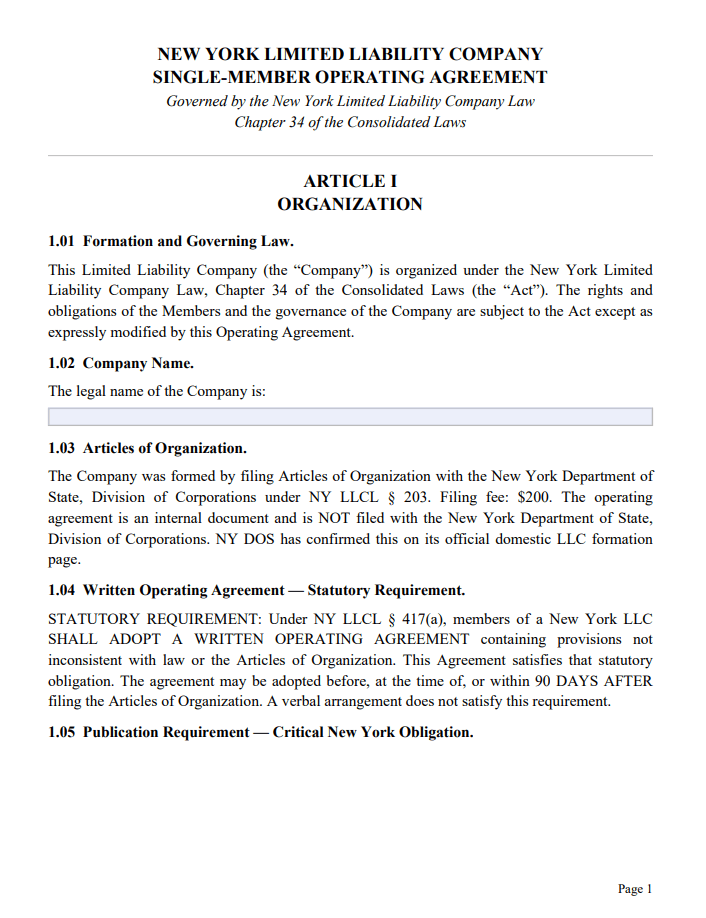
New York is one of the few states that legally requires LLCs to adopt a written operating agreement. NY LLCL § 417 sets the rules: the document isn’t filed with the state and must be adopted within 90 days of filing Articles of Organization.
Download Boost Suite’s free New York LLC Operating Agreement template
Choose the version that matches your New York LLC structure and download it in PDF or Word format. Each template helps you document ownership, management authority, member rights, and internal rules before banking, tax, or compliance issues come up.
Does New York require a written LLC operating agreement?
Section 417 of New York’s Limited Liability Company Law doesn’t leave room for interpretation. Members of every domestic LLC “shall adopt a written operating agreement” covering the business, its affairs, and the rights and responsibilities of members, managers, and agents. The New York Department of State confirms the same rule on its official Articles of Organization page.
The timing rule is flexible. An agreement can be signed before the Articles of Organization are filed with DOS through New York’s LLC formation process, at the same time, or within 90 days afterward. Section 203 sets the formation filing itself, while § 417 controls the internal governance document. The two never share a filing clerk.
There’s no single-member exception written into the statute. The law applies to LLC members generally, and NY DOS applies it to both single-member and multi-member LLCs. That matters for founders who think they can skip the paperwork because they’re running a one-person shop. The statute doesn’t carve out solo operators.
The statute is silent on what happens if no agreement exists. That doesn’t mean the penalty is zero. Banks want to see the document before opening a business account. Lenders ask for it during diligence. Courts use it as the first reference when a dispute lands on a judge’s desk. Without one, default statutory rules take over every contested point, and here’s the thing: those defaults rarely match how founders actually run the business.
The New York default rules your operating agreement quietly overrides
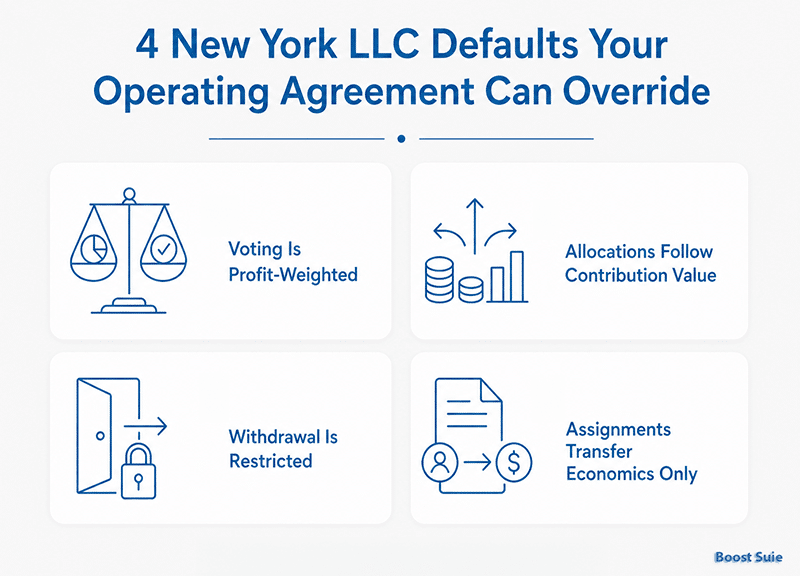
The statutory defaults kick in whenever the agreement is silent on a point. New York’s defaults don’t match how most founders actually run their businesses, which is the whole reason § 417 exists.
Voting follows current profit share, not one-member-one-vote (§ 402)
Under § 402, each member’s vote is weighted by that member’s share of current profits unless the operating agreement says otherwise. Two members who own the company 50/50 on paper can hold unequal votes if their profit allocations diverge for a tax year. Most founders assume votes go by headcount or ownership percentage, but the statute says neither.
Profits, losses, and distributions track contribution value (§ 503 and § 504)
Section 503 allocates profits and losses by the value of each member’s contributions shown in the LLC’s records. Section 504 applies the same rule to distributions. That’s a real trap for sweat-equity partnerships, where one person writes a check and another runs the business full-time. Without a clear allocation clause, the capital partner collects the return and the operator collects nothing.
Withdrawal is locked down until dissolution (§ 606)
A member can walk away only on the terms the operating agreement specifies. If it’s silent, § 606 blocks withdrawal until the LLC dissolves and winds up. That’s the opposite of the default rule in many other states. Buyout clauses, death-and-disability triggers, and divorce provisions all carry extra weight in New York.
Assignments transfer economics, not membership (§ 603, § 604, and § 607)
Selling or assigning a membership interest moves economic rights, not votes. Under § 603, an assignee receives the distributions and allocations tied to the interest. Section 604 blocks the assignee from becoming a full member without a majority-in-interest vote of the non-assigning members, unless the agreement opens the gate. The same economic-rights-only treatment applies to a judgment creditor holding a charging order under § 607. The rule protects control but requires drafters to address admission expressly.
Aaron Kra’s Take on New York’s Contribution-Value Trap
I’ve advised a New York real estate LLC where one partner put in $500,000 and the other brought zero cash but handled every renovation personally. They agreed verbally on a 50/50 split. Two years later, when profits finally came in, § 503 controlled the outcome because New York’s default rule follows contribution value, not the handshake.
Both owners believed profits would be split 50/50 because one funded the deal and the other personally handled the renovation work.
Because the operating agreement did not override the default rule, the cash partner was entitled to every dollar under the contribution-value formula.
Form the New York LLC, then write the profit, vote, and exit rules clearly.
Northwest can help form your New York LLC with registered agent service, giving you a clean filing before the operating agreement handles profit shares, contribution values, withdrawal limits, assignments, and buyout rights.
Provisions a New York LLC operating agreement should cover
A working New York operating agreement handles the points § 417 lets members customize. Leaving gaps means the statutory defaults fill them in automatically.
Core provisions to include:
- Ownership and capital contributions. Names, percentages, initial contributions in cash or property, and any promised follow-on contributions.
- Profit and loss allocations. Override § 503 when the split shouldn’t track contribution value.
- Distributions. Timing, priority, and whether distributions follow allocations or a different rule.
- Voting thresholds. Override § 402’s current-profits default where a different vote weight makes sense.
- Member admission, transfers, and withdrawal. Customize § 603, § 604, and § 606 to control who can join, sell, or exit.
- Management structure. Member-managed or manager-managed, with authority limits and signing powers.
- Dispute resolution, dissolution triggers, and tax classification. Forum, governing law, dissolution events, and disregarded-entity or partnership tax treatment.
The map below shows which defaults an agreement actually replaces:
| Topic | Default Rule (No OA Provision) | With Operating Agreement |
|---|---|---|
| Voting weight | Current profit share (§ 402) | Any weighting members choose |
| Profits and losses | Contribution value (§ 503) | Any allocation the members agree on |
| Distributions | Contribution value (§ 504) | Any formula, priority, or schedule |
| Member withdrawal | Blocked until dissolution (§ 606) | Allowed on defined events |
| Admission of assignees | Majority-in-interest consent (§ 604) | Custom thresholds or automatic triggers |
The goal isn’t to cover every imaginable scenario. It’s to fix the defaults that actually bite.
Single-member vs. multi-member operating agreements in New York
Section 417 applies the same way to both. The practical content differs.
For a single-member LLC, the document’s main job is evidentiary. It proves the LLC is a separate entity from the owner, which matters in veil-piercing fights and in banking. It also spells out succession: what happens if the sole member dies, becomes incapacitated, or sells the interest. And it tells banks who’s authorized to sign. Tax classification (disregarded entity by default, with optional S-corp or C-corp elections) gets documented here so the IRS, lenders, and any future buyer see one consistent story.
For a multi-member LLC, the same document does heavier work. Economics, control, and exit all need affirmative drafting because the statutory defaults under § 402, § 503, § 504, § 606, § 603, and § 604 rarely match what the members actually intend. Multi-member LLCs default to partnership tax classification unless the members elect otherwise, and the operating agreement should document that choice clearly. Common friction points: what a non-contributing member receives when profits arrive, how the LLC treats a spouse inheriting an interest, and who’s got signing authority at the bank.
The liability shield under NY LLCL § 609(a) applies equally to both. Members, managers, and agents aren’t personally liable for LLC debts solely because of their status. The operating agreement doesn’t create the shield, but weak documentation, commingled finances, and vague governance all feed a veil-piercing argument.
Member-managed or manager-managed under NY LLCL § 401, § 408, and § 409
New York defaults to member-managed under § 401 unless the Articles of Organization expressly vest management in a manager. That one line in the Articles unlocks manager-managed treatment. Without it, an operating agreement alone can’t do the work. If the Articles are silent, courts and third parties treat every member as a potential agent of the LLC.
In a member-managed structure, each member can typically bind the LLC on day-to-day matters. Signing a vendor contract, opening a bank account, hiring an employee, all fall within apparent authority. That’s efficient for a tight team and messy for anything larger.
Under § 408, a manager-managed LLC vests authority in one or more named managers. Members aren’t agents of the LLC solely because they’re members. The operating agreement becomes the document that defines manager scope: reserved matters requiring member consent, spending limits, banking authority, related-party transactions, and removal rules.
Section 409 sets the duty standard, a fiduciary-style obligation. A manager must act in good faith and with the care an ordinarily prudent person in a similar position would exercise. The operating agreement can limit liability, but § 417 blocks limitations for bad faith, intentional misconduct, knowing legal violations, improper personal gain, and certain improper distributions. The catch: those carve-outs can’t be contracted away.
The New York liability shield and its § 609(c) wage-liability carve-out
Section 609(a) gives New York LLC members the standard liability shield. Provided the LLC is properly maintained, personal assets stay off the table for contract debts, tort liabilities, and business obligations. The operating agreement doesn’t create the shield, but it documents the separation between member and entity that courts look for in veil-piercing analyses.
Subsection 609(c) carves out a state-specific exposure that rarely appears in generic templates. The ten members with the largest percentage ownership interests can be held jointly and severally personally liable for unpaid wages. The liability covers wages owed to laborers, servants, or employees performing services in New York. Any contrary language in the operating agreement is moot, because members can’t contract their way out of it.
Three practical consequences follow. First, ownership structure matters for personal exposure: a member below the top-10 cutoff falls outside the rule by design. Second, the claim requires statutory notice and enforcement steps, and employees rarely invoke it, but it stays on the books. Third, multi-member LLCs with hourly workers, performers, or contractors operating in New York should address payroll compliance expressly in the agreement.
Aaron Kra’s Take on New York’s Wage-Liability Carve-Out
I reviewed a New York hospitality LLC with seven members and a kitchen staff of twelve. When two line cooks sued for unpaid overtime, every single member fell inside the top-10 ownership cutoff under § 609(c). Their operating agreement was clean, but the statute does not care. All seven owners faced joint personal exposure on the wage claim.
The liability shield looked solid on paper, so the owners assumed wage claims would stay at the company level. But New York’s § 609(c) creates a separate risk: members within the top-10 ownership group can still face personal exposure for unpaid wages.
This is exactly why generic LLC templates miss the mark in New York. Even a well-drafted operating agreement cannot override the statute, which means payroll discipline matters just as much as liability-shield language.
Two New York rulings every drafter should know
Matter of Wythe Berry LLC v. Goldman (Appellate Division, First Department, 2024) set a signature-block trap that matters for every amended agreement. The court held that the LLC itself wasn’t bound by an arbitration provision in a Fifth Amendment to its operating agreement. The reason: the LLC hadn’t executed the amendment, even though the members had. The drafting lesson: when the LLC itself must be bound by arbitration, forum-selection, or indemnification clauses, the LLC needs its own signature block through an authorized signer. Individual member signatures alone aren’t enough.
Matter of 1545 Ocean Avenue, LLC (Appellate Division, Second Department, 2010) remains the lead case on judicial dissolution under § 702. The court held that a petitioner must show one of two things. Either management is unable or unwilling to reasonably permit the stated purpose to be achieved, or continuing the entity is financially unfeasible. The test ties directly to the operating agreement and Articles of Organization. Section 701 lists the statutory dissolution events themselves; § 702 covers what happens when a member petitions a court instead. If the operating agreement is silent on a termination date, the LLC has perpetual existence by default. A vague purpose clause or missing deadlock mechanics gives a petitioning member less to work with and makes litigation harder to resolve.
Where the operating agreement fits in New York’s compliance calendar
The operating agreement is the internal half of New York LLC compliance. On the external side, filings run through the New York Department of State and NY Tax. Each has its own deadline and fee.
- Articles of Organization ($200) form the LLC under § 203.
- Publication requirement (within 120 days) mandates notice in two newspapers designated by the county clerk for six consecutive weeks.
- Certificate of Publication ($50) gets filed with affidavits of publication after publication runs.
- Biennial Statement ($9) is due every two years in the calendar month the Articles were filed. That keeps filing the biennial statement in New York on a strict two-year cycle.
- Certificate of Assumed Name ($25) covers any name the LLC uses beyond its true legal name.
- Form IT-204-LL handles the state LLC/LLP filing fee when New York-source income exists.
- NYC UBT (4%) applies to LLCs with taxable income allocated to New York City.
- EIN (employer identification number) from the IRS is free and separate from state filings, but banks routinely ask for it alongside the operating agreement.
The publication step catches almost every first-time owner off guard. In Manhattan, two-newspaper publication can run over $1,000. In upstate counties, it might run $200. That adds up fast for founders who didn’t budget for it.
Missing the Certificate of Publication deadline triggers suspension of the LLC’s authority to transact business in New York. Expedited handling with DOS is optional: $25 for 24 hours, $75 for same-day, $150 for two hours. For timing estimates across filing methods, see how long it takes to form a New York LLC.
The Articles of Organization designate the Secretary of State as the statutory agent for service of process. Many owners also appoint a private New York registered agent service to intercept legal notices directly and avoid default judgments from missed service.
As of January 1, 2026, the New York LLC Transparency Act applies in a narrower form than the original bill contemplated. Under current NY DOS guidance, domestic LLCs and LLCs formed in another U.S. state or U.S. territory are exempt from beneficial ownership reporting. The requirement applies mainly to reporting companies: LLCs formed outside the United States and authorized to do business in New York. After Governor Hochul’s December 2025 veto of a broader reporting bill and the federal BOI narrowing, U.S.-formed LLCs sit outside the reporting regime. Worth flagging: older templates and summaries still describe the NYLLCTA as broadly applicable. It isn’t, as of this writing.
Form your New York LLC with Bizee
New York LLC compliance involves more than an operating agreement, from Articles of Organization to publication rules and recurring state filings. Bizee helps you start your New York LLC with a simple formation process, so you can move from planning to official registration with less guesswork.
Signing, storing, and amending a New York operating agreement
No notarization requirement exists under § 417, but notarized signatures add evidentiary weight in later disputes. For multi-member LLCs with outside investors or lenders, notarizing the signature page isn’t optional in practice. Single-member LLCs can sign and store the document without any third-party witness.
Signature-block practice matters after Wythe Berry. Each amendment should include a dedicated signature line for the LLC itself, signed by an authorized member or manager in a representative capacity, in addition to individual member signatures. That single line determines whether the LLC is bound by the clauses inside.
A practical storage and maintenance checklist:
- Keep the signed original and all amendments in a dated corporate records book.
- Back up a digital copy in encrypted cloud storage accessible to all authorized members.
- Match the LLC name exactly across the operating agreement, Articles of Organization, and the record visible in the New York business entity lookup maintained by DOS.
- Store proof of publication, affidavits, and the Certificate of Publication alongside the agreement.
- Review every two years at Biennial Statement time to confirm membership, management, and contact information still match.
Amendments follow whatever procedure the agreement specifies. If there’s no procedure, unanimous written consent of all members is the safe default. The amendment should be dated, signed by all members, executed by the LLC, and attached to the master agreement.
Aaron Kra’s Amendment-Signing Rule After Wythe Berry
After the Wythe Berry decision, I stopped accepting operating-agreement amendments without a separate LLC signature block. That case changed my drafting routine because the procedural defect was simple, but the consequence was serious: the Appellate Division flagged in 2024 that the LLC itself had not properly executed the amendment.
I require each member to sign in their individual capacity so there is no question that the amendment was approved by the people bound as members.
I also require the LLC to sign through an authorized representative so the company itself is clearly bound by the amendment, not just the people behind it.
I attach a written member consent resolution to document the approval trail and remove any doubt about who authorized the amendment and on what basis.
Choose the version that fits your New York LLC structure.
New York LLC operating agreement questions owners ask
Three questions dominate consultations around New York LLC operating agreements: whether it’s legally required, whether it gets filed, and what happens if one never gets drafted. The answers below handle those plus the most common follow-ups.
Is an operating agreement legally required in New York?
Yes. NY LLCL § 417 requires every LLC to adopt a written operating agreement, and the New York Department of State confirms the requirement on its official Articles of Organization page. The statute is silent on penalties, but banks, lenders, and courts all expect the document.
Do I file my operating agreement with the New York Department of State?
No. The agreement is an internal document of the LLC and never gets filed with DOS. Only the Articles of Organization, Certificate of Publication, Biennial Statement, and certain other corporate filings go to the state.
Does a single-member LLC in New York really need an operating agreement?
Yes. Section 417 contains no single-member exception, and NY DOS treats the document as required regardless of member count. For a sole owner, the agreement also proves the LLC is a separate entity in veil-piercing and banking contexts.
What is the New York 90-day rule?
The operating agreement must be adopted before the Articles of Organization are filed, at the same time as filing, or within 90 days afterward. The adoption window comes directly from § 417 and is confirmed by NY DOS guidance.
Does a New York LLC operating agreement need to be notarized?
No. Section 417 doesn’t require notarization. Members with outside investors, lenders, or real estate transactions often notarize the signature page voluntarily to strengthen the document’s evidentiary value in later disputes.
What happens if my New York LLC never adopts a written operating agreement?
The statutory defaults across Articles 4, 5, and 6 of the LLCL fill every gap. Voting defaults to current profit share (§ 402), allocations track contribution value (§ 503 and § 504), withdrawal is blocked until dissolution (§ 606), and assignees don’t automatically become members (§ 604). Bank account openings may stall, and lenders often refuse to close without the document in hand.
How do I amend a New York LLC operating agreement after it’s signed?
Follow the amendment procedure set by the agreement itself. If the agreement is silent, unanimous written consent of all members is the safe default. After Wythe Berry, the amendment should include a dedicated signature line for the LLC itself, not only individual member signatures.
- New York Department of State, Beneficial Ownership Disclosure FAQ
- New York Department of State, Articles of Organization for Domestic Limited Liability Company
- New York Senate, Limited Liability Company Law § 417
- New York Senate, Limited Liability Company Law § 402 (voting defaults)
- New York Senate, Limited Liability Company Law § 609 (liability shield and wage carve-out)
- New York Senate, Limited Liability Company Law § 702 (judicial dissolution)
- New York Department of State, Certificate of Publication for Domestic Limited Liability Company
Launch your New York LLC with Harbor Compliance
From filing your Articles of Organization to guiding you through compliance, Harbor Compliance makes forming your New York LLC simple and stress-free. So you can focus on building your business.