

A Virginia LLC operating agreement is the written contract that controls how members run their company. Virginia law doesn’t require one, but skip it and the Virginia Limited Liability Company Act fills every gap with default rules under § 13.1-1023. Here’s what to include and how to lock it in.
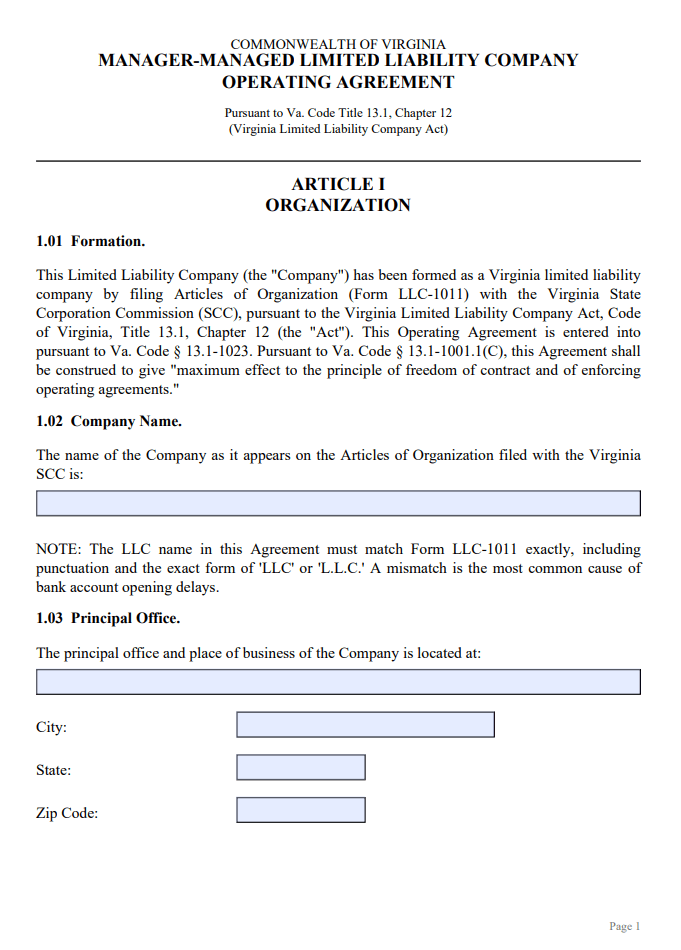
Download Boost Suite’s free Virginia LLC Operating Agreement template
Choose the version that matches your Virginia LLC structure and download it in PDF or Word format. Each template is designed to help you document ownership, management, and internal rules more clearly from day one.
Is a Virginia LLC Operating Agreement Required by Law?
No. Under Va. Code § 13.1-1023(A)(1), members “may” enter into an operating agreement. The statute never makes it mandatory. The same chapter goes further than most states: § 13.1-1001.1(C) instructs courts to give “maximum effect” to the principle of freedom of contract and to enforce operating agreements as written.
That language matters in court. When two members fight over distributions or voting rights, a Virginia judge starts with the operating agreement and only reaches for the statute if the agreement is silent. Without one, the statute runs the show.
A handful of Virginia law-firm marketing pages claim the agreement “must be in writing to be enforceable.” That’s wrong. Read the statute itself for the controlling rule.
Written, Oral, or Implied: What Virginia Actually Allows
Va. Code § 13.1-1023(B)(1) is unusually permissive: an operating agreement need not be in writing unless the articles of organization or another writing requires it. Oral and implied agreements are technically valid in Virginia.
In practice, oral agreements collapse the moment a dispute reaches court. Without a signed document, the burden shifts to whoever is asserting the term, and email chains, text messages, and meeting notes get pulled into evidence. A written operating agreement isn’t legally required, but it’s effectively required if you ever want to enforce a distribution clause, a buy-out, or a voting threshold.
The Special Single-Member Rule Most People Miss
Single-member LLCs in Virginia are governed by a quirky carve-out at § 13.1-1023(A)(2). Any writing signed by the sole member that relates to LLC affairs is deemed part of the operating agreement. So is any agreement between that person and a non-member manager touching the LLC’s business.
The catch: that includes informal documents. A signed memo, a side letter, even an email about how distributions will be handled can become binding operating agreement language. Single-member owners are better off signing one consolidated document. Scattering decisions across emails or notes only invites later disputes about what counts as part of the agreement.
What Happens When a Virginia LLC Has No Operating Agreement
The Virginia Limited Liability Company Act doesn’t leave a vacuum. It fills it with detailed default rules that govern profits, voting, dissociation, and dissolution. Most owners assume those defaults match how they actually run the business. They rarely do.
Below is the short version of how Virginia treats the most common questions when the operating agreement is silent or missing entirely.
| Issue | Default rule (no OA) | Statute |
|---|---|---|
| Profit and loss allocation | Based on recorded value of contributions | Article 6, § 13.1-1030 |
| Voting power | Proportional to contributions; majority by value | § 13.1-1022 |
| Manager elections | Members elect; majority vote removes/replaces | § 13.1-1024 |
| Member dissociation | Triggered by death, bankruptcy, or expulsion | § 13.1-1040.1 |
| Dissolution | Specified events, unanimous consent, or judicial order | § 13.1-1046 |
How Profits and Losses Get Split by Default
Article 6 of the Virginia LLC Act ties profit and loss allocation to the recorded value of each member’s contributions, not to headcount or any handshake percentage. If one member puts in $200,000 and the other contributes $10,000, the statute splits distributions pro-rata to those contributions, not 50/50.
That’s a trap if members thought they were equal partners. Capital accounts and contribution records become the controlling document. § 13.1-1035 also blocks distributions that would leave the LLC unable to pay its debts, and § 13.1-1036 holds members liable for two years if they receive a wrongful one.
Voting Power Without an Operating Agreement
In a member-managed LLC, voting follows the same proportional rule under § 13.1-1022: each member votes by the value of their contributions, and a majority by value controls. One-member-one-vote isn’t the default in Virginia. With three members holding unequal stakes, the largest investor can outvote the other two on routine decisions.
Manager-managed LLCs follow § 13.1-1024 instead. Managers are elected by members. Decisions go by majority vote of managers, and members fill vacancies the same way. None of that flexibility exists unless the operating agreement says otherwise.
Dissociation and Dissolution Without a Written Plan
Death, bankruptcy, expulsion by court order, or written resignation each trigger member dissociation under § 13.1-1040.1. The remaining members don’t get a say unless the operating agreement adds one.
Dissolution under § 13.1-1046 follows similar mechanics. Triggers include events listed in the articles, unanimous written consent, or judicial dissolution. Virginia does carve out a recovery window: § 13.1-1047.1 lets members waive dissolution and resume business if all members agree before winding up is finished. A succession clause in the operating agreement usually closes that gap before it opens.
Form the Virginia LLC, then put the real ownership deal in writing.
Bizee can help with Virginia LLC formation and registered agent setup, giving owners a clean filing record before the operating agreement changes the default rules for contributions, voting power, dissociation, and dissolution.
Why Skipping a Virginia Operating Agreement Backfires
Banks ask for one. Investors ask for one. So do partners, lenders, and eventually a judge if the LLC is sued or its veil is challenged. When forming a Virginia LLC, the operating agreement is one of the few documents the State Corporation Commission doesn’t ask for, but every commercial counterparty will.
For multi-member LLCs, the agreement settles disputes before they reach court. For single-member LLCs, the document is even more important. It’s one of the strongest pieces of evidence that the LLC is a separate legal entity, not just an extension of the owner.
The Supreme Court of Virginia confirmed in A.G. Dillard v. Stonehaus Construction, LLC that veil-piercing standards for LLCs match the stringent corporate standard. A signed operating agreement, documented capital contributions, and observed formalities are how owners stay on the right side of that line.
What to Include in a Virginia LLC Operating Agreement
Virginia gives drafters wide latitude, and that’s a feature, not a bug. The clauses below cover the defaults the LLC Act fills in automatically, plus the practical provisions banks and investors expect to see.
A few items are state-specific. Reference the Virginia statute by section number where the clause overrides a default. Pull the LLC’s exact name and registered office from Form LLC-1011 to keep public filings and the agreement aligned.
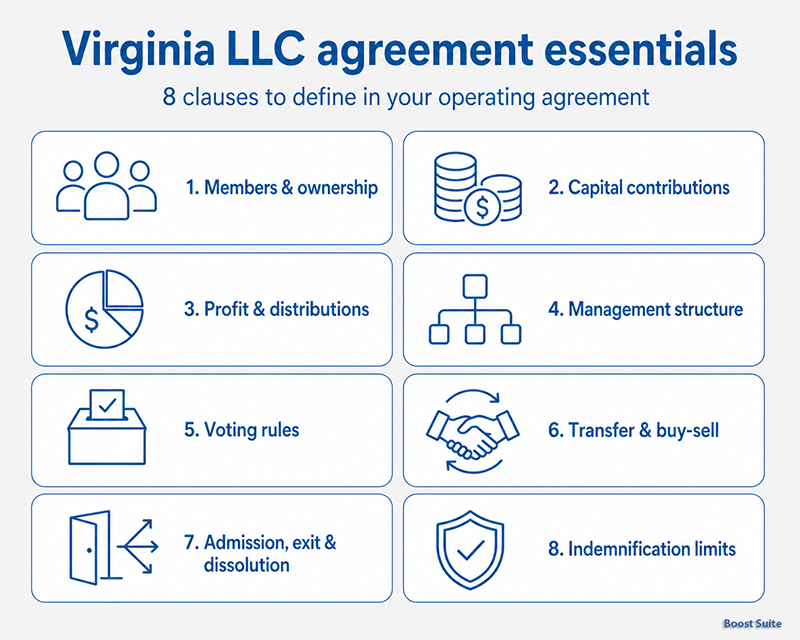
- Member identification and ownership percentages: Full legal names, Virginia addresses, and each member’s interest in the LLC
- Capital contributions and capital accounts: Initial and future contributions, since these drive distribution defaults under § 13.1-1030
- Profit, loss, and distribution rules: Custom allocations that override Article 6 defaults
- Management structure: Member-managed or manager-managed, matched word-for-word to the choice on Form LLC-1011
- Voting rights and quorum thresholds: Override § 13.1-1022 and § 13.1-1024 defaults with a custom voting matrix
- Transfer restrictions and buy-sell provisions: Layered on top of § 13.1-1041.1 charging order rules
- Member admission, dissociation, and dissolution: Custom rules for §§ 13.1-1038.1, 13.1-1040.1, and 13.1-1046
- Indemnification and liability limitations: Within the § 13.1-1025 cap of the greater of $100,000 or 12 months of cash compensation, with carve-outs for willful misconduct or knowing criminal violations
Your registered agent’s name and Virginia address belong in the management section.
Form your Virginia LLC with Northwest and keep your documents aligned
Your operating agreement should match the details in your Virginia formation filing. Northwest helps you form your LLC, organize key company information, and start with a clean compliance setup.
Member-Managed vs. Manager-Managed Virginia LLCs
Virginia treats these as two distinct governance pathways, and the LLC must declare which one it’s using on Form LLC-1011 with the State Corporation Commission. The operating agreement has to mirror that declaration. Mismatches between the public filing and the internal document create ambiguity that judges resolve case-by-case.
Member-Managed: The Default Authority Structure
Under § 13.1-1022, every member is an agent of the LLC for purposes of its business unless the articles or operating agreement say otherwise. That makes every member a potential signatory on contracts, leases, and vendor agreements. Each member can bind the company in the ordinary course. Voting follows contribution value, with the majority by value controlling.
Closely-held LLCs where every member is active in operations are a natural fit for this structure. It’s the default Virginia assumes if you don’t pick something else on Form LLC-1011.
Manager-Managed: Delegated Authority and Liability Boundaries
§ 13.1-1024 sets the rules when members delegate management to one or more managers. Managers are elected by members, decisions go by majority vote of managers, and § 13.1-1024(H) lets managers sub-delegate authority to officers or employees acting in good faith.
Under § 13.1-1025, liability rules apply equally to managers and members. The operating agreement can cap damages in internal proceedings at the greater of $100,000 or 12 months of cash compensation. It can’t shield anyone from willful misconduct or a knowing criminal violation. Parallel indemnification clauses should cover both members and managers.
Single-Member Virginia LLCs and the Liability Shield
Single-member LLCs face a higher bar than multi-member LLCs when courts evaluate the liability shield. With nobody else inside the entity to demonstrate separateness, the burden falls entirely on the sole member. That’s why a signed operating agreement is one of the strongest documents an owner can produce in a veil-piercing fight.
Virginia’s Supreme Court applies the corporate veil-piercing standard to LLCs in A.G. Dillard v. Stonehaus Construction, LLC. The doctrine treats LLC veil-piercing the same as corporate veil-piercing. Piercing is reserved for fraud, injustice, or a near-total lack of separateness between the owner and the entity. In narrow circumstances, Virginia also recognizes reverse veil-piercing under cases like C.F. Trust, Inc. v. First Flight Ltd. Partnership, which can expose LLC assets to claims against an individual owner.
The IRS treats single-member Virginia LLCs as disregarded entities by default. Owners report income on Schedule C of Form 1040 unless they elect corporate taxation through Form 8832. Multi-member LLCs default to partnership treatment with Form 1065 and must file the Virginia pass-through entity return on Form 502.
Before signing anything, run the LLC’s exact name through the Virginia business search tool to confirm spelling and entity status with the SCC. A name mismatch between Form LLC-1011 and the operating agreement is the single most common reason banks delay opening a business account, and it’s avoidable.
Charging Orders: Virginia’s Quiet Asset Protection
Under § 13.1-1041.1(D), a charging order is the exclusive remedy a judgment creditor can use against a member’s transferable interest. Creditors don’t seize LLC property, and they don’t gain management rights. The remedy is a lien on distributions only, applied when the LLC chooses to make them.
Owners with creditor risk get a real protection worth flagging. The transfer restrictions clause in the operating agreement should reference § 13.1-1041.1 directly. It should also lock in additional consent or right-of-first-refusal mechanics on any voluntary transfer. Virginia’s statute does the heavy lifting on involuntary transfers; the operating agreement covers everything else.
Annual Registration Fee, Not Annual Report
Virginia LLCs don’t file annual reports. They pay a flat annual registration fee under § 13.1-1062 instead, due to the State Corporation Commission. Comparison guides written by out-of-state services frequently get this wrong and call it an “annual report fee.” It isn’t.
| Compliance item | Amount or date | Source |
|---|---|---|
| Annual registration fee | $50 | § 13.1-1062 |
| Late penalty | $25 | § 13.1-1064 |
| Due date | Last day of anniversary month | 5VAC5-40-20 |
| Filing portal | Clerk’s Information System (CIS) | SCC |
Miss the Virginia annual registration deadline by several months and the SCC can administratively cancel the LLC’s existence.
How to Adopt and Sign Your Virginia Operating Agreement
The operating agreement is an internal document, so the State Corporation Commission never sees it. Even though it’s never filed publicly, the execution steps below cover how to put it into effect and keep it enforceable.
- Customize the template to match the articles of organization: Pull the exact LLC name, registered office, and management mode from the Form LLC-1011 filing receipt
- Confirm capital contributions and ownership percentages: Document each member’s contribution value, since this drives Virginia’s allocation defaults under Article 6
- Schedule a member meeting and sign in person or via e-signature: Virginia recognizes electronic signatures under the Uniform Electronic Transactions Act, so DocuSign or similar services are valid
- Store the executed agreement with the LLC’s records: Keep alongside the Certificate of Organization, EIN confirmation letter, and SCC annual registration receipts. Don’t file the operating agreement with the state
- Build in an amendment procedure: Add a written amendment clause with a clear vote threshold so future changes route through one document instead of scattered side letters
Most Virginia LLCs are organized within 2 to 3 business days online and 7 to 15 days by mail. For deeper detail on Virginia LLC processing times, check the state-specific guide.
Choose the version that fits your LLC structure.
Virginia Operating Agreement Questions Answered
The questions below cover follow-ups that come up after a Virginia LLC adopts an operating agreement. They focus on edge cases that don’t fit neatly into the body of the article.
Is a Virginia LLC operating agreement required?
No. Virginia law doesn’t require LLCs to adopt an operating agreement. The Virginia Limited Liability Company Act (Va. Code § 13.1-1023) provides default rules that apply when members don’t adopt their own.
Does a Virginia operating agreement need to be notarized?
No, notarization isn’t required. Notarizing the signature page adds evidentiary weight in court and is recommended for single-member LLCs where ownership and authenticity could be challenged years later.
Do I file my operating agreement with the State Corporation Commission?
No. The operating agreement is an internal document. The SCC only requires the Articles of Organization (Form LLC-1011) at formation and the $50 annual registration fee thereafter. Keep the operating agreement with the LLC’s records.
How much does it cost to create a Virginia LLC operating agreement?
Free with a template, or roughly $300 to $700 with a Virginia business attorney for custom drafting. Complex ownership structures, series LLCs, or partner buy-out provisions usually justify legal review.
Can a husband-and-wife Virginia LLC use a single-member operating agreement?
Generally no. Virginia is a common-law state, not a community-property state, so the IRS qualified joint venture election that lets some spouses file as a single owner doesn’t apply. A husband-and-wife Virginia LLC has two members and needs a multi-member operating agreement.
How do I amend a Virginia operating agreement?
Follow the amendment procedure inside the agreement itself. Most Virginia operating agreements require written consent of all members or a supermajority vote. Sign the amendment, store it with the original document, and update the LLC’s internal records.
Can a Virginia operating agreement be enforced if it’s only oral?
Technically yes, under § 13.1-1023(B)(1). Practically no. Without a signed document, every disputed term ends up re-litigated in court, with emails, texts, and witness testimony as evidence. A written agreement is the only practical way to enforce custom voting, distribution, or buy-out terms.
Start your Virginia LLC with Harbor Compliance
A clear operating agreement works best when your Virginia LLC is set up correctly from the beginning. Harbor Compliance helps you handle the formation filing, organize core company details, and stay aligned with state compliance requirements.