

Wisconsin doesn’t legally require an LLC to have an operating agreement. But Chapter 183, rewritten by 2021 Wisconsin Act 258, gives the agreement broad power to override default rules. Without one, those defaults rule, and some catch single-member LLCs off guard.
Download Boost Suite’s free Wisconsin LLC Operating Agreement template
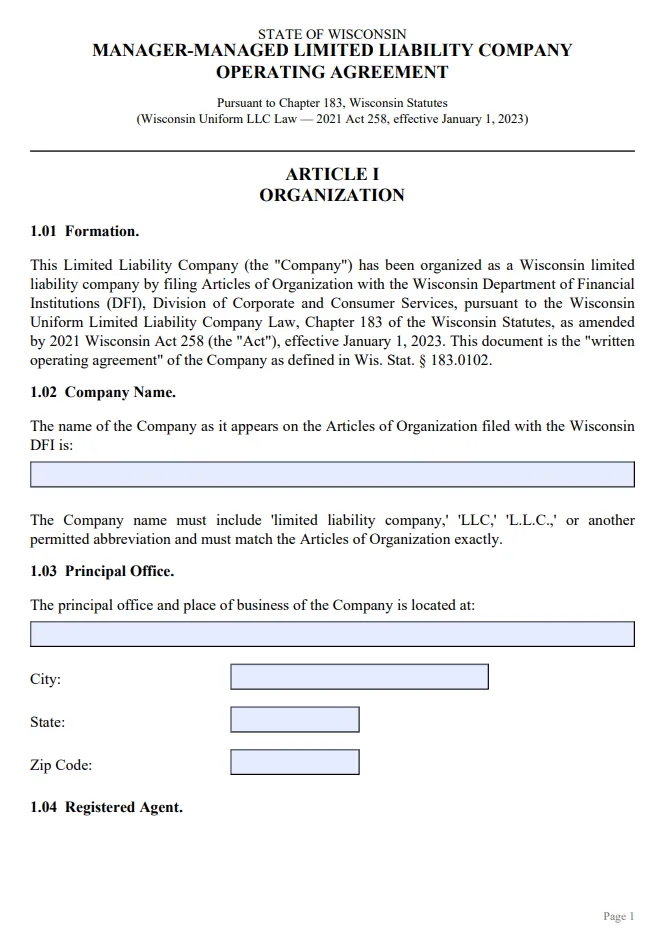
Choose the version that matches your Wisconsin LLC structure and download it in PDF or Word format. Each template is designed to help you document ownership, management, and internal rules more clearly from day one.
Is a Wisconsin LLC Operating Agreement Legally Required?
Wisconsin law doesn’t force any LLC to adopt one. The statute does something more useful: it defines, regulates, and gives override power to whatever operating agreement the members do adopt.
What Wisconsin Statute Says
Under Wis. Stat. § 183.0105, the operating agreement governs relations among members, the rights and duties of managers, the company’s activities, and how the agreement itself can be amended. The catch: under § 183.0102 the statute treats an operating agreement as oral, implied, in a record, or any combination of these. Members don’t have to sign a thing for an agreement to exist in a Wisconsin court.
That breadth came from 2021 Wisconsin Act 258, which took effect January 1, 2023. Act 258 made a written, signed operating agreement more important now than at any point in Wisconsin LLC history.
A few defaults still apply when no operating agreement is in place:
- Member-managed by default: under § 183.0407(1)
- Voting power and management rights: proportional to the value of each member’s contributions
- Distributions before dissolution: proportional to contribution value, not equally per member
- Adding new members, mergers, and conversions: require unanimous consent
Skip the document, and these defaults rule.
Why Banks, Investors, and Courts Want One
The Wisconsin DFI doesn’t ask for an operating agreement, but plenty of other people do. Before opening an LLC bank account, banks routinely require a signed one, especially for multi-member LLCs. Lenders and investors ask for it before funding. If a dispute reaches a Wisconsin court, the judge interprets the relationship under the operating agreement first and the statute second. A working Wisconsin registered agent will often flag the missing OA during onboarding too. According to Aaron Kra, this remains the single most common reason a freshly formed Wisconsin LLC delays its first bank account opening.
Since Act 258 took effect in 2023, I’ve watched dozens of Wisconsin LLC owners walk into a bank with freshly stamped Articles of Organization and walk back out empty-handed because they could not produce a signed operating agreement.
I see this most often with single-member LLCs. Founders assume the bank already knows they are the only owner, so they expect the Articles alone to be enough. In practice, that is not how bank onboarding works. The teller does not care, and the bank’s compliance team cares even less.
- Owners arrive with state-approved formation documents only
- Single-member LLCs are the group that gets caught most often
- The missing signed operating agreement stalls the account opening
- Bring a signed operating agreement to the very first bank visit
- Do not assume the Articles of Organization will be enough
- Doing this upfront avoids a second trip and a delayed account
How 2021 Wisconsin Act 258 Changed Operating Agreements
On January 1, 2023, 2021 Wisconsin Act 258 took effect. It replaced Wisconsin’s older LLC statute with a version closer to the Revised Uniform Limited Liability Company Act (RULLCA). Worth flagging: most pre-2023 templates miss the three changes that hit operating agreements directly.
Oral, Implied, and “In a Record” Agreements
Under Wis. Stat. § 183.0102, an operating agreement is the agreement of the members “whether oral, implied, in a record, or in any combination thereof.” That definition pulls in member emails, group chats, meeting notes, and consistent course of conduct over time. A handshake deal between two members can become enforceable as an oral OA.
The risk is real: if members later disagree, a Wisconsin court can reconstruct the operating agreement from texts and emails the members never thought of as legal documents. Treat every business communication with members like it might end up in front of a judge.
When Wisconsin Demands a Written Operating Agreement
Some clauses only work if they’re set out in a signed writing. Per § 183.0105(3)-(4), an operating agreement can only modify default duties so far, and several modifications require a written operating agreement to be valid. Examples include:
- Limited modification of duty of loyalty or duty of care: signed agreement only
- Indemnification standards: under § 183.0408
- Exculpation provisions: affecting member or manager liability
Wisconsin distinguishes between “operating agreement” (oral, implied, written, or any combination) and “written operating agreement” (a defined term in § 183.0102). When the statute requires a written operating agreement, nothing oral or implied counts.
The “Written Amendments Only” Clause
Wisconsin attorneys put this clause near the end of every Act 258-compliant operating agreement: amendments must be in writing, signed by all members, and dated. Without that clause, members can amend the operating agreement through emails, recorded votes, or even consistent course of conduct. Most won’t realize they’ve done it.
A Wisconsin operating agreement without this clause is open to revision every time members exchange business correspondence. The fix: lock down amendments to written, signed instruments only.
What to Include in a Wisconsin LLC Operating Agreement
Wisconsin’s default rules differ from many states in ways that surprise founders. The provisions below override the defaults that hit hardest.
| Provision | Wisconsin Default Rule | What to Specify in Your OA |
|---|---|---|
| Profits, losses, and distributions | Distributions go proportionally to contribution value per § 183.0403; profits and losses will track distribution defaults absent an agreement | Pro-rata to membership interest, special allocations, or a hybrid formula |
| Voting rights | Vote weight proportional to contribution value under § 183.0407 | Per-capita voting (one member, one vote), tiered thresholds, or class-based voting |
| Management structure | Member-managed under § 183.0407(1) | Manager-managed (only valid in a written operating agreement) |
| Member admission | Unanimous consent of existing members per § 183.0401 | Lower threshold (majority, supermajority) or admission committee |
| Transferable interests | Assignment doesn’t admit assignee as a member; a creditor of a sole member can obtain LLC ownership outright | Right of first refusal, prohibited transferees, mandatory buyout on death/divorce/bankruptcy |
| Dissolution triggers | Listed in § 183.0707 plus member consent | Continuation on member death, term limits, succession plan |
| Amendment procedure | Implied or oral amendments allowed under Act 258 | Written, signed, dated; “no oral amendments” clause |
| Indemnification | Permitted within limits of § 183.0409 (cannot waive duty of loyalty or willful misconduct) | Scope, advancement of expenses, insurance requirements |
Each row represents a Wisconsin default that won’t match how most LLCs actually operate. The operating agreement is where the override happens, and it should be drafted alongside the Articles of Organization filed with the Wisconsin DFI. For the full setup sequence, Boost Suite’s Wisconsin LLC formation guide walks through how the operating agreement fits with the other steps.
Form the Wisconsin LLC, then override the defaults in writing.
Northwest can help file the Wisconsin LLC and registered agent details cleanly, giving owners a reliable DFI record before the operating agreement sets voting weight, distributions, manager authority, transfer limits, and no-oral-amendment rules.
Single-Member vs. Multi-Member Wisconsin LLCs
Wisconsin applies most of the same default rules to single-member and multi-member Wisconsin LLCs. The risk profile is wildly different.
The Single-Member Creditor Trap
Act 258 changed creditor remedies in a way that hits single-member LLCs harder than multi-member ones. In a multi-member LLC, a creditor of one member is usually limited to a charging order, a court-ordered claim on that member’s distributions but no ownership rights. In a single-member Wisconsin LLC, courts have more flexibility to give the creditor the LLC itself.
That’s a major shift from pre-Act 258 practice. Boost Suite’s review of post-Act 258 Wisconsin commentary confirms that asset protection strategies built for states with strong charging-order protections (like Delaware or Nevada) don’t carry over directly to Wisconsin.
A few defenses Wisconsin attorneys recommend:
- Add a second member: even a 1% holder converts the LLC to multi-member status
- File a Statement of Nonapplicability: with the Wisconsin DFI to opt out of Act 258 (only available to LLCs formed before January 1, 2023)
- Layer the LLC: under a Wisconsin trust or another entity that adds a buffer between the founder and the operating company
Where Multi-Member Templates Need More
Multi-member operating agreements carry provisions single-member templates can skip:
- Buy-sell triggers: death, divorce, disability, bankruptcy, voluntary withdrawal
- Deadlock resolution: third-party mediator, buy-sell shotgun, dissolution vote
- Capital call procedures: when members must contribute additional capital
- Distribution priority: tax distributions vs. discretionary distributions
- Exit valuation: how a departing member’s interest gets priced
I had a client in Madison who had run a single-member real-estate LLC for eight years before Act 258. He assumed the LLC would be untouchable in his personal divorce, but the new law changed the risk analysis in a way he had not accounted for.
Location: Madison, Wisconsin
Structure: Single-member real-estate LLC
Timing: Operated for 8 years before Act 258
Main assumption: The LLC would be shielded from personal divorce exposure
What changed: Under Act 258, a Wisconsin court could reach directly into the LLC’s ownership in a way the client had not expected
- I first confirmed that the client’s old asset-protection assumptions no longer matched the practical risk under Act 258.
- The fix took about 3 weeks and started with filing a Statement of Nonapplicability with the Wisconsin DFI.
- I then restructured the operating agreement so the LLC was no longer standing on a pure single-member setup.
- As part of that restructuring, we added the client’s adult child as a 1% member.
Member-Managed vs. Manager-Managed Under Wis. Stat. § 183.0407
Wisconsin treats every LLC as member-managed unless a written operating agreement says otherwise. There’s another wrinkle Act 258 added: management structure no longer needs to appear in the Articles of Organization.
| Element | Member-Managed (Default) | Manager-Managed (Requires Written OA) |
|---|---|---|
| Who runs the company | All members, jointly | One or more managers, appointed by members |
| Voting power | Proportional to contribution value | Specified in OA; managers handle day-to-day |
| Fiduciary duties | Owed by every member | Owed by managers; non-manager members are passive |
| Authority to bind LLC | Any member can bind the LLC in ordinary business | Only managers can bind for ordinary business |
| Filing requirement | No statement needed in Articles | Must be set forth in a written operating agreement |
Pre-Act 258, the management form had to appear on the Articles of Organization. Now it doesn’t, but choosing manager-managed is meaningful only if a written operating agreement spells it out under § 183.0407(4). Neither members nor third parties can rely on a verbal understanding.
How to Sign and Store Your Wisconsin Operating Agreement
The operating agreement won’t help anyone if it can’t be produced when a bank, court, or the Wisconsin DFI asks for it. Treat the signing process the way the law treats it: as a formal, recordable event.
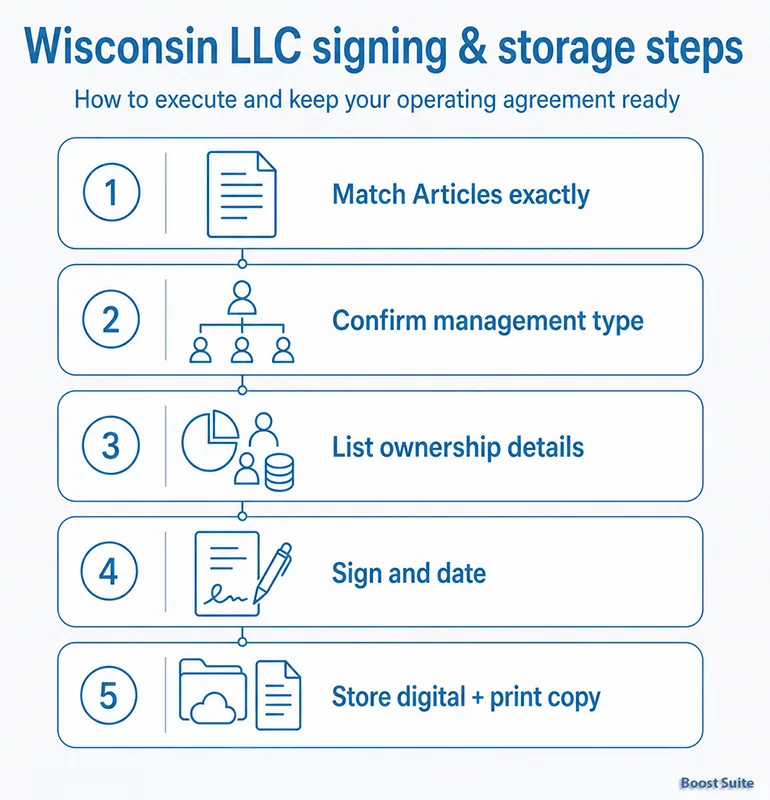
- Match the Articles of Organization exactly: The LLC name, principal place of business, and registered agent address in the operating agreement must match what’s filed with the Wisconsin DFI, including punctuation and the “LLC” or “L.L.C.” designation. A quick Wisconsin business name search confirms what’s actually on file.
- Confirm member-managed or manager-managed in writing: Per § 183.0407(4), manager-managed status only works if a written operating agreement says so. State it explicitly.
- Specify capital contributions and member percentage interest: List initial capital contributions, each member’s percentage interest, capital call procedures, the distribution formula, and how the LLC will be taxed (sole proprietorship, partnership, S-corp, or C-corp). Wisconsin’s default proportional-to-contribution rule won’t match most LLCs’ intent.
- Have all members sign and date the agreement: Single-member LLCs sign solo. Multi-member LLCs need every member’s signature; notarization isn’t required but adds an authentication layer for future disputes.
- Keep the signed copy with your business records: Wisconsin doesn’t require a state filing, but the DFI, banks, and courts can ask for it on demand. A digital copy plus a printed copy in the corporate book is the usual setup.
Filing the Articles of Organization typically runs about 5 to 7 business days online with the Wisconsin DFI. The operating agreement should be drafted and signed during that window. Bottom line: have the OA ready before the Articles get stamped, not after. See Wisconsin LLC processing time for current timelines.
Form your Wisconsin LLC with Bizee and keep your records bank-ready
Bizee helps you file your Wisconsin LLC with the state, so your Articles of Organization are handled properly and your operating agreement can match the details banks, courts, and the Wisconsin DFI may ask to review.
Wisconsin LLC Costs Around the Operating Agreement
Wisconsin sits in the middle of the pack for LLC formation costs. The operating agreement itself doesn’t cost anything from a template, but the surrounding costs add up fast for multi-state businesses.
| Item | Fee | Authority |
|---|---|---|
| Articles of Organization (online filing) | $130 | Wisconsin DFI |
| Articles of Organization (paper filing) | $170 | Wisconsin DFI |
| Annual report (domestic LLC) | $25 | Wisconsin DFI, due by end of anniversary quarter |
| Annual report (foreign LLC) | $65 | Wisconsin DFI, due March 31 |
| Operating agreement | $0 (no state filing) | Self-executed |
Wisconsin’s annual report deadline catches founders off guard because it’s not a fixed date. Domestic LLCs file Wisconsin’s annual report by the end of the calendar quarter containing the anniversary of the Articles’ effective date. For an LLC formed in February, that means a March 31 deadline; for one formed in August, September 30. Miss it and the DFI can administratively dissolve the LLC under § 183.0708.
Choose the version that fits your LLC structure.
Every Wisconsin operating agreement I have drafted since Act 258 took effect in 2023 includes a written-amendments-only clause. I consider it the single highest-impact clause in the document because it keeps informal conversations from becoming accidental governance changes.
- A Wisconsin court can reconstruct an operating agreement from emails.
- Group chats and member conduct can become evidence of what the members agreed to.
- A casual message can later turn into an argument over ownership, voting, or profit splits.
- All amendments must be in writing.
- Every member must sign the amendment.
- The amendment must be dated and kept with the company records.
A two-sentence written-amendments-only clause can save members from arguing later about whether a Slack message, email thread, or repeated course of conduct changed the profit split.
Wisconsin LLC Operating Agreement Questions, Answered
A few common questions come up after Wisconsin LLC owners read through Chapter 183 and Act 258 for the first time. Quick answers below.
Do I file my operating agreement with the Wisconsin DFI?
No. The Wisconsin DFI accepts the Articles of Organization, the annual report, and a few other entity filings. The operating agreement stays internal: signed by the members and kept with the company’s records.
Does a Wisconsin LLC operating agreement need to be notarized?
Wisconsin doesn’t require notarization for an operating agreement to be valid. Signed and dated by all members is enough under Chapter 183. Notarization can still be useful for multi-member LLCs where future disputes are likely, since it adds an authentication layer.
How do I amend a Wisconsin LLC operating agreement?
Most Wisconsin operating agreements include an amendment clause requiring written, signed, and dated changes by all members. Without that clause, Act 258 allows amendments through course of conduct or even oral agreement. The cleanest method is a written amendment signed by every member and stapled to the original.
What is a Statement of Nonapplicability under Wisconsin Act 258?
A Statement of Nonapplicability is a Wisconsin DFI form that lets an existing LLC opt out of Act 258 and remain governed by the prior version of Chapter 183. It’s only available to LLCs formed before January 1, 2023. New LLCs formed after that date are automatically under Act 258.
Do I need a new operating agreement if I add a member to my Wisconsin LLC?
Not necessarily, but the existing operating agreement must address admission. For example, if the agreement covers admission terms (vote thresholds, capital contribution, profit allocation adjustment), an amendment plus a joinder signed by the new member is enough. If it doesn’t, the safer path is a fully restated operating agreement.
Can I use my Wisconsin operating agreement if I move the LLC to another state?
Not as-is. Wisconsin operating agreements reference Chapter 183 and Wisconsin-specific defaults. Domesticating the LLC into another state, or forming a new entity there, requires an operating agreement aligned with that state’s LLC act. The Wisconsin terms won’t translate cleanly.
How long should I keep a signed Wisconsin operating agreement?
For the life of the LLC plus seven years after dissolution. Wisconsin courts can review operating agreements in disputes that arise years after a member has left or the LLC has wound down. Keeping the original (and every amendment) protects against gaps in the record.
- WisBar Inside Track: Drafting LLC Operating Agreements Post-Act 258
- Wisconsin Statutes Chapter 183
- Wis. Stat. § 183.0105: Operating Agreement, Scope, Function, and Limitations
- Wis. Stat. § 183.0407: Management of Limited Liability Company
- Wis. Stat. § 183.0708: Administrative Dissolution
- Wisconsin DFI Business Entity FAQ
- Wisconsin DFI Annual Report Form 5 Instructions
- Wisconsin DOR Publication 119: Limited Liability Companies
- IRS Limited Liability Company (LLC) Overview
Form your Wisconsin LLC with Harbor Compliance before you finalize your agreement
Harbor Compliance helps you set up your Wisconsin LLC properly, from formation filings to compliance support, so your operating agreement starts from a clean legal foundation.