

Oregon doesn’t require an operating agreement, and ORS 63.057 even recognizes oral ones. But default rules split profits equally regardless of contribution. Download Boost Suite’s free Oregon templates below before you form an Oregon LLC.
Download Boost Suite’s free Oregon LLC Operating Agreement template
Choose the version that matches your Oregon LLC structure and download it in PDF or Word format. Each template helps you document ownership, management authority, member rights, and internal rules more clearly from day one.
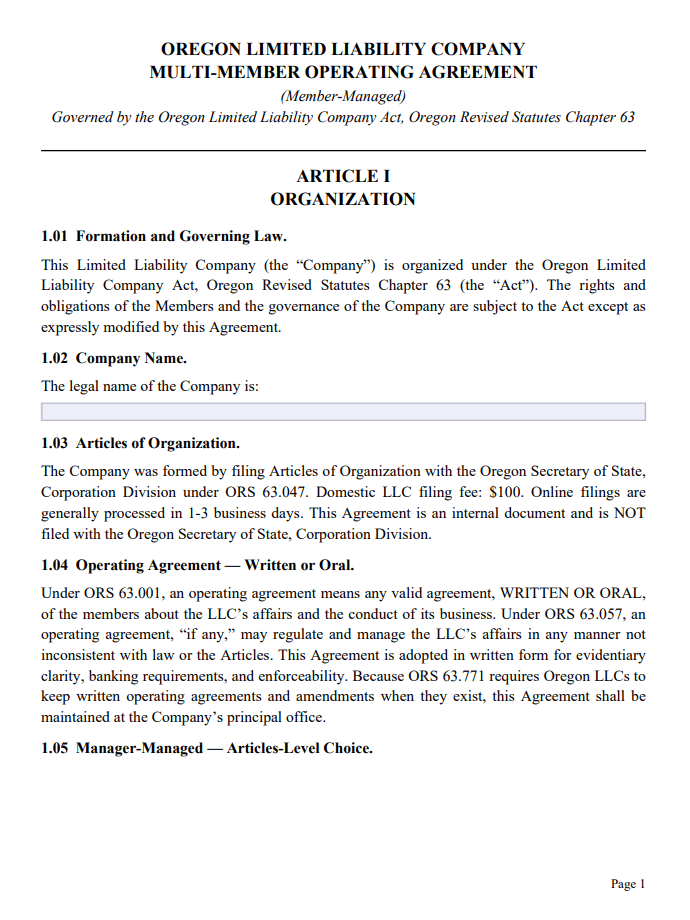
Is an Operating Agreement Required for an Oregon LLC?
No. Oregon doesn’t require an operating agreement, and the state won’t ask for one when you file your Articles of Organization. ORS 63.057 uses permissive language: an operating agreement, “if any,” may regulate the LLC’s internal affairs. That sets Oregon apart from states like California, which conditions formation on adopting a written agreement. In Oregon, the operating agreement lives with the members, not the Oregon Secretary of State.
Written or Oral Agreements Under Oregon Law
Oregon is one of the few states that expressly recognizes oral operating agreements. ORS 63.001 defines the operating agreement as any valid agreement, written or oral, among the members about the LLC’s affairs.
That sounds flexible. In practice, it’s a landmine. Oregon courts still need evidence of what the members agreed to. Two co-owners testifying to two different “oral deals” is the short version of how LLC disputes end up in litigation.
Oregon’s Recordkeeping Rule (ORS 63.771)
If an Oregon LLC has a written operating agreement, it’s required to keep it. ORS 63.771 lists the records every Oregon LLC must maintain: current member and manager lists, the Articles of Organization, tax returns, and any written operating agreements with amendments. Members have inspection rights under the same statute, so when partners disagree, a clean signed document in one place avoids weeks of back-and-forth.
What Oregon’s Default Rules Cost You Without an Operating Agreement
Skip the agreement and the Oregon Revised Statutes fill every gap. Under ORS Chapter 63, state law controls who votes, how profits split, how new members join, and how existing members leave. Those defaults aren’t designed around any specific business, and they can quietly undermine the deal the founders shook hands on.
| Issue | Oregon default | Source |
|---|---|---|
| Management structure | Member-managed unless Articles state manager-managed | ORS 63.047 |
| Voting in member-managed LLC | One equal vote per member; ordinary matters by majority of members | ORS 63.130 |
| Profit and loss allocation | Equal among all members regardless of contribution | ORS 63.185 |
| Interim distributions | Proportional to profit-sharing rights | ORS 63.195 |
| Admission of new members | Majority member consent unless Articles/OA say otherwise | ORS 63.245 |
| Assignment of interest | Assignee gets economic rights only, not voting | ORS 63.249 |
| Voluntary withdrawal | Six months’ prior written notice unless restricted | ORS 63.205 |
| Dissolution | Unanimous consent if no Articles/OA provision | ORS 63.621 |
Profits and Losses Split Equally by Default (ORS 63.185)
Here’s the default nobody expects: if the operating agreement is silent, Oregon allocates profits and losses equally among all members. Not proportional to capital contribution. Not proportional to ownership percentage. Equal.
ORS 63.185 says so directly. Say one member puts in $100,000 and another puts in $5,000. Each is entitled to 50% of the profits unless the Articles of Organization or operating agreement say otherwise. A single clause allocating profits by capital contribution or ownership percentage overrides the default.
Management Rights, Voting, and Agency Power (ORS 63.130, 63.140)
Oregon’s management defaults follow the same equal logic. In a member-managed Oregon LLC, every member has equal rights in management regardless of ownership percentage. Ordinary-course decisions go by majority of members, counted by headcount, not by interest. A 90% owner and a 10% owner each get one vote.
ORS 63.140 adds another wrinkle: every member is an agent of the LLC for ordinary-course business. Any member can sign contracts, open vendor accounts, or bind the company, unless the third party knows the member lacks authority. Manager-managed LLCs shift that authority to named managers, but only if the Articles of Organization say so.
Admission, Transfers, and Withdrawal Defaults
Three defaults catch Oregon LLCs off guard the first time membership changes. Admission requires majority consent of existing members (ORS 63.245). An assignment of interest gives the assignee economic rights only, not voting or management rights (ORS 63.249). A member can voluntarily withdraw with six months’ prior written notice unless the agreement restricts it (ORS 63.205). All three are overridable. None is what most founders actually want.
Start the Oregon LLC, then write the split and authority rules.
Bizee can help with Oregon LLC formation and registered agent options, giving you a clean filing before the operating agreement sets profit percentages, voting power, agency limits, transfer rules, and withdrawal terms.
Member-Managed vs. Manager-Managed: Authority, Agency, and Fiduciary Duties
Oregon treats this choice as a filing-level decision, not a drafting-level one. An LLC is member-managed by default under ORS 63.047. If the Articles of Organization don’t state the LLC is manager-managed, every member is presumed to have management authority under ORS 63.130, regardless of what the operating agreement later says. This is the single biggest disconnect between Oregon operating agreement templates and reality.
| Authority | Member-Managed | Manager-Managed |
|---|---|---|
| Who runs day-to-day | All members equally (ORS 63.130) | Managers only |
| Ordinary decisions | Majority of members | Majority of managers |
| Agency power | Every member can bind the LLC (ORS 63.140) | Managers only; members aren’t automatic agents |
| Fiduciary duties | All members owe duties to the LLC | Managers owe duties; non-manager members don’t |
| How to establish | Default; no Articles statement needed | Articles must state “manager-managed” |
The operating agreement can adjust some duties, but Oregon sets a floor. ORS 63.155 says the agreement can’t completely eliminate the duty of loyalty, can’t unreasonably reduce the duty of care, and can’t eliminate the obligation of good faith and fair dealing. ORS 63.160 adds limits: no agreement can shield anyone from loyalty breaches, bad faith, intentional misconduct, knowing violations of law, improper distributions, or improper personal benefit. A non-manager member who steps in and exercises manager-like authority is held to the same standards to the extent of that exercise. Bottom line: these Oregon laws set a floor that no “broad indemnification” clause can override.
| Modification | Permitted under Oregon law |
|---|---|
| Identify activities that don’t breach loyalty (if not unconscionable) | Yes (ORS 63.155) |
| Specify standards for good faith (if not unconscionable) | Yes (ORS 63.155) |
| Indemnify members/managers for routine acts | Yes (ORS 63.160) |
| Completely eliminate duty of loyalty | No |
| Unreasonably reduce duty of care | No |
| Indemnify intentional misconduct or knowing legal violations | No |
Clauses Every Oregon LLC Operating Agreement Should Include
A good Oregon operating agreement isn’t a generic template with state names swapped out. Each clause should track an Oregon statute or override a default. The checklist below gives the Oregon-specific reason for each clause.
- Legal name: match the Articles of Organization exactly; even “LLC” vs. “L.L.C.” mismatches delay bank accounts. Run an Oregon LLC name search first.
- Principal office and mailing address: required on Oregon filings under ORS 63.047.
- Registered agent and registered office: Oregon requires a physical registered office under ORS 63.111.
- Member-managed or manager-managed designation: must match the filed Articles or the whole structure defaults back.
- Members and ownership percentages: override Oregon’s equal default (ORS 63.185) in writing.
- Capital contributions: document cash, property, services, and promises.
- Profit and loss allocation: state whether allocation follows ownership, capital account, or another method.
- Voting thresholds and major decisions: ORS 63.130 requires special consent for amendments, dissolution, mergers, and asset sales.
- Admission and transfer restrictions: override ORS 63.245 and ORS 63.249.
- Withdrawal, buy-sell, and deadlock provisions: override ORS 63.205 and plan for death, disability, divorce, and bankruptcy.
- Tax classification, officers, and partnership representative: name the federal classification, identify any officers (such as a president or treasurer) authorized to bind the LLC, and designate the IRS partnership representative.
- Dissolution and winding up: override ORS 63.621’s unanimous-consent default with a workable exit.
Skip any one of these and Oregon’s defaults fill the gap. That’s the catch: defaults almost never match founder intent.
Form your Oregon LLC with Northwest
Northwest builds your Oregon LLC with the right structure from the start, helping you align filings, ownership terms, and operating agreement details so state defaults never take over.
Single-Member vs. Multi-Member Agreements in Oregon
Oregon permits LLCs with one or more members, and drafting priorities differ for each. Single-member LLCs focus on separateness and documentation. Multi-member LLCs focus on overriding defaults and planning for disputes.
Both benefit from liability protection under ORS 63.165. The statute says the LLC’s debts are solely the LLC’s, and confirms that failure to observe LLC formalities, alone, isn’t grounds for personal liability. Oregon case law sets limits: in Cortez v. Nacco Materials Handling Group, a member-manager was personally liable for their own negligent acts. In Adelsperger v. Elkside Development LLC, LLC status didn’t automatically bar claims against members. An operating agreement won’t override those outcomes, but clean separateness and signed records strengthen the defense when veil-piercing is argued.
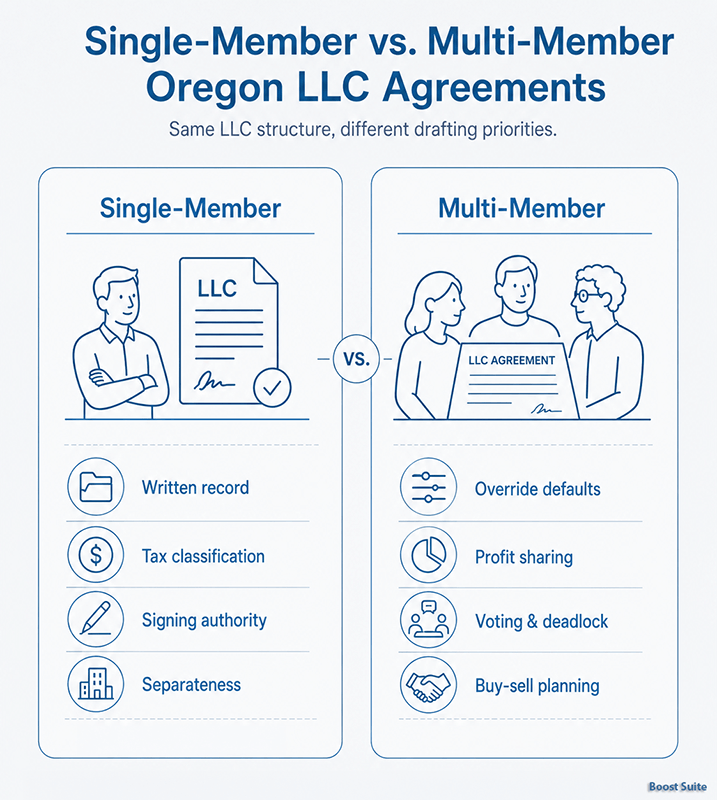
Single-Member Oregon LLC: Drafting Priorities
Solo owners often skip the agreement because Oregon doesn’t require one and there’s nobody to negotiate with. That’s shortsighted. ORS 63.431 expressly recognizes the sole member’s power to adopt, amend, or repeal the operating agreement. A written single-member agreement does four things no unwritten arrangement can:
- Documents tax classification (disregarded entity, S-corp, or C-corp) for the IRS and Oregon Department of Revenue
- Records initial capital contribution and the start date
- Establishes authority to sign contracts and open bank accounts
- Supports veil-piercing defense by showing separateness between owner and entity
Banks ask for it before opening an Oregon LLC account. So do lenders and most commercial landlords. ORS 63.771 requires keeping the written OA and amendments, so storing it with the EIN letter and Articles is standard practice.
Multi-Member Oregon LLC: 50/50 Traps and Deadlock
Multi-member Oregon LLCs are where default rules cost real money. The most dangerous default is ORS 63.185’s equal-profit allocation, covered above. Deadlock is a close second.
A 50/50 Oregon LLC with no deadlock clause can grind to a halt the first time members disagree on a major decision. ORS 63.130 requires special consent for dissolution, asset sales, mergers, and conversions. Without a tiebreaker, litigation becomes the only exit. A simple buy-sell clause with a fixed valuation method avoids that. Multi-member LLCs taxed as partnerships also owe the Oregon partnership minimum tax ($150 annually with Form OR-65), so the OA should identify who files and signs the return.
Oregon LLC Formation, Fees, and Annual Reports
The operating agreement should match the formation paperwork, so it helps to know the numbers. Here’s what an Oregon LLC actually costs, based on the Oregon SOS Business Registry Fee Schedule.
| Filing | Fee |
|---|---|
| Domestic LLC Articles of Organization | $100 |
| Domestic LLC Annual Renewal | $100 |
| Articles of Amendment or Dissolution | $100 |
| Foreign LLC Application for Authority | $275 |
| Foreign LLC Annual Renewal | $275 |
Oregon LLC annual reports are due on the anniversary date of the original filing. The Oregon Secretary of State sends renewal notices about 45 days before the due date. ORS 63.787 requires report information to be current as of 30 days before that anniversary. Miss the deadline for Oregon’s $100 Annual Report and the LLC risks administrative dissolution under ORS 63.647 (reinstatement available under ORS 63.654, typically within five years).
Online Business Registry filings run in 1 to 3 business days. The full Oregon LLC processing time breakdown covers mail and expedited options. Worth flagging: Oregon SOS warns about private companies mailing fake annual-report solicitations with inflated fees. The real fee is $100, paid directly to the state.
Oregon’s Strict Registered Office Rule (ORS 63.111)
Every Oregon LLC must continuously maintain a registered agent and a registered office in Oregon. The registered office has to be a physical street address where service of process can be personally delivered. Oregon law excludes commercial mail receiving agencies (CMRAs), mail-forwarding businesses, and virtual offices from serving as the registered office. A UPS Store mailbox, a Regus virtual office, or a coworking mailbox won’t qualify.
Oregon LLC Taxes Your Operating Agreement Should Account For
Tax language in an Oregon operating agreement isn’t filler. Oregon imposes several state-level taxes that most LLC pages ignore, and the OA should address each one that applies.
| Tax | Threshold / Rate | Who files |
|---|---|---|
| Corporate Activity Tax (CAT) | $250 + 0.57% of Oregon commercial activity above $1M | LLCs with over $750K of Oregon commercial activity |
| Partnership minimum tax | $150 annually | Multi-member LLCs filing Form OR-65 |
| S-corp minimum excise tax | $150 | LLCs electing S-corp treatment |
| PTE-E elective tax | 9% (first $250K) / 9.9% (above) | Pass-through entities electing on Form OR-21 |
| BIN / payroll tax | Varies | Any LLC with Oregon employees |
The Corporate Activity Tax isn’t a corporation-only tax despite the name; LLCs with enough Oregon commercial activity owe it too. Oregon’s pass-through entity elective tax (PTE-E) was extended through tax years beginning before January 1, 2028 under SB 1510. The election lets members deduct state taxes federally above the $10,000 SALT cap, so it’s worth modeling before forming.
A well-drafted Oregon OA identifies who files Form OR-65, Form OR-21, or the CAT return. It names the partnership representative for IRS matters. And it specifies how distributions work when PTE-E is elected, since the entity pays the tax, not the members. See the Oregon Department of Revenue’s Corporate Activity Tax page for current thresholds.
Choose the version that fits your Oregon LLC structure.
Oregon LLC Operating Agreement FAQs
A few practical Oregon-specific questions come up again and again. Here’s what ORS Chapter 63 actually says.
Does an Oregon LLC operating agreement need to be notarized?
No. Oregon law doesn’t require notarization. Member signatures are sufficient under ORS 63.001 and 63.057. Some banks may ask for notarized signatures as internal policy, but the state imposes no such rule.
Do I need an operating agreement if I’m the only member of my Oregon LLC?
Technically no, but effectively yes if the LLC is going to do anything useful. ORS 63.431 confirms a sole member can adopt their own operating agreement. Banks, tax preparers, and veil-piercing defenses rely on having a written document on file.
What happens if multi-member Oregon LLC members disagree without a written agreement?
ORS Chapter 63 takes over. Profits split equally (ORS 63.185), votes are one-per-member (ORS 63.130), and major decisions require special consent. When defaults can’t resolve the disagreement, judicial dissolution under ORS 63.621 may be the only option.
Can an Oregon operating agreement limit fiduciary duties?
Partially. ORS 63.155 allows the agreement to identify activities that don’t violate loyalty and to specify standards for good faith, if they aren’t unconscionable. It can’t fully eliminate loyalty, unreasonably reduce care, or eliminate good faith and fair dealing.
Can I use an out-of-state operating agreement template for my Oregon LLC?
It’s risky. Template language tied to another state’s statute often contradicts Oregon defaults. An Oregon agreement should cite ORS Chapter 63, match the filed Articles of Organization, and address Oregon-specific items like CAT, PTE-E, and the ORS 63.111 registered-office rule.
Does Oregon have an LLC publication requirement like New York?
No. Oregon has no newspaper publication requirement. The only filings on record are the Articles of Organization plus later amendments or annual renewals filed with the Oregon Secretary of State.
Do banks require an operating agreement to open an Oregon LLC account?
Most do. Chase, Wells Fargo, U.S. Bank, and most Oregon community banks ask for the operating agreement (or a written member resolution) before opening a business account. Single-member LLCs are sometimes exempt at smaller banks, but producing the signed OA removes friction.
Can I amend my Oregon operating agreement after formation?
Yes. Members can amend using the procedures the agreement contains, or by majority consent if the document is silent. ORS 63.771 requires keeping each amendment with the original. Redate and re-sign the full agreement rather than stacking loose addenda, which tend to get lost.
- Oregon Department of Revenue, Corporate Activity Tax
- Oregon Secretary of State, Domestic Limited Liability Companies Forms
- Oregon SOS Business Registry Fee Schedule (PDF)
- ORS 63.057, Operating agreements
- ORS 63.185, Allocation of profits and losses
- ORS 63.130, Rights of members and managers
- ORS 63.047, Articles of Organization
- ORS 63.165, Liability of members and managers
Start your Oregon LLC with Harbor Compliance
Harbor Compliance helps you form your Oregon LLC with accuracy and structure, so your operating agreement, ownership terms, and compliance requirements are aligned from the start.