

A South Carolina LLC is approved within 24 hours online, or in up to five business days on paper, as of 2026. Both numbers are published by the state itself. No expedited tier exists at any price, so the channel picked at filing sets the whole timeline, and everything else in starting a business in South Carolina waits on it.
South Carolina approves LLC filings within 24 hours when they are submitted through Business Entities Online, and in up to five business days when they arrive on paper. No expedited service is offered at any fee, so filing online is the fastest route available.
Useful for anyone whose lease or bank appointment is already on the calendar.
Filing office: South Carolina Secretary of State, Business Filings Division, 1205 Pendleton Street, Columbia.
Portal: Business Entities Online.
South Carolina LLC processing time: 24 hours online
Two turnaround figures are published by the state, and no others. South Carolina Business One Stop puts online filings at within 24 hours and paper filings at up to five business days to process.
Processing time is the state’s side of the clock, and approval time is what someone forming an LLC actually experiences. In South Carolina the gap between the two is postage.
That single fact is why the channels separate so sharply.
| Filing channel | State processing time | Add for delivery |
|---|---|---|
| Business Entities Online | Within 24 hours | None, documents download |
| Mail to Columbia | Up to 5 business days | Postage both ways |
| In person, Columbia counter | Up to 5 business days | Return delivery |
| Expedited service | Not offered | Not applicable |
I treat South Carolina’s two published processing figures as commitments the state publishes, not deadlines it legally owes you. Chapter 44 sets no deadline at all for acting on an LLC filing. Corporations get a five-day rule, but limited liability companies have no equivalent. In practice, I’ve never had the online channel drift on me. That distinction only becomes important on the day the published timing is missed.
Online filings through Business Entities Online
Business Entities Online is the only channel that clears inside that 24-hour window. Approved documents are downloaded from the portal, so nothing waits on a postal round trip.
Almost everyone takes this route. Across roughly 147,000 corporate filings in fiscal year 2024-25, the Secretary of State reported online filings holding steady at nearly 90%.
Same-day approval is promised nowhere. Twenty-four hours is the published commitment, and that is the number worth planning against.
South Carolina is fast online. Northwest keeps the filing straightforward.
With online filings processed within 24 hours, the bigger advantage is avoiding the extra time that comes with paper. Northwest can handle the formation paperwork while keeping the process simple from the start.
Mail filings to the Columbia corporate filings office
Post the Articles of Organization and the state takes up to five business days to process them, counting from the day the envelope reaches 1205 Pendleton Street. Posting day itself counts for nothing.
Postage runs in both directions. Stamped filings come back by mail too, and that return leg is what most timelines forget to count.
In-person filings at 1205 Pendleton Street
Walking a filing into the state office in Columbia does not buy a faster decision. South Carolina Business One Stop places in-person submissions in the same five-business-day window as mail. The counter is a delivery method, and the queue behind it does not care how the paperwork arrived.
A counter visit removes the outbound postage and nothing else, which makes the drive to Columbia hard to justify against filing from a laptop.
Can you expedite an LLC filing in South Carolina?
No. Across the whole fee schedule, for LLCs and every other entity type, there is one price for the Articles of Organization and no rush tier at any amount.
Online filers do pay $15 more than paper filers, and that gap is the most misread number in South Carolina. On the receipt it appears as a service fee for SC.gov, the platform that runs the portal on the state’s behalf.
Older receipts carried the same $15 line under the heading Electronic Records Access. Either way, what it buys is access to the portal.
Nobody moves up the queue for paying it.
Speed does separate the two channels, and the gap comes from skipping the envelope. Full pricing sits on the cost of forming an LLC in South Carolina page.
Paying a service to file the Articles changes none of this. The queue at the Secretary of State is the same queue whoever presses submit. What a service is genuinely worth buying for is accuracy and a South Carolina registered agent address.
Clients regularly ask me whether South Carolina’s $15 fee buys them speed. It never did. It’s an SC.gov service fee, labelled Electronic Records Access on older receipts. What happens is that the portal delivers the filing about four business days faster than sending it by envelope, so people naturally connect the fee with the faster result. They pay it expecting priority, get the outcome anyway, and the misunderstanding survives.
ZenBusiness cannot move your filing ahead in South Carolina’s queue, but it can help get the paperwork right and provide a registered agent address.
Form Your South Carolina LLC with ZenBusinessWant to look closer first? See our ZenBusiness review.
Business Entities Online approval and your LLC formation date
Filing is the moment that counts, not the arrival of a confirmation email. Under section 33-44-202, the legal existence of a limited liability company begins when the articles of organization are filed.
Section 33-44-206 pins that moment down. A filing takes effect at the time of filing on the date it is filed, evidenced by the Secretary of State’s date and time endorsement on the original record.
Read that carefully. The endorsement sits on the Articles the state hands back.
The email carries no legal weight of its own.
Business Entities Online covers filing, entity search and document requests, and the search returns entities already on file. Proof of timing arrives with the paperwork, and there is no pending-status dashboard to watch while a filing sits.
The Customer Receipt and stamped Articles of Organization
Two documents come back, and they do different jobs. The portal issues a Customer Receipt carrying the line “This filing has been approved”, which section 33-44-206 requires the office to send for the record and the fees. The stamped Articles carry the date and time endorsement that fixes the effective moment.
Section 33-44-202 adds a useful backstop. Filing the Articles is conclusive proof that the organizers satisfied every condition of formation, which is why banks and title companies keep asking for the stamped copy.
Certificate of Existence: a separate $10 request
Two state pages describe this step differently, which is where the confusion starts. South Carolina Business One Stop tells new filers to expect a Certificate of Existence within 24 hours. The Secretary of State states that certificates of existence cost $10, a fee set by statute, and are ordered separately through the portal’s document request system.
What actually happens is simpler: a formation filing returns the receipt and the stamped Articles. A Certificate of Existence is an add-on, available at checkout or any time afterwards.
Most new LLCs never need one. It becomes worth ordering when a bank asks for proof of good standing, or when the company registers in another state.
Delayed effective dates: the 90-day cap for LLCs
Articles of Organization can name a future date, and the state will hold the company’s existence until then. This is the one part of the timeline a filer controls outright.
Section 33-44-206 caps how far ahead that date can sit. A delayed effective date later than the ninetieth day after filing is pulled back to the ninetieth day. A date given without a time takes effect at the close of business.
Most people who use this want a clean calendar start. Filing in November for a January 1 date is comfortably inside the 90 days, while filing in June for the same date is not.
What delays LLC approval at the South Carolina SOS?
Rejection is the main risk, and South Carolina is unusually open about it. The Secretary of State publishes its common rejection reasons and ranks the five most frequent from the previous fiscal year.
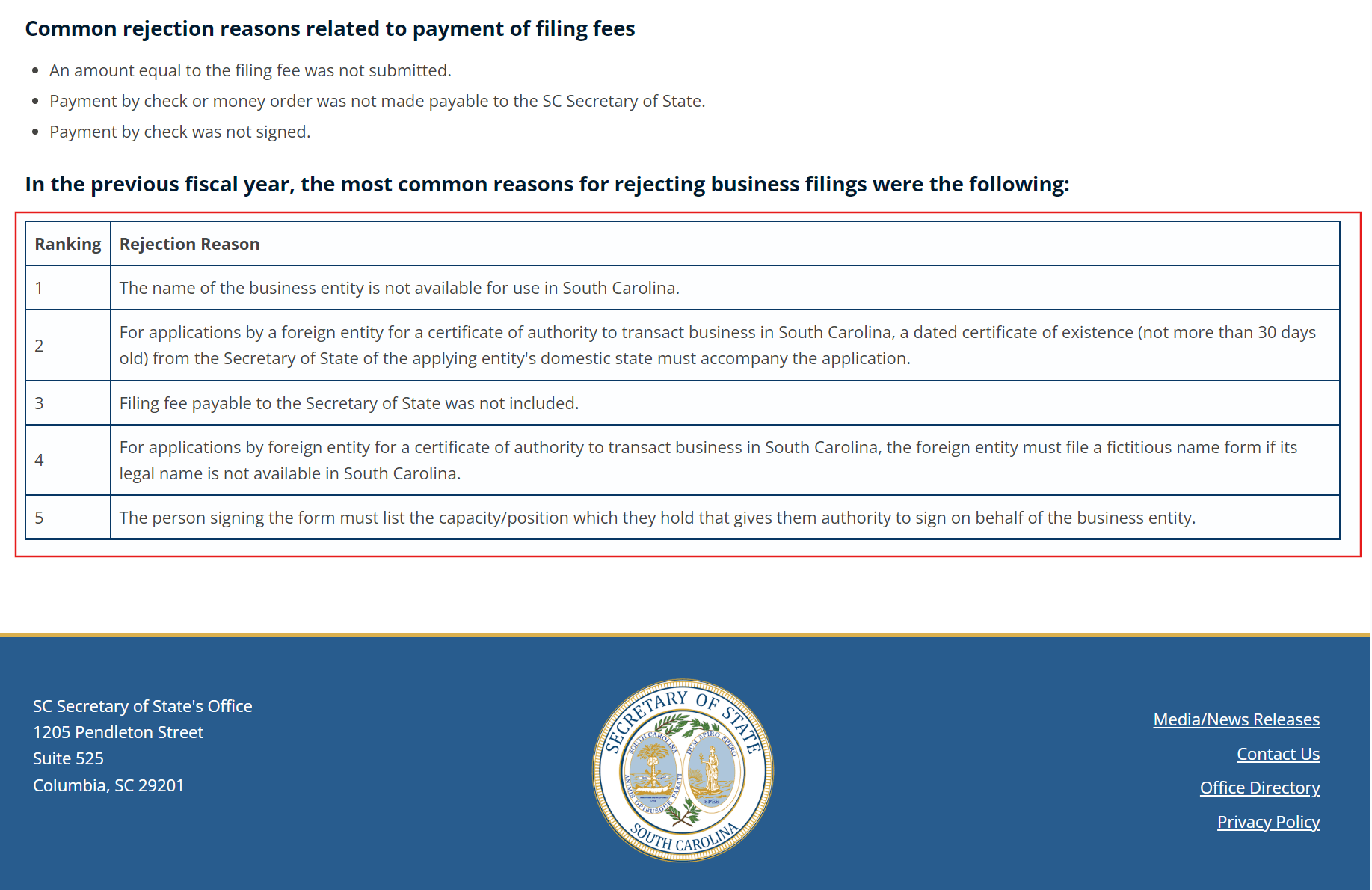
Three of those five hit domestic LLC filings, and the wider list adds one more worth knowing.
- The name is not available. Ranked number one by the state. Section 33-44-105 requires an LLC name to be distinguishable on the Secretary of State’s records, a stricter bar than merely looking different. Run the South Carolina business name search first.
- Organizer details are incomplete. Every organizer’s name and address has to appear, with the signer’s capacity stated next to the signature under section 33-44-205. A missing capacity line ranks fifth on the state’s list, and the valid capacities are narrow. A member signs for a member-managed LLC and a manager for a manager-managed LLC, while an unformed company is signed for by its organizer.
- The registered agent has no South Carolina street address. An agent must be an in-state individual or an entity authorized to do business here, with a street address on file. Choosing a registered agent in South Carolina before drafting avoids a return trip.
- Payment is wrong on a mailed filing. A fee left out of the envelope ranks third overall. An unsigned check does the same damage, and so does one made out to the wrong payee. None of that can happen on a card payment.
One thing never appears on the Articles at all: the members. An unsettled ownership split is no reason to hold a filing back.
Where a filing was submitted decides what a rejection costs. Online, a filer can save the work and correct errors until it is accepted, so problems usually clear in the same session.
A paper rejection travels back by mail and restarts the clock on arrival. Nothing in the published guidance covers a corrected refiling, so budget for the full round trip twice.
I pay particular attention to the LLC name because the name is South Carolina’s own number-one rejection reason. And “distinguishable” is a stricter test than simply looking different. A name that reads as unique to you can still collide with something already on the register. That’s why I never treat an early name search as final.
Harbor Compliance is a practical choice if you want help catching filing details before they turn into a South Carolina rejection.
File Your South Carolina LLC with Harbor ComplianceWant a closer look first? See our Harbor Compliance review.
How soon a South Carolina LLC can start operating
Approval is not the last clock. Next comes the EIN, which the Internal Revenue Service issues immediately and free through its online EIN tool.
Sequence beats speed here. Anyone applying for an EIN before the state filing is complete risks having the application delayed, according to the IRS. The EIN process for a South Carolina LLC covers the detail.
Weekends are covered too, so a Friday approval does not cost two days. Only one EIN is issued per responsible party per day.
Banking comes next, and every institution sets its own paperwork requirements. Keeping the EIN and the stamped Articles in the same place is what saves a second trip.
Licensing runs last, and in sequence. No retail license from the Department of Revenue can be applied for until the Secretary of State filing is complete. Local business licenses come from the county or city instead, on timelines that vary and sit outside the state’s control.
South Carolina LLC timing questions
Everything above covers the filing itself. Three clocks sit either side of that, and most filers only meet them once it is too late to plan around them.
How long is a South Carolina LLC name reservation valid?
Under section 33-44-106 a reservation holds a name for 120 days and cannot be renewed. The Secretary of State also states plainly that a reservation is not needed by anyone ready to organize their entity. For most filers it adds a step without saving a day.
Do foreign LLCs take longer to register in South Carolina?
The processing window is the same, but a different clock binds. A foreign limited liability company files an Application for a Certificate of Authority under section 33-44-1002, and must attach a certificate of existence from its home state. The Secretary of State ranks a certificate more than 30 days old as its second most common rejection reason, so order it close to the filing date.
With no annual report, what can put a South Carolina LLC at risk?
An unpaid fee or tax. Most South Carolina LLCs owe the Secretary of State no annual report at all, so the exposure sits in section 33-44-809 instead: a fee or tax 60 days past due lets the office start administrative dissolution, with 60 more days to fix it after notice.
Reinstatement stays possible for two years after that. The South Carolina annual report rules set out who the exceptions are.
- Business Entities, South Carolina Secretary of State
- FAQs About Business Entities, including the ranked rejection reasons
- Registering with the Secretary of State, South Carolina Business One Stop
- Downloadable paper forms and filing fees, Business Entities Online
- South Carolina Code Title 33, Chapter 44, Uniform Limited Liability Company Act
- Secretary of State FY2025 Annual Accountability Report
Looking for an overview? See South Carolina LLC Services
Form your South Carolina LLC fast with Bizee
Bizee helps you prepare and submit your South Carolina LLC filing online, making it easier to take advantage of the state’s 24-hour processing time.