

Your LLC’s name has to do two jobs at once: comply with state naming rules and make your brand easy to remember. This guide gives you 75+ strong ideas plus the exact rules most states apply: what you must include, what you can’t use, and how “distinguishability” works. You’ll learn how to check availability (state database + a basic USPTO search), reserve or file the name, and avoid common rejection traps. Use the quick checklist below to pick a name you can file with confidence.
75+ Best LLC Company Names (2026): Ideas and Examples
If you want a name that actually makes it through approval, start by treating naming like a screening process, not a brainstorm. In most states, your legal LLC name must (1) include an LLC designator and (2) be distinguishable on the state’s records, so two “pretty similar” names can still be a problem. For example, Delaware’s LLC statute requires an LLC designator and a name that is distinguishable on the Secretary of State’s records. New York also requires the LLC indicator and a distinguishable name, so it’s worth running an NY LLC lookup before you get attached to a name.
Then do a trademark reality check before you invest in branding. The USPTO’s trademark search tools are the right starting point for federal marks. (This is not legal advice, but it is a smart, standard step.) All of the names below are fictional examples designed to spark ideas. Before you choose one, verify state availability and run a trademark search.
Professional LLC Name Examples
These work best if you want a name that sounds credible in email signatures, proposals, and invoices. The pattern is simple: clear positioning + a “steady” word (Advisory, Partners, Group, Solutions).
Here are professional-style name ideas you can adapt:
- Northbridge Advisory
- Summit Ridge Partners
- Harborstone Consulting
- Everwell Strategies
- Keystone Operations
- Brightline Finance Co.
- Atlas Ledger Services
- Clearview Compliance
- Stonegate Business Solutions
- Meridian Growth Group
- Ridgeway Analytics
- Beaconpoint Advisors
- Oak & Iron Consulting
- Silverpine Advisory Group
- Fieldstone Management
- Vanguard Process Partners
- Cedarbrook Consulting
- TrueNorth Tax Solutions
- BluePeak HR Partners
- Seaport Operations Group
Unique LLC Name Examples
These are for founders who want a brand that feels original and memorable without trying too hard. Unique names are often easier to build into a strong brand, but you still need to confirm they are not already in use.
Here are unique-style name ideas:
- Juniper & Jolt
- LumenCraft
- Paperwild Studio
- Ember & Ivy Works
- Driftwood Logic
- Honeyed Hammer
- Quiet Canyon Co.
- Moonlit Metric
- Coppercloud Creative
- Ripple & Root
- Meadowline Market
- Wildfern Supply
- Brightnest Collective
- Velvet Circuit
- Cedar & Sparrow
- Woven Harbor
- Bramble & Co.
- Goldleaf Guild
- Pebblepeak Lab
- Lantern & Loom
Catchy / Cool LLC Name Examples
Catchy names are short, punchy, and easy to repeat. They are great for social, ecommerce, and modern service brands. The risk is sounding trendy, so choose something you will still like in five years.
Here are catchy or cool name ideas:
- ZipNest
- BoldBrew Co.
- SnapHarbor
- PeakPop
- GlowForge
- QuickCedar
- NeonNook
- SkyKite Studio
- FreshVibe Works
- NovaLane
- CrispCurrent
- RocketRidge
- ClickCove
- UrbanHush
- SparkHaven
- TinyTitan
- PivotPulse
- CloudKick
- BrightBoulder
- DriftDash
Generic / All-purpose LLC Name Examples
If you are not sure where your business will go yet, a broad name can keep you flexible. These tend to be easier to fit across multiple services or product lines, but you may need stronger branding to stand out.
Here are all-purpose name ideas:
- Horizon Ventures
- Evergreen Holdings
- Cornerstone Group
- Pinnacle Enterprises
- Riverstone Solutions
- BlueSky Services
- Summit Valley Partners
- Oakridge Ventures
- ClearPath Group
- Prime Harbor LLC
- Ironwood Enterprises
- Crestline Ventures
- Westfield Solutions
- Grandview Group
- Bayview Partners
- Sterling Point Holdings
- Maple Ridge Ventures
- Crosswind Services
- Highwater Group
- OpenRange Ventures
Business Name Review with Northwest
Northwest helps confirm name availability and files your business using the selected legal name, with expert support if issues come up.
How to Come Up With a Great LLC Name
A great LLC name is not just “sounds nice.” It is a name that can pass your state’s naming rules, avoid obvious trademark conflicts, and still work as your business grows. Most states require your LLC name to be distinguishable on the state’s records, and many states also restrict certain words or require agency approval for specific terms. For example, New York explicitly requires an LLC indicator and a distinguishable name, and it notes that some words are prohibited or restricted and may require consent from other agencies.
If you want a simple process to validate your top picks, follow this LLC name check process before you commit to branding
What Makes a Good LLC Name
Before you brainstorm “cool,” decide what your name needs to do for your business.
Here are the three traits that matter most:
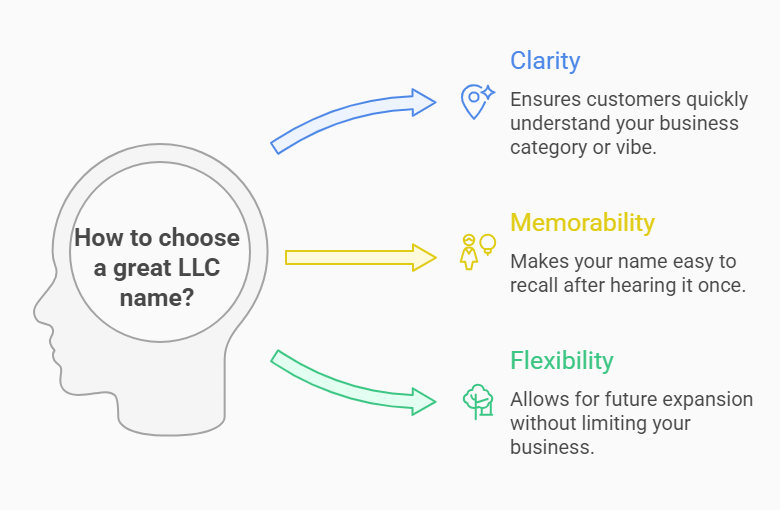
- Clear: A stranger should understand your category or vibe quickly. This matters more for local services (plumbing, cleaning, bookkeeping) than for product brands.
- Memorable: Easy to recall after hearing it once. Short, distinct sounds and simple spelling usually win.
- Flexible: Does not box you into a single service if you plan to expand. “Bayview Home Painting” is clear, but it can feel limiting if you later add flooring and remodeling.
- If you are a local service business, clarity beats cleverness. A descriptive name can convert better because it signals trust.
- If you are building a scalable brand, distinctiveness matters more. It is easier to protect and easier to stand out.
- If you are creating a holding company or multi-brand LLC, use an umbrella-style name and run DBAs for each brand later.
Quick Tests (say-it/spell-it + future-proof)
These quick tests catch most problems before you get attached to a name.
Here is the fast screening checklist:
- Say-it test: Can someone repeat it correctly after hearing it once?
- Spell-it test: If you say it out loud, can they spell it without asking twice?
- Email test: Does it look professional in an email address and invoice header?
- Five-second test: Show the name to someone for five seconds, hide it, then ask them what it was.
- Future-proof test: Would the name still make sense if you add a second service, a second location, or a new product line?
- Approval reality check: Search your state’s business database for exact and similar names. Many states use a “distinguishable” standard, and some differences do not count. Arizona explains that some differences are ignored when determining distinguishability.
- Restricted-words check: Many states limit certain terms. New York, for example, notes restricted and prohibited words and that some require agency consent.
- Trademark sanity check: Use the USPTO’s Trademark Search system as a starting point for federal marks.
If you want to run the “approval reality check” properly, this state entity search directory helps you jump straight to the right official database without guessing.
Avoiding “too generic” (and how to fix it)
Generic names feel safe, but they create two problems: you blend into competitors, and you may have little to no protectable brand value.
The USPTO’s guidance is clear that generic terms are not eligible for federal trademark registration. That does not mean your LLC cannot legally exist with a generic-ish name, but it does mean you should not expect strong trademark protection from a purely generic brand.
Here are common “too generic” patterns:
- “[City] + Services”
- “Best + [Industry]”
- “[Industry] + Solutions”
- “Quality + [Product]”
Here are practical ways to fix a generic name without losing clarity:
- Add a distinctive modifier: “ClearPath Bookkeeping” instead of “Bookkeeping Services.”
- Use a suggestive phrase: “Ledger & Lantern” signals bookkeeping without using the generic phrase.
- Combine uncommon words: “Harborstone” is more brandable than “Harbor Consulting.”
- Avoid relying on “generic + .com” as a shortcut: The USPTO has specific guidance for evaluating “generic.com” marks after the Booking.com decision.
LLC Name Templates
If brainstorming is stalling, templates give you momentum. They also help you stay consistent with what your business actually is, which improves clarity for customers and reduces the “this sounds like everyone else” problem.
Before you finalize any template-based name, remember that your legal LLC name must include an LLC indicator like “LLC” or “L.L.C.” (states vary on acceptable abbreviations). New York states this explicitly.
5 proven naming formulas
Below are five formulas that work across most industries. Use them to generate 15 to 30 options quickly, then run your state and trademark screening.
1. [Distinctive Word] + [Category Word]
Good for: professional services, B2B, firms that want credibility
Harborstone Advisory
ClearPath Operations
Meridian Compliance
2. [Benefit] + [Outcome]
Good for: service businesses that sell results
Faster Close Solutions
CleanStart Property Care
SmoothFlow Logistics
3. [Metaphor] + [Business Noun]
Good for: brandable names with personality
Lantern & Loom Studio
Coppercloud Collective
Driftwood Partners
4. [Place or Founder] + [Service]
Good for: local services where trust and clarity matter
Ridgeway Home Repair
Bayview Tax & Bookkeeping
Ellis Street Landscaping
5. [Verb] + [Noun]
Good for: modern brands, ecommerce, tech-enabled services
BuildNest
GrowHarbor
LaunchLedger
Umbrella Templates for Multi-business LLCs
If you plan to own multiple brands under one LLC, umbrella naming keeps your legal entity flexible. You can still operate consumer-facing brands using DBAs, but your base LLC name stays broad.
Here are umbrella-style templates you can adapt:
- [Brand] Holdings (best for long-term ownership and assets)
- [Brand] Ventures (best for multiple projects or investments)
- [Brand] Group (best for a parent entity with multiple service lines)
- [Brand] Enterprises (broad, traditional, all-purpose)
- [Brand] Brands (best when you will run multiple customer-facing brands)
All-Purpose LLC Names for Multiple Businesses
If you plan to run more than one brand, service line, or investment under the same LLC, an all-purpose “umbrella” name can keep your legal entity flexible. You can still operate under a customer-facing name using a DBA (also called a trade name, assumed name, or fictitious name), depending on your state and local rules. The SBA notes that “doing business as” names are typically registered with the appropriate office (county clerk or state government, depending on location), and the USPTO explains that trade names are business names registered at the state level, which is different from trademark rights.
Best Umbrella Endings
Different endings signal different intent. Pick the ending that matches how you will actually use the LLC over the next 2 to 5 years.
Here’s a quick comparison to help you choose:
| Ending | Best for | What it signals | When to avoid |
|---|---|---|---|
| Holdings | Real estate, assets, long-term ownership | “We own things” (properties, IP, equity) | If you only sell services and want a friendly, approachable feel |
| Ventures | Multi-project founders, startups, investments | “We launch and expand” | If you want a traditional, conservative tone |
| Group | Parent company with multiple divisions | “We have multiple units under one umbrella” | If you are a solo founder and do not want to sound “big” |
| Partners | Professional services, client work, advisory | “We work closely with clients” | If you are not a service business and do not want the client-work vibe |
- If you are building a real estate LLC, “Holdings” often fits better because it matches the asset-ownership story.
- If you are building a multi-brand ecommerce setup, “Group” or “Ventures” usually gives you more flexibility for future product categories.
- If you are a consultant or agency, “Partners” can improve trust because it sounds relationship-based.
Examples of multi-business-friendly LLC names
These are fictional examples designed to show the “umbrella” pattern. Use them as templates, not final picks.
Here are multi-business-friendly name ideas:
- Northbridge Ventures LLC
- Harborstone Holdings LLC
- ClearPath Group LLC
- Summit Ridge Ventures LLC
- Evergreen Holdings LLC
- BluePeak Group LLC
- Meridian Ventures LLC
- Ironwood Holdings LLC
- Ridgeway Group LLC
- OpenRange Ventures LLC
- Stonegate Holdings LLC
- Westfield Group LLC
Common Mistakes to Avoid
Umbrella names are powerful, but they can backfire if you pick something that creates avoidable friction later.
Here are the most common mistakes and how to prevent them:
- Mistake: Naming the LLC after your first service line.
Fix: Use an umbrella LLC name, then run DBAs for each service or brand as needed. The SBA describes DBAs as a way to register a business name that differs from the legal name, depending on your situation and location. - Mistake: “Holdings” when you have no holdings.
Fix: If you are purely services today, choose “Group” or “Partners” and switch later if your structure changes. - Mistake: Too generic to stand out.
Fix: Add a distinctive anchor word (Harborstone, Ridgeway, Lumen, Cedarbrook), then pair it with the umbrella ending. - Mistake: Forgetting name conflict checks.
Fix: Check state availability first, then do a trademark sanity check. USPTO guidance also clarifies that trade names and trademarks are not the same thing.
Name Availability & Filing Support from ZenBusiness
ZenBusiness helps you check business name availability and prepares the formation filings where your umbrella name is officially recorded.
LLC Naming Rules (2026): Requirements and Restricted Words
LLC naming rules vary by state, but the approval logic is surprisingly consistent: your name must clearly indicate it is an LLC, it must be distinguishable in the state’s records, and it cannot mislead the public. For example, Delaware law requires an LLC designator and a name that is distinguishable on the Secretary of State’s records. California’s guidelines similarly state that an LLC name must be distinguishable and that the Secretary of State will not file a name likely to mislead the public.
Required Designators (LLC, L.L.C.)
Most states require an LLC “identifier” in the legal name. The exact acceptable variations can differ, but “LLC” and “L.L.C.” are widely recognized.
Here are clear, state-level examples:
- Delaware: The name must contain “Limited Liability Company,” “L.L.C.”, or “LLC.”
- Florida: The name must contain “limited liability company” or “L.L.C.” or “LLC.”
- New York: DOS guidance states the name must include “Limited Liability Company” or “LLC” or “L.L.C.”
Restricted Words + Misleading Endings (Inc, Corp, etc.)
Restricted words are one of the most common “surprise rejection” causes, especially for first-time founders. These rules exist because certain terms imply regulated industries or the wrong entity type.
Here are a few high-impact patterns to watch:
- Words that imply a different entity type: Many states do not allow an LLC name to use corporate identifiers like “Inc.” or “Corp.” California explicitly prohibits LLC names from including “incorporated,” “inc.,” “corporation,” or “corp.”
- Regulated finance terms: Terms like “bank,” “trust,” and “trustee” are restricted in many states. California prohibits LLC names from including “bank,” “trust,” or “trustee.”
- Insurance terms: California prohibits “insurer” and “insurance company,” and it also bars wording that suggests the business issues insurance policies and assumes insurance risks.
- Education and credentialing terms: New York’s Department of State publishes a restricted/prohibited word list that includes education-related terms and often requires additional consent or approvals.
Punctuation and Formatting Basics
Formatting seems minor, but it can affect distinguishability and database matching. Some states treat certain “differences” as meaningless, and some filing systems may reject unusual characters.
Here are practical, high-signal formatting rules to follow:
- Do not rely on “&” vs “and” to make a name unique. California’s name regulations give an explicit example that an ampersand and the word “and” do not make names distinguishable.
- Stick to common punctuation. California’s regulations define a wide set of punctuation characters (periods, commas, hyphens, apostrophes, parentheses, and more).
- Avoid “special character branding” in the legal name. Even if punctuation is technically allowed, it can create issues with bank systems, payment processors, and domain matching. Use the clean version legally, then get creative in logos if you want.
Is Your LLC Name Available?
Name availability is a two-part check: (1) can you register the entity name in your state, and (2) is it “distinguishable” under that state’s rules. The SBA summarizes the big idea well: your entity name is state-level, and it is legally independent from your trademark and domain name.
How to Check Availability
Start with your state’s official business entity search tool. Every state has one, but the interface and rules differ.
Here’s the simple workflow we use in practice:
- Search exact match first (the full name without punctuation).
- Search close variants (singular/plural, spacing, “and” vs “&”, spelled-out numbers vs numerals).
- Search the “root words” only (remove endings like Group, Ventures, Holdings, and the LLC designator).
- Open the closest matches and check status, industry hints, and how similar the names look on the record.
Examples of official state search tools:
- California: BizFile Online business search
- Delaware: Division of Corporations entity name search
Check LLC Name Availability
Secure your business identity with Northwest’s name search tools. Avoid conflicts and ensure compliance with a simple, reliable process.
What Doesn’t Count as “different” (punctuation, articles, endings, numbers)
Many founders lose time here. In a lot of states, you cannot make a name “unique” just by changing small formatting details.
Below is a practical cheat sheet based on official rules and guidance from states that publish clear standards:
| Change you make | Often does NOT make the name distinguishable | Example |
|---|---|---|
| Entity endings | LLC vs Inc vs Corp vs Co often do not count | AZ notes entity identifiers do not make a name distinguishable |
| Capitalization | Uppercase vs lowercase typically does not count | AZ notes case differences do not count |
| Punctuation and symbols | Punctuation, symbols, and spacing often do not count | CA regulations treat punctuation and spaces as non-distinguishing in many cases |
| “&” vs “and” | Often treated as the same | AZ explicitly lists “&” vs “and” as non-distinguishing |
| Articles and filler words | “the,” “a,” “an,” and sometimes “of” may not count | Tennessee SOS guidelines note articles and conjunctions do not distinguish |
| Numbers | 1 vs One often does not count | AZ explicitly lists numerals vs spelled-out numbers as non-distinguishing |
If you are filing in California, the state’s business entity name regulations spell out multiple “not distinguishable” scenarios, including cases where the only differences are identifiers, capitalization, punctuation, symbols, or spacing.
If you are filing in California, start with a California business entity search and remember the state’s business entity name regulations spell out multiple “not distinguishable” scenarios, including cases where the only differences are identifiers, capitalization, punctuation, symbols, or spacing.
What to Do if Your Name is Taken
If your first choice is unavailable, do not panic and do not just add “LLC” or change punctuation. Those moves often do not help.
Here are the options that actually work:
- Change the root words, not just the ending.
“Harborstone Group” vs “Harborstone Ventures” can still conflict, because endings often do not distinguish. - Add a distinctive modifier that changes meaning.
Example: “Harborstone Advisory” → “Harborstone Meridian Advisory.” - Reposition the name to match what you do.
If you are a local service, add a location or specialty. If you are building a brand, add a unique coined word. - Use an umbrella LLC name plus DBAs for each brand.
The SBA explains that DBAs are separate from your entity name and may be required depending on how you operate. - Reserve the name if your state offers it.
Example: California allows name reservations for a limited period.
Protect Your LLC Name
Think of protection as layers, not one checkbox. The SBA lays out four separate name “systems”: entity name, trademark, DBA, and domain name. They are independent, and using the same words across all four is ideal but not always required.
Domain Strategy
A strong domain makes your name easier to remember, share, and trust. It also reduces confusion when customers search for you.
Here is the domain workflow we recommend before you file:
- Aim for short and pronounceable. If people can say it, they can type it.
- Prefer simple spelling over clever spelling. “Lyte” looks cool, but “light” gets the traffic.
- If the .com is taken, choose one of these “clean” alternatives:
- Add a short modifier: “get”, “try”, “go”, “hq”, “co”, “shop”
- Use a relevant TLD: .co, .io, .net, or an industry TLD if it fits your audience
- Avoid hyphen-heavy domains if you can. They are easy to mistype and harder to say out loud.
- Grab matching social handles early even if you will not post yet.
Example:
“LanternLoom(dot)com” was taken. The founder secured “LanternLoomCo(dot)com” plus the same handle on two social platforms. The legal entity stayed clean, and the public brand stayed consistent.
Also remember: domain registration is separate from entity registration. The SBA calls this out directly.
Trademark Screening Basics
State approval does not mean you are safe to use a name nationally. Trademark rights are a different system, and if you’re unsure where the line is, this guide on LLC vs. trademark protection breaks down what an LLC actually protects (and what it doesn’t).
Start with two fundamentals from the USPTO:
- The USPTO provides official tools to search the trademark database.
- A trade name (business name) registered with a state is not the same as a trademark, and registering a trade name does not automatically create trademark rights.
Before you invest in logos, packaging, and ads, do a basic screening:
- Search identical names in the USPTO system.
- Search close variants (spacing, pluralization, phonetic matches).
- Check related categories: even if you are not identical, similar names in related goods or services can matter.
- Do a real-world search: Google, app stores, and social platforms, because not every brand relies on federal registration.
- If the name is a key asset, consider a trademark attorney for clearance and filing strategy (especially for ecommerce, national services, or scalable brands).
DBA / Trade Name (If Your Business Name Is Different)
A DBA (doing business as) is how you legally operate under a public-facing name that is different from your LLC’s legal name. The SBA summarizes DBAs as one of the four common “name systems” (entity name, trademark, DBA, domain) and notes that you may need to register a DBA with the state, county, or city depending on your location and structure. The USPTO also explains that a trade name is simply your business name registered at the state level, and it is not the same thing as a trademark.
LLC Legal Name vs Brand Name
Your LLC legal name is what appears on state records and formation documents. Your brand name is what customers see. They can be identical, but they do not have to be.
Here are clear examples so you can visualize the difference:
- Legal name: Harborstone Ventures LLC
Brand name: Harborstone Home Care
How it shows up publicly: “Harborstone Home Care” on the website and invoices, but the legal entity behind it is Harborstone Ventures LLC. - Legal name: ClearPath Group LLC
Brand name: ClearPath Payroll
How it shows up publicly: “ClearPath Payroll” for marketing, while contracts and official filings reference the legal entity.
Tax form detail that trips people up: The IRS EIN application (Form SS-4 instructions) has a specific line for a trade name if it differs from the legal name, and it warns to use names consistently to prevent delays and errors. If you ever need to verify a vendor or partner during onboarding, this EIN lookup guide covers the fastest places to check.
DBA Examples for Multiple Businesses
If you are running multiple brands under one LLC, DBAs let you keep one “umbrella” entity while operating different customer-facing businesses.
Here are common multi-business DBA setups you can copy:
- Legal umbrella LLC: Northbridge Holdings LLC
DBA 1: Northbridge Rentals
DBA 2: Northbridge Renovation Co. - Legal umbrella LLC: Summit Ridge Ventures LLC
DBA 1: Ridgeway Marketing Studio
DBA 2: LedgerLight Bookkeeping - Legal umbrella LLC: Evergreen Group LLC
DBA 1: Evergreen Home Services
DBA 2: Evergreen Pest Control
DBA Pitfalls
DBAs are useful, but the operational details matter. Most problems are not legal drama, they are paperwork mismatches that slow you down.
Below is the short list of pitfalls to avoid:
- Contracts: If you sign agreements using only a brand name, the other party may not clearly know which legal entity they are contracting with. A practical best practice is to identify the party as “Legal Name LLC, doing business as Brand Name” so the legal entity is unambiguous. (This is a common contract convention used by many small business law practices.)
- Banking: Banks often request documentation if you are using a fictitious name, assumed name, or DBA. For example, Wells Fargo’s business account opening document checklist explicitly lists items like a “Fictitious Name Certificate/Statement” or “Certificate of Assumed Name” depending on the situation, and TD’s small business account opening info similarly references DBA or trade name certificates if applicable.
- Licensing and permits: Counties and cities may require DBAs and local licenses, and requirements can vary by jurisdiction. The SBA notes that some counties and cities require you to register your DBA if you use one.
- Tax name consistency: If you use a trade name on forms, keep it consistent everywhere you use it. The IRS specifically warns that mixing legal name and trade name inconsistently can cause processing delays and errors.
- If you are a solo service provider, you might not need a DBA if your LLC name already matches your brand.
- If you run ads, ecommerce, or take card payments, clean paperwork matters more because platforms verify identity.
- If you operate multiple brands, plan DBAs upfront so each brand can sign vendor agreements and open accounts cleanly.
Bonus: 25 Extra LLC Name Ideas
Looking for a little extra spark? Below are 25 bonus LLC name ideas, organized by theme so you can scan fast, shortlist two or three favorites, and pressure-test them against your state’s rules. Treat these as inspiration, not pre-cleared names. Always confirm availability in your state’s database, then run a basic USPTO trademark search before you commit.
Here are 25 fresh ideas by theme:
Modern & Minimal
- Slate & Co. LLC
- Brightfield LLC
- Alderline LLC
- Modern Foundry LLC
- Clearway Studio LLC
Nature & Place
- Juniper Hollow LLC
- Coastline Grove LLC
- Meadowstone LLC
- Willow Canyon LLC
- Pinecrest Path LLC
Strength & Reliability
- TrueStone Works LLC
- Ironhaven LLC
- Cornermark LLC
- Beaconstead LLC
- Heritage Forge LLC
Movement & Energy
- Emberlane LLC
- Apex Current LLC
- Driftline Works LLC
- Signal Ridge LLC
- Rapid Meadow LLC
Fresh & Modern Tech
- Cloudcanvas LLC
- Nova Circuit LLC
- Pixel Prairie LLC
- Golden Kernel LLC
- Desert Dataworks LLC
Frequently Asked Questions About LLC Name
Here’s a focused FAQ to help you pick, check, and secure a compliant, brandable LLC name fast. Each answer is concise, practical, and pulled from the article you provided so you can act with confidence.
What is an LLC name and why does it matter?
Your LLC name is the legal identity on state records and the first impression for customers. A strong, compliant name speeds approval, reduces confusion, and supports long-term branding. Because states enforce naming rules, choosing wisely upfront prevents rejections and costly reprints later. Aim for a short, memorable, future-proof name that reflects your offering without boxing you into one product, city, or founder’s surname.
How do I check if my LLC name is available?
Start with your Secretary of State’s business search and test close variations: plurals, hyphenation, spacing, punctuation, and sound-alikes (e.g., “After Life,” “After-Life”). If you’ll operate in multiple states, check each database. A quick web search and social handle scan helps catch obvious conflicts. Remember: database results are informational only. Your name is secured when a name reservation is approved (temporary hold) or your Articles/Certificate of Organization are officially filed and accepted.
If you’re filing in North Carolina, this walkthrough for North Carolina’s SOS search shows the exact steps to verify availability and status
What makes a name “distinguishable” from others?
States generally require your name to be clearly different from every existing record. Cosmetic tweaks rarely count. Swapping “&/and,” adding “the/a,” changing punctuation or capitalization, using numerals versus words (“7th/Seventh”), or just tacking on an entity ending (“LLC/Inc.”) typically won’t pass. To avoid rejection, screen for exact matches, near-matches, misspellings, and sound-alikes. If your pick is borderline, choose a more original term or add a distinctive, non-generic word.
Do I need to include “LLC” in my business name?
Yes. Most states require a permitted designator such as “Limited Liability Company,” “L.L.C.,” or “LLC.” Some accept variants like “L.C.” or “Ltd. Liability Co.” You can place a comma before it (“Munster Media, LLC”) or omit the comma—either is fine legally. Professionals in some states may need “PLLC.” The designator confirms your entity type; it doesn’t change your brand voice, and many businesses leave it out of their web domain – here’s a deeper breakdown of legal vs. public-facing name rules so you don’t accidentally overuse “LLC” in branding.
Which words are restricted or prohibited in LLC names?
You typically cannot use terms that imply a different entity type (“Corporation,” “Inc.,” “Corp.”). Many states also restrict regulated terms such as “bank,” “trust,” “insurance,” “engineer,” or words suggesting government affiliation (“FBI,” “Treasury”) unless you provide licenses or approvals. Rules and approval processes vary by state, and some terms may be fully off-limits. If your industry is regulated, check your state’s naming rules before printing anything.
How do I reserve or register my LLC name?
If you’re not ready to form, file a Name Reservation to hold the name for a limited period (often 30–120 days) for a small fee. To fully secure it, file your Articles/Certificate of Organization with the exact name, registered agent, and other required details, then pay the filing fee. Approval locks the name in that state. If you plan multi-state operations, repeat the process or consider foreign registration where you’ll do business, and if you want the whole process laid out end-to-end, use this step-by-step LLC formation guide.
How can I protect my LLC name nationwide?
State approval protects your legal name only in that state. For broader rights, consider trademark protection. First, search the USPTO database and evaluate whether your name is distinctive (not generic or merely descriptive). If it qualifies, file for federal registration to gain nationwide presumptions, stronger enforcement tools, and clearer brand ownership. Even without registration, consistent use builds common-law rights—but registration typically offers better protection and deterrence across markets.
- U.S. Small Business Administration (SBA): Choose your business name
- National Association of Secretaries of State (NASS): Corporate Registration
- United States Patent and Trademark Office (USPTO): Search our trademark database
- United States Patent and Trademark Office (USPTO): Apply online
- LII / Legal Information Institute (Cornell Law School): Cal. Code Regs. Tit. 2, § 21004 – Distinguishable in the Records of the Secretary of State
- Justia (California Code): California Corporations Code § 17701.08 (2024)
- Hunton Andrews Kurth: Texas Changes Its Name Availability Standard for Entities (PDF)
- North Carolina State Bar: What’s In a Name? And What Shouldn’t Be?
Ensure Name Compliance
Harbor Compliance offers expert LLC name validation and trademark checks to safeguard your business from legal risks.