

An LLC biennial report is a state-required filing that keeps your company’s public record current every 2 years. Depending on the state, it may confirm details such as your LLC’s address, registered agent, management information, or service-of-process mailing address. If you miss the deadline, your LLC may become past due, lose good standing, face late fees, or eventually risk administrative dissolution or revocation.
What Is an LLC Biennial Report?
An LLC biennial report is a periodic state compliance filing required every 2 years. It exists so the state’s record has a reliable mailing address (for official notices and service of process) and so banks, partners, and other agencies can verify the LLC’s current status using the state registry.
In some states, the filing is literally called a “Biennial Statement.” For example, New York requires LLCs to file a biennial statement every 2 years and, at minimum, to provide the address where the state should mail a copy of any process accepted on the LLC’s behalf.
What information is usually required?
The specific fields vary by state, but most biennial-style filings are “confirm or update” forms. Before you see the list below, keep 1 thing in mind: some states ask for only a narrow item (like an address for service of process), while others ask for a fuller profile.
Common items you may be asked to confirm or update include:
- Entity identifiers: your LLC’s exact legal name and state-issued ID number (New York’s online filing notes you need the exact name and DOS ID).
- Principal office address: a physical street address, plus a mailing address if different (Colorado’s periodic report instructions show this structure clearly).
- Registered agent details: registered agent name and agent street address, often requiring a physical address.
- Service of process address: where the state should forward legal papers accepted for your LLC (explicitly required for New York LLC biennial statements).
- Contact and notification info: some systems let you add an email for reminders or notifications about due dates.
Biennial Report vs Annual Report
Both filings exist for the same reason: to keep your LLC’s state record current so your company can stay in good standing. The difference is how often you have to do it, and how the deadline is calculated.
If you want the yearly version explained separately, our LLC annual report guide covers the annual filing process in more detail
Key Difference in Filing Frequency
A biennial report is filed every 2 years, while an annual report is filed every year. In practice, states apply this 2-year cycle in a few different ways:
- Anniversary-month rule: you file every 2 years during the same calendar month your LLC was formed or authorized (New York uses this approach).
- Fixed calendar date: you file by a specific date, then repeat every 2 years (Washington, DC uses April 1).
- Odd-year or even-year cycle: you file in odd-numbered years or even-numbered years, typically by a fixed date (Iowa and Nebraska use odd-year timing for LLC biennial reports).
- Every 2 years after a starting point: some states tie it to initial registration timing, then repeat every 2 years (California’s LLC Statement of Information is due within 90 days of initial registration and every 2 years after).
For readers who are still comparing the two concepts, this separate guide explains what an annual report is for an LLC before the timing differences become state-specific
Why Some States Use Biennial Reports Instead of Annual Reports
States mainly want a reliable, up-to-date public record for notices, service of process, and basic business verification.
- New York explicitly frames the biennial statement as a way to keep the service-of-process address current and avoid “past due” status showing on certificates of status.
- California similarly treats Statements of Information as a recurring requirement and notes that missing it can lead to delinquency and penalties assessed by the Franchise Tax Board, plus suspension or forfeiture.
Keep Your LLC Filing Cycle on Track with ZenBusiness
ZenBusiness helps LLC owners manage annual and biennial compliance requirements with helpful reminders, business maintenance tools, and support for staying in good standing.
Which States Require an LLC Biennial Report?
Only a handful of U.S. jurisdictions use a true every-2-years cycle for LLC “keep our record current” filings. Below is a practical state-by-state overview based on official state sources.
State-by-State Biennial Report Overview:
| Jurisdiction | Official filing name | Due rule | Base state fee |
|---|---|---|---|
| Alaska | Biennial Report | Jan 2 in your odd or even year cycle | $100 domestic LLC; $200 foreign LLC |
| California | Statement of Information (LLC) | Within 90 days of registration, then every 2 years | $20 |
| Washington, DC | Biennial Report | Apr 1 of the year after formation, then every 2nd year by Apr 1 | $300 (plus $100 late fee) |
| Indiana | Business Entity Report | Every 2 years; due in your anniversary month | $32 on INBiz; $50 by paper |
| Iowa | Biennial Report | Odd-numbered years; filing opens Jan 1, due Apr 1 | $30 online; $45 paper |
| Nebraska | Biennial Report | Odd-numbered years; due Apr 1, delinquent Jun 16 | $25 online; $30 paper |
| New York | Biennial Statement | Calendar month of original filing, every 2 years | $9 |
States That Use Different Names for the Same Filing
Different label, same idea: a recurring state update that keeps your LLC record current.
- California: “Statement of Information” (LLC) is the biennial-style filing for LLCs.
- New York: calls it a “Biennial Statement.”
- Indiana: commonly refers to it as a “Business Entity Report,” filed on a biennial schedule.
- Alaska, Nebraska, Iowa, DC: use “Biennial Report” wording (or very close to it).
LLC Biennial Report Deadlines and Fees
Deadlines and pricing vary a lot, but most biennial-report states fall into a small number of repeatable patterns. Use the pattern to predict how your state thinks, then confirm your exact rule on the official portal.
Common Filing Windows and Due Dates
Here are the most common deadline structures (with official examples):
| Deadline pattern | What it means in real life | Official example(s) |
|---|---|---|
| Anniversary month | You file every 2 years during the same calendar month your LLC was originally filed/authorized. | New York. |
| Fixed date (recurring) | A statewide due date that repeats every 2 years. | Washington, DC uses April 1. |
| Odd-year cycle + fixed date | You file only in odd-numbered years, usually within a defined window. | Iowa (Jan 1 to Apr 1, odd years) and Nebraska (Apr 1, odd years; delinquent June 16). |
| Odd/even-year tied to formation year | Your filing year depends on whether the entity was created in an odd or even year. | Alaska uses a January 2 due date with the odd/even cycle. |
| Rolling “every 2 years after initial” | Your next report follows the initial timing, then repeats every 2 years after. | California: within 90 days of initial registration and every 2 years thereafter. |
Typical Filing Fees and Late Penalties
Fees range from “almost nothing” to “meaningful compliance cost,” and late penalties can add up quickly. This quick snapshot shows how wide the spread is across official sources.
For a broader comparison of recurring compliance costs beyond biennial reports, see our guide to state-by-state LLC annual fees
How to File an LLC Biennial Report
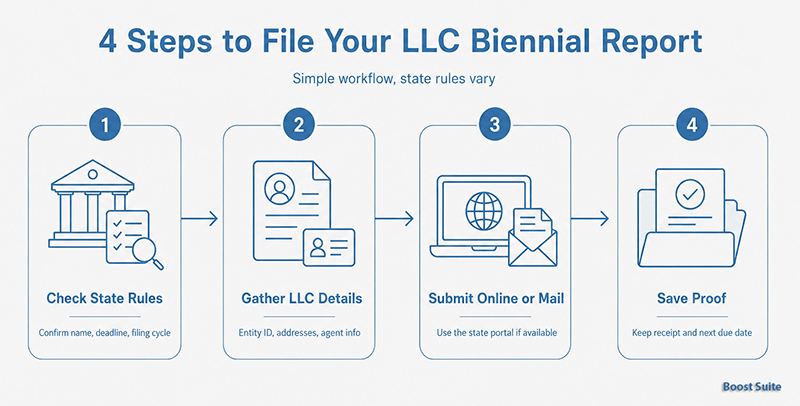
The exact screens differ by state, but the workflow is usually the same: confirm the requirement, prepare your entity details, submit online (or mail, if allowed), then save proof.
Step 1: Confirm Your State Requirement
Start by checking your state’s official business portal (or the official “biennial report” guidance page) so you know the correct filing name, cycle, and due rule.
Here are real examples of how states define the requirement:
- New York uses a biennial statement tied to your LLC’s filing month.
- Iowa requires biennial reports to be delivered during a January 1 to April 1 window (and explains what happens if you miss it).
- Indiana states these reports are filed every 2 years and are due during your anniversary month.
- California requires an LLC Statement of Information within 90 days of registration and biennially thereafter, with online filing available.
We recommend writing the rule in a single line you can reuse every cycle, like: “File in the anniversary month (every 2 years)” or “File Jan 1 to Apr 1 (odd years).”
Step 2: Gather Your LLC Information
Before you open the filing form, collect the items you are most likely to be asked for. This keeps you from abandoning the form halfway through and risking a missed deadline. If the filing or a related compliance step asks for a federal tax ID and you do not have it handy, this guide can help you find your company’s EIN before you start
Here’s a practical checklist (based on what official filing instructions commonly require):
| What to prepare | Why it matters | Official examples |
|---|---|---|
| Entity ID number and exact legal name | Portals often require exact matching to pull your record correctly. | Colorado’s periodic report instructions note ID number and entity name are pre-filled and tied to the state record. |
| Principal office street address | Many states require a physical address (not a PO box) for the principal office. | Colorado explicitly requires a principal office street address and notes it must be a physical address. |
| Registered agent and registered agent address | States use this for official notices and service of process. | Colorado includes registered agent address requirements in its report instructions. |
| Service-of-process or mailing address | Some states specifically use the filing to confirm where legal papers or notices should be sent. | New York explains the biennial statement includes an address where process should be mailed. |
| Manager/member info (where required) | Some biennial-style filings request basic management info. | California’s LLC-12 filing is a Statement of Information for LLCs and is part of the biennial cycle. |
If your state asks for an industry or business activity field, confirm your LLC NAICS code before filing so your state, tax, banking, and licensing records stay consistent.
Step 3: File Online or by Mail
Most states want (or strongly prefer) online filing because it is faster and reduces errors.
- Online filing is common: Iowa’s SOS help center explicitly notes online filing through its system and shows that fees can differ by filing method.
- California supports online filing for LLC Statements of Information: the official LLC-12 instructions reference online filing availability.
- Indiana uses INBiz for business filings and biennial business entity reports.
If your state still allows paper filing, treat it as a “send early” method. Mail time plus processing time can turn an on-time form into a late form.
Step 4: Save Your Confirmation
After submission, save proof in 2 places:
- A PDF “Compliance” folder (receipt, confirmation page, filed copy).
- A note with the next due rule (so you do not need to re-research it).
This matters because proof of filing often comes up during banking, vendor onboarding, financing, or a sale, and states may show a lag between filing and status updates.
File LLC Biennial Reports Confidently with Northwest Registered Agent
Northwest Registered Agent helps LLC owners stay organized with dependable registered agent service, compliance reminders, and secure handling of state documents to make biennial filings easier to manage.
What Happens If You Miss a Biennial Report Deadline?
Missing the deadline is not always catastrophic, but it can quickly become expensive or operationally painful. Before the list below, remember this: states usually escalate consequences in stages, from “past due” to “delinquent” to dissolution or revocation if ignored long enough.
- Late fees, interest, or added charges
Some jurisdictions add a specific late fee to the biennial report. For example, DC lists a biennial report late fee for LLCs. - Loss of good standing or “past due” status
New York states that failure to file is reflected as past due, and any Certificate of Status will show that, which can block certain transactions. - Delinquency notice and a countdown window
Iowa explains that if you miss the filing window, you receive a delinquency notification, and continued non-filing can lead to dissolution (domestic) or revocation (foreign). - Administrative dissolution or revocation risk
Nebraska warns that entities can be administratively dissolved or revoked and may need to reinstate to continue doing business. - Suspension or forfeiture in tax-linked compliance systems
California warns that failure to file required Statements of Information can result in penalties assessed by the Franchise Tax Board and suspension or forfeiture.
How to Fix a Missed Filing
The fastest path is usually “file first, then clean up anything else,” but follow your state’s sequence if it is strict.
- File the overdue report as soon as possible
Many states let you file online even if you are late (and the system will calculate what is due). Iowa’s help guidance makes clear the report can be filed online or by mail, and it explains reinstatement becomes necessary after dissolution/revocation. - Pay all required fees and late charges
Late fees can be separate line items (for example, DC lists a late fee for LLC biennial reports). - If your entity is inactive, complete reinstatement (if required)
- Iowa: the Secretary of State states that if your entity is inactive due to failure to file, you can apply for reinstatement (online or by paper).
- California: the Franchise Tax Board explains that suspended/forfeited entities must file past due returns, pay balances, and submit a revivor request to regain good standing.
- Verify your status after filing
We recommend checking the official entity search the next business day and again after 1 week. Status updates can lag behind your submission confirmation.
If you are not sure where to look, our business entity search guide explains how state lookup tools work
LLC Biennial Report FAQ
Quick answers to the most common biennial report questions, based on official state sources.
What is an LLC biennial report?
An LLC biennial report is a state-required update you file every 2 years to keep your LLC’s public record current and compliant. Some states use different labels (for example, “Biennial Statement” in New York).
Is a biennial report the same as an annual report?
They are similar in purpose (keeping your state record current), but the schedule is different.
Here’s the practical difference:
– Annual report: filed every year.
– Biennial report: filed every 2 years, sometimes on an odd-year cycle.
Which states require LLC biennial reports?
Before you rely on any list, confirm on your state’s official portal because naming varies by state.
Examples of jurisdictions with an LLC biennial-style filing (official sources):
– Alaska (Biennial Report).
– California (Statement of Information for LLCs, due every 2 years).
– Washington, DC (Biennial report required by DC Code).
– Indiana (Business Entity Report filed every 2 years).
– Iowa (LLCs file in odd-numbered years, window Jan 1 to Apr 1).
– Nebraska (LLCs file in odd-numbered years by Apr 1, delinquent June 16).
– New York (Biennial Statement).
How much does an LLC biennial report cost?
Fees vary a lot by state and sometimes by filing method.
Official examples:
– New York: $9 biennial statement fee.
– California: $20 Statement of Information (LLC).
– Indiana: INBiz lists an INBiz fee of $32 for most entity types on its roadmap pages, and the Business Entity Report is filed every other year.
– Iowa: $30 online or $45 by paper.
– Washington, DC: $300 biennial report fee.
We recommend saving your receipt and the next-due rule in one “State Compliance” folder so the next cycle takes minutes.
What happens if I file my biennial report late?
Most states escalate consequences in stages, from “past due” to delinquency and then stronger actions if it stays unresolved.
Common outcomes (official examples):
– Late fee in some jurisdictions (DC lists a $100 late fee).
– Past-due status that can show on certificates (New York).
– Delinquency notice and dissolution or revocation if it remains unfiled (Iowa describes delinquency notification and dissolution or revocation by August).
– Administrative dissolution or revocation risk (Nebraska notes delinquent timing and reporting rules for LLCs).
– Penalties and potential suspension or forfeiture in California for failing to file the required Statement of Information, with penalties handled through FTB after SOS notice.
Can I file my LLC biennial report online?
In many states, yes, and online is often the default.
Official examples:
– New York: online filing via the Department of State e-Statement service.
– Iowa: file online through Fast Track Filing (paper is also available).
– California: “Online Only” for the LLC Statement of Information.
– Indiana: Business Entity Reports are filed through INBiz.
- Alaska Department of Commerce, Community, and Economic Development: LLC Forms by Entity Type and Fees
- California Secretary of State: Statements of Information Filing Tips
- D.C. Law Library: D.C. Code § 29–102.11 Biennial Report
- District of Columbia Department of Licensing and Consumer Protection: Corporations Division Business Registration FAQs
- Indiana Secretary of State: Business Entity Report Information Form PDF
- Iowa Secretary of State Fast Track Filing Resource Center: Missed Biennial Report Deadline
- Nebraska Secretary of State: Annual and Biennial Reporting
- New York Department of State: Fee Schedules
Stay Ahead of LLC Biennial Report Deadlines with Harbor Compliance
Harbor Compliance helps LLC owners manage biennial report filings, registered agent requirements, and ongoing compliance obligations with reliable reminders and secure document handling.