

This guide explains what an Alaska LLC must submit every 2 years to keep its record current, including the deadline, cost, and the basic steps. For most for-profit LLCs, the cutoff is January 2 in the correct even or odd cycle, with a late charge if it is postmarked after February 1.
Alaska LLC Biennial Report Quick Facts
If you just want the essentials, the table below summarizes the cycle, deadline, cost, and where it is handled. Values reflect the official schedule for for-profit LLCs.
| Item | Alaska-formed (domestic) | Registered elsewhere (foreign) | Short description |
|---|---|---|---|
| Filing Frequency | Every 2 years | Every 2 years | The cycle follows the even or odd creation or registration year. |
| Due Date | Jan. 2 (correct cycle) | Jan. 2 (correct cycle) | The window opens about 3 months before the due date. |
| Filing Fee | $100 | $200 | Standard charge if submitted before the late window. |
| Late Fee | Total $137.50 on or after Feb. 2 | Total $247.50 on or after Feb. 2 | Late applies when postmarked after Feb. 1. |
| Filing Agency | Corporations Section (CBPL), DCCED | Corporations Section (CBPL), DCCED | Same office for both categories. |
| Filing Method | Web portal or paper submission (choose 1) | Web portal or paper submission (choose 1) | Do not submit both methods for the same cycle to avoid duplicates. |
Alaska LLC Biennial Report: What It Is
This requirement is essentially a scheduled update that keeps the public record accurate and confirms key details like office and management information. The Corporations Section uses the term “Biennial Report” for this submission and ties it to an even or odd cycle.
Alaska LLCs File a Biennial Report, Not an Annual Report
For most for-profit LLCs, the required submission is on a 2-year cycle, not a yearly one. The official guidance and the LLC statute both describe it as a “biennial report” and place the due date before January 2 in the correct cycle.
Why Some Owners Call It an Alaska LLC Annual Report
People often use “annual report” as a generic label because many other jurisdictions use that wording for their recurring update. In Alaska’s system, the name is different, and the timing is different, so using the official label matters to avoid submitting the wrong thing or planning the wrong cadence.
Who Must File an Alaska LLC Biennial Report
The LLC statute covers both locally formed LLCs and foreign LLCs that are authorized to conduct affairs in Alaska. If you operate outside your formation state, you may need to register as a foreign LLC before you can legally transact business there.
Here is the practical way to think about who is in scope:
- Domestic LLCs (formed under Alaska law) must submit it.
- Foreign LLCs (formed elsewhere but registered to conduct affairs in Alaska) must submit it, too.
The Corporations Section’s FAQ also groups LLCs into the set of entities that follow the January cycle and lists the standard charges.
Domestic vs Foreign Alaska LLC Filing Rules
The deadline logic is the same idea for both, but it anchors to different “start points”:
- For a domestic LLC, the even or odd cycle tracks the year it filed its articles of organization.
- For a foreign LLC, the even or odd cycle tracks the year it registered in Alaska.
In both cases, it is due before January 2 of the correct cycle, and it is considered delinquent if not submitted before February 1 for that cycle.
Alaska Initial Report vs Biennial Report
These are 2 separate updates in the Corporations Section system. One is a one-time startup update due within 6 months (no additional charge for a domestic LLC), while the other repeats every other year on the January 2 schedule, with a late penalty if postmarked after February 1.
Quick comparison:
| What to compare | Initial Report (startup update) | Biennial Report (every-2-years update) |
|---|---|---|
| What it is | One-time update shortly after creation (domestic). | Recurring update for domestic and foreign entities on an even or odd cycle. |
| Timing | Within 6 months of creation (domestic). | Due by January 2 in the correct even or odd cycle (for LLCs). |
| Who uses it | Domestic: yes. Foreign: not applicable. | Domestic and foreign: yes. |
| Cost | Domestic LLC: no additional fee (web submission). | Domestic LLC: $100 (or $137.50 with late). Foreign LLC: $200 (or $247.50 with late). |
| Late trigger | Not described as a “late fee” item the same way; the key risk is non-compliance if missed. | Late penalty applies when postmarked after February 1 (late total applies on or after February 2). |
| How it’s submitted | Web portal submission listed for domestic LLCs. | Web portal or paper option, choose 1 to avoid duplicates. |
How to File an Alaska LLC Biennial Report
Most owners finish this in one session as long as they have the public record open and know what needs updating. The key rule is to use 1 submission path per cycle to avoid duplicate charges.
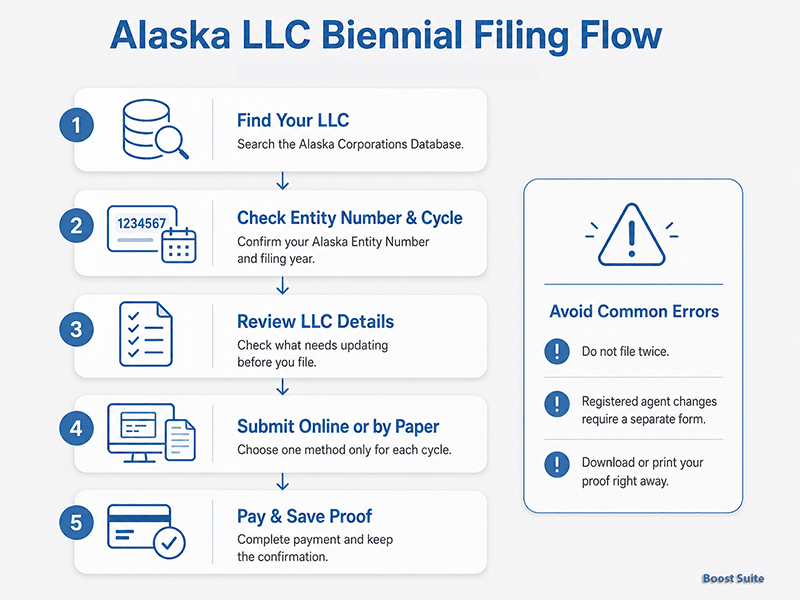
Find Your LLC in the Alaska Corporations Database
Start by opening the Search Corporations Database page and locating your record by name or by your Alaska Entity Number. Open the result so you can see the “Entity Details” screen, since that is where the system shows your due date and status.
If you want the exact clicks and what to look for on the profile, follow our Alaska business entity search walkthrough
Confirm Your Entity Number and Filing Year
On “Entity Details,” confirm 2 things before you start:
- The Alaska Entity Number you will enter into the submission screen.
- The due cycle shown for your record (the reporting window opens 3 months before the due date for this entity type).
If more than one cycle is due, the official instructions say to repeat the submission process for each one that is outstanding.
Review Your LLC Information
Before you submit anything, scan the record and decide what you need to update so you can complete it in one pass.
A few official “rules of thumb” matter here:
- Avoid browser auto-fill if it causes incorrect entries.
- Do not use your browser back or forward buttons during the process.
- For LLCs, officials and ownership details can be updated when the biennial submission is due.
Submit the Biennial Report Online or by Paper Form
Use the biennial start page and enter your Alaska Entity Number. From there, the system lets you choose either to complete it on screen or to print a paper copy.
If you choose paper delivery, the official guidance says to submit via fax or U.S. mail and not by email (for security). Processing time is listed as 10 to 15 business days in most months, with longer delays expected in the October to February period.
If timing matters, compare this with the broader guide to Alaska LLC processing times before choosing paper submission.
Pay the Filing Fee and Save Confirmation
For on-screen submission, payment is by credit card and the filing posts immediately. After payment, you can view, save, or print the record from the database.
For paper delivery, the FAQ notes payment can be by check or credit card payment, with checks payable to the State of Alaska.
Keep Your Alaska LLC Notices Organized with Northwest Registered Agent
Filing your Alaska biennial report is easier when your official notices and state correspondence are handled properly. Northwest Registered Agent gives your Alaska LLC a reliable registered agent address, helps protect your privacy, and keeps important compliance mail from slipping through the cracks.
Alaska LLC Updates, Late Filing, and Compliance Notes
This part covers what changes when you miss the window, and how to keep your public record accurate between cycles using the correct change form. The Corporations Section is clear that not receiving a reminder does not excuse missing required submissions.
What Happens If You File Late
If your submission is postmarked after Feb. 1, the late penalty applies (the higher total starts Feb. 2).
What you should expect in practice:
- Higher total cost for that cycle because the late penalty is added.
- Your record can show a delinquent posture until the cycle is satisfied.
What Happens If You Skip the Biennial Report
Skipping a required cycle can trigger involuntary dissolution (domestic) or revocation of authority to transact business (foreign). Reinstatement typically involves extra charges.
Also, the Corporations Section explicitly notes that not receiving a notice does not remove the obligation to stay current.
How to Update Address Changes Between Reports
Use the Entity: Address Change form when your business physical or mailing address changes and you do not want to wait for the next cycle. This form has $0 cost, is intended for in-between-cycle updates, and the form states web submission is not available for it.
Important nuance the form calls out:
- This form updates only the entity’s business addresses on record. It does not change the appointed agent or the agent’s addresses.
- Separate notification is required for agent and officials address changes.
How to Update Officials or Managers Between Reports
Use the Change of Officials form for LLCs to report changes between cycles in members, managers, and percentage of interest held. It has a $25 nonrefundable charge and the form says it will not be accepted if the biennial record is not current. When ownership or management details change, also review your Alaska LLC operating agreement so your internal records match the public filing.
Two details that prevent rejections:
- Provide a complete list of current officials after the change, because the form treats any omitted prior names as removed.
- Include all members owning 5% or more, and list at least 1 member. If the LLC is manager-managed, list at least 1 manager.
Why Registered Agent Changes Need a Separate Filing
Agent changes are handled through a dedicated Statement of Change process, not through an address-change update and not as a side effect of other filings. The address-change form states you must submit a separate Statement of Change with its required $25 charge if the agent or agent address needs updating. If your current agent is the reason notices are getting missed, it may also be worth taking time to compare registered agent options in Alaska before filing the change.
For domestic LLCs, the domestic Statement of Change form also emphasizes the requirement to continuously maintain an agent and office in the state and notes the filing can be rejected if the signer does not match an official on record or if the biennial record is not current.
We recommend picking the change form by what is changing, not by what is due next.
| What changed | Use this filing | Cost |
|---|---|---|
| Business physical or mailing address | Entity: Address Change (in-between-cycle update) | $0 |
| Members, managers, or ownership percentages | Change of Officials (LLC) | $25 |
| Registered agent or agent address | Statement of Change (separate submission) | $25 |
Alaska LLC Biennial Report FAQ
Here are the most common questions owners ask after reviewing the due date, cost, and update rules. If you’re still in the setup phase, this guide shows how to start an Alaska LLC (and what to prepare early so your filings stay clean later).
Do Alaska LLCs file annual reports?
For most for-profit LLCs, the recurring submission is a biennial update, not a yearly one. Many owners still say “annual” out of habit because other jurisdictions use that label, but the official Alaska schedule is every other year.
How often do Alaska LLCs file biennial reports?
Every 2 years, based on whether the LLC originally formed or registered in an even-numbered or odd-numbered year. The reporting window opens about 3 months before the due date.
What is the Alaska LLC biennial report due date?
For for-profit LLCs on the January cycle, it is due by January 2 in the correct even or odd cycle year. A late penalty applies when the submission is postmarked after February 1 (the higher total applies on or after February 2).
How much does the Alaska LLC biennial report cost?
The official FAQ lists $100 for a domestic LLC and $200 for a foreign LLC when submitted on time, with higher totals after the late threshold.
Does an Alaska LLC need to file an initial report?
Yes, many domestic LLCs have an “Initial Report” step due within 6 months of creation, and the FAQ describes it as a free online submission used to add ownership and or officers.
What are the consequences of failing to file on time?
If you miss the window, you can expect at least 2 practical issues (and sometimes more):
Non-compliance status and potential administrative action, including involuntary dissolution for an LLC and a reinstatement process if that happens.
Late penalty after the February 1 postmark threshold (January-cycle entities).
- Alaska Department of Commerce, Community, and Economic Development: Biennial Reports
- Alaska Department of Commerce, Community, and Economic Development: Biennial Report Online Filing Instructions
- Alaska Department of Commerce, Community, and Economic Development: Initial Report Online Filing Instructions
- Alaska Department of Commerce, Community, and Economic Development: Forms by Entity
- Alaska Department of Commerce, Community, and Economic Development: Statutes and Regulations – Corporations (PDF)
- Alaska Department of Commerce, Community, and Economic Development: Address Change – All Entity Types (PDF)
- Alaska Department of Commerce, Community, and Economic Development: Change of Officials – Limited Liability Company (PDF)
Stay Ready for Alaska Biennial Reports with Harbor Compliance
Alaska LLCs must file a biennial report to keep their state record in good standing. Harbor Compliance provides registered agent service that helps you receive official notices, track compliance deadlines, and keep your Alaska LLC organized between filing years.