

The California LLC annual report doesn’t exist as an official document. As of 2026, every California LLC files a biennial Statement of Information (Form LLC-12) with the Secretary of State, not an annual report. Get the cycle and the $800 tax separation right and the rest is straightforward.
Does California Require a Biennial Report for LLCs?
Yes. Every California LLC and every foreign LLC registered to transact intrastate business in California files a biennial Statement of Information with the Secretary of State’s Business Programs Division. The legal requirement sits in California Corporations Code section 17702.09. Form LLC-12 is the document, and it’s filed once every two years.
Alaska, Indiana, Iowa, Kansas, Nebraska, and New York share the biennial pattern; everywhere else either files annually or doesn’t file at all.
One thing trips owners up almost universally: California corporations file annually under their own statutory provisions, while LLCs file biennially under Corporations Code section 17702.09. The frequency is set by entity type.
I’ve watched plenty of new California LLC owners search for an “annual report” and miss the 90-day initial filing in the process.
Form LLC-12 is due within 90 days of your file-stamped Articles of Organization.
After the first filing, the Statement of Information is due every 2 years.
The Secretary of State sends a reminder before the recurring window, but missing that single notice can still cost your LLC $250.
The same day you receive your file-stamped Articles, set 2 calendar reminders: one for the 90-day initial filing deadline and one for the biennial recurrence.
Which California LLCs Must File the Biennial Statement
Every domestic LLC formed under the California Revised Uniform Limited Liability Company Act files Form LLC-12. Every foreign LLC that registered through Form LLC-5 to transact intrastate business does too. Single-member, multi-member, manager-managed, and member-managed LLCs all sit under the same rule.
Inactive LLCs aren’t exempt. As long as the LLC remains registered with the Secretary of State, the Statement of Information requirement applies, even if no revenue has come in and no bank account has been opened.
California corporations file annually on a different schedule, which doesn’t change anything for LLC owners. If you’re still in formation rather than compliance mode, Boost Suite’s California LLC formation guide covers the Articles of Organization step that precedes the 90-day filing, and the broader California LLC compliance hub tracks the rest of the calendar.
California LLC Biennial Filing Deadline and Cycle
The deadline rule has three parts: the initial 90-day filing, the recurring biennial filing, and the six-month window mechanic. Each one trips owners up for a different reason.
The Initial 90-Day Filing After Formation
Every new California LLC must file its first Statement of Information within 90 days of the date the Secretary of State stamps the Articles of Organization (Form LLC-1). Foreign LLCs have the same 90 days from the date their Application to Register (Form LLC-5) is filed.
The 90-day clock starts on the Date Filed shown by the Secretary of State, not on the date the paperwork was submitted or the formation fee was paid. The $20 fee applies to this initial filing exactly as it does to recurring filings.
The Recurring Biennial Filing Window
After the initial filing, California LLCs file every two years during a six-month filing window. The window opens on the first day of the fifth month before the LLC’s anniversary month and closes on the last day of the anniversary month. That’s the anniversary month plus the five calendar months preceding it.
The cycle is tied to the year of initial registration. Register in an even year and the recurring filings fall in even-numbered years (2026, 2028, 2030). Register in an odd year and they fall in odd-numbered years (2025, 2027, 2029).
| Anniversary month | Filing window opens | Filing window closes |
|---|---|---|
| January | August 1 of previous year | January 31 |
| February | September 1 of previous year | February 28 or 29 |
| March | October 1 of previous year | March 31 |
| April | November 1 of previous year | April 30 |
| May | December 1 of previous year | May 31 |
| June | January 1 | June 30 |
| July | February 1 | July 31 |
| August | March 1 | August 31 |
| September | April 1 | September 30 |
| October | May 1 | October 31 |
| November | June 1 | November 30 |
| December | July 1 | December 31 |
Worked example: an LLC formed March 15, 2026 has a March anniversary month and registered in an even year. Its next biennial Statement opens October 1, 2027 and closes March 31, 2028.
Simplify California Biennial Filings with Bizee Registered Agent Service
Bizee provides reliable California registered agent service with compliance alerts, secure document delivery, and helpful reminders to keep your LLC ready for every Statement of Information deadline.
How to Find Your LLC’s Biennial Filing Window
The fastest way to confirm your filing window is the California business entity search on the Secretary of State’s BizFile Online system. Search by entity name or 12-digit SOS file number, and the public record shows the Date Filed, the anniversary month, and the current entity status.
The Secretary of State sends a reminder notice before the filing window closes. The LLC stays responsible whether or not that reminder notice arrives, so calendar it independently.
Form LLC-12 Filing Fee: $20 in 2026
The 2026 filing fee for the California LLC Statement of Information is $20, the same for domestic and foreign LLCs. If nothing has changed since the last full filing, the LLC files Form LLC-12NC (Statement of No Change) for $20 instead of submitting a fresh LLC-12.
Optional expedite services exist for ad hoc situations: $350 for 24-hour processing, $750 for same-day, and $500 for 4-hour preclearance, each on top of the $20 base. Most owners don’t need these because routine online filings post quickly.
Here’s the thing about the $20: it’s one of the lowest filing fees in the country, but the late penalty is $250. Twelve times the fee. That math is the whole reason this article exists.
How to File the California Statement of Information: Step-by-Step
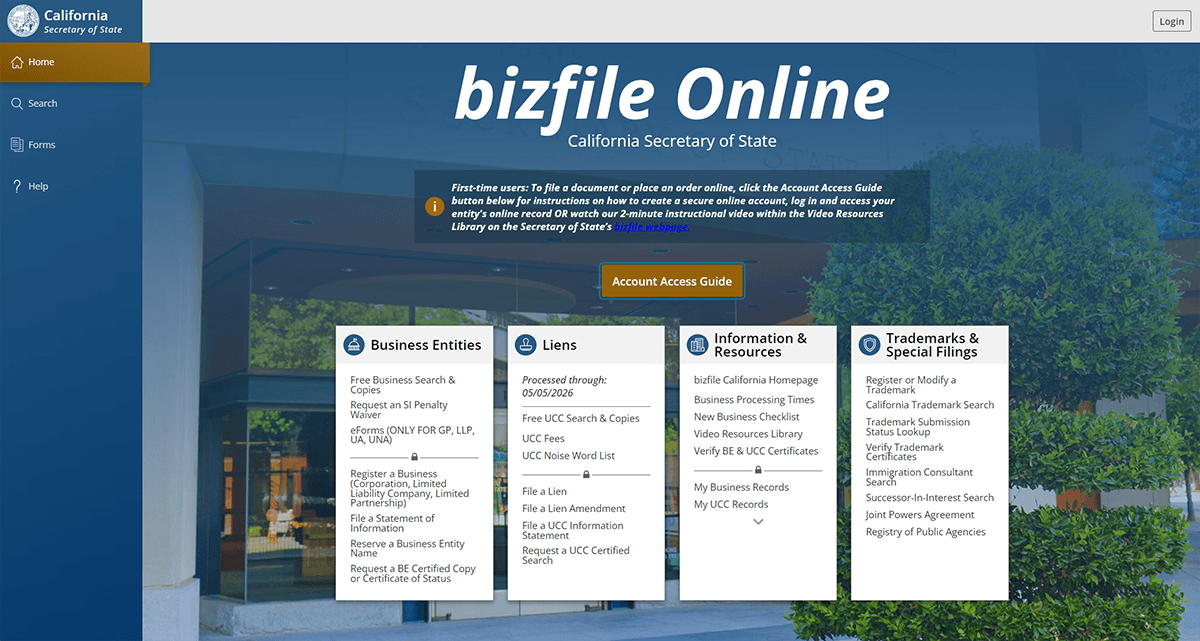
Most California LLCs complete Form LLC-12 online in under 10 minutes once they have the required information in hand. The Secretary of State directs all filings through BizFile Online, the official filing portal at bizfileonline.sos.ca.gov.
9 Steps to File Form LLC-12 Online via BizFile Online
Gather everything you’ll need before you start the form. Here’s the full process:
- Gather your information. You’ll need: SOS file number, entity name, agent for service of process and California street address, principal office address, mailing address, names and addresses of managers and CEO (or members if no managers), general business activity, email for notices, and the labor judgment disclosure answer.
- Open BizFile Online at bizfileonline.sos.ca.gov.

- Sign in or create a free BizFile account. First-time filers register; returning filers sign in with their existing credentials.
- Search for your LLC by entity name or 12-digit SOS file number.
- Select “File Statement of Information” from the list of available filings associated with the entity.
- Complete each required field on Form LLC-12. Manager-managed LLCs list managers and the chief executive officer (if any). Member-managed LLCs list each member.
- Answer the labor judgment disclosure question. This California-specific field asks whether any member or manager has an outstanding final judgment from the Division of Labor Standards Enforcement or a court for wage order or Labor Code violations, with no pending appeal.
- Review the form and pay the $20 filing fee. Credit card and BizFile account balance are both accepted.
- Save your confirmation receipt and verify the filing on California Business Search within a few business days.
File California LLC-12 with Confidence Using Northwest Registered Agent
Northwest Registered Agent gives California LLC owners dependable registered agent support, secure state mail handling, and practical compliance reminders to help Form LLC-12 filings go smoothly.
When to Use Form LLC-12NC (Statement of No Change)
If nothing has changed since the last full Statement, the LLC files Form LLC-12NC instead of a fresh LLC-12. The fee stays $20. One catch: LLC-12NC can’t be used for the initial 90-day filing, and any change to a required field means filing a fresh LLC-12 instead.
Filing Channel and a Word on Misleading Solicitations
California directs LLC Statement of Information filings through BizFile Online as of 2026. The online flow is faster than any alternative and reduces the risk of rejection over a typo.
Worth flagging: private companies send misleading Statement of Information solicitations that look like official notices, often demanding $100 to $300 to “file” on the LLC’s behalf. The Secretary of State maintains a dedicated alert page. If the letter didn’t come from the California Secretary of State directly, treat it as marketing.
Here’s the confusion I get most often: clients pay the $20 Statement of Information and assume they’re done with California for the year. They’re not.
The Statement of Information goes to the California Secretary of State.
The annual LLC tax goes to the Franchise Tax Board on Form FTB 3522.
The day the LLC is formed, I recommend setting 2 separate recurring calendar reminders: one for the Statement of Information and one for the $800 annual LLC tax.
What Information Form LLC-12 Requires
California Corporations Code section 17702.09 lists the required fields for Form LLC-12. Most are routine; a couple are California-specific.
The full list:
- LLC name
- 12-digit California Secretary of State file number
- For foreign LLCs, the name under which the LLC is authorized to transact intrastate business
- For foreign LLCs, the state or jurisdiction of organization
- Name and California street address of the agent for service of process (or the name only, if a 1505 corporate agent is used)
- Street address of the principal office
- Mailing address, if different from the principal office
- Names and complete business or residence addresses of all managers and the chief executive officer (or members, if no managers have been elected)
- Email address for receiving notices, if the LLC opts in
- General type of business representing the LLC’s principal activity
- Labor judgment disclosure
The labor judgment disclosure is unique to California. It asks whether any member or manager has an outstanding final judgment from the Division of Labor Standards Enforcement or a court, with no pending appeal, for violating any wage order or Labor Code provision.
Form LLC-12 doesn’t require a NAICS code or EIN. Tax forms filed with the Franchise Tax Board may ask for different identifiers, but that’s outside the Secretary of State’s filing. Because Form LLC-12 captures the LLC’s current managers, CEO, and members, the biennial filing window is also a natural moment to refresh the California LLC operating agreement so internal governance documents match the public record. If the agent for service of process needs to change, California registered agent options cover standalone agent services and 1505 corporate agents.
Biennial Statement vs the $800 California LLC Tax
The biennial Statement of Information and the $800 annual LLC tax aren’t the same thing, and the two confuse new owners more than any other California compliance question. Form LLC-12 goes to the Secretary of State, costs $20, and is filed every two years. The $800 LLC tax goes to the Franchise Tax Board on Form FTB 3522 every year.
There’s also an estimated LLC fee when California-source income exceeds $250,000 in a tax year, paid on Form FTB 3536. The tiers run $900, $2,500, $6,000, and $11,790 based on income brackets, separate from the $800.
Filing the Statement doesn’t pay the tax. Paying the tax doesn’t file the Statement.
Late Penalties, Delinquency, and Suspension in California
Missing the biennial filing window doesn’t trigger an immediate penalty. California follows a multi-step procedural chain, summarized in the table below.
| Stage | What happens | Trigger or timing | Legal basis |
|---|---|---|---|
| 1. Missed filing | LLC fails to file Form LLC-12 during the window | End of filing window | — |
| 2. Notice of delinquency | SOS mails notice with right to cure | After missed window | Corp. Code § 17713.09 |
| 3. SOS certifies the LLC to the FTB | Secretary of State certifies delinquency to Franchise Tax Board | 60 days after notice | Corp. Code § 17713.09 |
| 4. $250 penalty | FTB assesses the late penalty | After certification | RTC § 19141 |
| 5. Suspension or forfeiture | LLC loses powers, rights, and privileges | Continued nonfiling | Corp. Code § 17713.10 |
| 6. Administrative cancellation | LLC may be canceled | After 60+ months of FTB suspension | Corp. Code § 17713.10.1 |
A suspended LLC loses the right to enforce contracts, defend itself in court, or use its registered entity name. Another business can reserve or begin using the name during the suspension period. Administrative cancellation is the most extreme outcome and only applies after the FTB has held the LLC in suspension for at least 60 continuous months.
How to Revive a Suspended California LLC
The revivor path depends on which agency suspended the LLC and the underlying cause. In general:
- SOS suspension only: File the current Statement of Information through BizFile Online. The Secretary of State typically lifts the suspension once the delinquency is cured.
- FTB suspension only: Resolve past-due returns, taxes, penalties, and interest with the Franchise Tax Board, then submit Form FTB 3557 (Application for Certificate of Revivor) to the Revivor Unit.
- Dual SOS and FTB suspension: File the current Statement of Information first, request the Secretary of State’s Proposed Relief Letter, then submit Form FTB 3557 to the FTB. This is typically the slowest and most expensive scenario.
Total reinstatement costs and processing times vary by the LLC’s tax history, missing filings, and unpaid penalties.
Revivor is rarely just the $250 Statement penalty. I’ve seen California clients owe much more once missed tax years, penalties, and suspension problems start stacking up.
Back-owed California LLC tax payments can apply for every missed year.
Unpaid balances can grow with additional penalties and interest.
The missed Statement of Information penalty can still apply on top of tax-related costs.
Revivor may also require filing an Application for Certificate of Revivor.
During suspension, another business can grab the LLC name. That is why I treat suspension as a business risk, not just a late filing issue.
A $20 Statement of Information filed on time.
Everything that follows after missed filings, unpaid taxes, penalties, interest, revivor paperwork, and name risk.
California LLC Biennial Report Frequently Asked Questions
These are the questions California LLC owners search for most, with answers grounded in the Secretary of State’s official guidance and the Corporations Code.
Is Form LLC-12 the same as a California annual report?
No. California uses the term Statement of Information, not annual report, and LLCs file it every two years. The form number is LLC-12 for the full filing and LLC-12NC if nothing has changed since the last filing.
What year does my California LLC file the biennial Statement of Information?
The cycle matches the year of initial registration. An LLC registered in 2024 (even year) files its biennial Statement in 2026, 2028, 2030, and so on. An LLC registered in 2025 (odd year) files in 2027, 2029, 2031.
What happens if I miss the California Statement of Information deadline?
The Secretary of State sends a notice of delinquency. If the LLC doesn’t file within 60 days of the notice, the SOS certifies the LLC to the FTB, which assesses the $250 penalty. Continued nonfiling can lead to suspension or forfeiture under Corporations Code section 17713.10.
Can I update my registered agent through Form LLC-12?
Yes. The agent for service of process can be updated through the Statement of Information, and the Secretary of State actually requires a new Statement when the agent changes, resigns, or is no longer valid. An LLC can file an interim Statement at any time between regular filing windows for this purpose.
Is the $800 California LLC tax part of the biennial Statement of Information?
No. The $800 annual LLC tax is a separate Franchise Tax Board obligation, paid every year on Form FTB 3522. The Statement of Information is a Secretary of State filing every two years for $20. Different agencies, different deadlines, different forms.
How do I revive a suspended California LLC?
Revival depends on which agency suspended the LLC. File a current Statement of Information for an SOS-only suspension, submit Form FTB 3557 for an FTB-only suspension, or do both with a Proposed Relief Letter for dual suspension. All back taxes, penalties, and interest must be paid before revival.
- California Secretary of State, misleading Statement of Information solicitations alert
- California Secretary of State, Statements of Information Filing Tips
- BizFile Online, California’s official LLC filing portal
- California Corporations Code section 17702.09, biennial filing requirement
- California Corporations Code section 17713.09, delinquency and FTB certification
- California Corporations Code section 17713.10, suspension and forfeiture
- California Revenue and Taxation Code section 19141, $250 late penalty
- California Franchise Tax Board, LLC tax overview
Keep Your California LLC on Track with Harbor Compliance
Harbor Compliance helps California LLC owners manage biennial Statement of Information reminders, state notices, and compliance documents through reliable registered agent support.