

If your LLC was administratively dissolved (or “forfeited”), you can usually reinstate it by fixing the compliance issue that triggered the dissolution and filing a reinstatement request with your state. The exact form name, fees, and time limits vary by state, so your Secretary of State (or equivalent business filing agency) is the source of truth.
To reinstate an LLC, you usually do these 3 things:
- Confirm the exact status and reason for dissolution in the state database.
- Fix the issue (late reports, unpaid fees, registered agent problems).
- File the state’s reinstatement (or “revival”) request and then verify your status returns to “active.”
Understanding Business Reinstatement
Reinstatement is a state action that puts a dissolved or forfeited entity back into active status (often described as “active and in good standing”). Some states issue a “certificate of reinstatement,” while others use an “application for reinstatement,” but the outcome is the same: restoring your entity’s status in the state’s records.
Importance of Keeping Your Business in Good Standing
Good standing is not just a label, it is what prevents small compliance issues from snowballing into forfeiture and a reinstatement project. For example, Kansas explains how missing required reports can move an entity from delinquent to forfeited, and once forfeited you typically need reinstatement plus past-due reports to return to good standing.
Also, timelines can matter. Georgia states you generally must apply for reinstatement within 5 years of administrative dissolution, and it notes the entity name is reserved only during that window (or until reinstated). If you miss the window, another entity may be able to use the name.
Common Reasons for Business Dissolution
Administrative dissolution is often triggered by predictable compliance issues. A common pattern is “missed filings” or “registered agent problems,” and states often spell this out directly. This is different from choosing to close an LLC voluntarily, where the owners usually approve the shutdown and follow a formal dissolution process.
Here are the kinds of triggers states commonly cite:
- Missing required periodic reports (annual reports, biennial reports, or “information reports,” depending on the state).
- Failing to maintain a registered agent or registered office (or equivalent requirement).
Failure to File Annual Reports
Many states use annual reports as the main compliance trigger, but the label varies. Some states call them “information reports” and may require them every other year, yet the impact is similar: missing the report can push the entity into delinquent status and eventually forfeited status.
Many states use annual reports as the main compliance trigger, but the label varies. Some states call them “information reports” and may require them every other year, yet the impact is similar: missing the report can push the entity into delinquent status and eventually forfeited status.
If you need a broader filing overview, our LLC annual report guide explains how due dates, fees, and state requirements usually work.
Steps to Reinstate Your LLC
Reinstatement usually goes faster when you treat it like a checklist: confirm the state’s status details first, then fix the issue, then file the reinstatement, then verify the status update. States often require past-due filings to be submitted along with your reinstatement, so skipping the “fix” step can stall the process.
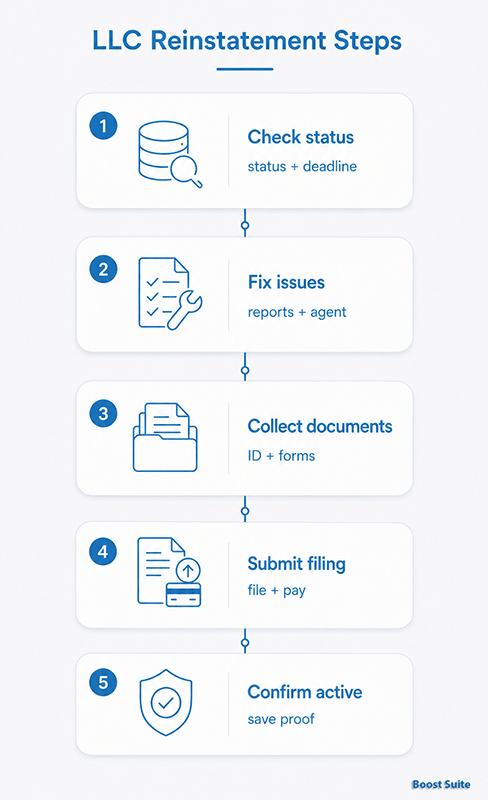
Verify the Status of Your Dissolved Business
Start with the state’s business entity search to confirm what you are dealing with (and avoid filing the wrong form).
Before you do anything else, capture these details from the state record:
- Current status (administratively dissolved, revoked, forfeited, etc.).
- Dissolution/forfeiture date (helps you confirm deadlines).
- The reason or compliance trigger, if the state provides it (missed report, agent issue, etc.).
Bring the LLC Back Into Compliance
This is the part many people underestimate. In practice, “reinstatement” often means you must also file whatever was missed (often one or more periodic reports), so it helps to understand what an LLC annual report includes before you calculate the backlog. You may also need to correct agent or address issues before the state will restore good standing. Kansas is explicit that missing reports must be submitted with the reinstatement form and payment, and Kansas also describes how missing reports lead to delinquent and forfeited status.
We recommend making the compliance fixes first (reports, agent, addresses) so your reinstatement submission is not rejected or delayed for missing prerequisites.
Gather Necessary Documentation
Exact requirements vary by state, but most reinstatement workflows ask for the same inputs.
Typically, you should have:
- Your entity ID or document number from the state record.
- The reinstatement form (or online filing access) for your entity type.
- Any past-due reports required to bring the entity current.
- Your registered agent and office details, plus your principal and mailing address details if the state allows updating them during reinstatement.
File the Reinstatement Application with the State
File using the state’s official process (online or paper), pay required fees, then save proof.
A few real examples of what states may do:
- Florida explains that a reinstatement application returns an administratively dissolved or revoked business to active status, and it notes some online reinstatements can post immediately (depending on timing and payment method).
- Georgia allows reinstatement online or by mail, and it provides a clear 5-year filing window for administratively dissolved domestic entities.
State-Specific Filing Requirements
Rules can differ in ways that matter, so always read the state instructions before you hit submit.
Here are 4 things we always check on the official state page:
- Deadline to reinstate: Some states have a firm window (Georgia: 5 years).
- What you can change on reinstatement: Florida allows updates like registered agent, principal office, and mailing address, but it does not let you change the entity name through the reinstatement filing.
If you are unsure which address to use, compare your LLC business address options before submitting the update. - Name availability checks: Florida notes it may need to check name availability in certain cases before processing.
- Foreign entities vs domestic entities: Georgia notes only domestic entities reinstate, while a foreign entity with revoked authority must re-qualify.
Want help keeping your LLC in good standing?
Reinstatement fixes the immediate problem, but the next step is preventing missed reports, agent issues, and compliance deadlines from happening again. Harbor Compliance can be a good fit if you want help tracking entity requirements, managing registered agent details, and keeping future filings organized.
Financial Considerations for Reinstatement
Reinstatement is usually not a single fee. In many states, you pay a reinstatement fee plus whatever it takes to bring the LLC current (late reports, penalties, and sometimes tax clearance steps). Florida, for example, lists a reinstatement fee for an LLC plus an annual report fee for each report year due.
If you are estimating the ongoing cost after reinstatement, you can also compare LLC annual fees by state so the same compliance issue does not surprise you again next year.
Understanding Potential Fees
Most reinstatement budgets have the same “buckets,” even though the numbers vary by state and entity type.
Here’s a simple way to think about the cost items:
| Cost item | What it usually covers | Official examples |
|---|---|---|
| Reinstatement application fee | The state’s fee to restore status | Georgia lists a $260 reinstatement fee. |
| Past-due report fees | Annual/biennial reports (or “information reports”) you missed | Florida lists an LLC reinstatement fee plus $138.75 for each report year. |
| Penalties and interest | Tax and compliance penalties tied to late filings | Texas requires paying any tax, penalty, and interest due before requesting a reinstatement tax clearance letter. |
| Optional proof documents | Certificate of status/good standing often requested by banks | Florida lets you request a certificate of status during reinstatement; LLC fee is $5 and it is emailed to you. |
| Expedite fees | Faster processing, if the state offers it | Georgia notes expedited processing is available for an additional fee. |
Tax Clearance Requirements
Some states involve the tax agency in reinstatement, and that can add steps, time, and cost.
Common patterns (always confirm on your state’s official pages):
- Tax clearance letter required before SOS reinstatement filing: Texas lists a sequence where you file outstanding reports, pay tax/penalties/interest, request a tax clearance letter, then submit that letter with SOS reinstatement forms and fees.
- Reinstatement portal decides if tax clearance is required: New Jersey’s portal tells you if a tax clearance certificate is required; if it is, you are reinstated after the Division of Taxation issues the certificate.
- Certificate of clearance from the revenue department: Indiana’s reinstatement flow requires attaching a Certificate of Clearance from the Indiana Department of Revenue.
We recommend checking the reinstatement instructions and the state tax agency page before you submit, because “tax clearance” requirements often sit outside the Secretary of State site.
Budgeting for Your Reinstatement
A practical budget comes from your exact backlog. The fastest way is to list what is missing (reports, agent issues, taxes), then attach the required fees to each item.
Before you pay anything, we recommend you identify:
- How many report years you owe (Kansas, for example, requires missing information reports to be submitted with the reinstatement form and payment).
- Whether you need tax clearance (Texas and New Jersey show two different official models).
- Whether you will need proof documents for a bank or vendor (Florida’s certificate of status is optional but commonly useful).
Checking the Status of Your Reinstatement
After you file, your goal is simple: confirm the state posts your LLC back to “active” and keep proof for your records.
How to Track Your Application
Tracking is easiest when you use the same channel the state uses to communicate with filers.
A reliable tracking approach looks like this:
- Save your filing confirmation and any receipt immediately after submission (Florida sends filing confirmations and communications to the email you provide).
- Monitor the state business search for a status change (Kansas points you back to Business Search for key status and forfeiture timing).
- If you requested proof, watch for delivery (Florida’s certificate of status, if requested, is emailed as an attachment).
We recommend taking a screenshot of the state record once it shows “active,” because it is the fastest proof in real-world situations like bank requests.
Understanding Processing Times Across States
Processing times vary a lot, and the fastest path is usually online filing if your state supports it.
A few official examples show how different it can be:
- Georgia: online reinstatements are generally processed within 7 to 10 business days; paper filings are generally processed in 15 business days from receipt.
- Texas: after making payments, the Comptroller tells you to wait 2 to 3 business days before requesting your tax clearance letter.
- New Jersey: if tax clearance is required, reinstatement happens after the Division of Taxation reviews and issues the clearance certificate.
What to Do If Your Reinstatement Is Denied
Most “denials” are fixable because they are usually missing prerequisites, signer problems, or unresolved tax issues.
A clean way to respond:
- Identify the reason (missing reports, wrong signer, tax clearance required, etc.).
- Fix the blocker, then resubmit using the state’s instructions.
- Avoid repeating the same mistake, especially with signer rules.
For example, Georgia is very specific about authorized signers. If the reinstatement application is not signed by an authorized person, it must include a notarized statement, and Georgia warns failure to do so can delay or forfeit the filing.
And if your reinstatement depends on clearing tax issues, Texas requires outstanding reports filed and taxes, penalties, and interest paid before you can request the tax clearance letter needed for reinstatement.
Frequently Asked Questions
LLC reinstatement is mostly a state checklist, but the same questions come up in almost every state. Below are the answers that help you avoid extra fees, delays, and repeat dissolutions.
What Happens After I Reinstate My LLC?
Once the state processes your reinstatement, your LLC’s status should change back to active (or “active and in good standing”) in the state database. In many states, reinstatement also requires paying for missed report years and bringing filings current. For example, Florida’s reinstatement schedule shows an LLC reinstatement fee plus an annual report fee for each report year due. We recommend saving the confirmation and then checking the state business search until you see the updated status (this is often what banks and vendors rely on).
Are There Penalties for Late Reinstatement?
Yes, but what you pay depends on what you missed. In many states, the “penalty” is a mix of late report fees, late filing penalties, and extra years of required reports. Florida is a clear example: its reinstatement page lists fees per report year due, and its annual report page warns about a $400 late fee for many entity types if you file after the deadline. In states with a reinstatement deadline (like Georgia’s 5-year window), waiting too long can also create bigger problems, including name availability issues.
Before you spend money on a late filing, it can help to check whether your LLC name is still available in the state record.
How Long Do I Have to Reinstate My LLC After Dissolution?
It depends on the state. Georgia says an administratively dissolved LLC may apply for reinstatement within 5 years of the dissolution date, and it notes the name is reserved during that period (or until reinstated). Oregon similarly says reinstatement for an administratively dissolved business for less than 5 years can be done online or by paper form. We recommend checking the dissolution date in the state record first, then confirming your state’s exact deadline before you spend money on filings.
Do I Need a New EIN After Reinstating My LLC?
Reinstatement alone does not automatically mean you need a new EIN. The IRS says you generally need a new EIN when you change your entity’s ownership or structure, and you do not need a new EIN just to change a business name or address. Practically, if your state reinstates the same LLC (not a brand-new entity), many businesses continue using the existing EIN. If your reinstatement window has passed and you must form a new entity instead, that is when EIN questions become more likely, and you may need to apply for a new EIN for the replacement business.
How Can I Avoid Future Dissolutions?
Most administrative dissolutions come from preventable compliance misses. Kansas, for example, explains that forfeited businesses must file reinstatement forms and past-due information reports to return to good standing, which is a strong hint that staying current avoids the whole reinstatement cycle.
We recommend building a simple “good standing routine”:
– Put annual or biennial report deadlines on a calendar and file early.
– Keep a registered agent and current addresses on record.
– Save receipts and confirmations for every filing so you can prove compliance fast if questions come up.
- U.S. Small Business Administration (SBA): Register Your Business
- U.S. Small Business Administration (SBA): Stay Legally Compliant
- Electronic Code of Federal Regulations (eCFR): Federal Business Tax Regulations
- Georgia Secretary of State – Business Division: Reinstatement FAQ
- Texas Comptroller of Public Accounts: Tax Clearance Letter for Reinstatement
- Florida Department of State – Division of Corporations: Reinstatement Filing
- Florida Department of State – Division of Corporations: Reinstatement Filing Instructions
Get Your Dissolved LLC Back on Track with Northwest
Northwest helps business owners stay compliant with reliable registered agent service, state filing support, and reminders that can help prevent future administrative dissolution.