

Searching for Indiana LLC annual report rules? Indiana doesn’t use that term. Every LLC registered in Indiana files a Business Entity Report once every two years through INBiz, the state’s online portal. As of 2026, here’s exactly what the filing covers, what it costs, and when yours is due.
Does Indiana Require an LLC Annual Report?
No. Indiana does not require an LLC annual report. Indiana LLCs file a Business Entity Report every two years instead.
Indiana’s Uniform Business Organizations Code sets out a biennial filing requirement for every domestic LLC and every foreign LLC registered to do business in Indiana. The governing statute is Indiana Code IC 23-0.5-2-13, found in Title 23 of the Indiana Code on the Indiana General Assembly website. The statute calls this a “biennial report,” while the Indiana Secretary of State’s Business Services Division titles the form Business Entity Report on State Form 48725. Same document. Different naming.
That naming gap is why most searches default to “Indiana LLC annual report.” The filing isn’t annual. It’s biennial, meaning once every two calendar years, by the end of the LLC’s anniversary month.
If you haven’t formed your Indiana LLC yet, our Indiana LLC formation guide walks through the Articles of Organization process first, which is where your filing anniversary month gets locked in.
Which Indiana LLCs Must File a Business Entity Report (and How Often)
Most Indiana domestic LLCs and foreign LLCs registered to do business in Indiana file the Business Entity Report with the Secretary of State. The cadence is biennial under IC 23-0.5-2-13: once every two calendar years, by the end of the entity’s anniversary month, on a schedule tied to its formation month or foreign registration month. Specialized entities, including insurance corporations and financial institutions, may have separate agency instructions and should follow those.
Indiana doesn’t require an initial report after formation. The first Business Entity Report comes due by the end of your anniversary month, two years after the LLC was created or registered in Indiana. Single-member LLCs file the same form as multi-member LLCs, and the rule applies regardless of whether you’ve elected S-corp or C-corp tax treatment.
How to Calculate Your Indiana Business Entity Report Filing Year
Indiana doesn’t use one statewide odd-year or even-year cycle. Your filing year is tied to the year your LLC was formed in Indiana or first registered as a foreign entity. Formation year parity controls everything. An even-year LLC files in even years. An odd-year LLC files in odd years.
Even-Year vs. Odd-Year Filing Cycles for Indiana LLCs
The short version: parity matters more than any specific year. Once you know whether your LLC’s formation year is even or odd, the two-year cadence repeats forever from your anniversary month.
| LLC formation event | First Business Entity Report due | Subsequent reports |
|---|---|---|
| Formed March 15, 2024 | March 2026 | March 2028, 2030, 2032 |
| Formed November 2, 2025 | November 2027 | November 2029, 2031 |
| Formed January 10, 2026 | January 2028 | January 2030, 2032 |
| Foreign LLC registered July 2024 | July 2026 | July 2028, 2030 |
How to Find Your Anniversary Month via the Indiana Business Database
The fastest way to confirm your filing window is the Indiana Business Database Search maintained by the Indiana Secretary of State. Type in your LLC name, pull up the entity record, and check the “creation date.” The month listed is your anniversary month. Our Indiana LLC search guide walks through the database step-by-step if you’ve never used it.
If you’re still in formation and want a realistic sense of how soon that creation date hits your calendar, our Indiana LLC processing time guide breaks down current Secretary of State turnaround. Once you have the formation date locked in, set a recurring two-year calendar event so you never have to look it up again.
Indiana Business Entity Report Filing Fee (2026)
As of 2026, INBiz lists a $32 online filing fee for for-profit Business Entity Reports and adds a processing fee at checkout. Paper filing costs $50 using State Form 48725. The Business Entity Report fee stays identical for domestic LLCs and foreign LLCs registered in Indiana, and the form itself doesn’t change either.
The processing fee added at checkout is calculated as the greater of $1 or 2.15% of the transaction. Worth flagging: some search results still show a $30 Business Entity Report fee. That’s outdated. Always confirm the current fee on the INBiz portal fee calculator before submitting.
How to File the Indiana Business Entity Report Step-by-Step
Most Indiana LLCs complete the Business Entity Report online in under 10 minutes once they have the entity’s control number and registered agent details ready. Paper filing is available, but it’s slower and $18 more expensive than online.
Filing Online Through INBiz
Start at inbiz.in.gov, the official Indiana Secretary of State business filing portal. From the homepage, select “Business Filings,” then “Business Entity Report” (or “File Entity Report” depending on the entry path). If you don’t already have an INBiz account, you’ll register with an email and a password before continuing.

Once logged in, search for your LLC by name or by Indiana entity control number. Confirm the entity match. Then review and update each field the portal surfaces: principal office address, registered agent name and Indiana street address, plus any other fields tied to your entity type. If your registered agent has changed since your last filing, INBiz folds that change into the same submission automatically under IC 23-0.5-4-7.
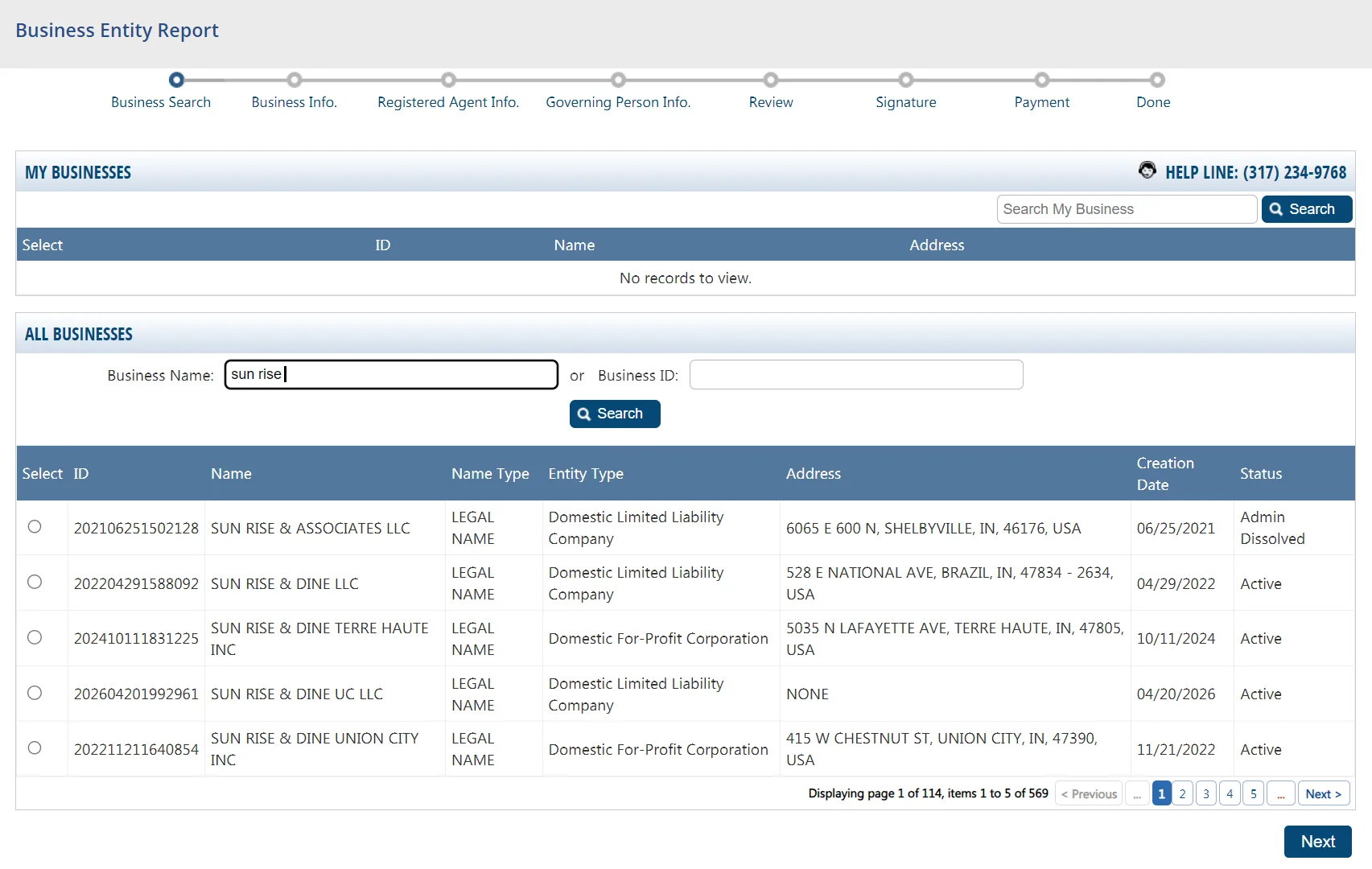
Pay the $32 fee plus the small processing fee at checkout. Most LLCs receive filing confirmation immediately. Save the confirmation PDF locally; the state doesn’t mail a paper copy and won’t resend it if you lose it.
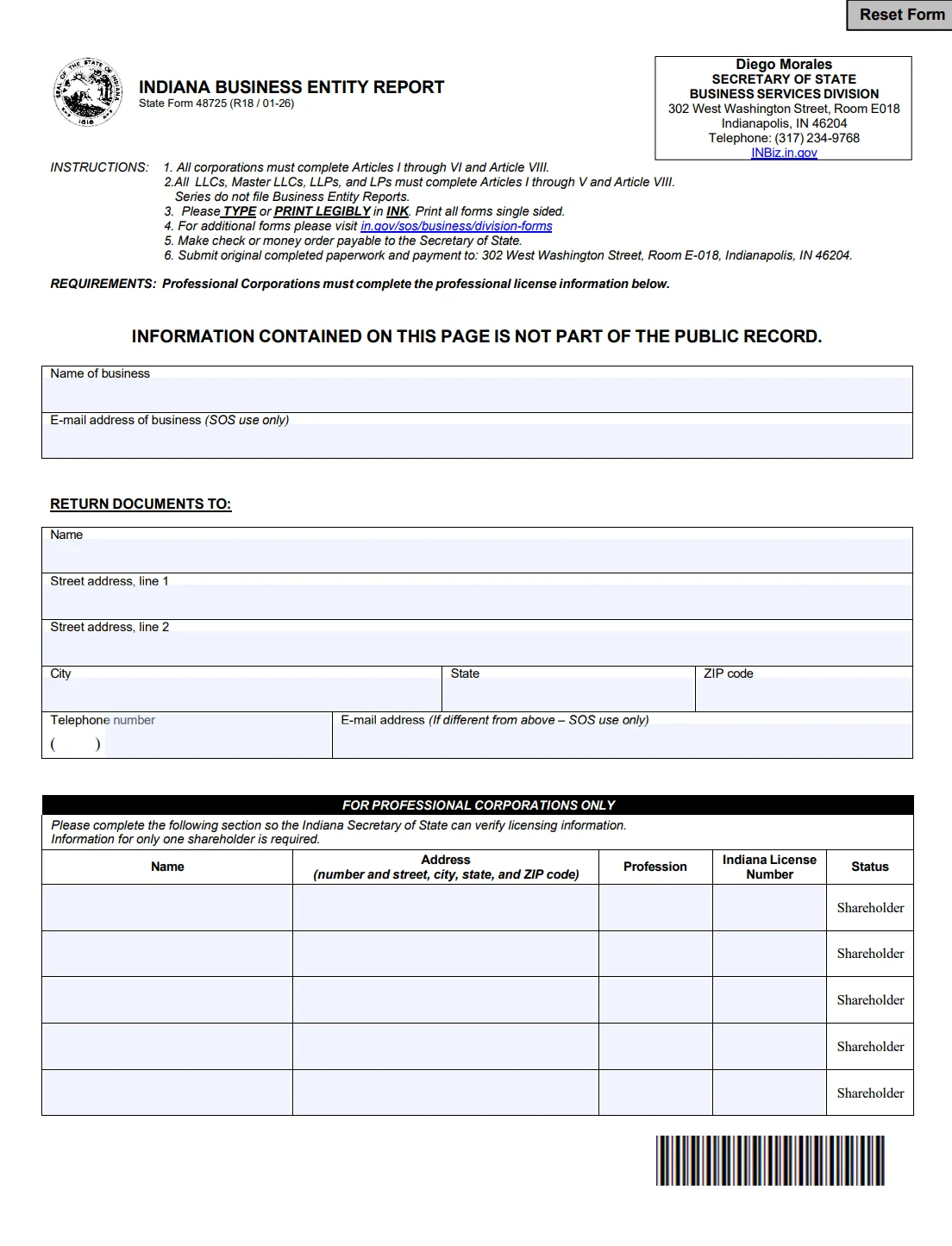
Filing by Paper Using State Form 48725
Download State Form 48725 from the Indiana Secretary of State Business Forms page. Complete it by hand or by typing into the PDF, then mail it with a check or money order for $50 made payable to “Secretary of State.” Cash isn’t accepted.
302 W. Washington Street, Room E-018
Indianapolis, IN 46204
Paper filing is slower than online filing and more prone to rejection; check current Secretary of State guidance before mailing. If a paper filing is rejected for incomplete information, IC 23-0.5-2-13 gives you a 30-day correction window. Deliver a corrected report within that window and it’s still treated as timely.
Keep your Indiana Registered Agent details ready with Northwest
Northwest helps Indiana LLC owners maintain a reliable registered agent address, receive state documents, and keep important compliance information organized before report deadlines arrive.
What Information You’ll Need Before You File
A short prep session before you log into INBiz keeps the filing under 10 minutes. Indiana’s Business Entity Report fields mostly mirror your formation documents, so most of the information is already sitting in your Articles of Organization.
Have these on hand before you start:
- LLC legal name as registered with the Indiana Secretary of State
- Indiana entity control number (visible in your INBiz dashboard or the Indiana Business Database)
- Principal office street address (and mailing address if different)
- Registered agent name and Indiana street address (a dedicated Indiana registered agent service can be substituted here if you’ve switched providers)
- Jurisdiction of formation, for foreign LLCs only
- Signer’s name, title, and the date
Member or manager information is not listed as a standard LLC field in IC 23-0.5-2-13, though INBiz may request additional information depending on the current filing flow. NAICS code and EIN are not listed in IC 23-0.5-2-13 for the standard LLC biennial report either. Check the current INBiz prompt before filing.
What Happens If You Miss the Indiana Business Entity Report Deadline
Indiana doesn’t charge a separate monetary late fee for missing the Business Entity Report deadline, but that’s not the same as no penalty. The real consequence is enforcement: administrative dissolution for domestic LLCs, revocation of authority for foreign LLCs. Both kick in 60 days after the due date, both come with a written notice and a 60-day cure window before they become final.
The table below summarizes the Indiana statutory framework:
| LLC type | Enforcement action | Statutory trigger | Cure window |
|---|---|---|---|
| Domestic Indiana LLC | Administrative dissolution | 60 days past due date (IC 23-0.5-6-1) | 60 days after written notice (IC 23-0.5-6-2) |
| Foreign LLC in Indiana | Revocation of authority | 60 days past due date (IC 23-0.5-5-11) | 60 days after written notice |
After administrative dissolution, the LLC continues only for limited purposes such as applying for reinstatement or winding up its affairs. Do not rely on a dissolved LLC to conduct normal business until reinstatement is completed. Foreign LLCs whose authority has been revoked lose their right to transact business in Indiana and may face exposure for activities conducted during the revoked period.
How to Reinstate an Administratively Dissolved Indiana LLC
Reinstatement in Indiana isn’t just paying the missed report fee. This is where it gets tricky: you’ll need a Certificate of Clearance from the Indiana Department of Revenue (request it with the AD-19 Affidavit), an Application for Reinstatement on State Form 4160, and an updated Business Entity Report on State Form 48725 covering all owed years. The Secretary of State charges a $30 reinstatement fee on top of any back-owed Business Entity Report fees. Foreign LLCs must also attach a current Certificate of Existence from the home state.
Under HB 1593 changes effective January 1, 2026, domestic entities dissolved for more than five years must reinstate by paper and include a statement explaining the reason for reinstatement and intended future activities. If the filer is not listed as a governing person, a notarized affidavit from a governing person or attorney is required.
2026 Updates: HB 1593 and HB 1666 Filing Changes
Two laws passed in 2025 took effect January 1, 2026 and changed parts of how Indiana handles business entity reporting. Most LLC owners aren’t affected day-to-day, but two changes are worth flagging if you delegate filings or operate in regulated industries. The Indiana Secretary of State maintains an official HB 1593 and HB 1666 filing changes page with the current guidance.
Under HB 1593, if a person submits a Business Entity Report on behalf of another person, the submitter must take reasonable steps to verify the identity of the person authorizing the filing. Identification documents should not be uploaded with the filing, but the verification method or information must be provided to the Secretary of State upon request. This rule applies to formation services, registered agents, attorneys, and any compliance vendor filing for clients.
Under HB 1666, codified at IC 23-0.5-2-14, covered health care entities doing business in Indiana may need to report ownership information as part of the Business Entity Report. Reportable ownership may include persons or entities with at least 5 percent ownership, any practitioner ownership interest, controlling interest, or private-equity-partner interest.
Required information may include names of persons or entities with reportable ownership or control, business addresses, business websites if applicable, applicable identifiers such as NPI, TIN, EIN, CCN, NAIC or insurance-license identifiers, ownership stake, and Medicaid-provider status. The report may not include any individual’s Social Security number. Ordinary non-health-care LLCs aren’t subject to these fields.
Separate from the SOS Business Entity Report rules, insurers, third-party administrators, and pharmacy benefit managers may have Indiana Department of Insurance ownership-reporting obligations under Public Law 239-2025. Those are a different regime from the SOS Business Entity Report and follow IDOI guidance.
Indiana Business Entity Report: Common Questions Answered
These are the questions that come up most often around the Indiana LLC Business Entity Report, drawn from People Also Ask data and Indiana Secretary of State support topics. The answers below assume the 2026 fee schedule and IC 23-0.5-2-13 in its post-January 2026 form.
Is the Business Entity Report the same as an Indiana LLC annual report?
No. Indiana doesn’t have an LLC annual report. The Business Entity Report is the official filing under IC 23-0.5-2-13, and it’s biennial, which means it’s filed once every two years. Search engines just default to “annual report” as a generic placeholder.
When is my Indiana Business Entity Report due if my LLC was formed in an even year?
Even-year LLCs file in even years, by the end of their anniversary month. If your Indiana LLC was formed in March 2024, you’ll file by the end of March 2026, March 2028, and March 2030.
What happens if I miss the Indiana Business Entity Report deadline?
Indiana doesn’t impose a separate monetary late fee, but the Secretary of State can begin administrative dissolution if the report isn’t filed within 60 days after the due date. You’ll receive a written notice and a 60-day cure window before dissolution becomes final.
Can I file the Indiana Business Entity Report early?
Yes. IC 23-0.5-2-13 lets the Secretary of State accept the report up to 90 days before your anniversary month. Filing 30 to 60 days early is the safest practice and doesn’t cost anything extra.
Does Indiana charge a separate late fee for the Business Entity Report?
No separate monetary late fee shows up in the Indiana Secretary of State fee schedule. The real financial cost shows up at reinstatement: a $30 reinstatement fee plus all back-owed report fees, plus the time cost of getting a Certificate of Clearance.
Can I change my registered agent on the Business Entity Report?
Yes. If the registered agent information on your Business Entity Report differs from state records, IC 23-0.5-4-7 treats the difference as a Statement of Change. You can also file Indiana State Form 56367 separately.
Do foreign LLCs registered in Indiana file the Business Entity Report?
Yes. Foreign LLCs with authority to do business in Indiana file the same Business Entity Report as domestic LLCs. The filing month is tied to the date Indiana granted authority, not the home-state formation date.
Does Indiana require an initial report after LLC formation?
No. Your first Business Entity Report comes due by the end of your anniversary month, two years after the LLC’s formation or foreign registration date. A solid Indiana LLC operating agreement is the next compliance step most owners should tackle in year one.
- Indiana Business Database Search
- INBiz Business Entity Reports portal
- Indiana Secretary of State Business Forms
- Indiana Code Title 23 (Indiana General Assembly)
- Indiana Secretary of State Reinstatement Instructions (PDF)
- Indiana Secretary of State Reinstatement Information
- Indiana SOS HB 1593 and HB 1666 Filing Process Changes
- Indiana Department of Revenue
Stay compliant with your Indiana LLC using Harbor Compliance
Harbor Compliance helps Indiana LLC owners manage state deadlines, maintain registered agent coverage, and handle important business filings with confidence.