

Forming an LLC creates a legal business entity, but it does not automatically give you permission to operate. Many LLCs still need business licenses, permits, tax registrations, or professional approvals before they can legally open, sell, hire, or provide regulated services. Requirements depend on what you do, where you operate, and your industry.
LLC licenses and permits at a glance
What to check before you open, sell, hire, or expand
Does an LLC Need a Business License?
Often, yes, but it depends. An LLC is your legal structure, while licenses and permits are approvals to do specific things in specific places.
Here’s the practical way to think about it:
- An LLC is a legal business structure. It creates a registered entity, usually at the state level.
- A license or permit is permission to conduct an activity. This can come from a city, county, state, federal agency, or an industry board.
- Some LLCs need several approvals, others need very few. A home-based consulting LLC may need only a local registration, while food, childcare, construction, alcohol, transportation, and other regulated industries often have more steps.
- Requirements follow where you operate and what you do. If you change location, add employees, or start selling regulated goods, your licensing checklist can change.
What Is the Difference Between a License and a Permit?
The names are not perfectly consistent across every state and city, but the distinction below is a useful rule of thumb for most LLCs.
Business License
A business license usually means a general authorization to operate in a specific jurisdiction, such as a city, county, or state. In many places, it functions like a local business registration or tax certificate that says you are allowed to do business there.
For a broader comparison between entity formation and operating permission, our LLC vs. business license explainer can help separate the legal structure from the approvals you may still need.
Business Permit
A permit is usually tied to a specific activity, condition, or safety requirement. Examples include permits for building renovations, signage, health and sanitation, occupancy, home-based business use, or handling regulated products.
Professional License
A professional license is required when the service itself is regulated and the person (or the business) must be licensed before offering it. This is common in fields like healthcare, legal services, accounting, real estate, contracting trades, and cosmetology. These licenses are typically managed by state licensing boards or similar agencies.
Form Your LLC with ZenBusiness Before Applying for Licenses
ZenBusiness helps you form your LLC and set up a strong business foundation, so you can move forward with local licenses, permits, and professional requirements more confidently.
Common Types of LLC Licenses and Permits
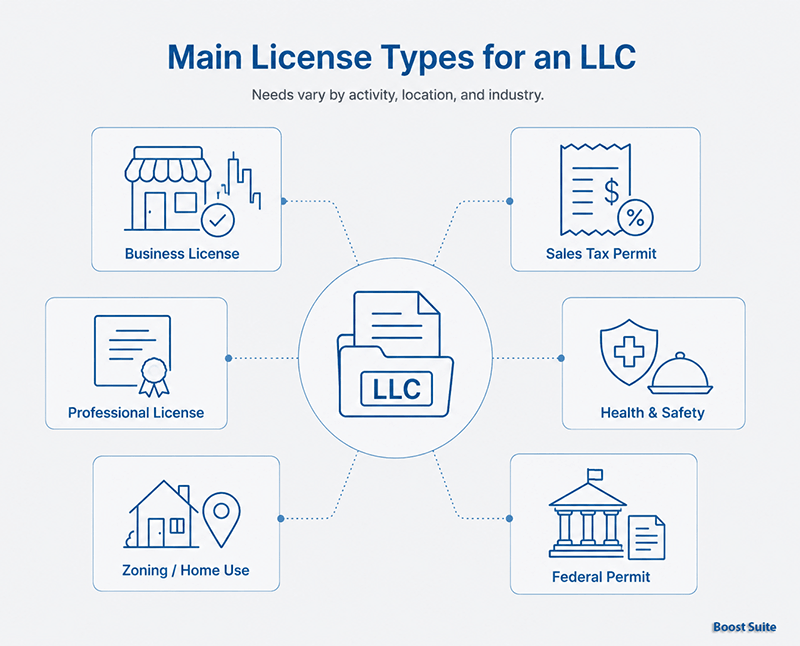
Most LLCs deal with a mix of general operating approvals (city or county), tax registrations (state), and industry-specific permits (state or federal). The exact combination depends on what your LLC does and where it operates.
General Business License
A general business license (sometimes called a business tax certificate) is commonly issued by a city, county, or sometimes a state. It is often the baseline “permission to operate” in that jurisdiction, even if your LLC is already formed.
In practice, this is most common when you:
- operate from a physical location (office, shop, warehouse), or
- provide services locally (on-site work), or
- run a home-based business with local rules.
Sales Tax Permit or Seller’s Permit
If your LLC sells taxable goods or taxable services, you may need to register with the state before you collect sales tax. The registration name varies by state (sales tax permit, seller’s permit, sales and use tax permit), but the idea is the same: it authorizes you to collect and remit sales tax when required.
This can also matter for small marketplace sellers, so an Etsy shop owner should review our Etsy business license guide before assuming an online storefront is exempt from local or state requirements.
A quick rule of thumb: if you plan to charge sales tax on invoices or checkout, check this before your first sale.
Professional or Occupational License
A professional license applies when the service itself is regulated and the person (or business) must be licensed before offering it. Common examples include healthcare, accounting, real estate, legal services, contracting trades, and cosmetology.
If your industry has a licensing board, treat “licensed before you advertise or accept clients” as the default expectation.
Construction is a good example because contractor licenses, trade-specific certifications, safety rules, zoning, and project approvals can all overlap, so our guide on how to start a construction business is a useful next step for readers in that industry.
Health, Safety, or Food Permits
If your LLC operates in a space that impacts public health or safety, you may need permits tied to inspections and ongoing compliance.
This commonly shows up for:
- restaurants and food trucks (read our restaurant startup guide and food truck startup guide)
- childcare and similar facilities
- salons and personal care services
- health-related services
- businesses that require occupancy, fire, or sanitation checks
Zoning or Home-Based Business Permits
Zoning and land-use rules can determine whether you can legally operate at a specific address. This matters for storefronts, warehouses, and offices, but it also applies to many home-based businesses (traffic, signage, employees on-site, inventory storage, customer visits).
If you are signing a lease or planning renovations, zoning is one of the first checks to do.
Federal Licenses or Permits
Keep this on your radar if your LLC touches a federally regulated activity. The SBA lists common examples such as alcoholic beverages (TTB plus state/local control), aviation (FAA), firearms, ammunition, and explosives (ATF), radio/television broadcasting (FCC), and certain transportation activities.
Form Your LLC After Checking License Requirements with Northwest
Once you know which licenses and permits your business may need, Northwest can help you form your LLC, set up your registered agent, and keep your business foundation organized.
How to Find Out Which Licenses and Permits Your LLC Needs
There is no single universal list. The fastest approach is to check requirements in layers: state, local, then industry regulators, and then re-check when your operations change.
Check State Requirements
Start with your state’s business filing agency and any relevant tax or licensing boards. The SBA specifically recommends using your Secretary of State website as a starting point because requirements vary by state and industry.
Check City and County Rules
Local requirements are often separate from state rules. Many businesses need a city or county license, plus permits tied to zoning, signage, occupancy, or inspections. Plan to check the city and county where the LLC is physically operating, not just where the LLC was formed.
Check Industry-Specific Agencies
If your LLC operates in a regulated space, a dedicated regulator may control approvals (for example: alcohol via TTB plus state/local boards, broadcasting via the FCC).
Check Before Selling, Hiring, or Opening a Location
Your licensing list can change the moment your operations change. The SBA highlights that the licenses and permits you need depend on your business activities and location, and that many permits also have renewal cycles.
Common “change points” to re-check:
- starting to sell taxable products or services
- hiring employees
- opening a storefront, kitchen, clinic, or warehouse
- moving addresses or adding a second location
- expanding into another city, county, or state
When I review licensing requirements for an LLC, I do not start by searching for “LLC license” only. That usually gives incomplete results because licenses are tied to activity, location, and industry, not just the entity type.
I define the activity first: selling products, serving food, offering professional services, hiring employees, or operating from a physical address.
I check the location second: state requirements, then city and county rules for the exact business address.
I confirm the regulator last: tax department, local licensing office, health department, zoning office, or professional licensing board.
When Should an LLC Apply for Licenses and Permits?
Timing is mostly about avoiding “we’re ready to open, but we are not allowed to operate yet.” Some approvals are instant, while others depend on inspections or third-party signoffs, so it helps to map requirements to business milestones.
Here’s a practical timing table you can follow:
| Business milestone | What to do | Why it matters |
|---|---|---|
| Before opening to the public | Confirm your local business license and any occupancy, health, or safety approvals | Many cities and counties treat this as a baseline requirement to operate locally |
| Before selling taxable products or services | Register with the state tax agency if sales tax collection applies | In many states, you must register before collecting sales tax |
| Before signing certain commercial leases | Check zoning, occupancy rules, and whether permits are needed for buildouts or signage | Leasing a space that cannot legally be used for your activity can create delays and extra costs |
| Before hiring employees (if registrations are required) | Confirm employer-related registrations and any local business requirements tied to payroll | Requirements can change once you hire |
| Before offering regulated professional services | Verify professional or occupational licensing rules | Some industries require licensing before you advertise or accept clients |
| Before expanding to another city, county, or state | Re-check licenses for the new jurisdiction | Permits and fees vary by location, and local rules are often separate |
We recommend confirming licenses and permits before you commit to a grand opening, sign a long lease, or start taking payments, because fees and requirements can vary by activity and location, and some approvals are not instant.
How Much Do LLC Licenses and Permits Cost?
There is no single national price. Costs vary based on your business activity, your location, and the agency issuing the license or permit. If you are budgeting before launch, compare this section with our state-by-state business license cost breakdown, because local and industry-specific fees can change the total quickly.
Here are the most common cost drivers:
- License type and industry: regulated industries often add inspections, testing, or higher fees.
- Jurisdiction: you may pay separate fees at the state level and at the city or county level.
- Ongoing renewals: many licenses have recurring renewal fees.
- Inspections and compliance steps: some permits are tied to fire, health, building, or occupancy approvals, which can add extra costs.
Form Your LLC with Bizee Before You Open for Business
Bizee helps you set up your LLC early, so you can move on to licenses, permits, tax registrations, and other requirements before taking payments or opening your doors.
Do LLC Licenses and Permits Need to Be Renewed?
Often, yes. Many licenses and permits expire after a set period, and renewal schedules vary. Missing a renewal can lead to penalties, suspension, or a forced pause in operations. Keep these deadlines separate from your LLC annual report, because an annual report usually updates your state business record, while a license or permit renewal keeps a specific operating approval active.
A simple way to stay on top of it:
- Track renewal dates separately from annual reports and tax deadlines (they are different obligations).
Licensing renewals usually come from state, city, county, or industry agencies, while federal tax filing depends on how your LLC is taxed, which we explain further in our guide on how to file business taxes as an LLC. - Store proof of approval (PDFs, certificates, account logins, receipt numbers).
- Re-check after changes like moving addresses, adding new services, or opening a new location, because requirements can change by jurisdiction.
What Happens If an LLC Operates Without the Required License?
Operating without the right license or permit can create fast, expensive problems, especially when you are dealing with local business licensing, inspections, or regulated work. The SBA emphasizes that license and permit requirements vary by activity and location, which is why it is important to confirm what applies before operating.
Here are common real-world outcomes:
- Fines or penalties: Many cities treat unlicensed operation as a citable violation and may assess penalties until you comply.
- Forced closure or suspension: Some jurisdictions can suspend, revoke, or shut down licensed activity until the issue is fixed.
- Delayed approvals: If you apply after you have started operating, you may trigger extra reviews, inspections, or paperwork, which can slow everything down.
- Loss of professional license eligibility: In regulated fields, operating first and licensing later can jeopardize approvals or create disciplinary risk (this is very profession-specific).
- Business friction: You may run into problems with inspections, vendor onboarding, contract requirements, insurance, or lease compliance if you cannot show proof of licensing.
- Possible tax or local compliance issues: For example, if sales tax registration is required and you collect tax without being properly registered, it can create reporting and compliance issues.
I treat missing licenses as an operational risk, not just a paperwork issue. In practice, the bigger problem is often not the first fine. It is the chain reaction that follows when a business cannot prove it is authorized to operate.
Before taking payments
I check whether sales tax registration, local licensing, or industry approval is required.
Before signing a lease
I confirm zoning, occupancy, signage, and inspection requirements for the exact address.
Before offering services
I verify whether the owner, employee, or business entity needs a professional or occupational license.
LLC Licenses and Permits Checklist
If you want a simple workflow you can reuse, use this checklist. It is designed to be quick to scan and easy to turn into an internal SOP. (It follows the same structure as your outline.)
LLC licenses and permits checklist
-
Confirm your LLC’s business activities (what you sell, what you do, where you operate).
-
Check state requirements (state licensing portals, tax department, licensing boards).
-
Check city and county requirements (local business license plus zoning, occupancy, signage, inspections).
-
Review industry-specific rules (especially regulated activities and professional services).
-
Register for sales tax if required before you collect tax from customers.
-
Confirm zoning for your address (home-based, retail, warehouse, office, childcare, food).
-
Apply before operating, and schedule any inspections early if your industry needs them.
-
Save copies of approvals (PDFs, certificates, account logins, receipt numbers).
-
Track renewal deadlines separately from annual reports and tax deadlines.
-
Update licenses when things change (new location, new services, ownership changes, expansion into a new jurisdiction).
FAQs About LLC Licenses and Permits
Licensing rules are not one-size-fits-all. They depend on your business activity, location, and which agencies regulate what you do.
Does an LLC need a business license?
Often, yes. Forming an LLC creates the legal entity, but you may still need separate licenses or permits to operate, especially at the city or county level, and for regulated activities.
What licenses do I need for my LLC?
There is no single universal list. The fastest way is to build your checklist in layers:
– State: business licensing portals, tax department registrations, and licensing boards
– Local (city and county): general business license, zoning, occupancy, signage, health, fire, and other local permits
– Industry regulators: rules for your specific field (professional services, food, transportation, alcohol, and more)
This “layered check” approach is exactly what the SBA recommends because requirements vary by activity and location.
Do I need a business license before forming an LLC?
You do not need to form the LLC just to research licensing. In fact, we recommend checking requirements early so you do not sign a lease or set a launch date without knowing your approvals and lead times.
That said, some applications may require your LLC details (legal name, entity ID, or EIN), so the actual filing often happens after the LLC exists. The SBA notes requirements vary by location and activity, so timing can differ by jurisdiction.
Is a business license the same as an LLC?
No.
– An LLC is a business entity created under state law (a legal structure).
– A business license or permit is permission from a government agency to do specific activities in a specific place.
Do online LLCs need business licenses?
Sometimes, yes. “Online” describes how you sell, not where your business is legally operating. If you operate from a home office, store inventory, ship products, hire workers, or sell taxable items, you may trigger local licensing, zoning rules, and state tax registrations.
The SBA’s general rule still applies: requirements depend on business activity and location.
For Amazon sellers specifically, our guide to selling on Amazon with or without an LLC explains why platform registration and legal business setup are related, but not the same thing.
What happens if my LLC does not have the required license?
Common consequences include fines, forced closure or suspension until you comply, delays in inspections or approvals, and operational friction (leases, vendor onboarding, insurance, or contracts that require proof of compliance).
- U.S. Small Business Administration: Apply for licenses and permits
- Internal Revenue Service: State government websites for business and tax information
- U.S. Small Business Administration: Pick your business location
- U.S. Department of Education: Professional licensure and state licensing authorities
- U.S. Food and Drug Administration: How to start a food business
- Alcohol and Tobacco Tax and Trade Bureau: Applying for a permit and/or registration
Get the LLC Licenses and Permits You Need with Harbor Compliance
Harbor Compliance’s Business License Compliance Package helps your LLC identify required licenses, permits, and registrations so you can operate legally and avoid compliance gaps.