

LLC taxes depend mainly on how the IRS classifies your LLC for federal tax purposes. In most cases, the default treatment is simple: 1 owner is usually treated differently than 2+ owners. Your activity and your state can add extra tax obligations on top of the federal baseline.
What Are LLC Taxes?
“LLC taxes” is a practical way to describe the tax obligations an LLC may need to handle based on its federal tax classification, what the business does, and where it operates (since state and local rules can add their own requirements).
How LLC Taxes Work
An LLC is created under state law, but for federal income tax purposes, the IRS generally taxes an LLC based on its tax classification (default rules or elections the LLC files).
| Your LLC setup | Default federal income tax treatment | Can it change? |
|---|---|---|
| 1 member | Disregarded entity (reported as part of the owner’s return) | Yes, it can elect corporate treatment |
| 2+ members | Partnership | Yes, it can elect corporate treatment |
If you need the legal structure first, our guide to what an LLC is explains the entity basics before getting into tax classifications.
Single-Member LLC Taxes
For income tax purposes, a single-member LLC is usually treated as a disregarded entity (meaning the IRS generally treats it as part of the owner’s tax return), unless the LLC elects to be treated as a corporation.
One important nuance: even when it is disregarded for income tax, the IRS still treats a single-member LLC as a separate entity for employment tax and certain excise taxes.
Multi-Member LLC Taxes
A domestic LLC with at least 2 members is generally classified as a partnership for federal income tax purposes by default, unless it files an election to be treated as a corporation.
LLC Taxed as a Corporation
An LLC can choose corporate tax treatment by filing Form 8832 (Entity Classification Election), if it is eligible.
If the LLC qualifies and wants S corporation treatment, it generally uses Form 2553 (Election by a Small Business Corporation).
LLC Tax Forms by Tax Classification
The IRS forms you file usually depend on your LLC’s federal tax classification, not the fact that you formed an LLC under state law.
Below are the most common federal income tax filing forms by setup.
Forms for a Single-Member LLC
If your single-member LLC setup is taxed as a disregarded entity, the business income is typically reported on the owner’s individual return (Form 1040) using:
- Schedule C (Form 1040) to report profit or loss from the business.
- Schedule SE (Form 1040) if you have net earnings from self-employment and need to calculate self-employment tax.
Forms for a Multi-Member LLC
If your LLC has 2+ members and is taxed as a partnership by default, the LLC generally files:
- Form 1065 (an information return for partnership activity).
- Schedule K-1 (Form 1065) for each member to report their share of income, deductions, and other items.
Forms for an LLC Taxed as an S Corp or C Corp
If your LLC elects corporate treatment and qualifies:
- S corporation treatment: Form 1120-S (and shareholders receive Schedule K-1).
- C corporation treatment: Form 1120.
What Taxes Might an LLC Need to Pay?
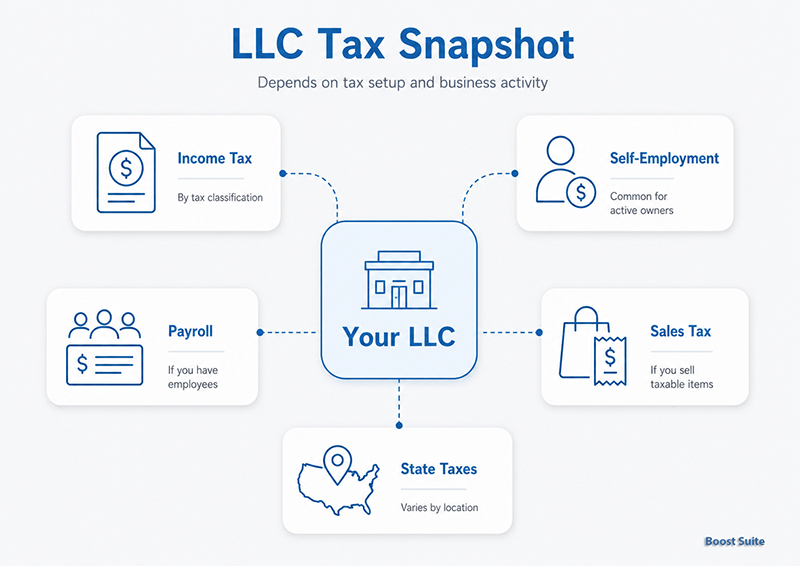
An LLC can face more than one type of tax. The key is to separate income tax (classification-driven) from other taxes triggered by how you operate, like having employees or selling taxable products.
Federal Income Tax
Federal income tax treatment depends on how the IRS classifies the LLC for tax purposes (for example, disregarded entity, partnership, or corporation). That classification drives which return is filed and how the income is generally taxed, and it also affects the LLC tax rate a business owner may need to plan around.
What Is the LLC Tax Rate?
An LLC has no federal tax rate of its own unless it’s taxed as a corporation. Under the default rules, the profit passes through to the owners and is taxed at their individual rates, which run from 10% to 37% for tax year 2026. Owners with net earnings from self-employment of $400 or more also pay self-employment tax of 15.3% (12.4% for Social Security, 2.9% for Medicare) on 92.35% of those earnings, and deduct half of it when figuring adjusted gross income. The Social Security part stops at an annual earnings cap.
An LLC that elects C corporation treatment pays a flat 21% federal rate on its taxable income. Profit paid out to owners as dividends is taxed again on their returns, at the lower capital gain rates when the dividends are qualified dividends.
There’s no separate tax rate on LLC distributions under the default rules. Members of an LLC taxed as a partnership report their share of the profit whether or not it is distributed, so taking the cash out is generally not taxed again. The exception is a cash distribution larger than the member’s basis in the LLC: the excess is taxable gain under 26 U.S.C. § 731(a)(1).
LLC Tax Rate in Florida and California
Florida’s constitution bars a state tax on the income of resident individuals (Article VII, Section 5), so the owners of a pass-through Florida LLC owe no Florida income tax on its profit. A Florida LLC classified as a corporation is different: it files a Florida corporate income/franchise tax return and pays 5.5% on Florida net income, after a $50,000 exemption.
California taxes LLC members at its personal income tax rates of 1% to 12.3% (2025 rate schedules), plus a 1% Behavioral Health Services Tax on taxable income over $1 million. The LLC itself also pays an $800 annual tax and, once its total California income reaches $250,000, an LLC fee of $900 to $11,790 depending on that income.
Self-Employment Tax
Many LLC owners may owe self-employment tax when they have net earnings from self-employment, especially in common setups like a single-member LLC taxed as a disregarded entity and some members of partnership-taxed LLCs (depending on the facts and how the member is treated).
Payroll, Sales, and State Taxes
Beyond income tax, other taxes often depend on business activity:
- Payroll taxes: If your LLC has employees, you generally must withhold and report employment taxes (federal income tax withholding, Social Security and Medicare taxes, and federal unemployment tax).
- Sales tax: Sales tax rules are usually state and local, and whether you must collect it depends on what you sell and where you have obligations.
- State taxes: State and local obligations vary by location and business structure, so the same LLC setup can look different across states.
Keep Your LLC Tax and State Notices Organized with Northwest
LLC tax obligations can vary based on income classification, employees, sales activity, and state rules. Northwest Registered Agent helps keep important legal mail and state compliance notices in one reliable place.
LLC Tax Deductions
An LLC can often qualify for tax deductions, but the deductions usually come from ordinary business expenses, not from the LLC label itself. In practice, the rules are tied to what you spend money on, how the expense relates to your business, and whether you can prove it with records.
Common LLC Tax Deductions
Here are common categories many LLCs deduct when the expenses are business-related and properly supported:
- Software and online tools (subscriptions, SaaS platforms used for operations)
- Advertising and marketing (ads, creative services, marketing tools)
- Office supplies and small equipment (supplies, basic equipment used for the business)
- Business insurance (coverage that relates to operating the business)
- Professional services (accounting, legal, consulting fees connected to the business)
- Business travel (only when the trip is primarily business and meets IRS requirements)
- Home office expenses, if eligible (either actual expense method or the simplified option, if you qualify)
What Makes an Expense Deductible?
Most deductible business expenses follow a simple standard: they are ordinary and necessary, connected to your trade or business, and backed by records.
- Ordinary usually means common and accepted in your industry.
- Necessary generally means helpful and appropriate for your business, even if not strictly required.
- Business-related means the expense is tied to running the business, not personal spending.
- Properly documented means you keep records that support the deduction.
How to Choose the Right Tax Structure for Your LLC
Your “best” tax setup depends on how the IRS classifies your LLC and whether you choose to file an election to change that classification. An LLC can be taxed under the default rules, or it can elect corporate treatment (and potentially S corporation status if eligible).
When Default LLC Taxation May Be Enough
Default taxation is often the simplest path, especially when you are new, smaller, or want to keep administration light.
In many cases, the default rules look like this:
- 1 member: usually treated as a disregarded entity for federal income tax purposes.
- 2+ members: usually treated as a partnership by default.
This default setup can be “enough” when you want straightforward reporting and you are not trying to optimize around payroll and owner compensation.
When an S Corp or C Corp Election May Make Sense
This is where the decision becomes more strategic, but you can still keep it simple by focusing on a few practical factors.
At a high level, an election may be worth exploring when:
- Your LLC has consistent profit, and you want more structured tax planning.
- You are comfortable running payroll and compliance (especially with an S corporation structure).
- You understand that S corporations must pay reasonable compensation to shareholder-employees before taking non-wage distributions.
- You are willing to accept extra admin cost and complexity in exchange for potential planning benefits.
If you are comparing default LLC taxation with S corporation treatment, our LLC vs S corp comparison can help you understand the tax, payroll, and administrative differences before making an election.
planning-level comparison
| Option | What it usually changes | Extra complexity to expect |
|---|---|---|
| Default LLC taxation | Uses default federal classification rules | Usually the simplest ongoing compliance |
| Elect S corp treatment | Files an S election (typically via Form 2553 if eligible) | Payroll and reasonable compensation expectations |
| Elect C corp treatment | Files a classification election (Form 8832) and files a corporate return (Form 1120) | Separate corporate return and corporate tax structure |
LLC Tax Deadlines and Late Filing Penalties
LLC tax deadlines are not “one-size-fits-all.” They usually depend on your tax classification and your tax year-end, and if a due date lands on a weekend or legal holiday, it generally moves to the next business day.
LLC Tax Deadlines Depend on Tax Classification
Here’s the core idea: the filing deadline follows the return you are required to file.
In a few figures (common deadline rules and a real calendar-year example)
| LLC tax setup (federal) | Typical federal return | General deadline rule | Calendar-year example for the 2025 tax year |
|---|---|---|---|
| Disregarded entity (most single-member LLCs) | Form 1040 (with Schedule C, etc.) | Generally April 15 (moves if weekend/holiday) | April 15, 2026 |
| Partnership (most multi-member LLCs) | Form 1065 | 15th day of the 3rd month after tax year-end | March 16, 2026 (because March 15 is Sunday) |
| S corporation election | Form 1120-S | 15th day of the 3rd month after tax year-end | March 16, 2026 (because March 15 is Sunday) |
| C corporation treatment | Form 1120 | 15th day of the 4th month after tax year-end (special rule for June 30 fiscal year) | April 15, 2026 (for calendar-year corporations) |
What Happens If an LLC Files Late?
Late filing can trigger penalties, interest, and follow-on issues (like delayed K-1s for partners/shareholders). The exact outcome depends on which form was due, whether tax is owed, and how late the filing/payment is. Even when you think no tax is due, it is still worth understanding what can happen if you do not file taxes but do not owe, because filing requirements, refunds, and IRS records can still matter.
Here are the most common “late filing” consequences to understand:
- Failure-to-file penalty (common for returns with tax due): The IRS generally describes this as 5% of the unpaid tax per month (or part of a month), up to 25%.
- Failure-to-pay penalty: If you file but do not pay everything by the due date, the IRS generally describes a 0.5% per month late payment penalty (up to 25%) on the unpaid amount.
- Interest: Interest can apply on late-paid taxes and may also apply on penalties.
For business returns, there can also be form-specific penalties. For example:
- Partnership returns (Form 1065): The IRS instructions describe a late-filing penalty assessed against the partnership when required information is missing or the return is late (unless there’s reasonable cause).
- S corporation returns (Form 1120-S): The IRS instructions describe a late filing penalty and also explain how penalties may apply depending on whether tax is due and whether required information is included.
- C corporation returns (Form 1120): The IRS instructions describe late filing and late payment penalties and note that reasonable cause relief may apply in some cases.
FAQs About LLC Taxes
These are the questions readers ask most often when they are trying to understand how an LLC is taxed in real life. The short answer is that LLC taxes usually come down to tax classification, the forms that match it, and how you run the business.
What forms do I need to file taxes for my LLC?
It depends on how the IRS treats your LLC for federal tax purposes. Here’s the most common mapping:
– Single-member LLC (default: disregarded entity): you typically report business activity on Schedule C (Form 1040), and use Schedule SE (Form 1040) if you have net earnings from self-employment.
– Multi-member LLC (default: partnership): the LLC typically files Form 1065, and each member generally receives a Schedule K-1 (Form 1065).
– LLC taxed as an S corp: the entity generally files Form 1120-S, and S status is generally elected using Form 2553 (if eligible).
– LLC taxed as a C corp: the entity generally files Form 1120.
Can my LLC qualify for tax deductions?
Yes. Deductions are usually based on whether an expense is a legitimate business expense, not on the fact that you formed an LLC. In general, a business expense must be ordinary and necessary, connected to your business, and supported by records.
Common examples include software, advertising, office supplies, insurance, professional services, business travel, and home office expenses if you qualify.
How do I choose the right tax structure for my LLC?
Start with the baseline: an LLC has default federal tax treatment, but it can also file an election to change how it’s classified.
– Default taxation is often enough when you want simpler compliance and your setup is straightforward.
– An election may be worth discussing when your profits are steady enough that tax planning could outweigh the added admin costs (especially payroll and ongoing compliance). An LLC can generally use Form 8832 to elect entity classification, and eligible LLCs can use Form 2553 to elect S corporation status.
If you are considering S corp treatment, we recommend understanding the IRS “reasonable compensation” expectation for shareholder-employees, because it affects how you pay yourself.
What are the penalties for late filing for an LLC?
Late filing can lead to penalties and interest, and the exact impact depends on which return was due, whether tax is owed, and how late the filing and payment are.
A few high-level points to know:
– The IRS generally charges a failure-to-file penalty when a required return is late and tax is owed.
– If you file but do not pay by the due date, the IRS generally charges a failure-to-pay penalty and interest may also apply.
– Partnership and S corporation filings can have their own form-specific late filing penalties described in the IRS instructions.
Does an LLC pay taxes separately from its owner?
Often, no, at least by default. For federal income tax:
– A single-member LLC is generally treated as “disregarded” for income tax purposes, meaning the IRS generally treats it as part of the owner’s return (unless it elects corporate treatment).
– A multi-member LLC is generally treated as a partnership by default, and income is generally reported by the members.
– If the LLC is taxed as a C corporation, the corporation generally files and pays at the entity level on Form 1120.
Do LLC owners pay self-employment tax?
Many do, especially when the LLC is taxed under the default rules and the owner has net earnings from self-employment. The IRS explains self-employment tax as Social Security and Medicare taxes for individuals who work for themselves, and Schedule SE is used to calculate it.
If the LLC elects S corporation treatment, owner compensation is handled differently because shareholder-employees are generally paid wages, and the IRS emphasizes reasonable compensation rules.
- Internal Revenue Service: Self-Employment Tax
- Internal Revenue Service: Employment Taxes
- Internal Revenue Service: Business Return Due Dates
- Internal Revenue Service: Failure to Pay Penalty
- U.S. Small Business Administration: Pay Taxes
- U.S. Small Business Administration: Choose a Business Structure
- California Franchise Tax Board: Business Due Dates
- Texas Comptroller of Public Accounts: Franchise Tax Overview
Stay on Top of LLC Tax and Compliance Notices with Harbor Compliance
LLC taxes come with important filings, deadlines, and state requirements. Harbor Compliance can serve as your Registered Agent and help keep legal notices and compliance documents organized.