

A single member LLC is a limited liability company with only 1 owner. It gives a solo business owner a formal state-registered business structure, while still keeping ownership simple. For federal tax purposes, the IRS generally treats a single-member LLC as a disregarded entity unless it elects another tax classification.
What Is a Single Member LLC?
A single member LLC is a limited liability company with only 1 owner. In LLC terminology, that owner is called a member. The IRS recognizes that LLCs may have only 1 member, and for federal income tax purposes, a single-member LLC is generally treated as a disregarded entity unless it elects to be taxed as a corporation.
In simple terms, a single member LLC combines 2 ideas:
| Part | Meaning |
|---|---|
| Single member | The business has 1 owner |
| LLC | The business is formed as a limited liability company under state law |
The important difference is that a single member LLC is not just an informal solo business. It is created through a state filing, usually by submitting Articles of Organization or a similar formation document to the state business filing office. When the LLC is formed and operated in its home state, it is generally treated as a domestic LLC for state registration purposes.
Once formed, the LLC becomes a separate legal business structure under state law. That makes it different from simply operating as an individual freelancer, contractor, or sole proprietor without forming a business entity.
How Does a Single Member LLC Work?
A single member LLC is usually operated by its sole owner. The owner can make business decisions, manage daily operations, collect income, pay expenses, and handle clients or customers directly.
In practice, the LLC can act as the business identity. That means the LLC may be used for:
- Opening a business bank account
- Signing business contracts
- Receiving business income
- Paying business expenses
- Keeping business records under the LLC name
Even with only 1 owner, the business should not be treated like a personal wallet. The owner should keep personal and business finances separate, because clean records help support the LLC’s formal structure and make tax reporting easier.
A single member LLC operating agreement is also useful, even if no other members are involved. It can document how the LLC is managed, how money is handled, and how the owner treats the LLC as a separate business.
How to Start a Single Member LLC
Starting a single member LLC is usually a state-level process. The exact form name, fee, and compliance rules depend on your state, but the basic setup path is similar in most places. The SBA explains that LLCs usually register with the state, often through the Secretary of State or another state business agency.
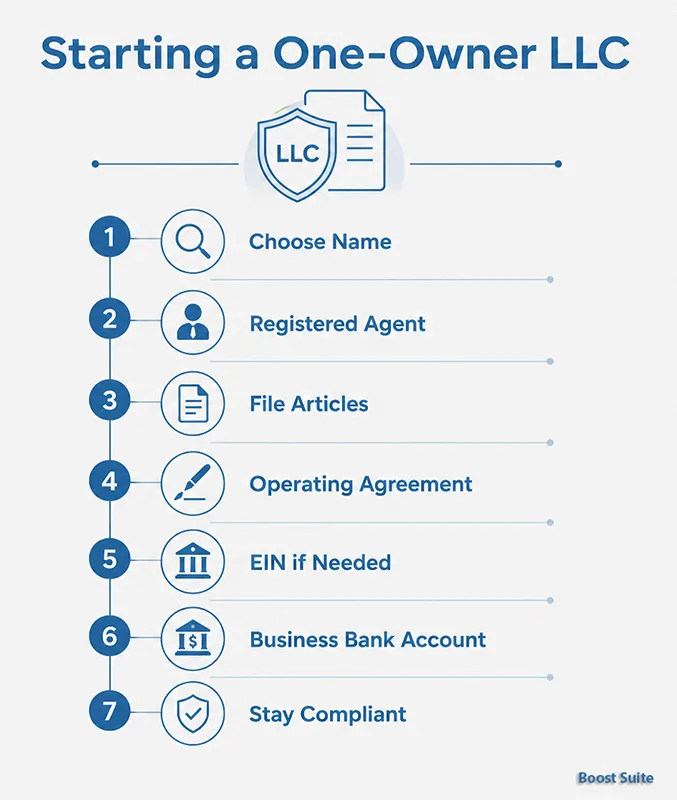
- Choose a business name
Pick a name that follows your state’s LLC naming rules and is available in the state database. - Appoint a registered agent
A registered agent receives official papers and legal documents for the LLC. The SBA notes that an LLC generally needs a registered agent in the state before filing, and that the agent must be located in the state where the business registers.
Before choosing one, it helps to understand what a registered agent does and why the role matters for state compliance. - File Articles of Organization
File the LLC formation document with the state. Many states call this document Articles of Organization, although the exact name can vary (in some states, the same type of filing may be called a Certificate of Organization). According to the SBA, Articles of Organization describe the basics of the LLC, such as the company name, address, member information, and registered agent. - Create a single member LLC operating agreement
An operating agreement is an internal document that explains how the LLC is managed and how key business decisions are handled. Even when the state does not require one, the SBA says an LLC operating agreement is widely recommended to help protect the owner and the business.
If you want a broader breakdown of what to include, our guide to how an LLC operating agreement works explains the main sections and why the document matters - Get an EIN if needed
A single-member LLC may need an EIN if it has employees, has certain excise tax obligations, needs one to open a bank account, or must have one under state tax rules. The IRS says a disregarded single-member LLC with no employees and no excise tax liability does not need an EIN for federal tax purposes, but it may still apply for one when needed.
If your LLC needs one, our guide on how to get an EIN walks through the basic application process and common use cases. - Open a business bank account
A separate business bank account helps keep LLC money away from personal money. Before applying, review what banks commonly request when you open a business bank account for an LLC, such as formation documents, an EIN confirmation letter, an operating agreement, and identification. The SBA recommends opening a business account when you are ready to accept or spend money as the business, and notes that banks commonly ask for documents such as an EIN, formation documents, ownership agreements, and business licenses. - Keep up with state compliance requirements
After formation, your LLC may have state or local follow-up requirements, such as initial reports, annual reports, tax registrations, licenses, or permit renewals. The SBA notes that some states require reports soon after registration and that state and local tax obligations vary by location.
Start Your Single-Member LLC with Northwest
Northwest Registered Agent helps you form your single-member LLC, appoint a registered agent, file your state paperwork, and keep your business setup organized from day one.
Single Member LLC vs Sole Proprietorship
A single member LLC and a sole proprietorship can both be owned by 1 person. The main difference is the legal structure. A single member LLC is a state-formed business entity, while a sole proprietorship is usually the default status when someone does business without registering another business structure. The SBA says sole proprietorships do not create a separate business entity, which means business assets and liabilities are not separate from the owner’s personal assets and liabilities.
| Point | Single Member LLC | Sole Proprietorship |
|---|---|---|
| Legal structure | State-formed business entity | Informal unincorporated business |
| Owner | 1 member | 1 owner |
| Liability separation | Possible if maintained properly | No formal entity separation |
| Setup | Requires state filing | Usually no entity filing |
| Business credibility | More formal | More basic |
A sole proprietorship may be simpler to start, but it does not create the same formal separation between the owner and the business. A single member LLC takes more setup, but it can give the owner a more formal business identity and potential liability separation when the LLC is properly formed and maintained.
If you want the full side-by-side breakdown, our guide on how a single member LLC compares with a sole proprietorship explains the liability, tax, cost, and setup differences in more detail.
How Is a Single Member LLC Taxed?
For federal income tax purposes, a single member LLC is treated by default as a disregarded entity, unless it files an election to be taxed as a corporation. This means the IRS generally does not treat the LLC as separate from the owner for federal income tax reporting, even though the LLC may still be a separate business entity under state law.
For many single-member LLC owners, business income and expenses are reported on the owner’s personal tax return. The IRS Self-Employed Individuals Tax Center says self-employed taxpayers commonly use Schedule C to report income or loss from a business they operated as a sole proprietor or from gig work.
Here is the simple version:
| Tax point | What it usually means |
|---|---|
| Default federal tax treatment | Disregarded entity |
| Income reporting | Usually reported by the owner on their personal tax return |
| Self-employment tax | May apply if the owner has net earnings from self-employment |
| Corporation election | Possible if the LLC files the proper IRS election |
| State and local taxes | May still apply depending on the business and location |
A single member LLC may also have other tax obligations. For example, sales tax, payroll tax, excise tax, local business tax, or state-level LLC fees may apply depending on what the business does and where it operates. The IRS also notes that a single-member LLC can still be treated as a separate entity for employment tax and certain excise tax purposes.
Pros and Cons of a Single Member LLC
A single member LLC can be a strong structure for solo business owners, but it is not perfect for every situation. The main tradeoff is simple: you get a more formal business structure, but you also take on more setup and maintenance than a basic sole proprietorship.
Advantages of a Single Member LLC
A single member LLC may be helpful when the owner wants a cleaner separation between personal and business activity. The biggest advantages are usually practical, legal, and operational.
- Liability separation
A single member LLC can help separate the owner from the business, as long as the LLC is properly formed and maintained. - Simple ownership structure
There is only 1 owner, so decision-making is usually straightforward. - More professional business identity
Using an LLC name on contracts, invoices, bank accounts, and business records can make the business look more formal. - Flexible tax options
A single member LLC is usually taxed as a disregarded entity by default, but it may elect corporate tax treatment if appropriate. - Easier to open a business bank account
Banks often ask for formation documents, ownership documents, licenses, and an EIN when opening a business account. Having an LLC can make that process clearer. The SBA lists common documents banks may request when opening a business bank account.
Disadvantages of a Single Member LLC
A single member LLC is still simpler than many other business structures, but it is not as effortless as operating informally. Owners should understand the extra filing, recordkeeping, and compliance responsibilities.
- State filing fees may apply
Forming an LLC usually requires a state filing fee, and the amount depends on the state. - Ongoing compliance may be required
Some states require annual reports, biennial reports, franchise taxes, state fees, business licenses, or other renewals. - Liability protection is not automatic if records are messy
The LLC structure is easier to defend when the owner keeps business and personal finances separate, signs documents properly, and maintains basic records. - More admin than a sole proprietorship
A sole proprietorship is usually easier to start, while a single member LLC normally requires formation paperwork, state records, banking setup, and ongoing maintenance.
Frequently Asked Questions About Single Member LLCs
A single member LLC is simple, but many owners still have questions about liability, taxes, setup, and EIN requirements. These answers cover the main points without turning this into a full state-by-state guide.
What are the advantages of a single member LLC?
The main advantages of a single member LLC are liability separation, simple ownership, and a more formal business identity. You can run the business as the only owner while still using an LLC structure for contracts, business banking, invoices, and records.
A single member LLC may also offer tax flexibility. By default, an LLC with only 1 member is treated as disregarded from its owner for federal income tax purposes, unless it elects to be taxed as a corporation.
How does a single member LLC differ from a sole proprietorship?
A single member LLC is a state-formed business entity. A sole proprietorship is usually an informal, unincorporated business owned by 1 person.
The biggest difference is legal separation. The SBA explains that a sole proprietorship does not create a separate business entity, meaning business assets and liabilities are not separate from the owner’s personal assets and liabilities.
What are the tax obligations for a single member LLC?
For federal income tax purposes, a single member LLC is usually treated as a disregarded entity by default. This means the owner typically reports the LLC’s income and expenses on their personal tax return, unless the LLC elects a different tax classification.
Other taxes may still apply depending on the business. These can include self-employment tax, state tax, sales tax, payroll tax, local tax, or excise tax. The IRS also notes that a single-member LLC may still be treated as a separate entity for employment tax and certain excise tax purposes.
How do I set up a single member LLC?
To set up a single member LLC, you usually choose a business name, appoint a registered agent, and file the LLC formation document with your state. Many states call this document Articles of Organization, but the name can vary by state.
After approval, create an operating agreement, get an EIN if needed, open a business bank account, and keep up with state compliance requirements. The SBA explains that LLC registration is usually handled at the state level, often through the Secretary of State or a similar state business agency.
Does a single member LLC need an EIN?
Not always. The IRS says a disregarded single-member LLC with no employees and no excise tax liability does not need an EIN for federal tax purposes. In that situation, the owner generally uses their own name and taxpayer identification number for federal tax reporting.
However, an EIN may still be needed if the LLC has employees, owes certain excise taxes, needs an EIN to open a bank account, or must have one under state tax rules.
Does a single member LLC protect personal assets?
A single member LLC can help protect personal assets in many situations, but the protection is not automatic in every case. The SBA explains that an LLC can protect personal assets, such as a vehicle, house, or savings accounts, if the LLC faces bankruptcy or lawsuits.
That protection works best when the owner treats the LLC as a real separate business. We recommend keeping separate bank accounts, signing contracts in the LLC’s name, maintaining clean records, and avoiding the use of LLC funds for personal expenses.
- U.S. Small Business Administration: Choose a business structure
- U.S. Small Business Administration: Choose your business name
- U.S. Small Business Administration: Basic Information About Operating Agreements
- Internal Revenue Service: About Form 8832, Entity Classification Election
- U.S. Small Business Administration: Open a business bank account
- U.S. Small Business Administration: Apply for licenses and permits
Keep Your Single-Member LLC in Good Standing with Harbor Compliance
Harbor Compliance’s registered agent service helps single-member LLC owners handle official notices, annual report reminders, and compliance deadlines with professional support.