

Most first-time sellers get stuck on the same question: Do we need to form an LLC before we can start selling? The short answer is no. As of February 2026, Amazon’s own registration guidance says you can register and sell as an individual, even if you are not incorporated.
What an LLC changes is not “permission to sell.” It changes how your business is structured behind the scenes, including liability separation, paperwork, banking, and how cleanly you can scale later. That is why this decision matters, but it should not block you from getting started.
Amazon Seller Requirements: Is an LLC Mandatory?
Amazon does not require you to have an LLC to start selling. In the registration flow, Amazon lets you sign up as an individual. If you are not incorporated, you can choose “None, I am an individual” as your business type (per Amazon’s registration guide).
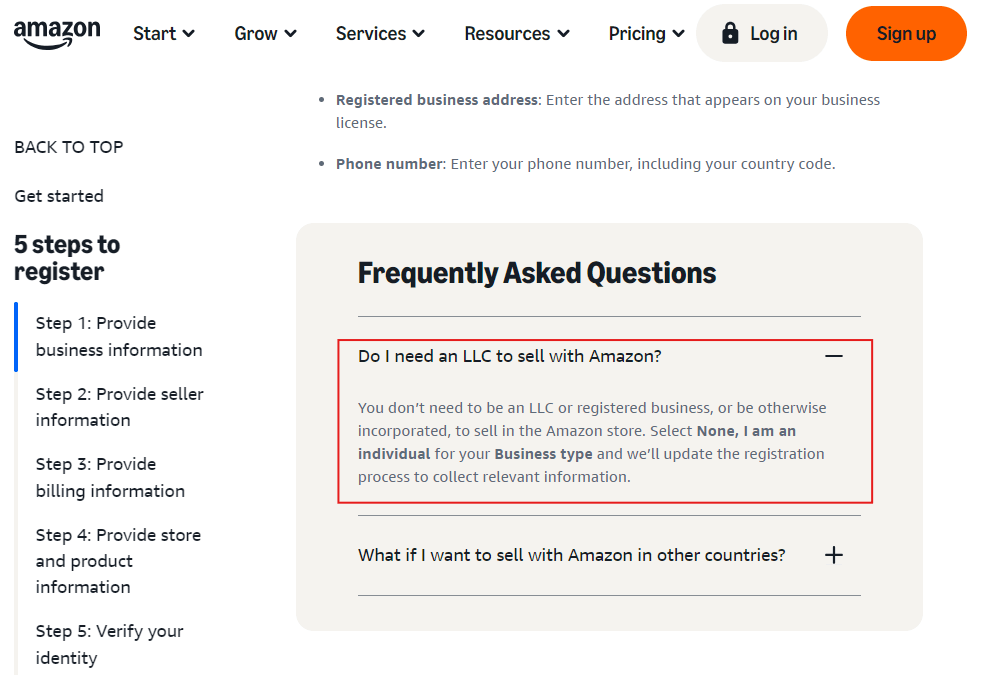
That means you can start selling first, then decide whether forming an LLC is worth it once the business proves itself. If you choose to upgrade later, follow this step-by-step LLC formation guide to do it in the right order.
What Amazon Requires
Amazon’s registration flow is mainly about verifying two things: who you are and how you’ll get paid and reported for tax purposes.
Before you begin, here’s the practical checklist of what you’ll typically need ready:
- Business info: business location, business type (individual vs registered), business name (if applicable), registration number (if applicable), and a phone number.
- Your personal details (as the primary contact): legal name, date of birth, residential address, plus a government-issued ID.
- Billing setup: a bank account for disbursements and a credit card. Amazon notes the bank account must be in your name or your business’s name, and the credit card does not need to be under your name.
- Tax interview: Amazon collects information needed to complete an IRS W-9 or W-8 form and determine whether sales are subject to IRS 1099-K reporting; you generally need a U.S. tax ID and/or a foreign tax ID if applicable.
Who Can Sell as an Individual vs. a Registered Business
Amazon treats this as a registration choice, not a gatekeeping rule. If you’re not incorporated, you can register as an individual. If you already have a legal entity (like an LLC), you register under that entity.
Here’s the clearest way to think about it:
| If you are… | You’ll usually register as… | What Amazon expects in practice |
|---|---|---|
|
Not incorporated (selling under your own name) |
Individual (often “None, I am an individual”) | Your personal legal details as the primary contact; bank account can be in your name. |
|
Incorporated (LLC, corporation, etc.) | Registered business | Business name and registration number (where applicable), plus details about beneficial owners and legal representatives. |
Protect Your Amazon Business with a Northwest Registered Agent
Northwest provides a reliable registered agent service that keeps your personal address off public records and ensures you never miss legal or state compliance notices as your selling business grows.
Selling as an Individual: How It Works Without an LLC
When people say “selling without an LLC,” what they usually mean is selling as an individual owner of an unincorporated business. In the U.S., that’s typically a sole proprietorship. If you’re weighing whether to stay simple or formalize, this single-member LLC vs. sole proprietorship comparison breaks down the tradeoffs.
This approach is common when you’re starting out because it’s simple: you can launch, learn, and keep your setup lightweight.
What “Sole Proprietor” Means in Plain Terms
A sole proprietorship is an unincorporated business owned by one person. There is no legal separation between you and the business, which means business debts and obligations can become personal obligations.
Two important nuances that keep people from getting tripped up:
- A sole proprietor can still use a brand name or store name. The legal structure is about ownership and liability, not what your storefront is called.
- A single-member LLC can be treated like a sole proprietorship for federal income tax purposes unless the owner elects corporate tax treatment.
What You Still Need to Start
Even without an LLC, you still need a clean foundation so Amazon can verify you and you can stay organized.
The practical setup to focus on first:
- A tax identification number (TIN)
Amazon’s tax interview is used to complete IRS W-9 or W-8 forms and determine reporting, and you’ll generally need your U.S. tax ID and/or a foreign tax ID if applicable.
In the U.S., that might be an SSN/ITIN or an EIN depending on your situation. The Internal Revenue Service explains what an EIN is for and when it’s needed. - A bank account to receive payouts
Amazon notes the bank account used for disbursements must be in your name or your business’s name.
Separate finances early (even if it’s just a dedicated account) so bookkeeping and taxes stay easy. - A credit card for charges and fees
Amazon lists common card networks it accepts and notes the card does not need to be under your name or your business’s name. - Basic records from day one
Track revenue, costs, Amazon fees, refunds, inventory purchases, and any contractor payments. This is less about perfection and more about avoiding a messy rebuild later.
Pros and Cons of Staying Unregistered Early On
If you’re deciding whether to start as an individual, it helps to be honest about the tradeoffs.
Here are the main benefits when you’re still validating the business:
- Faster launch: fewer steps before you can start testing products.
- Lower setup cost: no state filing fees or ongoing registered agent/admin overhead.
- Simple ownership: it’s just you, so decision-making is quick.
Now the downsides, which matter more as you scale:
- No liability separation: as a sole proprietor, there’s no legal identity apart from you.
- Harder to keep finances clean if you mix personal and business spending.
- Scaling friction: once you add partners, bring on employees, or change structure, the admin catches up quickly.
Many Amazon sellers who do decide to upgrade end up choosing a privacy-first jurisdiction so their home address never lands on the public seller record. That’s why Wyoming LLC formation keeps coming up in FBA seller forums: member names stay off the public filing, which matters when your shipping label and business listing are easy to look up online.
Amazon FBA Considerations: When an LLC Makes More Sense
Many new sellers ask a very specific version of the question: “If we use FBA, do we have to set up an LLC?” In practice, FBA is a fulfillment option you add to your seller account (see how Fulfillment by Amazon works) not a legal structure requirement. You can enroll products into FBA once you have a selling account, and Amazon notes you can use FBA whether you’re on an Individual or Professional selling plan.
FBA Doesn’t Require an LLC (but risk can increase)
FBA can make your business feel “bigger” quickly because Amazon handles storage, shipping, returns, and customer service. That operational leverage is great, but it also means you can scale inventory and volume faster than your legal setup and risk planning.
Here’s the simple way to frame it:
- FBA does not force an LLC -> If you can sell as an individual, you can still use FBA.
- FBA can increase exposure -> More units out in the world, more returns, more customer interactions, and usually higher monthly revenue. That’s when “Do we want liability separation?” becomes a real question.
Common FBA Situations Where Forming an LLC is Recommended
Forming an LLC is a “when it makes sense” move, not a “before you’re allowed” move. Below are common FBA scenarios where an LLC is at least worth considering.
- You’re moving beyond testing and into real inventory
- You’re placing larger orders (especially overseas) and storing meaningful value in inventory.
- Cash flow is no longer small, and mistakes get expensive.
- You’re private labeling or acting like the brand
- If your name (or brand) is on the product packaging, you’re more visible as the responsible party if something goes wrong.
- If your name (or brand) is on the product packaging, you’re more visible as the responsible party if something goes wrong.
- Your products have higher liability risk
- Anything safety-sensitive (kids, food-related, topical, electronics, supplements-style products, or “used on the body”) tends to justify stronger separation earlier.
- Anything safety-sensitive (kids, food-related, topical, electronics, supplements-style products, or “used on the body”) tends to justify stronger separation earlier.
- You’re approaching insurance-trigger territory
- If you expect months where sales may cross thresholds that trigger required insurance, it’s often cleaner to set up your entity and banking before the paperwork stacks up.
- If you expect months where sales may cross thresholds that trigger required insurance, it’s often cleaner to set up your entity and banking before the paperwork stacks up.
- You’re hiring help or adding partners
- Contractors, virtual assistants, prep centers, and especially co-founders are where “who owns what” and “who is responsible” should be clearer.
Once you’re hiring help, signing supplier contracts, or pitching wholesale buyers, jurisdiction credibility starts mattering more than filing fees. That’s why scaling FBA operators often weigh Delaware LLC registration alongside their home state: the case law, court of chancery, and recognition by investors and lenders make later capital raises or acquisitions noticeably cleaner.
Form Your Amazon FBA LLC with ZenBusiness
ZenBusiness helps you form an LLC when your FBA business starts to feel real, handling state filings and compliance so you can scale inventory, partners, and risk with more confidence.
LLC Benefits and Drawbacks for Amazon Sellers
An LLC can be a strong upgrade for Amazon sellers, but it’s not magic. It’s a legal wrapper that can improve separation and operations when you use it correctly, and it adds admin when you don’t need it yet.
Benefits Amazon Sellers
Below are the benefits sellers usually feel most in day-to-day operations.
- Liability separation (in most cases)
The U.S. Small Business Administration explains that LLCs protect you from personal liability in most instances, helping keep personal assets separate from business issues. - Cleaner finances and easier bookkeeping habits
An LLC pushes you toward better fundamentals: dedicated bank accounts, clearer expense tracking, and less mixing personal and business transactions. - Credibility with partners
Some suppliers, lenders, service providers, and even B2B buyers take you more seriously when you operate through a registered entity. - Flexibility for growth
The IRS notes LLCs are allowed by state statute and can be single-member or multi-member, which can make ownership changes easier later.
Drawbacks Amazon Sellers
LLCs come with real tradeoffs. The key is making sure you’re buying benefits you’ll actually use.
- State fees and ongoing compliance
Formation fees, annual reports, registered agent services, and basic compliance tasks vary by state and add recurring admin. - More accounts and documentation to maintain
Separate bank accounts, bookkeeping discipline, and keeping business activity clearly business-related. - An LLC does not replace insurance
Even with an LLC, Amazon can still require commercial liability insurance once you hit defined thresholds or if requested.
When Should You Form an LLC for Your Amazon Business?
You don’t form an LLC because you “need permission” to sell. You form one when it becomes the most practical way to protect yourself and run cleaner operations as the business grows.
A helpful way to decide is to think in phases: testing, growth, scaling.
Tax treatment is another lever some sellers pull when timing their formation. Nevada LLC formation attracts Amazon sellers based out West who want no state corporate income tax while keeping a familiar West Coast time zone for supplier calls and customer service hours.
The Timing Framework
The timing model below keeps the decision simple and prevents over-optimizing too early.
| Phase | What it looks like | What to do now | LLC is usually worth it when… |
|---|---|---|---|
| Testing | You’re validating products, small inventory, learning fees and returns | Keep setup lightweight and focus on product-market fit | You’re selling higher-risk products, investing serious inventory cash, or you want clean separation from day one |
| Growth | Sales are consistent month to month, you’re restocking, refining SOPs | Tighten bookkeeping, separate finances, plan for insurance triggers | You’re building a brand, hiring help, signing supplier contracts, or your risk exposure is rising fast |
| Scaling | You’re expanding SKU count, larger orders, more customer volume | Formalize structure, controls, and risk management | You’re approaching Amazon insurance requirements, adding partners, or you want a clean asset for sale later |
If You’re Not Ready Yet: alternatives and “next best steps”
If you’re not forming an LLC yet, you can still run your Amazon business like a real business. The goal is to reduce confusion, reduce risk, and keep the door open to upgrade later.
The goal of the list: remove the common failure point where sellers grow fast but their paperwork, banking, and documentation cannot keep up.
- Separate money immediately
Use a dedicated bank account for business activity (even if it’s still in your personal name). If you’re moving into an LLC soon, these free business bank account options for U.S. LLCs can help keep overhead low. Clean separation now makes an LLC transition easier later. - Get an EIN if it helps your setup (U.S. sellers)
The IRS states you can get an EIN directly from them for free, and warns against sites that charge for it. An EIN makes sense if you want to reduce SSN use, open accounts more cleanly, or prepare for vendors. And if you want a clean walkthrough, follow this guide on how to get an EIN fast (the free IRS method) - Document your product and supplier chain
Save invoices, test reports (if you have them), and supplier communications. If a claim or compliance question comes up later, documentation is your first line of defense. - Plan for insurance before you’re forced into it
Amazon’s seller agreement and help guidance can require commercial liability insurance after you exceed certain monthly sales thresholds or if requested. - Use an upgrade trigger you can measure
Example triggers: you cross a set monthly profit number, you place an order above a certain inventory value, you move into a higher-risk category, or you hire a contractor.
Form Your Amazon LLC with Bizee
Bizee makes it easy to form an LLC when your Amazon business hits the growth phase, with fast state filing and a straightforward setup that helps you separate risk without overcomplicating things.
Amazon Seller Setup Checklist
Whether you register as an individual or as a company, the goal is the same: get approved smoothly, get paid without issues, and keep records clean from day one. Use the checklist below to avoid the most common setup delays.
| What to prepare | Why it matters | Common mistake to avoid |
|---|---|---|
| Business location + business type (individual vs registered business) | Amazon uses this to set your legal profile and verification path | Picking the wrong business type, then needing to redo legal entity details later |
| Store name (unique) | This is your public storefront identity | Overthinking the name instead of launching and validating demand |
| Government-issued ID | Required for identity verification | Low-quality photo, glare, or cropped edges |
| Proof of address (recent statement, as requested in your flow) | Used to confirm address and identity details | Address format does not match, outdated document, or mismatch with signup info |
| Phone number + basic contact details | Needed for account security and verification | Using a number you cannot reliably access |
| Bank account for payouts | Needed for disbursements | Bank name or account holder mismatch (use an account in your name or business name) |
| Credit or debit card for charges | Used for plan fees and charges | Using a card that blocks online or international transactions |
| Tax interview info | Needed to complete tax forms and reporting setup | Rushing the tax interview without correct taxpayer details |
Next, set up your money system. This is what keeps your business scalable and what most beginners skip:
- One dedicated account for business cash flow (sales deposits, inventory purchases, Amazon fees).
- One simple bookkeeping method (spreadsheet or accounting tool) with monthly reconciliation.
- Core categories from day one: inventory, Amazon fees, shipping/prep, refunds, software, ads, and owner draw.
- Receipt and invoice storage: one folder system you can search fast.
Finally, cover the risk basics. You do not need to be paranoid, but you do need a baseline.
- Insurance planning: Amazon can require commercial liability insurance once you exceed the applicable threshold in a month or if requested.
- Product sanity checks: confirm safe use, accurate labels, and clear instructions.
- Supplier documentation: invoices, batch info (if available), and any testing or compliance documents you can get.
- Incident readiness: a simple SOP for complaints, refunds, and potential safety issues.
FAQs about LLC to Sell on Amazon
The questions below give new Amazon sellers a clear, practical answer on whether they “need” an LLC, especially when using FBA.
Do I need an LLC to sell on Amazon?
No, Amazon’s registration guide states you do not have to be an LLC or a registered business to sell. If you are operating as an individual or your business is not incorporated, you can select “None, I am an individual” during signup. An LLC can still be a smart upgrade later for separation and cleaner operations, but it is not a requirement to start.
Can I sell on Amazon without an LLC?
Yes, You can start as an individual seller as long as you complete Amazon’s verification steps and provide the required identity, banking, and tax information. Amazon notes it uses your registration details to verify you as the primary contact and collect relevant information for selling and payments. In other words, the gate is compliance and verification, not incorporation.
Do I need to create an LLC to sell on Amazon FBA?
No, FBA is a fulfillment program, not a legal structure. Amazon states you can use FBA with either an Individual or a Professional selling plan, which means you can still use FBA even if you are not registered as an LLC. The decision to form an LLC is about your risk and operations, not your eligibility to enroll in FBA.
Do I need to be an LLC to sell on Amazon as a beginner?
No, If you are just starting, it is usually fine to launch as an individual and focus on learning the basics: product research, pricing, fees, returns, and customer expectations. Amazon explicitly supports individual sellers during registration. Keep your setup simple at first, then switch to an LLC when the business proves traction or risk increases.
When should I set up an LLC to sell on Amazon?
When growth and risk become real. Common triggers include: consistent monthly sales, meaningful inventory investment, higher-risk products, hiring help, or planning to build a sellable brand asset. Also, Amazon’s policies may require commercial liability insurance once you exceed applicable sales thresholds (or if requested), which is often when sellers tighten structure and documentation. Measurable triggers keep the decision from being emotional.
Does an LLC lower taxes for Amazon sellers?
Not automatically, In the U.S., the IRS explains that a single-member LLC is generally treated as a “disregarded entity” for income tax purposes unless it elects to be treated as a corporation. That means forming an LLC often does not change your taxes by itself, but it can give you more options later depending on your situation.Always match the choice to your income level and goals.
Can I switch my seller account from individual to LLC later?
Usually, yes. Many sellers update their seller account details after forming an LLC by editing Legal Entity and redoing the tax interview, and Amazon may request new documents during the change. In some cases, Amazon guidance referenced by Seller Central forum responses mentions a “Transfer Account” flow for changing the legal entity, which can involve fresh verification. Plan the switch carefully to avoid delays.
- Amazon Seller Central Help: Amazon Services Business Solutions Agreement
- Amazon Seller Central Help: Commercial Liability Insurance Requirements
- Amazon Seller Central Help: Global seller identity, address, and business verification
- Internal Revenue Service (IRS): Employer identification number (EIN) – who needs it + how to apply
- Internal Revenue Service (IRS): Single-member limited liability companies (default tax treatment)
- U.S. Small Business Administration (SBA): Choose a business structure (LLC overview)
Set Up Your Amazon LLC with Harbor Compliance
Harbor Compliance helps you form an LLC when your Amazon business is ready to level up, with compliance-focused filings and ongoing support built for sellers planning to scale responsibly.