

The Connecticut LLC Annual Report is the yearly online filing every Connecticut LLC owes the Secretary of the State. As of 2026, the fee is $80 and the window runs from January 1 through March 31. Miss it and the consequences stack up fast.
Does Connecticut Require an Annual Report for LLCs?
Yes. Every domestic LLC and every registered foreign LLC must file a Connecticut Annual Report each year. It’s required by Conn. Gen. Stat. § 34-247k, part of Chapter 613a, the Connecticut Uniform Limited Liability Company Act.
The filing authority is the Connecticut Office of the Secretary of the State, Business Services Division, and everything runs through Business.CT.gov. Owners new to the state can start with our Connecticut LLC formation guide before tackling annual filings.
The report is short, the fee is flat, and the deadline is fixed. Skipping it isn’t free.
Connecticut Annual Report Deadline (and How to Calculate Yours)
Connecticut sets a single filing window for every LLC. Reports are due each year after January 1 and before April 1, which works out to a practical deadline of March 31. That’s the rule in Conn. Gen. Stat. § 34-247k(c), and it applies whether the LLC was formed in January or December of the prior year.
The first annual report is due the year after the calendar year in which the LLC was formed or registered as a foreign LLC. An LLC formed on December 20, 2026 has its first window open January 1, 2027 and close March 31, 2027.
For an LLC formed on January 3, 2026, the first deadline is identical. The day of formation inside the year doesn’t matter, only the year itself.
How to Confirm Your Connecticut LLC’s Filing Status
The fastest way to check whether a Connecticut LLC owes a report is the Business Records Search on Business.CT.gov, where filing history is public. The Connecticut business entity search guide walks through the lookup process step by step. Each LLC has a Business ID number and an Authoritative Legal Entity Identifier (ALEI) visible on its record. Use either to pull the filing history before you file.
Connecticut Annual Report Filing Fee (2026)
The 2026 Connecticut LLC Annual Report filing fee is $80, a flat rate for both domestic and foreign LLCs. It’s not based on revenue, members, or fiscal-year activity.
The fee jumped from $20 to $80 under Public Act 19-117 for any annual report concerning a year on or after July 1, 2020, and no 2026 legislation has reduced it. The fee statute is Conn. Gen. Stat. § 34-243u.
The Annual Report isn’t the only fee a Connecticut LLC might encounter. Here’s how the related filings stack up:
| Filing | 2026 fee | When it applies |
|---|---|---|
| Connecticut LLC Annual Report | $80 | Every year, Jan 1 to Mar 31 |
| Amended Annual Report | $25 | When filed info changes mid-year |
| Interim Notice of Change of Manager/Member | $20 | Replacement of a named manager or member |
| Change of Agent | $50 | Registered agent change outside the report |
| Certificate of Reinstatement | $120 | After dissolution by forfeiture |
| Expedited service | $50 per transaction | When offered online |
Worth flagging: a 2025 bill (HB 5332) proposed cutting the $80 fee to $25, but it never became law. Plan around the $80 figure until the Connecticut General Assembly enacts a change.
Stay Ahead of Connecticut LLC Annual Report Fees with Bizee
Bizee helps Connecticut LLC owners manage annual report deadlines, compliance notices, and registered agent requirements with simple tools designed to keep businesses in good standing.
How to File the Connecticut LLC Annual Report Step-by-Step
Most Connecticut LLCs file in under 10 minutes once they’ve gathered the required information. The entire filing workflow now runs through Business.CT.gov, with paper filing reserved for narrow exemptions.
Filing Online via Business.CT.gov
The Connecticut Office of the Secretary of the State retired the older CONCORD system; current filings go through Business.CT.gov via a CT.gov account.
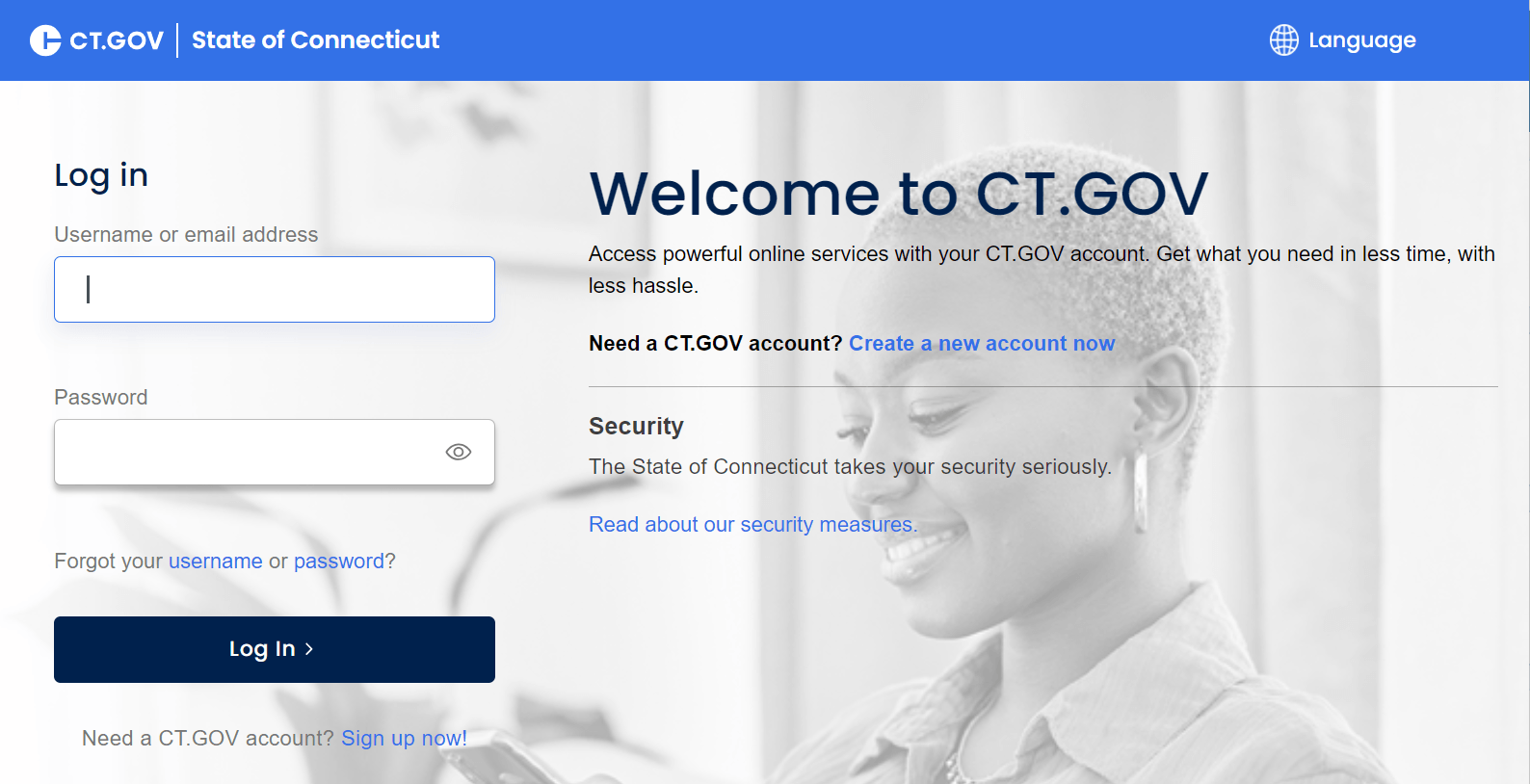
The flow:
- Log into or create a CT.gov account at Business.CT.gov.
- Open the Business.CT dashboard and pick the LLC by company name or ALEI.
- Select “File Annual Report” from the dashboard actions.
- Review the prefilled information. Update principal office address, mailing address, registered agent, members or managers, business email, and NAICS code as needed.
- Submit and pay the $80 fee with a debit card, credit card, or ACH transfer.
- Save the receipt from the dashboard. Filing history stays accessible in the same account.
In January 2025, the Business.CT dashboard update added a Follow Business feature that pushes notifications when a watched LLC has activity, plus a My Wallet function that stores payment methods. Owners who manage multiple Connecticut entities, or who help co-owners track filings, will find both more useful than the state’s email reminder alone.
Connecticut sends a reminder email to the address on file roughly one month before the due date, or mails a postcard if no email is on file. Don’t rely on either. The Department of State won’t chase anyone down. For owners curious about how filing turnaround compares to formation, see Connecticut LLC processing times for related filings.
Paper Filing and the Electronic-Filing Exemption
Online is the default and the strongly recommended filing method. Conn. Gen. Stat. § 34-247k(e) lets the Secretary of the State grant an electronic-filing exemption if the LLC cannot file or pay electronically or shows other good cause.
Paper filings are slower, require a check or money order, and don’t qualify for expedited service. Confirm the current paper workflow with the Business Services Division before mailing anything. Legacy P.O. Box addresses on third-party sites should be verified against current Business.CT.gov guidance.
Handle Connecticut LLC Filings Smoothly with Northwest Registered Agent
Northwest Registered Agent helps Connecticut LLC owners manage annual reports, registered agent updates, and compliance filings with secure document handling and reliable state notice forwarding.
Information Required Under Conn. Gen. Stat. § 34-247k
The required fields aren’t invented by the portal. They’re set in statute. Knowing what the law requires up front prevents the returned-for-correction loop most first-time filers run into. Conn. Gen. Stat. § 34-247k(a) names seven categories:
- Name of the LLC as it appears on the Certificate of Organization
- Street address and mailing address of the principal office
- Name, business address, and residence address of at least one member or manager
- Registered agent name and address for service of process
- Valid electronic mail address where the Secretary can communicate with the company
- For a registered foreign LLC: any alternate name adopted under Conn. Gen. Stat. § 34-275e, the governing jurisdiction, and any required-office addresses if that jurisdiction requires one
- NAICS code
Three Connecticut-specific quirks are worth knowing. The valid email requirement became mandatory under Public Act 24-111. State reminders and dissolution notices both arrive at this address, which makes it compliance-critical, not optional.
The NAICS code is self-reported and public, and Connecticut doesn’t verify the code or flag a wrong one. The statute also allows a business address in place of a residence address for a manager or member where good cause is shown, such as a personal-security risk from public disclosure.
The Connecticut LLC formation guide covers these fields at formation, and the Connecticut operating agreement page explains how member and manager naming carries through to the report.
What Happens If You Miss the March 31 Deadline
Connecticut handles late annual reports differently from most states. No LLC-specific monetary late fee was identified in the official annual report sources reviewed.
Each consequence below ties to losing good standing, which in Connecticut means losing access to a Certificate of Legal Existence (the equivalent of a Certificate of Good Standing in other states). The consequences come in three stages:
| Stage | Trigger | Consequence | Source |
|---|---|---|---|
| 1. Loss of good standing | Report past March 31 | LLC can’t obtain a Certificate of Legal Existence; bank loan closings, foreign-qualification filings, real estate closings, and contract approvals stall | Business.CT.gov |
| 2. Dissolution by forfeiture begins | LLC more than one year in default | Secretary of the State sends electronic-mail notice; LLC has three months to file and cure | Conn. Gen. Stat. § 34-267g |
| 3. Forfeited status | No cure within the three-month window | Secretary files Certificate of Dissolution by Forfeiture; LLC can only wind up affairs, liquidate assets, and apply for reinstatement; business name becomes available to others | Conn. Gen. Stat. § 34-267g(f) |
The name-availability risk in stage three is the one most Connecticut owners don’t see coming. Once an LLC is forfeited, anyone can register the business name. If the name is gone by the time the original owner files for reinstatement, the LLC must change its name as part of the reinstatement filing. That’s a permanent loss of brand equity over an $80 form.
Reinstating a Dissolved Connecticut LLC
Short version: reinstatement is possible. It’s just expensive compared to filing on time. A Connecticut LLC dissolved by forfeiture files a Certificate of Reinstatement under Conn. Gen. Stat. § 34-267b. The reinstatement fee is $120, on top of all back-owed annual report fees and any penalties or forfeitures incurred.
The filing must include consent of a majority in interest of the members, appointment of a registered agent, and the current year’s annual report. Reinstatement preserves the LLC’s original date of formation, which matters for contracts, leases, and statutes of limitations. The catch: name preservation isn’t guaranteed; if the name was taken during the forfeited period, the LLC reinstates under a new name through a Certificate of Amendment.
Connecticut LLC Annual Report: Common Questions Answered
These questions come up most often in Connecticut LLC compliance conversations. Each answer is short on purpose, with statute or portal references where it matters.
Do single-member Connecticut LLCs file an annual report?
Yes. Conn. Gen. Stat. § 34-247k makes no distinction by member count. Single-member LLCs file the same Annual Report at the same $80 fee.
What is the Connecticut Amended Annual Report?
A separate filing required by Public Act 24-111 when information in the current annual report changes (except the LLC name) before the next annual report is due. The fee is $25 and it’s filed through the same Business.CT.gov dashboard.
Is the Connecticut Annual Report a tax return?
No. Business.CT.gov is explicit that the Annual Report contains basic business information, not financial information. It’s filed with the Secretary of the State, not the Department of Revenue Services. The old Connecticut Business Entity Tax ended for tax periods beginning after December 31, 2018.
Can I change my registered agent on the Annual Report?
Yes. Registered agent information is one of the fields the report updates. A separate Change of Agent filing is also available for $50 outside the annual cycle.
Does Connecticut send a reminder for the Annual Report?
Yes, but not reliably enough to depend on. Business.CT.gov emails the address on file about one month before the due date, or mails a postcard if no email is on file. Set an independent calendar reminder.
How do I check whether my Connecticut LLC has been administratively dissolved?
The Business Records Search on Business.CT.gov shows current status, including forfeited.
Can I file the Connecticut Annual Report by mail?
Online is the default. Paper filing is allowed only under the electronic-filing exemption in Conn. Gen. Stat. § 34-247k(e), which requires a showing of inability to file or pay electronically or other good cause.
- Connecticut Department of Revenue Services: Business Entity Tax
- Business.CT.gov: File an Annual Report
- Business.CT.gov: Domestic LLC Annual Report Forms and Fees
- Connecticut General Assembly: Chapter 613a, Uniform Limited Liability Company Act
- Connecticut General Assembly: Public Act 24-111
- Conn. Gen. Stat. § 34-247k: Annual Report (readable text)
- Conn. Gen. Stat. § 34-267g: Dissolution by Forfeiture (readable text)
Launch your Arkansas LLC with Harbor Compliance
Harbor Compliance streamlines your Arkansas LLC setup, ensuring your operating agreement and filings are handled accurately so you can start strong and stay compliant.