

Transferring LLC ownership is mostly a paperwork and approval process: you confirm what is being sold or gifted, get the required member consent, sign a written transfer agreement, then update the LLC’s internal records. After that, you only file with the state if the ownership change also changes public information your state tracks. You should also check IRS update rules so your EIN records stay accurate.
LLC Ownership Transfer Rules to Check Before Starting
Before you draft anything, treat this as a rules check: your operating agreement and your state’s default LLC rules decide what is allowed, who must approve it, and whether existing members get a chance to buy first.
Operating agreement transfer restrictions
Your operating agreement usually controls whether you can transfer ownership freely, and whether the buyer becomes a full member or only gets “economic rights” (profits and distributions). If you need a refresher on the document itself, our guide to operating agreement provisions explains how ownership percentages, voting rules, member duties, and internal decision-making are typically handled. The U.S. Small Business Administration also describes an operating agreement as the document that defines how key decisions are made and each member’s duties, powers, and responsibilities, which is exactly why transfer rules often live there.
A quick way to scan for restrictions is to look for language about:
- “Transfer,” “assignment,” “admission of new members,” and “membership interest”
- “Permitted transferees” (for example, spouse, trust, or existing members only)
- “Trigger events” (death, divorce, bankruptcy, termination of employment)
We recommend printing or exporting the transfer section and using it as your checklist for the rest of the process.
Member approval requirements
Most LLCs require some form of member approval before a transfer is valid, especially if the buyer will become a voting member. This is especially important when the transfer is not just an economic assignment, but also results in admitting a new LLC member with voting rights or management authority.
Approval is usually documented as either:
- A written consent signed by the required members, or
- Meeting minutes showing the vote and the result
If your operating agreement is silent, your state’s default statute usually fills the gap. That is why it is smart to confirm the approval threshold early, before you negotiate price or timelines.
Buyout or right of first refusal terms
Many operating agreements include a buyout clause or a right of first refusal. This means you may have to offer your interest to existing members first, or follow a defined valuation process (for example, appraisal, formula, or agreed price).
Look for terms that define:
- The offer process and response deadline
- How the price is calculated
- What happens if the other members do not respond
How to Transfer LLC Ownership
Most transfers are straightforward when you follow a clean order: define what is being transferred, get the right approvals, document it in writing, then update records and filings.
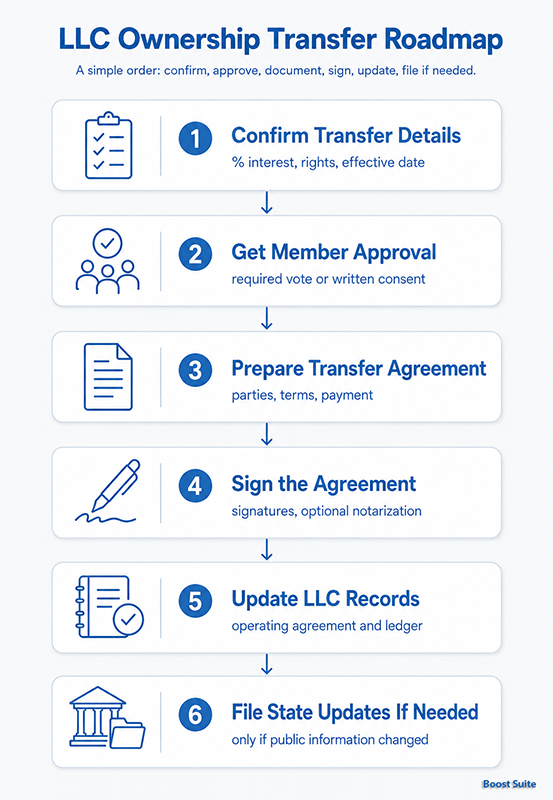
Step 1: Confirm the membership interest being transferred
Start by writing down exactly what is changing. This prevents disputes later and makes your paperwork consistent.
At minimum, confirm:
- Percentage being transferred (full or partial)
- Whether it includes voting rights, economic rights, or both
- Effective date (when the new owner is treated as the owner)
- Any class structure (Class A, Class B, manager-managed vs member-managed)
We recommend matching these details to your existing membership ledger so your “before vs after” ownership is clear.
Step 2: Get approval from the required LLC members
Next, get the approval that your operating agreement (or state default rules) requires. Do this before anyone signs the transfer agreement.
Your approval record should state:
- Who approved and in what capacity (member, manager, or both)
- The vote threshold required and the vote result
- The core terms being approved (buyer, percentage, effective date)
Step 3: Prepare a membership interest transfer agreement
This is the core legal document that proves the transfer. It can be simple, but it should be specific.
Common sections to include:
- Parties, LLC name, and the interest being transferred
- Price (or gift language) and payment terms
- Effective date and closing mechanics
- Representations (seller owns the interest, no undisclosed liens)
- Signatures and any required exhibits
Step 4: Sign the transfer agreement
Have all required parties sign, including any spouse consent if your agreement or local practice expects it.
Also decide whether you want extra proof steps:
- Notarization (not always required, but can help if disputes arise)
- Witness signatures (optional)
- Written acknowledgment by the LLC (often helpful)
Step 5: Update the operating agreement and membership ledger
This step is what makes your internal records “true” going forward. Many problems happen because people sign a transfer, then forget to update the LLC’s book.
Update:
- The membership ledger (ownership before and after)
- The operating agreement (member list, voting percentages, capital accounts if applicable)
- Manager or officer lists if your LLC uses them
Step 6: File state updates if public LLC information changes
Not every ownership change needs a state filing. Some states do not collect member-owner info at all, and keep ownership strictly as internal records. For example, Delaware notes that alternative entities are not required to list members or managers, and Delaware LLCs do not file annual reports.
You are more likely to need a filing when the transfer triggers a change in public records, such as:
- Registered agent or registered office
- Principal office or mailing address
- Manager information in states that collect it
For example, the California Secretary of State says an updated Statement of Information should be filed when information changes between filing periods.
Need help updating LLC records and state filing details?
An LLC ownership transfer is mostly handled through internal documents, but it can still trigger public record updates if your registered agent, registered office, mailing address, principal office, or manager information changes. Northwest Registered Agent is a strong option if you want privacy-focused registered agent service, straightforward filing support, and real human help keeping your LLC records organized after the transfer.
Documents Needed to Transfer LLC Ownership
Most ownership transfers go smoothly when your paperwork proves 2 things: the LLC approved the change, and your internal records match what was signed.
Membership interest transfer agreement
This is the main document that actually transfers the ownership interest. It should clearly state:
- Who is transferring and who is receiving
- What percentage (or units) is being transferred
- Whether voting rights transfer, or only economic rights
- The effective date
- The purchase price and payment terms (or gift language)
We recommend adding a simple “records update” clause that requires the LLC to update its ledger and operating agreement as part of the same closing.
Written member consent or meeting minutes
This is your proof that the LLC approved the transfer under the operating agreement (or default state rules). Keep it simple, but specific:
- Date of approval
- Who voted or consented
- The threshold required and the result
- What was approved (buyer, percentage, effective date)
Updated operating agreement
After the transfer, your operating agreement should reflect reality. Typically, you update:
- Member list and ownership percentages
- Voting rights and profit-sharing ratios (if they change)
- Any manager appointment language (if it changes)
Updated membership ledger
This is the internal “source of truth” most banks, accountants, and buyers will ask for. At minimum, your ledger should show:
- Ownership before and after
- Transfer date and reference to the signed agreement
- Signatures or certification (optional but helpful)
If your LLC also issues certificates, an ownership certificate can support the ledger by showing the member’s interest, units, or percentage in a more formal format.
State Filing Requirements After an LLC Ownership Transfer
This is the part people overdo. In many cases, the ownership change is handled internally, and the state only needs an update if your public record information changed.
When a state amendment may be required
You are more likely to need an amendment (or similar update filing) when the ownership transfer triggers a change to public-facing LLC information, such as:
- Manager-managed vs member-managed structure
- Names of managers (in states that display them)
- Principal office address, mailing address, or registered agent information
Different states use different forms and names, so the safest approach is to check your Secretary of State business portal for “update” and “amendment” options.
If the transfer also changes the principal office, mailing address, or where official correspondence is received, it is worth confirming your LLC business address rules before filing the update.
When ownership changes can be reported in the annual report
Some states let you update a lot of business information through the annual report process, which can be the simplest path when the portal supports it. For example, Connecticut notes that you can change most business information on the annual report, and some items can be changed on formation documents depending on entity type.
When no state filing is usually needed
In many states, ownership percentage changes that do not affect what the state tracks publicly are handled internally only. In other words, your transfer agreement, approvals, and updated ledger are the compliance record.
As a general pattern, Secretaries of State describe “maintenance” filings like annual reports and corrections as the tools for keeping the public record current, not for documenting every internal ownership change.
Tax and EIN Rules After Transferring LLC Ownership
EIN and tax treatment are connected, but they are not the same thing. The key is whether the LLC’s tax classification or the underlying “tax entity” changed.
For example, when an LLC ends up with one owner, you may need to confirm whether it is treated as a disregarded entity LLC for federal tax purposes.
When a new EIN may be required
The Internal Revenue Service explains that you generally need a new EIN when you change your entity’s ownership or structure, depending on entity type.
Common transfer situations that can trigger a new EIN include:
- A single-member LLC becomes a multi-member LLC (taxed as a partnership by default)
- A multi-member LLC becomes a single-member LLC (taxed as a disregarded entity by default)
- The LLC is terminated and a new entity is formed (even if the business looks “the same” operationally)
IRS Publication 5845 also summarizes scenarios where a new EIN is required (and where it is not), organized by entity type.
When the existing EIN may stay the same
In many cases, the EIN stays the same because the business entity continues and the tax classification does not change. The IRS notes, for example, that partnerships generally do not need a new EIN for an ownership change that does not result in the termination of the partnership.
We recommend confirming this with your accountant using 2 facts: the LLC’s current tax filing status, and what it will be after the transfer.
When to update the IRS responsible party
If the person who ultimately owns or controls the entity changed, you may need to update the IRS “responsible party” record. The IRS says you use Form 8822-B to report a responsible party change, and that changes must be reported within 60 days.
The IRS instructions for Form SS-4 define “responsible party” as the person who ultimately owns or controls the entity or exercises ultimate effective control.
FAQs About Transferring LLC Ownership
These answers cover the most common “what if” questions people run into during an LLC ownership transfer. Because LLC rules vary by operating agreement and state law, use these as a checklist, then confirm details on your state’s official business portal and the IRS pages linked below.
Can you transfer ownership of an LLC to another person?
Yes, in most cases you can transfer an LLC ownership interest to another person, but the transfer is usually controlled by your operating agreement and may require member approval. The SBA explains that an operating agreement governs an LLC’s internal operations and acts like a binding contract among members, which is why transfer limits and approval rules often live there. We recommend documenting the deal in writing and updating the membership ledger immediately so your internal records match what was agreed.
Can you transfer only part of your LLC ownership?
Yes, partial transfers are common, but they need extra clarity. Before you sign anything, confirm whether you are transferring only economic rights (profits and distributions) or also voting rights, and whether the buyer becomes a full member or just an assignee under your LLC rules. Operating agreements commonly define how percentages, voting, and admissions work. We recommend updating your membership ledger with “before and after” ownership percentages and the effective date so there is no confusion later.
Do all LLC members have to approve the transfer?
Not always. The required approval depends on your operating agreement, and if it is silent, your state’s default LLC statute usually fills the gap. The practical point is that many LLCs require some level of consent before a new person can become a full member with voting rights, even if economic rights can be transferred more freely. Because the operating agreement governs internal decision-making and member obligations, it is the first place to check for the exact threshold.
Do you need to file with the state to transfer LLC ownership?
Sometimes, but often not just for a change in ownership percentages. Many states focus on keeping the public record current, and updates are typically required only when information the state tracks changes, like addresses, registered agent, or managers in states that collect them. For example, a Secretary of State portal may describe the annual report as a way to affirm or update recorded business information. We recommend checking your state portal’s “update” and “annual report” options and filing only what is needed to keep public info accurate.
Does transferring LLC ownership require a new EIN?
It depends on what changed. The IRS says you generally need a new EIN when you change your entity’s ownership or structure, and it provides an LLC-specific section with examples of when you do and do not need a new EIN. If the transfer does create a new requirement, use an IRS-compliant process to apply for a new EIN before updating banks, licenses, or payroll systems. Even when a new EIN is not required, you may still need to update the IRS “responsible party” if control changed. The IRS notes that responsible party changes are reported on Form 8822-B and must be reported within 60 days.
- Internal Revenue Service: Form 8822-B – Change of Address or Responsible Party
- Internal Revenue Service: Instructions for Form SS-4 – Responsible Party Definition (PDF)
- Financial Crimes Enforcement Network: Beneficial Ownership Information Reporting
- Delaware Code Online: Limited Liability Company Act – Assignment of LLC Interests
- Delaware Division of Corporations: LLC/LP/GP Franchise Tax Instructions
- Connecticut Business Services: Update a Previously Submitted Business Form
Manage Your LLC Ownership Change with Harbor Compliance
Harbor Compliance helps LLC owners stay on top of state compliance requirements, registered agent updates, and business filing obligations during ownership changes.