

Wondering whether you need to file a Missouri LLC annual report? You don’t. As of 2026, Missouri doesn’t require one from limited liability companies, period. After forming a Missouri LLC, the real compliance work runs through the registered agent, DOR taxes, and records. Here’s what actually matters.
Does Missouri Require an Annual Report for LLCs?
No. Missouri does not require LLCs to file an annual report with the Secretary of State.
The Missouri Limited Liability Company Act, codified at Chapter 347, RSMo, contains no annual report provision. Corporations file a corporate registration report under Section 351.120, RSMo, but that statute doesn’t reach LLCs.
The Missouri Secretary of State’s Annual and Biennial Registration Reports portal covers corporations and nonprofit corporations only. It’s not built for LLCs, and skipping it is the right call.
I treat Missouri as one of the cleanest no-annual-report states for LLCs, but the Secretary of State’s portal name still throws owners off. “Annual and Biennial Registration Reports” sounds like it should apply to every business entity. It does not.
In practice, the Jefferson City Corporations Division has to redirect LLC owners away from that workflow all the time. If your entity is a Missouri LLC, that portal is not yours to use.
Missouri LLC Compliance: Registered Agent, DOR Taxes, and Records
A Missouri LLC has real compliance work that runs year-round, even without an annual report. The duties fall into three buckets: the registered agent, tax filings with the Missouri Department of Revenue, and internal records.
Maintaining a Missouri Registered Agent
Section 347.030, RSMo requires every Missouri LLC to maintain a Missouri registered office and registered agent without a gap. Section 347.033 sets the default rule: if the agent lapses, the Secretary of State becomes agent for service of process automatically, which means lawsuit paperwork lands at the SOS instead of the owner’s inbox.
Most owners either appoint themselves or hire a Missouri registered agent service to keep the address stable. Section 347.183, RSMo lets the Secretary of State cancel an LLC on several grounds, including failure to file required Chapter 347 documents, failure to maintain a registered agent, unpaid filing fees, fraud, false statements, or criminal-law violations. Each cancellation requires 30 days’ written notice before it takes effect. Without a recurring state filing, the LLC has to track agent status internally because nothing on the SOS side flags a lapse.
Keep Your Missouri LLC Covered with Northwest Registered Agent
Northwest helps your Missouri LLC maintain a reliable registered agent and stable registered office, so service of process and state notices don’t get missed.
Missouri Department of Revenue Filings
Tax obligations depend on activity, and they don’t run on a single schedule. A Missouri LLC may need to register with the Missouri Department of Revenue for sales tax, vendor’s use tax, consumer’s use tax, withholding tax, or unemployment tax. Registration runs through MyTax Missouri online or via Form 2643 on paper, with filing frequency varying monthly, quarterly, or annually based on volume.
LLCs with an open Missouri withholding account file Form MO-941 on the schedule the DOR assigns at registration, and a zero return is still required for periods with no withholding. Skipping a zero return triggers DOR notices that pile up fast. Missouri’s retail sales license workflow connects to a Certificate of No Tax Due, which the DOR issues free of charge and which certain local license renewals require before issuance.
Internal LLC Records and Local Licenses
Section 347.091, RSMo lists the internal records every Missouri LLC must keep: member and manager lists, articles of organization, a written operating agreement if one exists, tax returns, and financial statements. Though no state agency reviews these on a schedule, they surface fast in litigation, sales, lending, and audits. A current Missouri operating agreement sits at the center of this record set.
Local rules vary by location. In the City of St. Louis, LLCs operating inside city limits owe a business earnings tax. Other Missouri municipalities, professional licensing boards, and county offices each set their own renewal cycles, and none of those filings runs through the Secretary of State. That’s why Missouri’s no-AR setup can mislead owners: nothing on the state side reminds them that compliance doesn’t stop at formation.
Who Actually Files an Annual Report in Missouri (And Why LLCs Don’t)
Most of the Missouri annual report confusion comes down to entity type. After incorporation, formation, or registration, only some Missouri entities file recurring state reports. LLCs aren’t on that list.
Four Missouri entity types create most of the search-result mixups, and each is treated differently under state law:
- Corporations: file a corporate registration report annually under Section 351.120, RSMo, or biennially under Section 351.122 (current fees on the SOS schedule)
- Nonprofit corporations: file annual or biennial registration reports under Chapter 355, RSMo
- Limited liability partnerships and LLLPs: file separate renewals under Chapters 358 and 359, RSMo
- Limited liability companies: no filing
The Missouri Secretary of State’s reports portal is built for those first three groups. When LLC owners land there, they’re looking at the wrong workflow. Corporations face administrative dissolution under Section 351.484, RSMo for missed registration reports. LLCs face administrative cancellation under Section 347.183 for entirely different grounds, none of which include a missed annual report.
I have watched founders pay a third-party filing service to submit a Missouri LLC annual report that does not exist. The clerk does not refund those service fees, and the filing company rarely admits that the filing was never real for an LLC.
Before I let anyone pay for a Missouri annual report service, I always start with the entity record itself. Look up the business directly through the Missouri business entity search and confirm the registration type before entering payment details anywhere else.
- If the listing says LLC, no Missouri annual filing is due.
- If it shows a corporation, a registration report may apply.
- If it shows a nonprofit corporation, a registration report may also apply.
Missouri LLC Annual Self-Audit: 6 Items to Verify Each Year
Without a state filing to force the issue, a yearly self-audit carries the weight an annual report normally would. There’s no SOS reminder, no deadline notice in the mail. The six items below cover the high-risk gaps that show up in real Missouri LLC files.
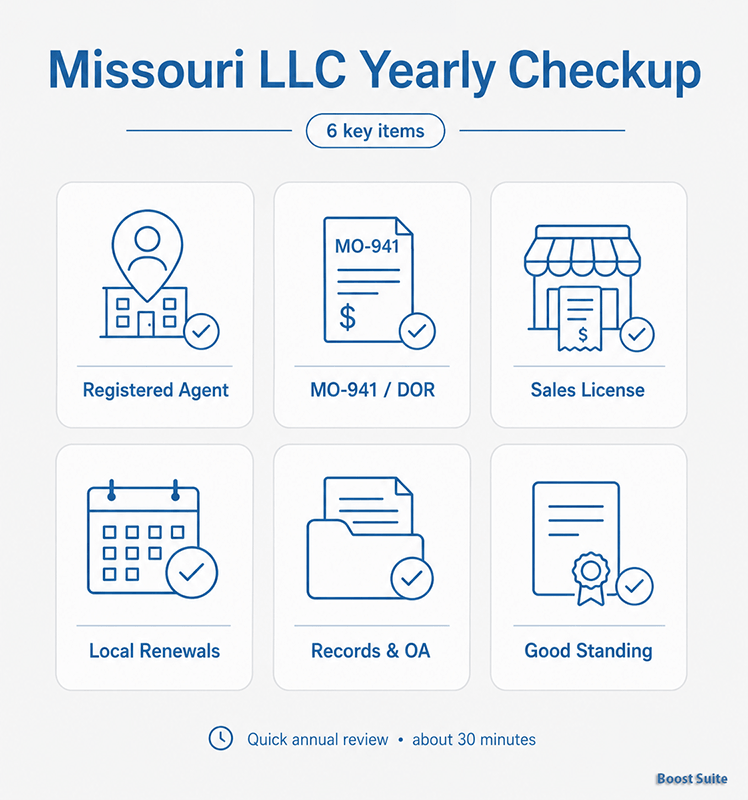
- Registered agent active, with registered office address current and matching the agent’s physical location
- DOR accounts in good standing, including zero-return Form MO-941 if a withholding account is open
- Retail sales license valid if the LLC collects Missouri sales tax
- Local renewals complete (city business license, county permits, professional licenses)
- Internal records updated per Section 347.091, RSMo: member list, operating agreement, financials
- Certificate of Good Standing available if a bank, lender, or out-of-state filing requests one (current fee on the SOS schedule)
Working through this list once a year takes about 30 minutes and avoids the painful reinstatement work that follows administrative cancellation.
Missouri LLC Annual Report Questions Owners Ask Most
The questions below come up in nearly every Missouri LLC consultation Boost Suite handles. Short answers first, with statute references where the law sets the rule.
Does Missouri require an annual report for LLCs?
No. Chapter 347, RSMo contains no annual report requirement for limited liability companies, and the Missouri Secretary of State publishes no LLC annual report form. Only corporations and nonprofit corporations file registration reports.
Is there a Missouri LLC annual report fee or annual franchise tax?
No on both. The annual report fee for a Missouri LLC is $0 because no filing exists. Missouri’s corporate franchise tax was repealed years ago, so there’s no current state-level annual LLC franchise tax for limited liability companies either.
What happens if a Missouri LLC misses a tax filing or loses its registered agent?
Section 347.183, RSMo lets the Secretary of State administratively cancel an LLC on several grounds, including failure to file required Chapter 347 documents, failure to maintain a registered agent, or unpaid filing fees. The state gives 30 days’ written notice, and the LLC may appeal the proposed cancellation to circuit court within 30 days after that notice. A cancelled LLC continues to exist but can’t conduct ordinary business beyond winding up.
How do I change my Missouri LLC registered agent?
File Form Corp. 59 (Statement of Change of Registered Agent or Registered Office) with the Secretary of State, per the current SOS fee schedule. The change takes effect on filing, and online submission is faster than mail. The Missouri LLC processing times page tracks current SOS turnarounds.
How do I reinstate an administratively cancelled Missouri LLC?
File a reinstatement application under Section 347.183, RSMo. The statute requires the application to include the LLC name, the effective date of cancellation, a statement that the grounds for cancellation never existed or have been eliminated, supporting documentation, and confirmation that the LLC name still satisfies Section 347.020. The statutory base fee is $100, plus delinquent fees, penalties, and other charges the Secretary determines are owed. If approved, the Secretary issues a certificate of reinstatement, and the reinstatement relates back to the cancellation date as if it had never happened. Processing time is best confirmed with the Missouri Corporations Division directly.
- Missouri Secretary of State, Annual and Biennial Registration Reports
- Missouri Secretary of State, Fees & Forms
- Missouri Revisor of Statutes, Chapter 347 (LLC Act)
- Missouri Revisor of Statutes, Section 347.183 (Reinstatement)
- Missouri Revisor of Statutes, Section 351.120 (Corporate Registration Report)
- Missouri Department of Revenue, Business Tax Registration
- Missouri Department of Revenue, No Tax Due System
Keep Your Missouri LLC Compliant with Harbor Compliance
Harbor Compliance helps your Missouri LLC stay organized year-round with reliable Registered Agent service and compliance support, even in a state with no LLC annual report requirement.