

When your LLC’s “on file with the state” information changes, you usually update it by filing an LLC amendment (your state may call it a Certificate of Amendment or Amendment to Articles of Organization). This matters because banks, licensing agencies, and partners often rely on your state record to confirm your LLC’s legal name and other formation-level details. If your internal paperwork says one thing but the state record says another, you can end up with avoidable delays.
Key Takeaways: LLC Amendment (Short Version)
A quick scan before the details.
A state filing that updates what your LLC has “on record” in its Articles of Organization (or equivalent).
Often “Certificate of Amendment” or “Amendment to Articles of Organization,” depending on the state.
Changes that were included in your original state filing, especially a legal name change.
Internal governance updates that belong in your operating agreement.
What Is an LLC Amendment?
An LLC amendment is a document you file with your state to update the LLC information that appears in your formation filing, typically your Articles of Organization (or the state’s equivalent document name).
States use different terminology, but the concept is consistent: you are updating your LLC’s official state record.
What an LLC amendment changes
An LLC amendment changes items that are part of your LLC’s state-filed formation record.
In practical terms:
- It updates the public, state-level “profile” of your LLC, not your day-to-day operating rules.
- It is typically used for changes that the state allows inside the original formation document, such as a lawful name change.
A helpful reality check: if the information is not included in your state formation document, an “amendment” may not be the right filing for that change.
How it connects to your Articles of Organization
Your Articles of Organization (or equivalent, uch as a Certificate of Organization in some states) are the filing that created your LLC in the state’s records. An LLC amendment is the follow-up filing that updates those same records when something you originally recorded needs to change.
Two details are worth knowing early:
- You generally can only amend what is lawful to include in the Articles in the first place.
New York, for example, explains that Articles can be amended to amend or add provisions that may be lawfully contained in the initial Articles, including a name change. - States often publish a specific amendment form and expect you to reference your LLC’s state ID number and the exact new text.
California’s LLC-2 form, for example, asks for the LLC entity number and the proposed new LLC name exactly as it should appear in state records.
Approach it with a “state record correction” mindset: be precise, match names exactly, and only change what you need to change.
LLC amendment vs. operating agreement amendment
These two updates solve different problems:
– Your LLC amendment updates the state’s official record.
– Your operating agreement governs the LLC’s internal operations and member rules.
Here is the clean way to compare them:
| Category | LLC Amendment (State Filing) | Operating Agreement Amendment (Internal Document) |
|---|---|---|
| Main purpose | Updates what the state has “on file” for your LLC | Updates how the LLC is run internally |
| Where it is filed | With the state agency that handles business entities | Usually not filed with the state |
| What it commonly affects | Formation-level details that are recorded in the Articles (or equivalent) | Ownership terms, voting, profit splits, management rules, internal procedures |
| Source reference | States describe amending Articles by filing an amendment document | SBA describes operating agreements as governing internal operations and decisions |
When Do You Need to File an LLC Amendment?
You usually file an LLC amendment when the change you want to make affects your LLC’s state-filed formation record (your Articles of Organization, Certificate of Formation, or a similar document name). In general, states limit amendments to provisions that can be lawfully included in the original formation filing.
Changing your LLC’s legal name
A legal name change is one of the most common reasons to file an amendment. In many states, the name change is handled through an amendment filing (or a closely related state form that updates the name shown on the formation record).
As a quick way to avoid filing the wrong document, check these items first:
- Your current formation record or entity record shows the existing legal name
- The state’s amendment instructions include a field or section for the new legal name
- Your LLC approved the name change internally (per your operating agreement)
If this is your main reason for filing, it helps to review the practical steps for changing your LLC name before you prepare the state form.
Changing information listed in your formation documents
If the detail you want to change appears in your formation document (or is pulled directly from it into the state’s record), an amendment is often the correct filing. What is listed varies by state, but it commonly includes formation-level items such as management structure and certain statements you chose to include at formation.
Match the change to the exact field on your state’s amendment form. If the amendment form does not give you a place to change it, your state may handle that update through a different filing type.
Updating optional provisions included in your original filing
Some LLCs include optional or customized provisions when they form the company, such as a specific duration or additional statements that the state allows in the formation document. If you included something like that and it now needs to change, an amendment is often the clean way to update the state record because it edits what was originally filed.
Update State-Filed LLC Details with ZenBusiness Amendment Service
ZenBusiness can help you file an LLC amendment when changes like a new legal name or formation-record update need to be officially recorded with the state.
What Information Can Usually Be Changed with an LLC Amendment?
In most states, an LLC amendment is designed to update items that are part of the formation record, especially items that were originally filed with the state. The easiest way to stay accurate is to compare your current state record with the fields your state’s amendment form actually supports.
Common changes an amendment often covers:
- Legal LLC name
Usually the most common amendment. If your state record needs to show a different legal name, the amendment filing is often the tool. - Business purpose or duration (only if listed)
Some LLCs have purpose or duration language on file because it was included at formation. If your current record includes it, an amendment may be used to update it. - Management structure (only if listed)
If your formation record shows whether the LLC is member-managed or manager-managed, an amendment may be the filing that updates that public record. - Other provisions already recorded with the state
If you added optional statements or special provisions in your original filing (and they are still allowed), an amendment may be the clean way to revise the text on record.
What Changes May Not Require an LLC Amendment?
Not every update goes through an “amendment.” Many states use separate maintenance filings for certain changes, and some states handle updates through periodic reports, statements of information, or a dedicated “change” form.
Common changes that often use a different filing:
- Registered agent updates
Many states treat registered agent and registered office changes as their own filing type, separate from an amendment.
If the update is about who receives legal notices for the company, start by confirming what a registered agent does for an LLC before choosing the correct state form. - Principal office or mailing address changes
Address updates are frequently handled through a periodic update filing (often called a statement of information) rather than an amendment.
This is especially important when the update involves your LLC’s principal office, because states may treat that address differently from a general mailing address. - Member or ownership changes
Ownership percentages and profit splits are usually internal matters. Even if a state database displays certain names publicly, the ownership terms themselves are typically handled in your internal documents, not through an amendment.
If the update involves selling, adding, or removing an owner, follow a proper LLC ownership transfer process before assuming a state amendment is required. - Internal operating agreement updates
Operating agreement changes usually do not require a state filing because operating agreements govern internal operations and are often not filed with the state.
How to File an LLC Amendment
An LLC amendment is usually a straightforward state filing, but mistakes happen when people amend the wrong thing or copy the wrong wording. Treat it like a records update project: confirm what the state currently shows, get internal approval, then file a clean amendment that matches your state’s form requirements.
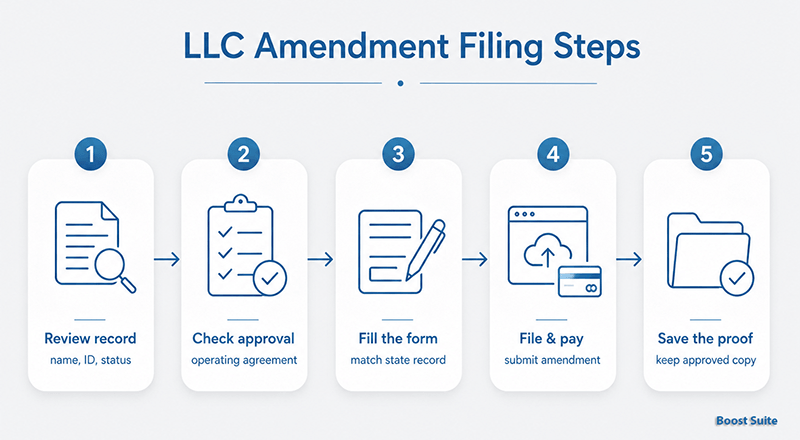
Review your current LLC state record
Start by pulling your LLC’s current record in your state’s business database so you can confirm the exact wording on file and your entity ID.
Not sure where to check? Start with our business entity search guide.
To make the review fast, look for these basics first:
- Your LLC’s exact legal name as shown in the state record
- Your entity ID or file number
- Entity status (active, suspended, dissolved)
- Any formation document details that your state displays publicly
Most states provide an official online portal where you can search for your LLC and retrieve public records.
Confirm the change is allowed by your operating agreement
Before you file with the state, confirm the change is approved internally under your operating agreement. The operating agreement is designed to govern internal decisions and rules for the LLC.
For a quick internal-approval checklist, confirm:
- Who must approve the change (members, managers, or both)
- What vote threshold applies (simple majority, supermajority, unanimous)
- Who is authorized to sign and submit the state filing
Some states bake this concept into the amendment itself. For example, Texas Form 424 includes a “Statement of Approval” section confirming the amendment was approved as required by law and the entity’s governing documents.
Complete the state amendment form
Most states provide a dedicated amendment form and expect you to follow the format closely.
In general, your state’s amendment form will ask for items like your entity number and the exact updated text you want recorded. Some amendment forms are very explicit that a new LLC name must be listed exactly as it should appear on the state record, including the correct way to write LLC after your company name, such as LLC, L.L.C., or another designator your state accepts.
Before you submit, do a final accuracy pass and verify these items line by line:
- Entity name and ID match the state record exactly
- The amended text is written exactly how you want it recorded
- Any required designator is included (LLC, L.L.C., or the equivalent required by your state)
- Signer name and capacity match what your state expects
Submit the amendment and pay the filing fee
Filing methods depend on the state, but online submission is often the fastest route when available. Follow your state’s official portal instructions for filing and payment, and keep the submission confirmation page or receipt.
Keep the approved amendment with your LLC records
Once approved, keep the filed amendment with your core LLC documents (formation record, operating agreement, tax and licensing records). If a bank or agency asks for proof, you may need an official copy from the state, so it helps to know where your state lets you order records and copies.
Keep LLC Record Updates Organized with Northwest Registered Agent
Northwest Registered Agent helps you maintain a reliable registered agent address, receive state notices, and stay organized when your LLC’s official records need updates.
LLC Amendment Cost, Filing Methods, and Processing Time
Costs and timing are state-specific, and the safest approach is to check your state’s official fee schedule and processing updates right before you file.
State filing fees
Fees vary widely by state and sometimes by entity type. Here are a few official examples to show how different it can be:
| State (Example) | Official Reference | Example Filing Fee |
|---|---|---|
| California | LLC-2 form | $30 |
| New York | Certificate of Amendment (Domestic LLCs) | $60 |
| Texas | Texas SOS fee schedule (Form 424, most Texas entities) | $150 |
Online, mail, and in-person filing options
Most states support at least 1 filing route, and many support multiple options.
A practical way to think about methods:
- Online: Often fastest and sometimes prioritized.
- Mail: Common option, usually processed in date order received.
- In-person drop-off: Sometimes available and may involve an added handling fee.
- State portal systems: Many states route online filings through an official business filing portal managed by the Secretary of State or a similar business services office, often with account login and a guided form workflow.
Standard vs. expedited processing
Processing time varies widely by state and by filing method. Some states offer expedited processing for an extra fee, while others only process filings in standard order.
What to Do After Your LLC Amendment Is Approved
Approval is not the finish line. The value comes from making sure your real-world operations match what the state now shows.
Update your operating agreement and internal records
After the state approves the change, update your operating agreement and internal records so they match your new official details. The SBA describes operating agreements as the document that governs internal operations and decisions, so it should reflect major changes like a legal name update.
A simple internal “amendment packet” should include:
- The approved, stamped amendment (or filing confirmation)
- The updated operating agreement pages (if applicable)
- A short internal note describing what changed and the effective date
Notify banks, licenses, vendors, and tax agencies when needed
Not every amendment triggers notifications, but name and address changes often do. This is where delays commonly happen, especially with banking and tax accounts.
Here’s a practical checklist you can run through:
- Banks and payment processors: Update the legal name on accounts and merchant profiles, and make sure your approved amendment matches the records used for your LLC business bank account.
- Business licenses and permits: Update any state or local registrations tied to the old name
- Key vendors and contracts: Update W-9 requests, contracts, and vendor onboarding profiles
- IRS (when applicable): The IRS has specific instructions for notifying them of a business name change depending on how the business files taxes (for example, partnership and corporation return workflows).
- IRS address and responsible party changes: Use Form 8822-B for business address or responsible party changes tied to your EIN.
Use the updated LLC information consistently
Once the state record changes, use the updated information everywhere you present your company publicly. Consistency prevents mismatches that slow down banking, licensing, and vendor verification.
To lock it in, update these common touchpoints:
- Invoices, proposals, and contract templates
- Your website footer, legal pages, and email signature
- Business profiles (directory listings, payment pages, booking pages)
- Any internal templates used by staff or contractors
LLC Amendment FAQs
LLC amendment rules are state-specific, but the core idea is consistent: you file an amendment to update what your state has “on record” in your formation document. When in doubt, check your state’s official amendment instructions and compare them to your current state record before filing.
What is an LLC amendment?
An LLC amendment is a state filing used to update certain information in your LLC’s formation document (often called the Articles of Organization or Certificate of Formation).
Think of it as updating the state’s official record of your LLC. It is not the same as updating internal policies or member rules, which typically belong in your operating agreement.
When do I need to file an LLC amendment?
You usually need an amendment when the change affects a provision that is part of your state-filed formation record and is legally allowed to be included in that record.
If the change is handled through a different maintenance filing (like a statement of information or a registered agent change form), an “amendment” may not be the right tool.
Can I change my LLC name with an amendment?
Yes, in many states a legal name change is handled through an amendment.
Start by confirming the exact new name meets your state’s naming rules, then updating your operating agreement and business systems only after the state approves the change.
Is an LLC amendment the same as changing an operating agreement?
No. An LLC amendment updates the state’s formation record. An operating agreement change updates the LLC’s internal rules.
The SBA explains that operating agreements outline financial and functional decisions and govern internal operations.
As a practical workflow, handle internal approval and operating agreement updates first, then file the state amendment when the formation record needs to change.
Do I need an LLC amendment to change my registered agent?
Often, no. Many states use a separate filing for registered agent changes.
For example:
– Texas uses a separate “Statement of Change of Registered Office/Agent” (Form 401).
– California’s LLC-2 notes that to change the agent for service of process, you file a Statement of Information (Form LLC-12), not the LLC-2 amendment.
Search your state site for “change of registered agent” before you assume it is an amendment, because the correct form is frequently different.
- U.S. Small Business Administration: Choose a Business Structure
- U.S. Small Business Administration: Basic Information About Operating Agreements
- U.S. Small Business Administration: Stay Legally Compliant
- Internal Revenue Service: Business Name Change
- California Secretary of State: Statements of Information Filing Tips
- New York Department of State – Division of Corporations: Certificate of Amendment for Domestic Limited Liability Companies
- New York State Senate: Limited Liability Company Law Section 211 – Amendment of Articles of Organization
Update Your LLC Records with Harbor Compliance
Harbor Compliance helps LLC owners manage amendment filings, update official state records, and keep business information accurate when names, addresses, members, or management details change.