

A foreign LLC is an LLC formed in 1 state that registers for authority to do business in another state. Here, “foreign” usually means out of state, not international. You typically need foreign LLC registration when you have ongoing business activity in the new state, such as an office, employees, regular clients, or repeated on-site operations.
Foreign LLC at a Glance
Key terms and filings you will see across most states.
| Foreign LLC | An LLC doing business outside its formation state |
|---|---|
| Home state | The state where the LLC was originally formed |
| Foreign state | The new state where the LLC wants authority to operate |
| Main filing | Application for Authority or Certificate of Authority (name varies by state) |
| Registered agent | Usually required in the foreign state |
| Good standing certificate | Often required from the home state |
| Ongoing compliance | May include annual reports, fees, and state tax filings |
What Is a Foreign LLC?
A foreign LLC is not a different type of LLC. It is the same company, but it has filed with another state to legally operate there. States commonly call this process foreign qualification, and the filing is often called an Application for Authority or Certificate of Authority.
If you need a quick refresher on the basic business structure before comparing domestic and foreign status, start with our plain-English guide to what an LLC is.
Domestic LLC vs Foreign LLC
- Domestic LLC: formed under a state’s laws (your formation state).
- Foreign LLC: formed somewhere else, then registered to “transact business” in the new state.
An LLC is domestic in the state whose law it was formed under, the state where it filed its Articles of Organization (or Certificate of Formation). The label is relative, not a separate type of company. An LLC formed in Delaware that registers to do business in Texas is a domestic LLC in Delaware and a foreign LLC in Texas, and it stays domestic in only one state however many registrations it adds.
Federal tax law uses “domestic” differently. Under Treas. Reg. § 301.7701-5, an entity created or organized in the United States or under the law of any state is domestic, so every LLC formed in a U.S. state is a domestic entity for the IRS, whoever owns it. A single-member LLC wholly owned by a foreign person is a “foreign-owned U.S. DE” in the Form 5472 instructions: still domestic, with its own reporting duty.
Benefits of a Domestic LLC in the State Where You Operate
Liability protection and tax classification come from being an LLC, so they’re the same whether the company is domestic or foreign in a given state. The difference is the number of state obligations. An LLC that is domestic in the only state where it operates has one formation filing, one registered agent, and one set of state reports and fees. Forming elsewhere doesn’t remove the obligations of the state where the business actually works; it adds a second state on top.
A business that operates only in Texas shows the gap. Formed as a Texas LLC, it pays the $300 Certificate of Formation fee once. Formed in Delaware instead, it pays Delaware’s formation fee and the $400 Delaware LLC annual tax due June 1, then registers in Texas as a foreign LLC for $750, and keeps a registered agent in both states.
When Do You Need a Foreign LLC Registration?
The practical test is whether your LLC will have repeated, ongoing business activity in a state outside its home state. Some states define this concept directly, and many warn that it depends on your specific facts.
Here are common situations that often trigger foreign registration:
- You have a physical location in the state (office, shop, workspace, warehouse).
- You have employees working in that state.
- You need to collect sales tax there (which can be tied to nexus rules depending on the state and sales channels).
- You need a state or local license/permit to perform the work in that state.
- You win a contract that requires in-state performance, like servicing a client on-site on an ongoing basis.
If you are unsure, check the foreign qualification guidance from the target state’s business filing office and confirm your facts with a qualified advisor. States often will not “pre-approve” whether you are transacting business.
If you are still deciding whether to expand, form, or operate beyond your home state, our guide on how to open a business in a different state gives the broader planning context before you focus on foreign qualification.
When You May Not Need a Foreign LLC Registration
Many states publish examples of activities that usually do not count as “transacting business” on their own, but the details can vary by state.
Common examples that often fall into the “not transacting business” bucket include:
- Defending or settling a legal proceeding
- Holding internal LLC meetings (members/managers) or handling internal affairs
- Maintaining bank accounts
- Selling through independent contractors
- Taking orders that are accepted outside the state
- Owning property without more activity
- A single, isolated transaction that is not part of repeated, ongoing in-state work
If your only connection to the state looks like the list above, you may not need to register. If you are building a real footprint (people, space, repeated operations), foreign registration becomes more likely.
How to Register a Foreign LLC
Foreign LLC registration is often called foreign qualification. The steps are similar in most states, but each state has its own rules, forms, and fees.
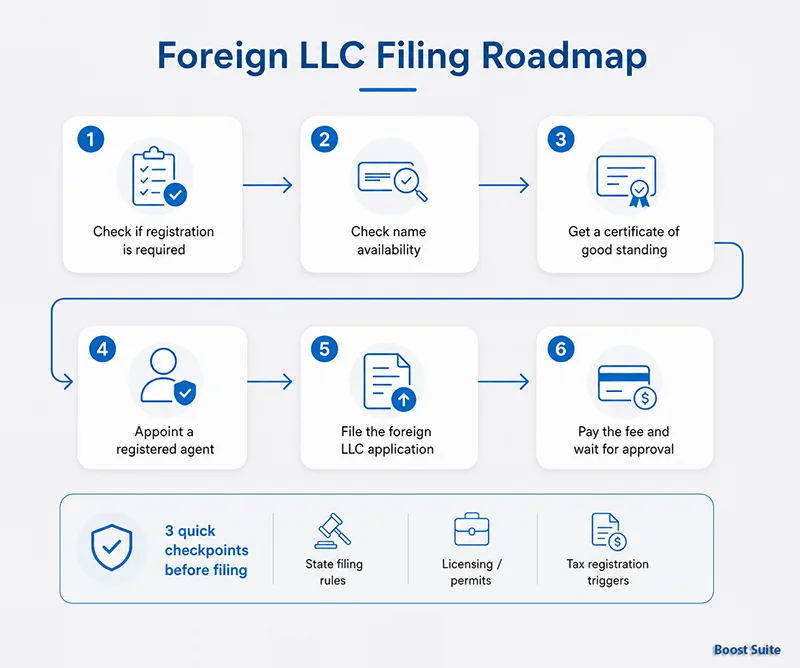
Step 1: Check Whether Foreign Registration Is Required
Start by confirming whether your activity counts as “doing business” (often called transacting business) in the target state. Many states explain this concept and also list activities that do not count.
We recommend checking these 3 areas before you file:
- The state business filing office’s guidance on foreign entities (or “certificate of authority”).
- Whether your activity needs an in-state license or permit (some states tie licensing to foreign qualification).
- Any state tax registration triggers (sales tax, payroll, etc.).
You should also separate foreign qualification from licensing, because our guide on whether your LLC needs a business license explains how local and industry rules can still apply even after the state entity filing is handled.
Step 2: Check LLC Name Availability
Next, run the business name search in the foreign state and confirm your LLC name can be used there. A broader business name availability check can help you spot conflicts before you prepare an alternate name or submit the foreign registration paperwork.
If your name is already taken, many states allow an LLC to register using an alternate name (sometimes called an assumed name or fictitious name), but the process depends on the state. For example, North Dakota allows a foreign LLC to apply under a name available in that state, and it notes that a trade name must be registered if the company uses a name different from its name in the jurisdiction of origin.
Step 3: Get a Certificate of Good Standing
Many states require proof that your LLC is active and compliant in its home state. This proof is usually called a Certificate of Good Standing, Certificate of Existence, or Certificate of Status.
Also watch the “freshness” rule: Wyoming requires the certificate to be dated not more than 60 days before filing, and Georgia requires an original certificate not more than 90 days old.
Step 4: Appoint a Registered Agent
Most states require a registered agent with a physical address in the foreign state, and your foreign application will typically ask for the agent’s name and address.
Step 5: File the Foreign LLC Application
The filing is commonly called an Application for Authority or Certificate of Authority.
Before submitting, prepare the key details the state usually requests, such as:
- LLC name (and alternate name, if needed)
- Home state and formation details
- Registered agent information
- Basic ownership or management information (varies by state)
Step 6: Pay the Filing Fee and Wait for Approval
Fees and processing times vary. Some states let you file online, and some offer expedited processing depending on the filing method.
Register Your Foreign LLC with Northwest
Northwest helps you foreign qualify your LLC, appoint a registered agent in the new state, and keep your expansion filing organized from start to approval.
How Much Does a Foreign LLC Cost?
Foreign LLC costs depend on the state and your situation, but the total is often made up of a few predictable items. The SBA notes that state registration costs are often under $300 in many cases, but fees vary by state and business structure.
In a few figures (typical cost items to plan for):
| Cost item | What it covers | Notes |
|---|---|---|
| State filing fee | The foreign registration filing (certificate of authority) | Varies a lot by state |
| Good standing certificate | Proof your LLC is active in the home state | Often required; must be “recent” in some states |
| Registered agent | Your in-state legal contact | Usually required in the foreign state |
| Optional expedite fees | Faster processing | Availability depends on the state and filing method |
Foreign LLC Ongoing Requirements
Foreign qualification is not a one-time task. After approval, you generally need to keep your registration active and stay compliant in both the home state and the foreign state.
One common recurring task is the state report or record update; our LLC annual report guide explains how these filings usually help keep your public business details current rather than serving as financial statements.
Annual Reports, Fees, and Registered Agent Requirements
Many states require foreign LLCs to keep a registered agent and file ongoing reports or records with fees. North Dakota, for example, describes revocation risk when a foreign LLC fails to file its annual report, maintain a registered agent and registered office, or file other required records.
We recommend setting a simple compliance checklist:
- Confirm annual or biennial report due dates (home state and each foreign state)
- Keep registered agent info current (address changes matter)
- Keep proof of good standing available if you operate in multiple states
If your LLC is registered in several states, comparing registered agent services for foreign LLCs can be more practical than managing separate local contacts and compliance reminders one by one.
What If You Stop Doing Business in the Foreign State?
If you stop operating in a state, many states let you file a withdrawal or cancellation to formally end your authority there. For example, North Dakota describes a certificate of withdrawal process for a foreign LLC that is no longer transacting business in the state.
What Happens If You Do Business Without Registering?
The consequences vary by state, but states often impose practical and financial penalties for “transacting business” without authority.
Common consequences include:
- Losing the ability to maintain a lawsuit in that state until you register (some states still allow defending a lawsuit).
- Civil penalties and possible court orders stopping you from continuing business until you comply.
- Late fees and back fees that can accumulate before approval.
Foreign LLC FAQs
Foreign LLC rules are state-specific, but the core idea is consistent: if your LLC is “doing business” in a state outside its formation state, you may need to register there. Below are quick answers to the most common questions, with official references where possible.
What is a foreign LLC?
A foreign LLC is an LLC formed in 1 state that registers for authority to do business in another state (often called foreign qualification). The filing is commonly called a Certificate of Authority or Application for Authority, depending on the state.
Do I need a foreign LLC for online business?
Not always. If your business is truly online-only and you do not have an in-state footprint (like employees, an office, or in-person operations), you may not be “transacting business” in that state, but the line is state-specific.
Many states publish examples of activities that typically do not count as transacting business, such as maintaining bank accounts, holding internal company meetings, or selling through independent contractors.
We recommend checking the target state’s Secretary of State “foreign entity” guidance first, because states define and enforce “transacting business” differently.
Is a foreign LLC the same as a foreign-owned LLC?
No. A foreign LLC is about where the LLC was formed versus where it operates (out-of-state registration).
A foreign-owned LLC is about who owns it, such as ownership by a non-U.S. person or foreign entity. That can trigger separate federal tax reporting rules in some situations, such as Form 5472 reporting for certain foreign-owned entities.
How much does it cost to register a foreign LLC?
It depends on the state. The SBA notes that foreign qualification usually involves filing a Certificate of Authority (or equivalent) and many states also require a Certificate of Good Standing from the formation state, with fees varying by state.
To see how different fees can be, Texas lists a $750 one-time registration fee for many foreign entities.
Can I have an LLC in multiple states?
Yes. You generally keep 1 “home state” LLC, then register that same LLC as a foreign LLC in each additional state where it needs authority to operate.
In practice, that often means you will maintain a registered agent and handle ongoing compliance in each state where you are registered.
What happens if I do not register my foreign LLC?
Consequences vary by state, but common results include financial penalties and legal limitations until you register. For example, Wyoming’s statute explains that a foreign entity transacting business without authority may be blocked from maintaining a court proceeding until it obtains authority.
Some states also assess late fees. Texas’ fee schedule notes that if a foreign entity transacts business in Texas for more than 90 days without registering, the late filing fee can be equal to the registration fee for each full or partial calendar year it operated without registration.
- U.S. Small Business Administration: Register Your Business
- Wyoming Secretary of State – Business Division: Foreign Certificate of Authority Guidance
- Wyoming Secretary of State – Business Division: Foreign LLC Certificate of Authority Application (PDF)
- Georgia Secretary of State: Register a Foreign Entity
- North Dakota Legislative Branch: Uniform Limited Liability Company Act (PDF)
- Texas Secretary of State: Foreign or Out-of-State Entities
- Texas Secretary of State: Form 304 – Foreign LLC Application for Registration (PDF)
Register Your Foreign LLC with Harbor Compliance
Harbor Compliance helps you handle foreign qualification filings, registered agent requirements, and state compliance when your LLC expands beyond its home state.