

Changing your LLC name is a legal update to your company’s official state record, not just a branding refresh. In most states, you do it by filing an amendment document (often called Articles of Amendment or a Certificate of Amendment) with your state business filing office. After the state approves it, you update key records like the IRS, your bank, and any licenses, contracts, and billing documents.
What Does It Mean to Change an LLC Name?
An LLC name change means you are amending the LLC’s official legal name on your state’s business registry. The company itself usually remains the same legal entity, but its official name on state records is updated once the amendment is approved. Because it is a legal change, you should plan to update important business records afterward, including your IRS name record and banking or licensing documents.
Here’s what this typically involves:
- The LLC continues as the same legal business entity (you are updating its state record, not forming a new company).
- The official name on state records changes once the amendment is approved.
- The EIN usually stays the same if the only change is the LLC’s name.
- You may need to update business records after approval, such as IRS records, bank accounts, licenses, and contracts.
LLC Name Change vs DBA
These are two different moves. An LLC name change updates your LLC’s legal name on the state’s record, while a DBA (trade name / assumed name) lets you operate under a public-facing name without changing the LLC’s legal name (a deeper LLC vs DBA comparison can help clarify the distinction). Requirements for DBAs vary by state and sometimes by county or city.
| Option | Best for | What changes? |
|---|---|---|
| LLC name change | You want to replace the LLC’s official legal name | State business record changes (legal name is updated) |
| DBA / trade name | You want to operate under another public-facing name | Legal LLC name usually stays the same (you are using an “assumed” name) |
Before You Change Your LLC Name
Before you file anything with the state, a few quick checks can prevent rejections, delays, and messy cleanup later.
Check Name Availability
In most states, your new LLC name must be available and distinguishable from other registered business names on the state’s records. A common best practice is to run a search in your state’s business database first, then decide whether you need to reserve the name (some states offer name reservations, others do not, and the rules vary).
Review LLC Naming Rules
States typically apply a few baseline naming rules. Here are the most common ones to watch for:
- An LLC designator is usually required, such as “Limited Liability Company” or “LLC.”
- The name must be distinguishable from other entities already on record.
- Restricted words can trigger extra approval, especially terms tied to regulated industries (for example, “bank” or “insurance”) or terms that imply a special status.
Before you file, it helps to review the common LLC business name rules so you understand designator requirements, distinguishability standards, and restricted words. Here are the most common ones to watch for:
Approve the Name Change Internally
Treat the name change like a formal business decision:
- If you have a single-member LLC, this may be as simple as a written decision you keep in your company records.
- If you have a multi-member LLC, you usually follow your operating agreement’s voting/approval rules (or your state’s default rules if your operating agreement is silent).
Overview of the LLC Name Change Process
The core process is similar across states: pick a compliant name, approve it internally, file an amendment with the state, then update your records after approval.
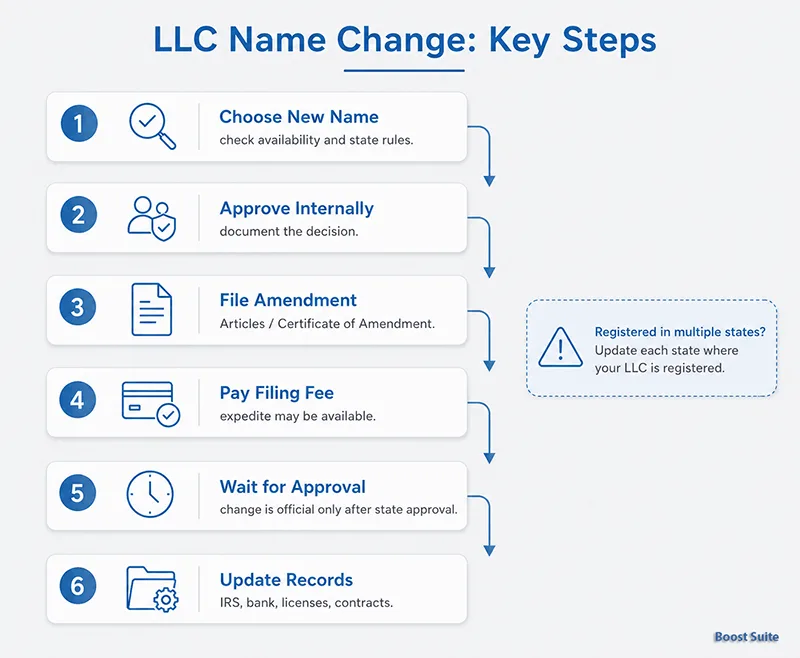
Step 1: Choose and Check the New LLC Name
Pick a name you can use for official business. Confirm it meets your state’s rules and is distinguishable in the state database before you file.
Step 2: Approve the Name Change
Follow your operating agreement (or your internal process) and document the decision. This keeps your state filing and your internal records aligned.
Step 3: File Articles of Amendment
File the amendment form with your Secretary of State (or equivalent state filing agency). Many states use one of these common form names:
- Articles of Amendment
- Certificate of Amendment
- Amendment to Articles of Organization
A name change is typically made official by filing the appropriate amendment document with the state.
Step 4: Pay the Filing Fee
Most states charge an amendment filing fee. Some also offer expedited processing for an additional fee.
Step 5: Wait for State Approval
Your LLC name is not legally changed until the state approves the amendment. Keep the approved document, confirmation page, or stamped copy as proof.
Step 6: Update Your Business Records
After approval, update key records so your new legal name matches across systems. For federal tax records, the IRS has a specific process for business name changes.
Start Fresh with an LLC from Northwest
Changing your LLC name can mark a new chapter, but if you’re forming a new business instead, Northwest helps you file your LLC paperwork, protect your privacy, and keep your business details organized from day one.
What Information Do You Need to File the Name Change?
Most states use an amendment form (online or paper), and the exact fields can vary. Still, these are the details you will almost always need ready before you start the filing.
- Current LLC name (exactly as it appears on the state record)
- New LLC name (including the required LLC designator, if applicable)
- State entity ID or filing number (for example, an entity number or state business ID)
- Date of internal approval, if your state asks for it (some forms do, some do not)
- Signature of an authorized person (member, manager, or other authorized signer depending on the form)
- Filing fee payment (the amount and payment method depend on the state)
- Filing method (online or paper, depending on what your state offers)
Changing an LLC Name in California or Florida
California’s name-only form asks for three entries: the LLC’s exact name on file, its Entity (File) Number, and the new name with an identifier such as “LLC” or “L.L.C.” (the Secretary of State adds “LLC” when it’s missing). A new business address, manager, or agent for service of process doesn’t go on this form. Those changes are made on the Statement of Information (Form LLC-12).
A Florida LLC changes its name by filing Articles of Amendment with the Division of Corporations. The new name has to be distinguishable on the Department of State’s records and end with “Limited Liability Company,” “L.L.C.,” or “LLC.” The Division of Corporations no longer offers name reservations or preliminary name searches, so the check before filing is a search of its records on Sunbiz. Under section 605.0207 of the Florida Statutes, the amendment can take effect on a later date, but no more than 90 days after filing.
Do You Need to Tell the IRS About an LLC Name Change?
Usually, yes. The IRS has a specific process for business name changes, and the action you take depends on how your LLC is taxed.
How you typically notify the IRS (based on tax filing)
Use this as a practical guide, then follow the IRS instructions for your filing situation:
| How the business files taxes | What the IRS generally says to do |
|---|---|
| Sole proprietorship (common for single-member LLCs taxed as a disregarded entity) | Write to the IRS at the address where you filed your return, signed by the owner or authorized representative. |
| Partnership (common for multi-member LLCs taxed as a partnership) | If filing a current-year Form 1065, check the name change box on the return. Otherwise, write to the IRS address where you filed, signed by a partner. |
| Corporation (LLC taxed as C corp or S corp) | If filing a current-year return, check the name change box on Form 1120 or Form 1120-S. If you already filed, write to the IRS address where you filed, signed by a corporate officer. |
Do you need a new EIN?
A name-only change usually does not require a new EIN. In general, the IRS ties a new EIN to changes in ownership or business structure, not a simple name update. For the IRS-side update, review the EIN name change process so your tax record matches the new legal name.
What to Update After Your LLC Name Change Is Approved
Once you have state approval, your goal is consistency. Use this checklist to update the records that most often cause friction when the old and new names do not match.
Tax and Government Records
Start with government records, since other institutions often rely on them.
- IRS business name record (follow the IRS name change process based on how your LLC is taxed)
- State tax agency accounts (sales tax, withholding, state payroll accounts, etc.)
- Local licenses and permits (city, county, or professional licenses)
Financial and Legal Records
These are the records most likely to block payments, deposits, renewals, or contract updates.
- Business bank account
- Payment processors (Stripe, PayPal, Square, merchant services)
- Insurance policies
- Contracts (clients, vendors, lease agreements)
- Vendor records (W-9 info on file, purchasing systems, portals)
Public-Facing Business Records
These updates reduce confusion for customers and help your documents match your legal name.
- Invoices and invoice templates
- Accounting software (legal entity name in settings)
- Website (footer, legal pages, invoices, terms)
- Email signature (and letterhead if you use it)
- Business profiles (Google Business Profile, directories, marketplaces)
- Client-facing documents (proposals, onboarding forms, statements of work)
Client and Vendor Notification
Notify clients or vendors if they pay your LLC, sign contracts, receive invoices, or search for your business by name. Keep it simple: explain that the legal name changed, but (if true) the ownership, services, payment terms, and contact details remain the same.
Build Your LLC with ZenBusiness from the Start
Updating records after a name change can take time. ZenBusiness helps new business owners form an LLC correctly, file key paperwork, and stay organized as the business grows.
How Long Does It Take and How Much Does It Cost to Change an LLC Name?
There is no single national timeline or price because it depends on your state, your filing method, and whether you choose expedited service. Many states publish general processing expectations and fee schedules, but they can still shift based on workload.
Processing Time
Processing time varies by state and by how you file. In general, online submissions are often processed faster than paper filings, and some states offer expedited options for an extra fee.
A practical way to think about timing is to split it into 2 phases:
- State approval time (how long it takes the state to accept and approve the amendment). States commonly note that turnaround depends on workload, and they may publish separate expectations for online vs paper.
- Transition time after approval (updating IRS records where applicable, banks, licenses, contracts, invoices, and client-facing materials). This part is usually what makes the “real-world” transition longer than the state approval itself.
Filing Fees
Most states charge an amendment filing fee to change an LLC’s legal name. Some also charge an optional expedited fee if you want faster handling, and you may also pay an optional filing service fee if you use a third party.
The state fee for a name-change amendment ranges from $25 to $150 in the four states below. Each figure comes from the state’s own form or filing instructions and covers the filing fee alone, without expedite or certified copy charges.
| State | Filing that changes the name | State filing fee |
|---|---|---|
| California | Amendment to Articles of Organization, Name Change Only (Form LLC-2-NA), on paper or on bizfileOnline | $30 |
| Florida | Articles of Amendment to Articles of Organization, filed with the Division of Corporations | $25 |
| New York | Certificate of Amendment (name change only), on paper or through BusinessExpress | $60 |
| Texas | Certificate of Amendment (Form 424) | $150 |
Beyond the state filing, plan for potential “secondary” costs, depending on your situation:
- Costs to update licenses and permits (state, county, city, or industry-specific)
- Admin or legal costs to update contracts (especially if you need amendments or formal notices)
- Branding costs (new signage, packaging, domain or email changes, printed materials)
Common Mistakes to Avoid When Changing an LLC Name
Most problems come from filing too early or forgetting a key update step. Here are the most common mistakes to avoid:
- Filing before checking name availability (can lead to rejection and delays)
- Confusing a DBA with a legal LLC name change (a DBA usually does not replace the legal name on the state record)
- Using the new legal name before state approval (your “official” name is not changed until the amendment is approved)
- Forgetting to update IRS records where applicable (the IRS has a defined process for business name changes)
- Not updating bank and payment accounts (mismatched names can create friction for deposits, payouts, and verification)
- Forgetting to notify clients or vendors when billing, contracts, or payments are involved (prevents confusion and delayed payments)
FAQs about Change LLC Name
These quick answers cover the most common questions readers have before and after filing a legal LLC name change. Always follow your state’s filing instructions, since form names, fees, and processing options vary.
What steps do I need to take to change my LLC name?
In most states, the path is straightforward and centers on filing an amendment with your state business filing office.
1. Choose a new name and check availability in your state database.
2. Approve the change internally (single-member decision or member vote based on your operating agreement).
3. File an amendment with your state (often called Articles of Amendment or Certificate of Amendment).
4. Pay the state filing fee (and expedited fee if you choose faster processing).
5. Wait for state approval before using the new legal name on official documents.
6. Update records after approval, starting with tax and banking systems (and notify clients/vendors if billing or contracts are involved).
How long does it take to process a name change?
Processing time depends on your state, its current workload, and how you file. Online filing is often faster than paper filing, and some states offer expedited options like 24-hour or same-day handling for an additional fee.
Also, the full transition usually takes longer than the state approval itself, because you still need time to update IRS records (when applicable), banks, licenses, contracts, and public-facing materials.
Are there any fees associated with changing my LLC name?
Yes, usually. Most states charge an amendment filing fee to update an LLC’s legal name. Depending on the state, you may also have optional costs like expedited processing or a third-party filing service fee.
In a few figures (official examples, fees vary by state)
– New York: $60 filing fee for a name-change-only Certificate of Amendment.
– Kansas: $35 filing fee for a Certificate of Amendment for most business types.
– California: Expedited options are listed for online filings, including 24-Hour Expedite ($350) (plus the underlying filing fee).
We recommend budgeting for follow-up costs too, such as updating licenses or permits, revising contracts, and replacing branding materials if you need new prints or signage.
Do I need to notify my clients about the name change?
If clients pay your LLC, sign contracts, receive invoices, or search for your business by name, you should notify them so payments and paperwork do not get delayed.
A simple approach that works well is:
– Tell them what changed: the legal name on state records
– Tell them what did not change: ownership, services, payment terms, and contact info (if true)
– Tell them what to update: invoices, vendor setup, ACH details, W-9 on file, contract name line (if applicable)
We recommend sending the notice right after state approval, then using the new legal name on invoices and contracts going forward.
Do I need a new EIN if I change my LLC name?
Usually no. The IRS generally says you do not need a new EIN if you only change the business name.
A new EIN is typically tied to changes in ownership or structure, not a name-only update.
Even when you do not need a new EIN, you may still need to update the IRS business name record using the IRS process for business name changes.
Is changing an LLC name the same as filing a DBA?
No. A legal LLC name change updates the LLC’s official name on the state record. A DBA (also called a trade name or assumed name) generally lets you operate under a public-facing name while the LLC’s legal name stays the same.
- Internal Revenue Service: Business Name Change
- U.S. Small Business Administration: Choose Your Business Name
- U.S. Small Business Administration: Register Your Business
- U.S. Patent and Trademark Office: Trademark Search
- California Secretary of State: LLC Amendment to Articles of Organization Name Change Only (PDF)
Rename or Start Your LLC with Harbor Compliance
Whether you’re updating your LLC name or launching a new business, Harbor Compliance helps you handle filings, compliance steps, and state requirements with confidence.