

An LLC can be worth it if you want personal liability protection plus tax flexibility without the heavier formalities of a corporation. It is a business structure created under state law, so the exact rules can vary by state.
LLC Benefits Overview for Business Owners
Before we dive into the detailed list, it helps to define what people mean by “LLC benefits” and what those benefits depend on. In this overview, we explain the practical advantages an LLC can offer and why many owners choose it as a simple legal structure for running a business.
What Are LLC Benefits?
LLC (Limited Liability Company) benefits are the practical advantages you get from using a state-recognized legal structure instead of operating as an individual or informal group. The big idea is separation: the LLC can help separate your business activities from you personally, and it also gives you flexibility in how the IRS treats the business for tax purposes.
If you need the basic definition first, start with what an LLC is: a Limited Liability Company structure that can help separate your business activities from you personally
Why Many Business Owners Choose an LLC
Many owners choose an LLC because it is a middle ground: liability protection similar to a corporation, with simpler day-to-day administration in many cases. We recommend thinking of an LLC as your “legal wrapper” first (protection and credibility), and then deciding how you want it taxed based on your business model and income level.
Main Benefits of an LLC
An LLC is popular because it can combine liability separation, pass-through-style taxation, and operational flexibility in one structure.
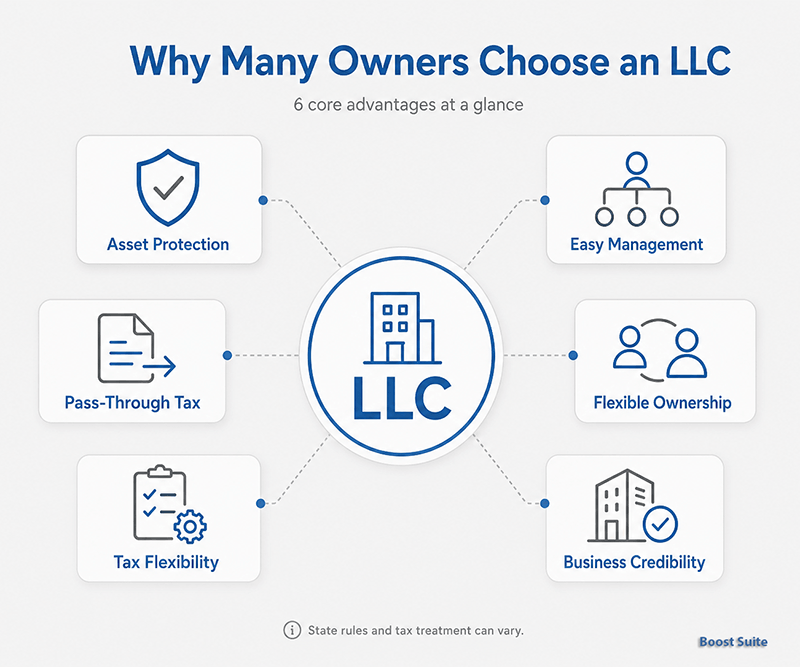
Personal Liability Protection
In most instances, an LLC helps protect your personal assets if the business faces debts, bankruptcy, or lawsuits.
We recommend treating the liability shield like a system you maintain, not a one-time benefit. A few practical habits help:
- Keep business and personal money separate (banking, cards, bookkeeping).
- Sign contracts in the LLC’s name (not your personal name).
- Stay current on state filings and fees so the LLC remains active.
Pass-Through Taxation
For many owners, the default tax setup is “pass-through” style, meaning profits and losses generally flow to the owners’ returns rather than being taxed first at the entity level.
Here’s the simplest way to think about the common IRS defaults:
| LLC setup | Common IRS default (income tax) | What that typically means |
|---|---|---|
| Single-member LLC | Disregarded entity | Reported on the owner’s return (commonly Schedule C, E, or F depending on activity). |
| Multi-member LLC | Partnership | Pass-through reporting unless the LLC elects corporate treatment. |
Flexible Tax Options
If the default tax classification is not ideal, eligible LLCs can elect how they are classified for federal tax purposes using Form 8832.
Some LLCs also pursue S corporation treatment when eligible by filing Form 2553 (this is a separate election path that applies to entities eligible to be treated as a corporation).
We recommend choosing tax elections based on numbers, not internet rules of thumb. The “best” option depends on income level, payroll plans, and how you pay owners, so it helps to compare the practical LLC tax benefits before choosing a default classification or making an election.
Simple Management Structure
LLCs are often chosen because they can be easier to run than a corporation in day-to-day governance while still giving you a formal legal structure under state law.
Flexible Ownership Rules
Most states do not restrict LLC ownership, and members can include individuals, corporations, other LLCs, and even foreign entities. There is also no maximum number of members, and most states permit single-member LLCs, but the ownership rules should still be documented clearly in an operating agreement.
Better Business Credibility
An LLC can make a business look more established to banks, vendors, and clients because you are operating under a recognized legal entity name. It does not guarantee trust, but it often helps you present more professionally.
I am careful when owners ask whether an LLC has tax benefits. The LLC gives you tax flexibility, but flexibility is only valuable when the chosen setup matches the owner’s profit level, payment plan, and ability to handle the extra admin work.
Turn LLC Benefits into Action with ZenBusiness
ZenBusiness helps you form an LLC so you can start building liability protection, tax flexibility, and business credibility with a simpler formation process.
LLC Benefits Compared to Other Business Structures
Choosing an LLC usually makes the most sense when you want liability separation plus tax and management flexibility, without the heavier structure of a corporation.
LLC vs Sole Proprietorship
A sole proprietorship is simple, but it generally does not give the same liability separation as an LLC. By contrast, an LLC can protect personal assets in most instances.
Tax-wise, a single-member LLC is commonly treated as a disregarded entity for income tax unless it elects corporate treatment, so it can feel similar to a sole proprietorship on the tax return.
LLC vs Partnership
A partnership can work well for multiple owners, but many owners prefer an LLC because it can provide liability protection in most instances.
Also, a multi-member LLC is generally classified as a partnership for federal income tax purposes unless it elects corporate treatment.
LLC vs Corporation
A corporation can be a strong fit for raising capital and formal governance, but it often comes with more structure. Many owners choose an LLC because it blends corporation-like liability protection with partnership-like pass-through taxation in many cases.
If the goal is to pursue S corporation treatment, that is handled through an IRS S election (Form 2553) for eligible entities.
If you are deciding between these two entity types, our LLC and corporation comparison explains the tax, ownership, and governance differences in more detail
Quick Comparison:
| Feature | LLC | Sole proprietorship | Partnership | Corporation |
|---|---|---|---|---|
| Personal liability protection | Yes, in most cases | No | No (general partnerships) | Yes, in most cases |
| Common federal tax treatment | Pass-through is common; elections possible | Pass-through | Pass-through | C corp is separate taxation; S corp possible if eligible |
| Ongoing formalities | Usually moderate | Low | Low to moderate | Often higher |
| Ownership flexibility | High (varies by state) | Not applicable (1 owner) | Depends on agreement | Structured (shares, classes possible) |
| Best fit for | Owners wanting protection + flexibility | Very small, low-risk businesses | Multi-owner with simple setup | Businesses needing formal structure and easier equity fundraising |
Limits of LLC Benefits
LLC benefits are real, but they come with conditions. Most “downsides” are not deal-breakers, they are simply things you must plan for upfront.
Liability Protection Is Not Automatic
An LLC can protect your personal assets in most instances, but that protection depends on how you run the business and whether the LLC stays compliant. One practical step is to open a dedicated LLC bank account so business deposits, expenses, and bookkeeping stay separate from your personal finances.
We recommend treating liability protection like a checklist you maintain:
- Keep business and personal funds separate (banking and bookkeeping).
- Sign contracts as the LLC, not as an individual.
- Stay current on state filings so your LLC remains active.
LLCs Still Have State Fees and Filing Rules
An LLC is created under state law, so formation and ongoing requirements depend on your state. You should expect at least some filing steps, and many states also have recurring compliance items.
Common “state-level” obligations often include:
- Formation filing (Articles or Certificate of Organization) and a state fee.
- A registered agent requirement in many states.
- Ongoing filings in some states (for example, annual or biennial reports) and related fees.
Before you compare the benefits, it helps to understand the basic process to start an LLC, from choosing a name to filing formation documents and handling initial compliance
Some LLC Owners May Pay Self-Employment Tax
If you actively run the business and your LLC is taxed under the common pass-through defaults, you may owe self-employment tax on net earnings. The IRS generally requires Schedule SE if net earnings from self-employment are $400 or more.
If you want different tax treatment, the IRS allows eligible LLCs to elect a different federal tax classification (for example, by filing Form 8832).
We recommend running a simple projection (default vs election) before choosing, because the “best” option depends on your income level and how you plan to pay owners.
I do not judge an LLC’s protection only by whether the formation document was filed. In real business use, I look for signs that the owner is treating the LLC as a separate company. The weak spots usually appear in everyday habits, not in the state filing itself.
Is an LLC Worth It for the Benefits?
For most small businesses, the decision comes down to a tradeoff: more protection and structure versus more admin and ongoing compliance.
When an LLC Makes Sense
An LLC is often worth it when you want clearer separation between you and the business, especially as the business becomes “real” in the eyes of customers, banks, or partners.
We typically see an LLC make the most sense when:
- Your work has real liability risk (clients, contracts, physical work, employees).
- You want partners or multiple owners with clear ownership rules.
- You want clean separation for business banking, payments, and vendor setup.
- You want flexibility in how the business is taxed as it grows.
When an LLC May Not Be Necessary Yet
An LLC may be “nice to have” rather than essential if your business is still very small, low-risk, and you are not signing meaningful contracts or taking on major obligations.
It may be reasonable to wait if:
- You are testing a side project and revenue is inconsistent.
- Your activity has low liability exposure and minimal assets at risk.
- You are not ready for state fees, filings, and basic bookkeeping separation yet.
LLC Benefits FAQ
These quick answers cover the most common LLC benefit questions business owners ask before forming. Because LLC rules are state-based and tax treatment depends on IRS classification rules, we link to official guidance where it matters.
What are the primary advantages of choosing an LLC?
The main advantages are personal liability protection in most cases, pass-through style taxation in many setups, and flexibility in ownership and management compared with more formal structures.
How does an LLC differ from other business structures?
An LLC is a legal entity created under state law, and the IRS then applies federal tax classification rules (for example, single-member vs multi-member defaults, plus optional elections). In practice, many owners choose an LLC when they want liability separation similar to a corporation, with simpler governance in many cases.
Does an LLC protect personal assets?
Often yes, but not automatically. Liability protection can break down if you personally guarantee debts, mix personal and business finances, or fail to keep the LLC compliant with state requirements. We recommend keeping clean separation (banking, contracts, records) so the LLC’s protection has a better chance of holding up when it matters.
Does an LLC have tax benefits?
It can. Many LLCs use default pass-through style taxation (single-member commonly reported on the owner’s return; multi-member commonly treated as a partnership), and eligible LLCs can also elect a different federal tax classification using Form 8832 when that better fits their situation.
Are there any downsides to forming an LLC?
Yes: LLCs still have state fees and filing rules, and many active owners may owe self-employment tax on net earnings (the Schedule SE instructions include the $400 net earnings threshold).
- Internal Revenue Service: LLC filing as a corporation or partnership
- Internal Revenue Service: Single member limited liability companies
- Internal Revenue Service: Self-employment tax (Social Security and Medicare taxes)
- Internal Revenue Service: Get an employer identification number
- U.S. Small Business Administration: Choose a business structure
- Arkansas Secretary of State: LLC Forms / Fees / Records Requests
- Arkansas Secretary of State: Franchise Tax / Annual Report
Unlock the Benefits of an LLC with Harbor Compliance
Harbor Compliance makes it easier to form your LLC, protect your personal assets, and build a more credible business structure from the start.