

LawDepot and Rocket Lawyer approach online legal help differently. LawDepot centers on self-guided forms, while Rocket Lawyer combines personalized paperwork with AI tools, attorney access, e-signatures, and broader business support. The better fit depends on whether you mainly need a specific form or an ongoing platform.
| Category | LawDepot | Rocket Lawyer |
|---|---|---|
| Best for | Self-guided forms | Ongoing support |
| Document library | Broad | Broad |
| Customization | Guided questionnaires | Personalized forms |
| AI tools | No comparable AI assistant clearly promoted | Rocket Copilot |
| Attorney access | Not central to the core product | Available by membership tier |
| Single-document purchase | Available | Membership-centered |
| Business formation | Not the main focus | Available |
| E-signatures | Supported | Included with memberships |
Quick Answer:
Choose LawDepot if you mainly need a customizable form or agreement and prefer a straightforward DIY workflow. Rocket Lawyer is stronger when AI analysis, consultations, e-signatures, or filing work will also be useful.
LawDepot vs Rocket Lawyer at a Glance
Although both can help non-lawyers prepare common paperwork, their product models are different enough that the better fit is usually clear once the intended use is identified.
LawDepot: Best for Self-Guided Documents
The platform focuses on customizable forms for real estate, estate planning, employment, lending, sales, and company agreements. A guided questionnaire collects the information needed to prepare the selected form.
That model works well when the task is already clear and a broader subscription is unnecessary. Anyone who wants to explore alternatives first can compare the best online legal services.
Rocket Lawyer: Best for Ongoing Help
Its membership combines personalized forms and e-signatures with Rocket Copilot, reminders, and consultation benefits. Higher tiers expand what is included.
The practical difference is simple: one is mainly form-centered, while the other bundles several ongoing functions into the same account.
Legal Documents and Customization: Which Platform Is Better?
This is one of the most important differences because both providers cover agreements, contracts, and other commonly used paperwork.
LawDepot’s Guided Creation Process
Its library covers personal and professional situations. The questionnaire asks for details such as the parties, dates, obligations, governing law, and information specific to the selected form.
Customization is useful, but the final document still needs to reflect the actual circumstances. An operating agreement, for example, should match the company’s ownership and management structure. This comparison of LLC operating agreement templates explains what to check before relying on a template.
Rocket Lawyer’s Editing and E-Signature Workflow
The platform also covers company agreements, real estate, family, and personal matters. Its workflow connects form preparation with signing and account storage, which can be convenient for repeated use.
Quality, Customization, and Important Limits
Neither provider should be treated as a substitute for individualized advice in every situation. Templates can handle basic and routine facts efficiently, but unusual ownership structures, high-value transactions, disputes, or complicated state requirements may warrant professional attention.
For consequential paperwork, a legal document review service may be appropriate when the effect of particular provisions is unclear. LawDepot also states that it is not a law firm and that its materials are not individualized legal advice.
Need more than a template? LegalZoom offers another way to handle your legal documents.
LegalZoom combines customizable legal forms with access to attorney consultations and document review through its separate legal plans. If your agreement involves unfamiliar terms or important obligations, explore the available services before relying on a template alone.
AI Tools and Attorney Support
The contrast becomes much sharper once the comparison moves beyond preparing forms.
Rocket Copilot vs Guided Form Creation
Rocket Copilot provides AI-powered Q&A and contract analysis. It can examine uploaded contracts for important terms and potential red flags and is included across the company’s current paid tiers.
LawDepot uses guided software to prepare customized forms but does not currently promote a directly comparable general-purpose AI assistant as a central product.
These functions are not equivalent. A questionnaire gathers information for a particular form, whereas an AI assistant can analyze submitted material or answer broader questions. Neither should be confused with individualized advice from a licensed attorney.
Attorney Access
Membership tiers provide different levels of interaction. Standard includes a limited number of written Ask an Attorney questions, while Plus and Pro expand availability and add live consultations. Separate paid advice sessions are also offered.
Because allowances can change, check Rocket Lawyer’s current membership pricing before subscribing.
LawDepot remains primarily focused on form preparation rather than an integrated consultation membership. For readers who expect ongoing professional guidance, that difference can be decisive.
A more detailed assessment is available in the Rocket Lawyer review.
LawDepot vs Rocket Lawyer Pricing and Value
The introductory offer matters less than the amount paid after it ends and what is actually included.
LawDepot Pricing
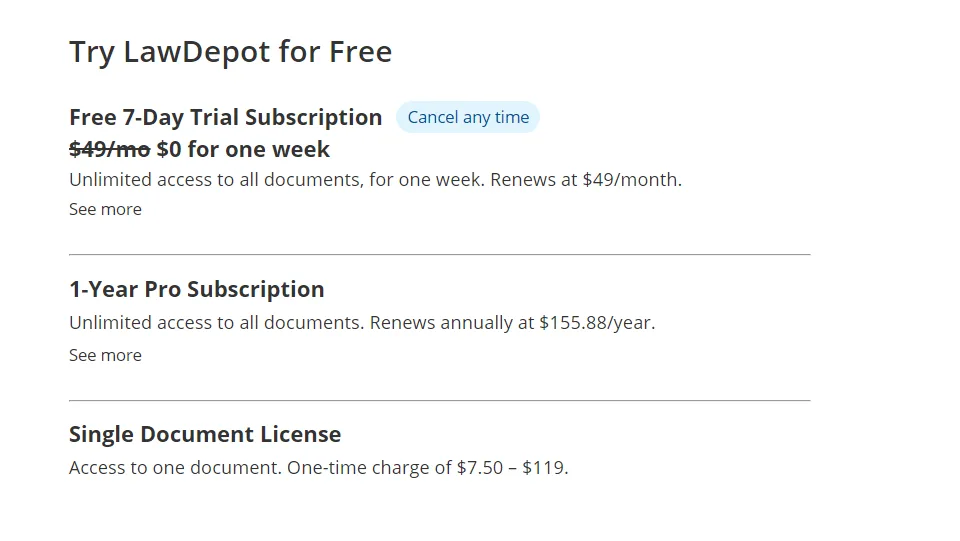
Current U.S. product pages show a seven-day free trial that renews at $49 per month and a $155.88 annual Pro subscription. Category-specific Essentials access and single-document licenses are also listed, so the final price depends on the product selected.
Check LawDepot’s current U.S. pricing before buying because rates and plan structures can change.
This arrangement can make sense for someone who needs one form without committing to a broader recurring package.
Rocket Lawyer Pricing
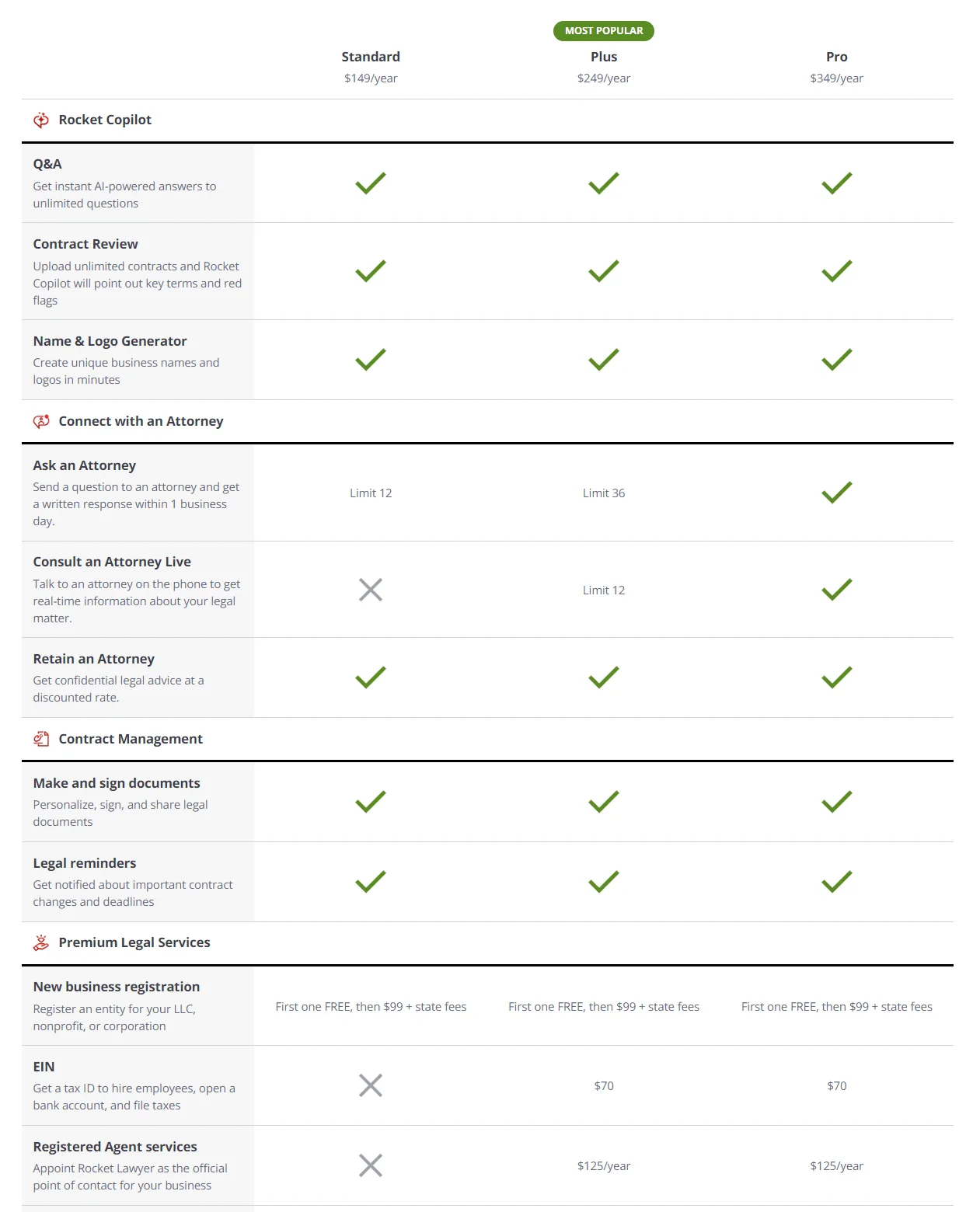
Current annual pricing is $149 for Standard, $249 for Plus, and $349 for Pro. Each tier currently starts with a seven-day free trial and includes personalized forms, e-signatures, and Rocket Copilot, while higher levels increase consultation allowances and premium benefits.
The additional cost is easier to justify when several included functions will actually be used.
Which Gives You Better Value?
For occasional DIY paperwork, LawDepot is generally more flexible. The membership alternative becomes more compelling for recurring agreements, AI analysis, consultations, or filing work.
Business Formation, Compliance, and Extra Services
This section matters most to entrepreneurs because the providers play different roles once the task goes beyond preparing forms.
LawDepot supplies company agreements, employment paperwork, operating agreements, and related templates, but it is not primarily an end-to-end formation provider.
The competing platform has a broader lineup covering company formation, registered agent service, EIN assistance, annual reports, DBAs, amendments, dissolution filings, trademark-related work, and other filings. Its business services page shows the current lineup.
Anyone planning to form a company can first read what an LLC is and the steps involved in forming an LLC online. Paying a provider to submit formation paperwork does not eliminate state filing fees or state-specific requirements.
It is also useful to understand what a registered agent does before purchasing that service. Founders choosing a corporation instead can follow the process for how to incorporate a business.
Ease of Use and Customer Experience
Both platforms are approachable for non-lawyers, but their workflows are different. LawDepot is simpler when the task is already known: choose a form, answer the questionnaire, check the result, and download or print it.
The membership platform has more moving parts, but the broader toolkit can be useful for repeat customers. E-signatures, AI analysis, reminders, saved paperwork, and consultation functions are available from the same account.
Customer support should also be distinguished from legal advice. A representative can address billing or account problems, but that is different from advising someone about rights, obligations, or strategy.
LawDepot vs Rocket Lawyer Pros, Cons, and Final Verdict
The better choice ultimately comes down to whether the priority is efficient DIY paperwork or a broader ongoing relationship.
LawDepot Pros and Cons
Pros: broad template selection, guided customization, single-document purchasing, and a focused workflow.
Cons: fewer integrated consultation benefits, no directly comparable Copilot-style tool, and limited filing capability.
Rocket Lawyer Pros and Cons
Pros: personalized forms, e-signatures, AI contract analysis, professional consultations, and a substantial range of formation and compliance services.
Cons: the membership model can be more than a one-time customer needs, and some premium filings or professional work cost extra.
Choose LawDepot when the primary goal is preparing a specific agreement or form. Choose Rocket Lawyer when recurring needs, AI-assisted contract analysis, professional guidance, or filing services are important.
Other relevant comparisons include Rocket Lawyer vs LegalZoom and Northwest Registered Agent vs Rocket Lawyer.
Frequently Asked Questions
These answers cover the main practical differences without repeating the full comparison.
Which platform offers better value for money?
LawDepot can provide better value for one-off or occasional form preparation. A membership can make more sense for someone who expects to use AI analysis, e-signatures, consultations, or filing functions repeatedly. The better deal depends on actual usage rather than the introductory price alone.
Which has better document variety and quality?
Both cover common personal and professional needs. LawDepot emphasizes a questionnaire-driven template workflow, while its competitor combines personalized forms with e-signatures, AI analysis, and professional guidance. Complex or high-stakes matters can still justify individualized advice.
Does either service provide AI-powered legal assistance?
Rocket Copilot can answer questions and analyze uploaded contracts for important terms and potential red flags. LawDepot uses guided software to customize forms but does not currently market a directly equivalent general-purpose AI assistant as a central feature.
What are the pros and cons of their subscription structures?
LawDepot provides annual access, category-based choices, and single-document licenses, which can suit occasional needs. The competing membership bundles more functionality but may be excessive for someone completing only one straightforward task.
Is attorney consultation included or available?
Yes, depending on the provider and plan. Rocket Lawyer includes written questions and, on higher tiers, live consultations, with limits determined by membership. Additional paid sessions are available. LawDepot’s core product is centered on document preparation rather than a consultation membership.
Which is easier to use for non-lawyers?
LawDepot is arguably simpler for completing one known form because its workflow stays focused on guided questions. The other platform remains accessible but contains more functions, which can be useful when several tasks need to be handled through one account.
Are there restrictions on document use or customization?
Yes. Download rights, licensing, continued availability, and customization can depend on the product purchased and the provider’s current terms. Users should check those terms before paying. Modifying a template also does not guarantee that it fits an unusual situation or every state-specific requirement.
- Federal Trade Commission: Free Trials, Automatic Renewals, and Subscription Cancellation
- U.S. Small Business Administration: Business Formation, Registration, and Legal Structure
- Internal Revenue Service: Employer Identification Number (EIN) Application
- American Bar Association: Lawyer Referral Directory and Access to Legal Assistance
- LawDepot: Legal Documents, Forms, and Guided Customization
- Rocket Lawyer: Rocket Copilot AI Contract Review and Attorney Support
- Rocket Lawyer: Membership Plans, Pricing, and Legal Benefits
Need More Than Legal Documents? Start Your LLC with ZenBusiness
If you’re ready to move beyond legal templates and officially launch your business, ZenBusiness helps you prepare and file your LLC paperwork, navigate the formation process, and access tools for managing your new company.