

Articles of Organization are the public filing that creates an LLC with the Secretary of State or similar filing office. They usually capture basic details such as the legal name, location, management setup, and registered agent, but they do not replace an operating agreement. Because LLC rules come from state statute, the exact process depends on the jurisdiction where the entity is formed.
Definition and Purpose of Articles of Organization
Think of Articles of Organization as the “birth record” of an LLC. The SBA describes it as a simple filing that captures the basics of your LLC, including details like the name, address, owners, and the registered agent.
What are Articles of Organization?
Articles of Organization are the official creation papers for an LLC (and in some jurisdictions the same formation filing is called a Certificate of Organization). After acceptance, your LLC exists as a legal entity under local statute, and third parties can rely on that public record. The IRS also notes that an LLC is allowed by statute and rules can differ depending on where you form it.
Before you start, it helps to know what this filing is designed to cover. It usually focuses on “identity and contact,” not detailed internal rules.
Here is what most jurisdictions commonly ask for:
- the exact legal name
- a main contact location
- who receives legal notices (registered agent)
- management style (owner-managed or manager-managed), when requested
- organizer name and signature
Certificate of Organization vs. Certificate of Formation vs. Articles of Organization
All three names describe the same filing: the document submitted to the state to create an LLC. Each state’s LLC statute picks the term, and the filing office prints that term on its form, so the right name is simply the one your state uses. Four examples:
- California: Articles of Organization (Form LLC-1)
- Pennsylvania: Certificate of Organization (form DSCB:15-8821, filed under 15 Pa.C.S. § 8821)
- Delaware: Certificate of Formation (6 Del. C. § 18-201)
- Texas: Certificate of Formation for a Limited Liability Company (Form 205)
The label changes little about the content. Pennsylvania’s Certificate of Organization asks for the LLC’s name with a designator such as “company” or “LLC,” either a registered office address in Pennsylvania or a commercial registered office provider, the name of each organizer, and an effective date (on filing or a later date).
Other state documents use the word “certificate” without creating anything. A certificate of amendment, such as Texas Form 424, changes what the formation filing says. A certificate of good standing, which Florida calls a certificate of status, confirms that an LLC already on file is current with the state.
Importance of Articles for LLC Formation
This filing matters for one simple reason: it is the step that makes the LLC real. Once accepted, you have a recognized entity you can use for common follow-up actions.
In real life, it also reduces friction. Banks, landlords, vendors, and licensing offices often want proof that the LLC exists (especially when you’re opening a business bank account for your LLC), and the accepted filing is usually the first thing they ask for.
Legal Requirements Across Different States
Rules are not uniform. Even when the form looks similar, the follow-up steps and costs can be very different (here’s a practical LLC cost breakdown you can use to budget correctly).
To show what “different” looks like, here are two quick examples from government pages:
| State | Requirement / Filing Info |
|---|---|
| California | Statement of Information is due within 90 days, then every 2 years. |
| New York | The creation submission lists a $200 filing fee, and publication paperwork carries a $50 filing fee. |
The safest approach is to use the filing office instructions for your jurisdiction, not a checklist from another location.
Turn your Articles of Organization into an official LLC with ZenBusiness
Now that you understand what Articles of Organization do, ZenBusiness can help you take the next step. From preparing your filing details to submitting your LLC formation documents, ZenBusiness makes it easier to launch with confidence.
Steps to File Articles of Organization
Most LLC setups follow the same pattern: choose where you are forming, prep the key details, submit the startup filing, then complete any follow-up reports (see a full LLC formation checklist if you want the entire sequence end to end). The SBA notes this type of filing is generally a simple record of core basics, but the exact process depends on location.
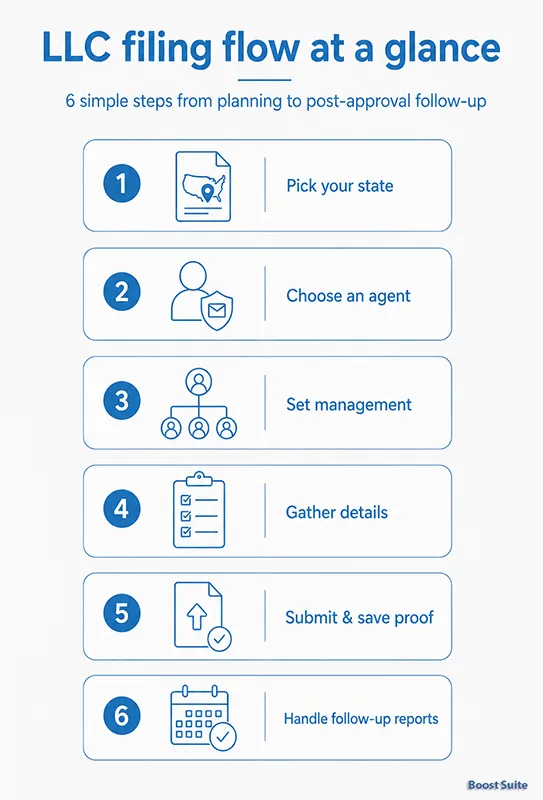
Step 1: Confirm where you are forming the LLC
Start with the right filing office for your location. The IRS is clear that an LLC is allowed by state statute and each state may use different regulations.
- confirm the exact name you want is available
- confirm whether your industry needs special approval (only if applicable)
- confirm whether there are extra steps after approval (publication, initial report, ongoing reports)
Step 2: Choose your service-of-process contact
Many jurisdictions require you to name a service-of-process contact (often called a registered agent) to receive lawsuits and other time-sensitive legal notices, so it helps to understand what a registered agent does before you choose one.
For example, Delaware explains that every entity must appoint a registered agent with a physical office address in Delaware, and that the agent’s job includes accepting service of process. Texas similarly explains that a filing entity must continuously maintain a registered agent and registered office, and keep that information current.
Some jurisdictions also allow the Secretary of State to be served as the statutory agent in certain situations. New York’s Department of State provides instructions for serving process on the Secretary of State as agent for domestic or authorized foreign entities.
Step 3: Decide how the LLC will be managed
Many states ask whether the LLC is member-managed or manager-managed, so it helps to understand the real-world difference when you’re choosing between member-managed and manager-managed. Choose this early because it affects what you put on the startup filing and what your internal setup should reflect later.
We recommend deciding this before submission because switching later can create mismatches between the public record and how the LLC actually operates.
Step 4: Gather the required details before you start
Even when the filing is short, prep your inputs first so you do not retype things from memory. The SBA emphasizes that registration steps depend on your location and structure.
Have these ready:
- the exact LLC name formatting (including punctuation)
- the main contact location
- agent for service of process details
- management choice, if requested
- organizer details (the person submitting)
Step 5: Submit online or by mail, then save proof
Many filing offices accept online submissions, and some still allow mail submission. Follow the instructions on the filing office page and save proof of acceptance.
We recommend keeping a simple “proof folder” with the acceptance confirmation and a copy of what you submitted. It can prevent delays later when a bank, landlord, insurer, or vendor asks for evidence that the LLC exists.
Step 6: Complete any follow-up reports after approval
Approval is not always the finish line. Many jurisdictions require follow-up reports on a schedule (including annual report deadlines), and some deadlines start soon after acceptance. The key takeaway is simple: treat “accepted” as the start of the next checklist, not the end.
I have seen founders choose a popular state because they heard it was “better,” then realize they still had to qualify where they actually operate. That can mean extra filings, extra fees, and more annual work than they expected.
Before I choose where to form an LLC, I look at where the owner actually works, where customers are served, where contracts are signed, and whether another state would create a second registration layer.
File your Articles of Organization with Northwest
Once you know what details your filing requires, Northwest can help you turn that checklist into a completed LLC formation. Their team helps prepare and submit your Articles of Organization while keeping the process clear from start to finish.
Key Components of Articles of Organization
The creation filing is usually short, but the details matter because they become part of the public record. The SBA describes it as a simple record that captures the basics.
Required Information for Registration
Most jurisdictions ask for a similar core set of fields. Here is what those fields usually do in practice:
| Item | Why it matters in real life |
|---|---|
| Legal name | Needs to match exactly across filings, contracts, and later accounts. |
| Primary contact location | Where notices and some government mail may be directed. |
| Service-of-process contact | Who receives legal papers and time-sensitive notices. |
| Management choice | Signals who can act on behalf of the LLC in normal operations. |
| Organizer | Identifies the person who submits the filing. |
A common mistake is typing details casually, then later discovering the same name or address is formatted differently across records.
Roles of Members and Managers
Ownership and management are not always the same. Many LLCs are run directly by their owners. Others name one or more managers to handle day-to-day decisions.
What matters for the creation filing is that the management choice lines up with how you actually plan to run the LLC, because third parties may rely on the public record when deciding who has authority.
Operating Agreement and Its Importance
The creation filing is not the rulebook for how owners work together. The IRS notes that LLC treatment can differ depending on elections and the number of owners, which is a reminder that your internal setup and your public creation step are different layers.
We recommend using an operating agreement to spell out the practical parts that the creation filing usually does not cover, such as:
- decision-making and voting
- profit splits and distributions
- what happens if an owner leaves, dies, or sells their interest
- dispute handling and deadlock fixes
Common Misconceptions About Articles of Organization
These misconceptions do not just create confusion. They cause delays, surprise costs, and missed follow-ups because people assume the startup paperwork does more than it actually does.
Myth: Articles of Organization Are the Same as an Operating Agreement
Reality: They solve different problems.
The SBA describes Articles of Organization as a simple filing that covers the basics (like name, address, and the service-of-process contact).
An operating agreement is the internal rulebook. It is where owners spell out how decisions are made, what happens if someone leaves, and how disputes get resolved. Treating the creation filing as the full rulebook is how people end up with “we never agreed on that” fights later.
Myth: Filing Articles Means the LLC Setup Is Fully Complete
Reality: Acceptance is often the beginning of the next checklist.
Some places require a follow-up report shortly after approval. For example, California lists a Statement of Information due within 90 days, then every 2 years.
Other places add post-approval steps that can carry separate costs. New York’s publication rule (Section 206) requires publication within 120 days, and the Certificate of Publication has a $50 filing fee.
Myth: Every State Uses the Same Filing Rules
Reality: There is no single national standard.
The IRS states that an LLC is allowed by state statute and each state may use different regulations.
That is why copying a checklist from another jurisdiction is risky. Even when the creation form looks similar, the follow-ups and deadlines can be totally different.
FAQs on Articles of Organization and LLCs
Short answers to the most common Articles of Organization questions, so you can submit your LLC paperwork correctly the first time. Use this as a quick checklist right before you file and again right after approval.
What are articles of organization?
They are the startup filing that creates an LLC in the public record with the filing office (often the Secretary of State). The IRS notes that an LLC is allowed by state statute and rules vary by jurisdiction.
What information do I need to include in the articles?
The SBA explains this filing typically includes basic details such as the name, main contact location, owners, and the service-of-process contact.
Most jurisdictions commonly ask for items like:
– legal name (exact spelling and punctuation)
– main contact location
– service-of-process contact (often called a registered agent)
– management choice (owner-managed or manager-managed), when requested
– organizer name and signature
What Documents Are Required for Filing?
Usually, it is just the startup filing itself, plus payment, submitted the way the filing office instructs. Because rules vary by jurisdiction, the safest move is to follow the checklist on the filing office page for your location.
Are There Fees Associated with Filing Articles?
Yes, there is typically a filing cost, and it depends on the jurisdiction. For example, California lists $70 for online submission, while New York lists $200.
Some jurisdictions also add separate post-approval costs, like New York’s Certificate of Publication filing cost of $50.
How to Open a Business Bank Account After Filing?
The SBA says many banks commonly ask for an EIN, formation paperwork, ownership agreements, and a business license (when applicable).
For the EIN, the IRS provides a free online application and can issue it immediately after approval.
We recommend calling your bank first and asking for their exact checklist for an LLC, because the requested items can vary by institution.
- Internal Revenue Service: Limited liability company (LLC) (state-statute entity; rules vary by state)
- California Secretary of State – Business Programs Division: Service of Process (agent requirement)
- California Secretary of State – Business Programs Division: Articles of Organization (Form LLC-1) (PDF)
- California Secretary of State – Business Programs Division: Statements of Information (filing info)
- New York State Department of State – Division of Corporations: Certificate of Publication (LLC) overview
- New York State Department of State – Division of Corporations: Fee Schedules (includes Publication $50)
- New York State Department of State – Division of Corporations: Instructions for Service of Process
File your Articles of Organization with Harbor Compliance
Ready to turn your business idea into an official LLC? Harbor Compliance can help you prepare and file the Articles of Organization, so your company starts on the right legal foundation.